







Примерное время чтения: 13 минут
A commercial track lighting rail system should be purchased as a complete, documented assembly, not as a length of metal selected by appearance. Buyers need to match the rail, power feeds, connectors, adapters, luminaires, supports, controls, and installation conditions. The best system is the one that satisfies the project brief, demonstrates compatibility, arrives as a complete bill of materials, and remains supportable after handover.
This guide focuses on commercial procurement decisions. It does not repeat the general design benefits covered in our guide to commercial LED track rail systems. Instead, it shows distributors, contractors, designers, and project buyers how to convert a lighting concept into verifiable purchase requirements and acceptance checks.
What exactly is included in a commercial track lighting rail system?
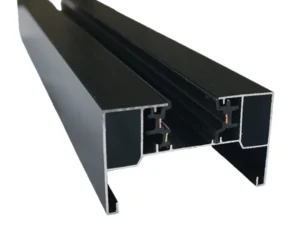
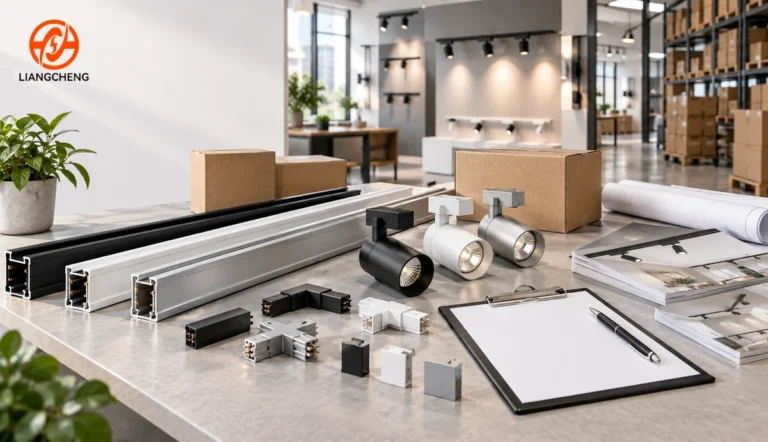
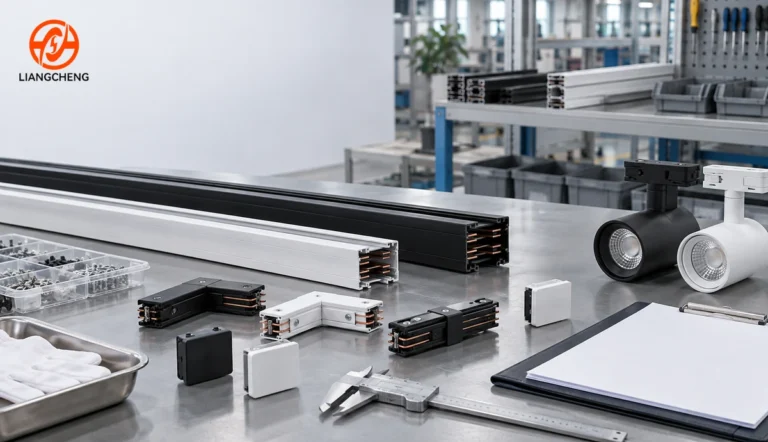
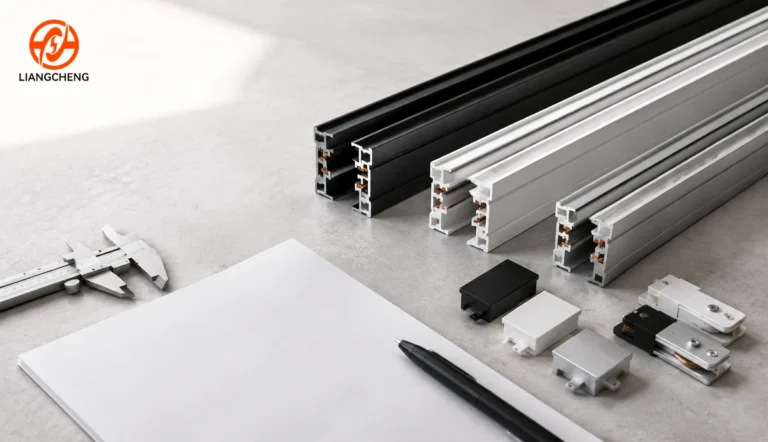
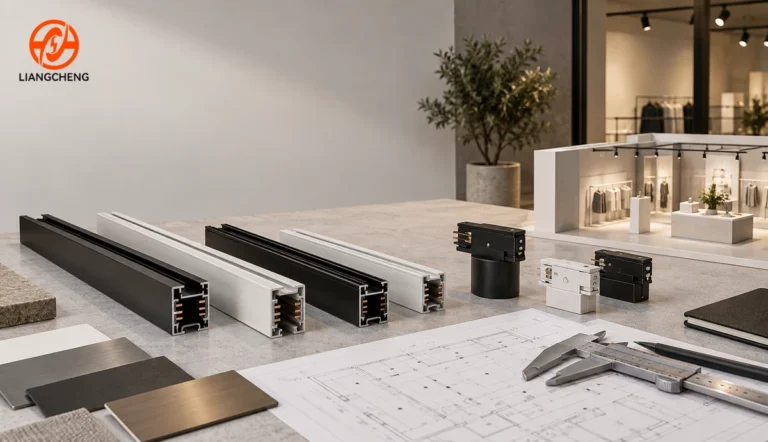
An electrified track is only one part of the system. A workable commercial package can include straight rail sections, live-end or central feeds, joiners, directional connectors, end caps, adapters, luminaires, mounting hardware, suspension parts, control components, and project-specific accessories. The exact list changes with the architecture and layout.
System boundaries matter because similar-looking quotations may cover different scopes. One offer may include only rail lengths. Another may include every connector and mounting component. A third may combine low-voltage track with a separate power supply. Comparing unit price per meter before aligning these boundaries produces a misleading result.
Buyers should also distinguish track from the equipment above and below it. The ceiling substrate, structural anchors, branch-circuit wiring, control gateway, and emergency-lighting provision may fall outside the rail supplier scope. The track-mounted luminaires can have separate performance, warranty, and approval documents. Record who owns each interface before placing an order.
Which requirement should a buyer define first?
Start with the operating brief, not the catalog. State where the system will be installed, what it must illuminate, how often the layout will change, how users will control the lights, and who will maintain it. A showroom that changes displays weekly has different operational priorities from a fixed office reception area.
A concise buyer brief should answer the following questions:
- What are the room dimensions, ceiling conditions, and planned track routes?
- Which luminaires, quantities, masses, and adapters will use each run?
- Which groups must switch or dim independently?
- Will the track be surface mounted, recessed, or suspended?
- What supply, control protocol, and local installation requirements apply?
- What ambient temperature, humidity, dust, or other exposure is expected?
- Which finish, color tolerance, and visual alignment criteria matter?
- What documentation, spares, packaging, and delivery sequence does the project require?
This brief prevents a common error: choosing a visually attractive rail and then forcing the control plan, luminaire range, and ceiling details to fit it. If the project is still deciding between system families, the ordinary track versus magnetic track comparison provides a useful architecture-level starting point.
How should buyers compare the main system architectures?
Commercial products are not described consistently across every market. Terms such as conventional, mains-voltage, magnetic, low-voltage, single-circuit, multi-circuit, two-wire, three-wire, and four-wire can describe different aspects of a system. A familiar label does not prove an electrical arrangement or compatibility.
| Decision | What it affects | Evidence to request |
|---|---|---|
| System family | Adapter interface, available luminaires, feeds, and accessories | Product family declaration and compatibility schedule |
| Circuit arrangement | Independent switching groups and conductor allocation | Wiring diagram, ratings, and control description |
| Power architecture | Supply equipment, placement, capacity, and maintenance | Complete schematic and power-supply specification |
| Mounting method | Ceiling interface, appearance, support spacing, and labor | Section drawings and installation instructions |
| Control method | Dimming, zoning, addressing, commissioning, and future changes | Control narrative and tested component list |
Wire count alone is particularly unreliable. The same number may be used differently between product families or markets. Our 2-wire, 3-wire, and 4-wire track guide explains how to interpret the labels without assuming that every manufacturer uses identical terminology.
Multi-circuit capability is useful when several groups need independent switching, but additional circuits do not automatically provide individual luminaire control. A separate control method may be required. Review the practical distinction in the single-circuit and multi-circuit comparison, then confirm the selected product wiring diagram.
Why is compatibility a procurement requirement rather than a visual check?
A track adapter must fit mechanically, contact the correct conductors, orient correctly, and operate within the approved electrical arrangement. Similar rail openings and matching colors do not establish any of these conditions. Small interface differences can prevent insertion, cause poor contact, or place a component in an unintended configuration.
Request a compatibility matrix that names the rail, each adapter, every connector, feeds, and relevant luminaires by exact model. The matrix should state which combinations are approved, not merely which parts look compatible. Ask whether substitutions require a new review and how revisions are identified.
If an existing site will be extended, begin with positive identification. Record labels, dimensions, cross-section details, conductor positions, and installed accessories. Do not order a replacement from photographs alone. The guide to трековые светильники, совместимые с 3-проводными направляющими shows why even a common label needs further verification.
A sample fit check can reveal obvious dimensional problems, but it is not an electrical approval or safety evaluation. Use the sample to confirm the specific documented pairing. Keep the approved sample or a controlled record so production deliveries can be compared with the accepted configuration.
How do buyers turn a layout into a complete bill of materials?
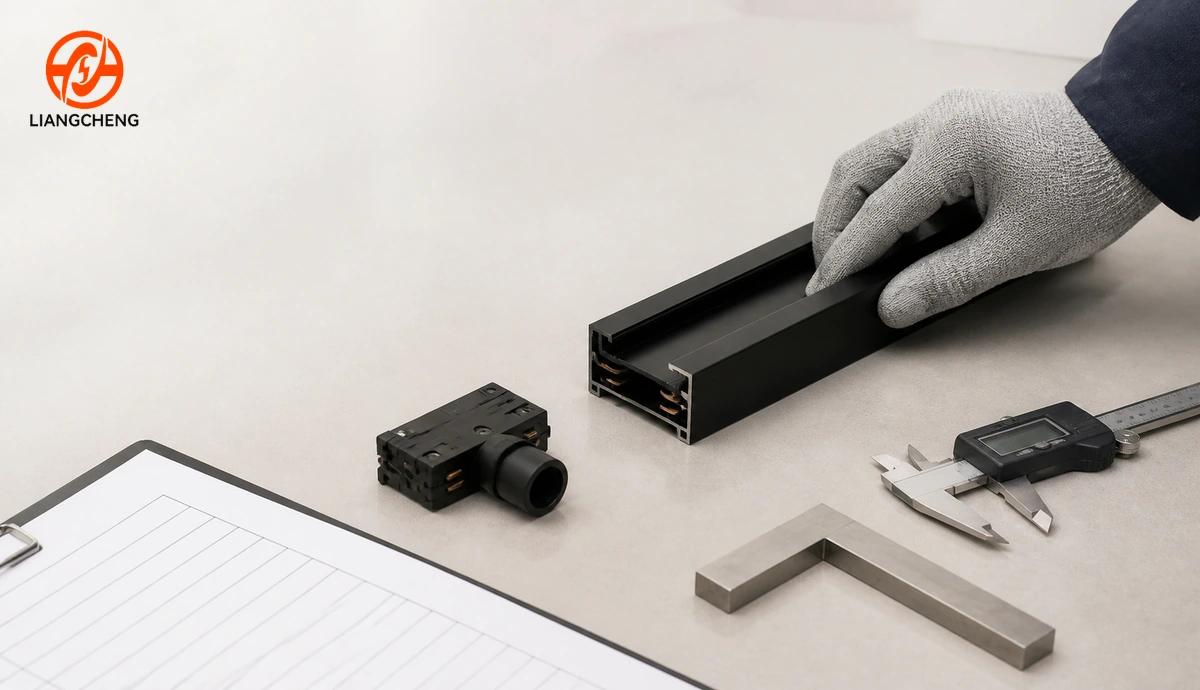
Mark every straight run, feed point, end, corner, junction, suspension point, and transition on the reflected ceiling plan. Assign a unique run identifier. Then build the bill of materials from the actual route rather than estimating straight meters and adding a general accessory allowance.
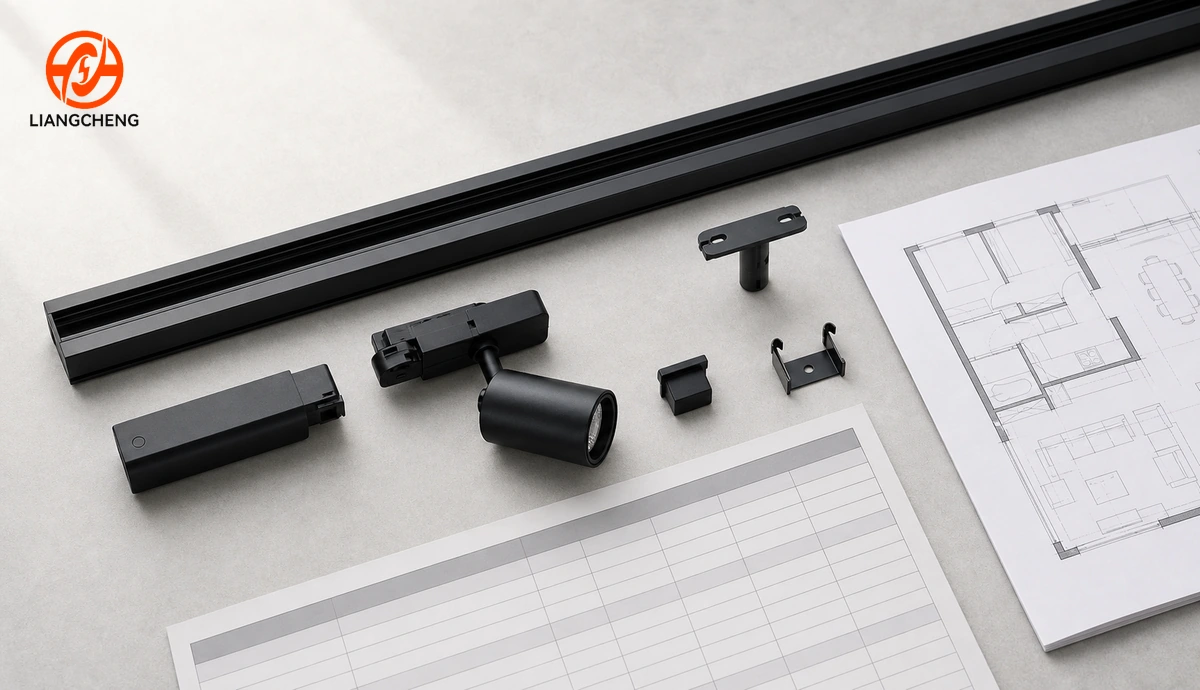
For each run, list rail lengths, cut pieces, feeds, joiners, directional connectors, end caps, mounting clips or suspension sets, adapters, and luminaires. Add power supplies or control components where the architecture requires them. Note the finish and model beside every line item so mixed families cannot enter the order unnoticed.
Connector geometry deserves special attention. Left, right, inside, outside, and polarity-sensitive arrangements may not be interchangeable. A layout that appears symmetrical on a plan can require distinct parts. Obtain a marked drawing that relates each connector code to its position and orientation.
Standard stock lengths affect cutting, joints, waste, packaging, and shipping. Use the руководство по размерам направляющих для трекового освещения to plan clearances and connector allowances, but apply the selected product drawing to the final takeoff. Do not infer a cutout or connector length from a generic size.
Which electrical and mechanical documents should buyers request?
Request rated voltage, frequency, current, conductor arrangement, protective-earthing provisions where relevant, insulation information, and permitted supply connections. For power-supply-based systems, request input and output ratings, capacity rules, placement limits, and compatible control information. Confirm that the stated data applies to the complete proposed combination.
The official IEC 60570 publication covers electrical supply track systems for luminaires within its stated scope. Buyers should identify which standard and edition apply in the destination market, then verify that certificates or reports cover the actual models being purchased. A standard number printed on a quotation is not the same as traceable product coverage.
For United States workplace applications, the OSHA NRTL guidance explains how recognized laboratory certification marks relate to applicable product safety standards. Local authorities and project specifications can impose additional requirements. Buyers should obtain advice from the responsible designer, qualified installer, or authority rather than treating one global document set as universal.
Mechanical evidence should address the actual rail orientation, support method, permitted spacing, fixture mass, load distribution, joints, and accessories. Material name and wall thickness alone do not establish system capacity. Ask for the applicable installation limits and any restrictions around connector locations, ends, or concentrated loads.
Keep emergency lighting within its own compliance and design review. A normal track lighting system does not automatically become an emergency system because selected heads can remain illuminated. Required duration, supply arrangements, monitoring, identification, and local rules can change the solution.
How should lighting and controls be specified without overloading the rail purchase?
The rail purchase should identify the luminaires it must support, but lighting performance comes from the whole design. Record target tasks, beam distributions, output, color characteristics, glare considerations, aiming ranges, and any dimming behavior. Photometric calculations and mockups should use the proposed luminaire data, not a generic track-head assumption.
Controls require a written sequence of operation. Define which zones respond together, which scenes are required, who can change settings, and what happens after a power interruption. If individual addressing is needed, identify where addresses are stored and how replacements are commissioned. This avoids discovering late that the rail circuits and control concept describe different zoning.
Allow capacity for the documented final load and approved future additions, but do not invent a universal spare percentage. Electrical limits, power-supply loading, voltage drop where relevant, thermal conditions, and project rules determine usable capacity. A qualified project professional should approve the calculation.
+
How should buyers normalize supplier responses?
Send the same requirement schedule to every shortlisted supplier and require responses against each line. A general brochure can support the answer, but it should not replace a completed compliance schedule. Mark every requirement as compliant, noncompliant, alternative, or awaiting clarification. Require a document reference for each important technical answer.
Normalize naming before comparing offers. One supplier may count a feed as a connector, while another lists it separately. One may quote net rail length, while another includes cutting waste. Create a common comparison sheet with the project quantities and map every offered code to it. Do not allow blank fields to become assumed inclusions.
Record deviations in a separate register. A deviation is not necessarily unacceptable, but it must be visible to the decision makers. Describe the requirement, proposed alternative, effect on layout or installation, supporting evidence, cost effect, and responsible approver. Verbal assurances should be transferred into the controlled quotation or technical submittal.
Commercial terms also need a common basis. Compare currency, taxes, delivery terms, payment milestones, sample charges, tooling ownership, packaging, inspection, documentation, warranty remedy, and spare-part availability. Lead time should state its starting event, such as receipt of deposit and approved drawings, rather than an isolated number of days.
Where customization is proposed, separate cosmetic changes from changes that affect critical interfaces. A custom color may require a finish sample and acceptance range. A change to profile geometry, contacts, insulation, feed design, or adapter engagement can require a much deeper technical review. Do not let the word custom hide which evidence must be updated.
Ask suppliers to identify exclusions and assumptions explicitly. Examples include ceiling anchors, branch wiring, control commissioning, emergency-lighting equipment, site cutting tools, or local approval fees. An offer with a higher total can be more complete and easier to deliver than a lower offer that transfers several responsibilities to the contractor.
Before commercial award, hold one final clarification review using the latest drawing, bill of materials, deviation register, and document index. Freeze the accepted revisions in the purchase order. This creates a stable baseline for sample approval, production, inspection, shipping, and any later change request.
What should be included in the commercial quotation?
A useful quotation mirrors the bill of materials and states every inclusion. It should show models, quantities, unit lengths, finishes, accessory codes, packaging, delivery terms, lead time basis, documentation, and warranty scope. Separate tooling, samples, testing, expedited production, and freight so buyers can compare equivalent totals.
Total installed cost matters more than rail price per meter. Extra joints can add material and labor. Difficult suspension adjustment can slow installation. Missing end caps can stop handover. A proprietary component with no planned spares can make later maintenance expensive. These costs remain invisible in a headline rail price.
Ask how minimum order quantities apply to colors, custom lengths, and accessories. One finish may have a different production threshold from a standard finish. Confirm whether partial cartons are allowed and whether spare connectors can be ordered later in small quantities.
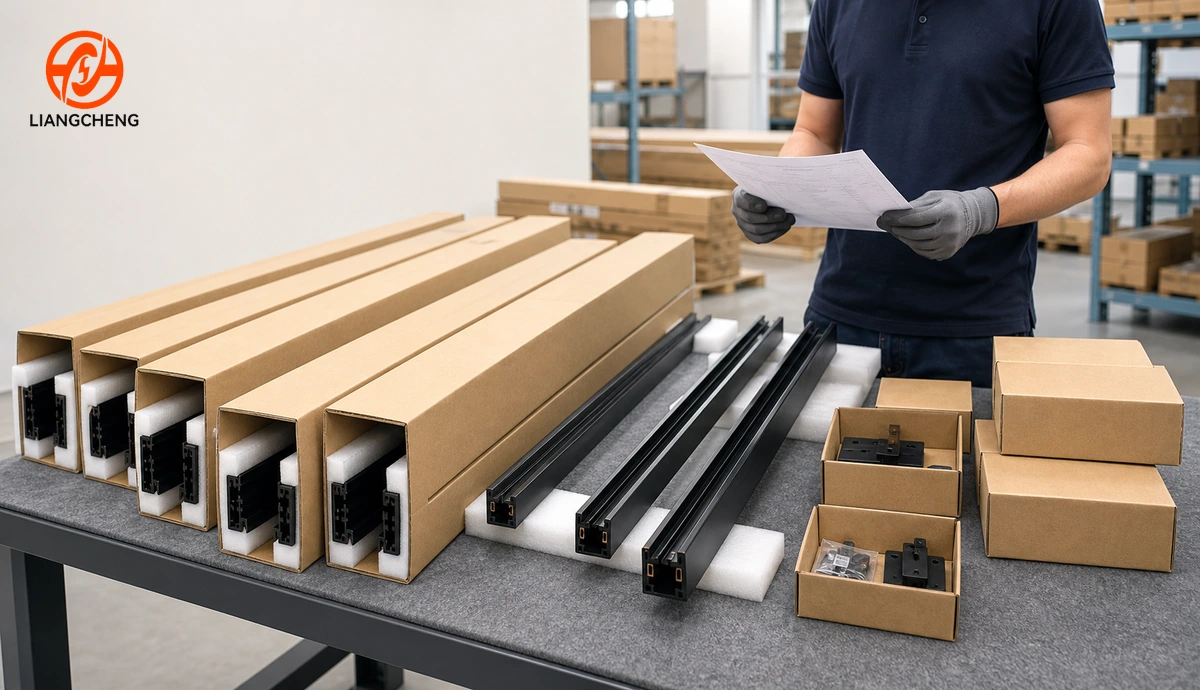
Packaging is part of the specification for long, finished profiles. Define separators, end protection, moisture protection where needed, carton strength, labels, and pallet or crate arrangement. Long rails can arrive unusable if profile ends, finishes, or insulating components are damaged in transit.
How should a preproduction sample be evaluated?
A sample plan should reflect the risk of the order. A useful mockup includes a representative rail length, actual feed, one or more connectors, end cap, approved adapter, proposed luminaire, and mounting or suspension hardware. If color is important, include the accessories beside the rail because different substrates can produce visible finish variation.
Evaluate identification, dimensions, straightness using the agreed method, finish, connector alignment, adapter operation, mounting details, and assembly instructions. Qualified personnel should review electrical construction and intended installation. Record the model and revision of every accepted component.
Use written acceptance criteria before the sample arrives. Subjective comments such as good quality are difficult to reproduce. State how appearance is viewed, which dimensions are critical, what documents must accompany the sample, and who can approve deviations.
Approval should not silently authorize every future change. The purchase order should require notification before changes to materials, dimensions, conductors, insulation, contacts, finish process, tooling, or critical subcomponents. Decide which changes require documents only, a new sample, or renewed testing evidence.
What incoming inspection protects a commercial project?
Inspect deliveries before installation disperses the products across a site. Verify purchase-order references, model codes, quantities, cartons, accessory packages, finish codes, and batch information. Check a defined sample of rails for transit damage, distorted ends, surface defects, damaged insulation, or mismatched components.
Inspection frequency and tolerances should come from the agreed quality plan. A buyer should not create arbitrary limits after a dispute begins. Record photographs, measurements, affected carton numbers, and the disposition of nonconforming goods. Keep suspect parts separated until the responsible parties agree on a response.
Do not repair electrical track by straightening, drilling, repainting, or replacing internal parts unless the approved instructions permit the action. Cosmetic repair approval does not necessarily cover damaged insulation or conductor alignment. Escalate functional damage for qualified review.
Retain the final bill of materials, compatibility matrix, certificates or reports, installation instructions, drawings, control records, and approved changes at handover. Store identified spare connectors, adapters, feeds, and end caps where project maintenance strategy requires them.
What are the four buyer approval gates?
| Gate | Minimum output | Do not proceed when |
|---|---|---|
| 1. Requirement freeze | Layout, mounting, luminaires, control narrative, environment, and responsibilities | System family or interface owners remain unclear |
| 2. Evidence review | Drawings, ratings, compatibility schedule, installation limits, and market documents | Evidence names a different model or incomplete assembly |
| 3. Sample approval | Controlled sample record and written acceptance criteria | Fit, finish, documentation, or critical dimensions remain unresolved |
| 4. Delivery release | Verified quantities, identity, condition, records, and nonconformance disposition | Damage, substitutions, or missing accessories could stop installation |
These gates create a shared decision record. They also make supplier comparisons fair: every offer must answer the same project questions. For a wider project-selection workflow, see how to choose the right track rail for a lighting project.
Часто задаваемые вопросы
Is a three-circuit track always best for a commercial space?
No. Three circuits can provide useful switching groups, but the project may need one circuit, another multi-circuit arrangement, or individually addressed controls. Choose from the written control sequence and compatible product family, not from the assumption that more circuits always create better control.
Can buyers mix rails, adapters, and connectors from different sources?
Only when the proposed combination has documented approval for that use. Similar appearance is not proof of mechanical or electrical compatibility. Obtain a model-specific compatibility statement and relevant evidence before treating components as interchangeable.
How much spare track should a commercial order include?
There is no universal percentage. Base spare quantities on project length, cutting plan, delivery risk, future layout changes, minimum reorder quantities, and maintenance strategy. Prioritize hard-to-source connectors, feeds, adapters, and finish-matched accessories as well as straight rail.
Can commercial track rail be cut on site?
Some systems permit cutting under specific instructions; others impose limits or require factory preparation. Cutting can affect conductors, insulation, polarity, burrs, finish, and end protection. Follow the selected system procedure and use qualified installers.
Does the rail determine light quality?
The rail mainly provides the approved mechanical and electrical interface. Beam distribution, output, color characteristics, glare, dimming, and thermal behavior depend heavily on the luminaires and the lighting design. Evaluate those components and calculations separately within the complete system.
What is the most important document in a bulk order?
No single document is enough. The controlled package should connect the project layout, bill of materials, compatibility matrix, product drawings, electrical and mechanical data, installation instructions, approval evidence, sample record, and change history. Gaps between those records create most procurement risk.
Final buying advice
Commercial track lighting rail systems reward disciplined specification. Define the operating need, select the system architecture, verify every interface, build the bill of materials from the layout, review model-specific evidence, approve a representative sample, and inspect the shipment before installation.
Assign one controlled product schedule to the project and update it through design, purchasing, installation, and handover. The schedule should identify approved models, revisions, quantities, locations, and substitutions. This simple record helps prevent an early design decision from becoming disconnected from the goods delivered months later. It also gives maintenance teams a usable reference when they need an additional adapter, connector, feed, or matching rail section. Commercial value comes from that continuity as much as from the initial hardware.
When requesting a Liangcheng proposal, send the reflected ceiling plan, intended luminaires, mounting method, control requirements, supply information, finish, destination market, delivery schedule, and required documents. A complete inquiry makes it possible to quote a complete system and exposes unresolved interfaces before they become site problems.
Нужны индивидуальные решения для трекового освещения?
Свяжитесь с Liangcheng Lighting для получения решений OEM/ODM по алюминиевым трековым системам и профессиональной светотехнической поддержке.