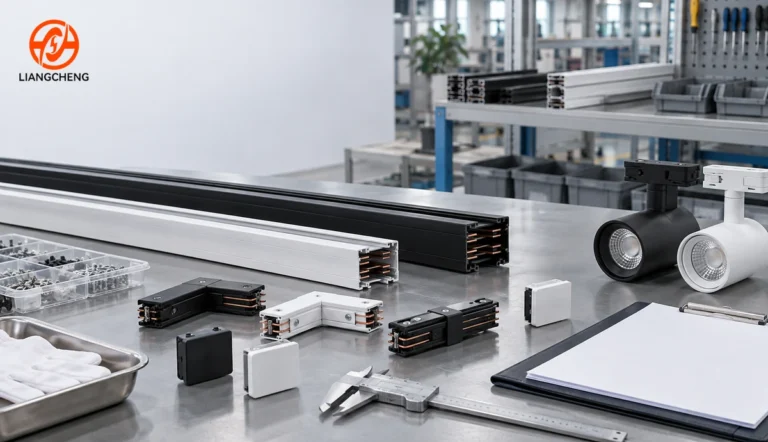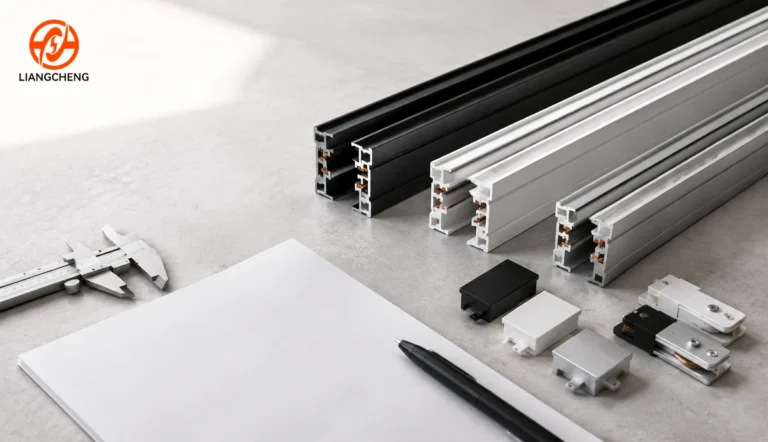






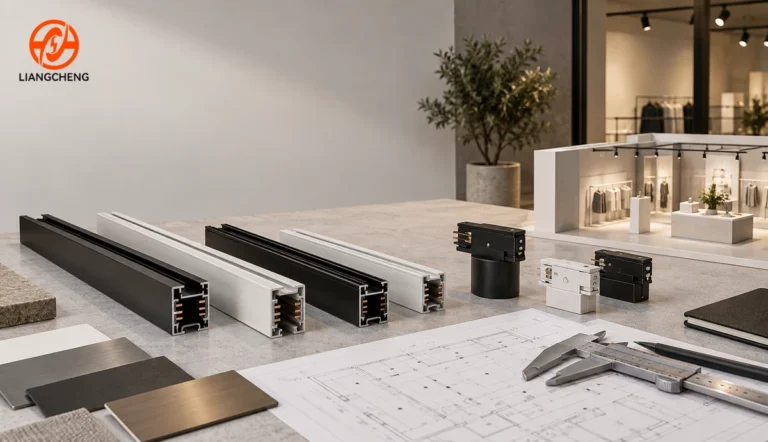

China is the world’s primary source for aluminum track rail — and for buyers who know what to evaluate, sourcing directly from Chinese manufacturers delivers significant advantages in cost, product range, and customization capability.
But the buyers who struggle with quality problems, hidden costs, and supplier reliability issues are also sourcing from China. The difference isn’t luck. It’s preparation.
This guide covers every factor that matters when importing aluminum track rail from China — from product specifications and material standards to OEM options, true landed costs, and shipping logistics. Whether you’re a first-time importer or looking to upgrade your current supply chain, these are the decisions that determine whether your import program succeeds.
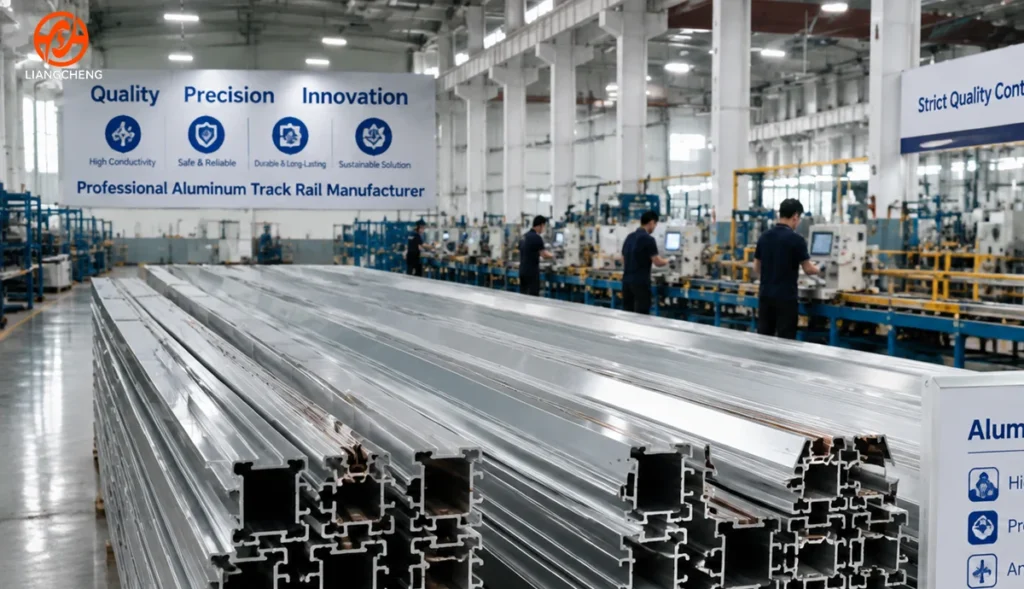
Why More Businesses Import Aluminum Track Rail from China
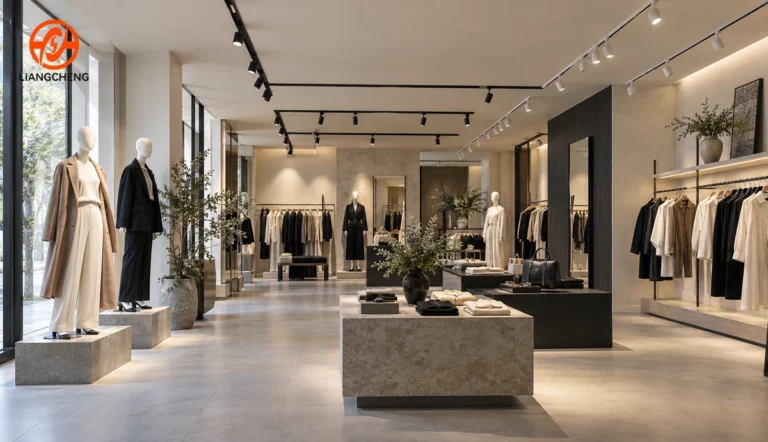
The LED lighting market has expanded significantly across commercial, retail, hospitality, and residential segments. With this growth has come rising demand for aluminum track rail systems — the structural backbone of any track lighting installation.
China has become the dominant manufacturing hub for aluminum track rail for several interconnected reasons:
Vertical supply chain depth. China produces aluminum billets, extrusion dies, anodizing chemicals, PC diffuser materials, and mounting accessories — all within tightly clustered industrial regions. This supply chain integration means lower production costs and faster lead times compared to manufacturers elsewhere.
Production scale. Major Chinese aluminum extrusion factories operate at production volumes that enable consistent quality across large orders. A mid-size factory with 100,000+ tons of annual capacity runs far more rigorous process controls than a small operation producing 5,000 tons.
OEM/ODM capability. Chinese manufacturers can develop custom track rail cross-sections, surface finishes, and packaging designs that let lighting brands differentiate their products. This OEM capability is available at price points that are unworkable in European or North American manufacturing.
Export experience. Established track rail manufacturers in Guangdong, Jiangsu, and Shandong have years of experience with CE, RoHS, LVD, EMC, and CB certification documentation — the compliance paperwork that international buyers require.
The buyers who benefit from these advantages are LED lighting distributors, electrical wholesalers, lighting brands developing private label product lines, contractors handling commercial projects, and project suppliers sourcing for specification work.
1. Understand Different Types of Aluminum Track Rail Before Importing
Before reaching out to suppliers, you need clarity on exactly what you’re buying. Aluminum track rail encompasses several distinct product categories with different structures, installation methods, and performance characteristics.
LED Aluminum Profile Types
Surface-mounted LED profile — fixed directly to a flat surface (ceiling, wall, cabinet). The most versatile and fastest to install. Commonly used in residential, retail, and commercial applications where recessing into the substrate isn’t possible or required.
Recessed LED profile — set into a routed channel or drywall opening so the face sits flush with the surrounding surface. Produces a clean, uninterrupted lighting line. Preferred for high-end architectural and hospitality projects.
Suspended LED profile — hung from the ceiling via wire or rod kits. Creates linear pendant lighting arrangements for offices, restaurants, and open commercial spaces. Available in single-emission and double-emission (up/down light) configurations.
Corner LED aluminum profile — designed with a 30° or 45° body angle to direct light into or along corners. Used extensively in kitchen cabinet lighting, display case edge lighting, and retail shelving.
Waterproof LED channel — IP65 or IP67-rated profile with silicone sealing or full silicone extrusion. Required in bathrooms, outdoor covered areas, and any environment with moisture exposure.
Lighting Track Rail System Types
Magnetic track rail — a specialized system where LED fixtures attach and detach magnetically, allowing flexible repositioning without tools. Popular in retail, museums, and gallery applications.
Linear lighting track — structural rail designed for pendant or suspended linear luminaire systems. Often used in commercial and office environments.
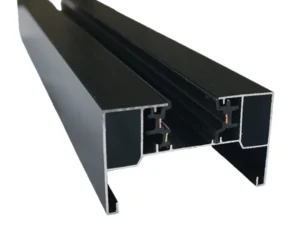
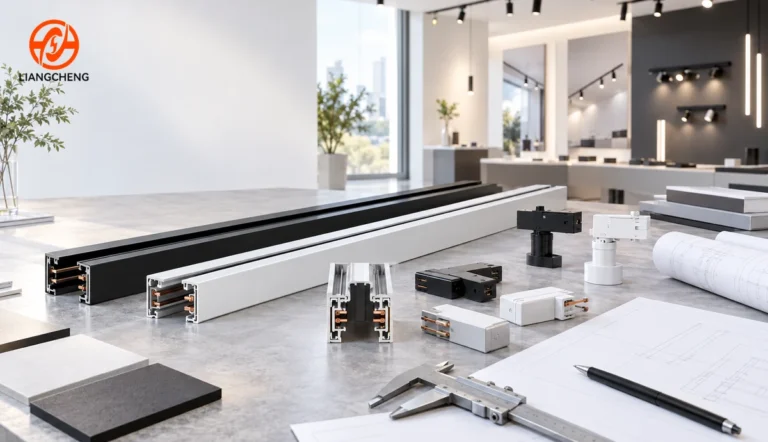
Ceiling track rail — surface-mounted or recessed track that carries current to compatible spotlights and fixtures. Available in 1-circuit (2-wire), 3-circuit, 4-circuit, 6-circuit, and magnetic configurations.
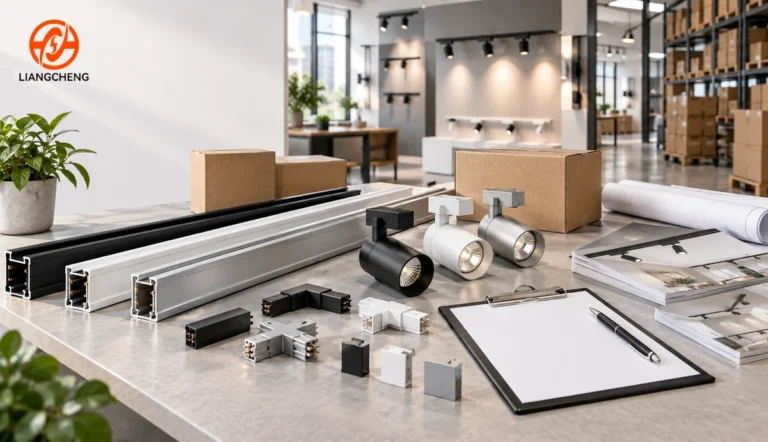
Commercial lighting track system — complete systems including rail, joiners, end feeds, end caps, and compatible fixture accessories. Complete system sourcing simplifies specification and reduces compatibility issues on projects.
Key Specifications to Confirm Before Ordering
Before requesting quotes, have these specifications ready:
- Profile dimensions (cross-section width × height in mm)
- Standard length options (1m / 2m / 3m) or custom cut lengths
- Aluminum wall thickness (specified in mm)
- Circuit configuration for track rail systems (1-circuit, 3-circuit, 4-circuit, 6-circuit, magnetic)
- Compatible LED strip specifications (if applicable) — strip width, maximum wattage
- Diffuser material — PMMA (acrylic) or PC (polycarbonate)
- Surface finish — anodized (silver/black/other), powder coated, mill finish
- End cap and accessory requirements
Providing complete specifications in your first inquiry saves time on both sides and signals to the supplier that you’re a serious buyer.
2. Choose the Right Aluminum Alloy and Material Quality
Material quality is where the most consequential quality differences originate. An aluminum profile can look identical from the outside while performing very differently in heat dissipation, surface finish consistency, and long-term durability — based entirely on alloy specification and material grade.
Common Aluminum Alloys Used for LED Profiles and Track Rail
6063 Aluminum Alloy — industry standard for LED profiles
6063 is the benchmark alloy for LED aluminum profile and track rail production. Its combination of properties makes it ideally suited to the application:
| Propiedad | 6063-T5 Value |
|---|---|
| Resistencia a la tracción | 145–195 MPa |
| Conductividad térmica | 200 W/m·K |
| Densidad | 2.70 g/cm³ |
| Extrusion performance | Excelente |
| Anodizing quality | Excelente |
| Corrosion resistance | Bien |
The T5 temper designation means the alloy has been artificially aged after extrusion, improving its mechanical properties without requiring a full solution heat treatment. This is the most practical temper for LED profile production.
6061 Aluminum Alloy — for structural applications
6061 has higher tensile strength than 6063 (up to 310 MPa in T6 temper) but is harder to extrude into complex cross-sections and anodizes less uniformly. It’s suited for track rail components that carry mechanical load, but not optimal for LED profile housing where anodizing quality and surface finish matter.
What to Ask Suppliers About Material Standards
A professional aluminum track rail manufacturer should be able to provide:
- Alloy grade specification — written confirmation of the specific alloy (e.g., 6063-T5)
- Material certificate — documenting the alloy composition and batch traceability
- Chemical composition report — confirming the alloy falls within specification limits
- Wall thickness specification and tolerance — the minimum wall thickness should be stated in the product spec sheet, not just “standard thickness”
Red flag: Any supplier who cannot specify the alloy they use, or who offers pricing significantly below market without explanation, is likely using recycled or blended aluminum that underperforms on heat dissipation and anodizing. This is one of the most common quality issues in low-price profile sourcing.
3. Evaluate the Manufacturer’s Production Capability
Choosing to work directly with a factory rather than a trading company gives you direct access to production controls, engineering support, and better pricing. But not all factories have equivalent capability.
Questions to Ask Before Committing to a Supplier
Use these questions to screen suppliers in your initial conversations:
- Are you a factory or trading company? (Request factory registration documents if unclear)
- How many aluminum extrusion press lines do you operate, and what are their tonnage ratings?
- What is your monthly production capacity for track rail profiles?
- Do you have in-house anodizing and powder coating, or do you outsource surface treatment?
- Can you provide OEM customization — custom cross-sections, custom colors, private label packaging?
- How many countries do you currently export to, and do you have documentation from those markets?
What a Professional LED Aluminum Profile Factory Should Have
The manufacturing process for quality aluminum track rail requires the following capabilities in-house or under close control:
Extrusión de aluminio — press equipment capable of producing the profile cross-section with dimensional tolerance within ±0.1mm on key dimensions. For track rail systems, tolerance on the current-carrying rail channel is particularly critical for fixture compatibility.
Precision cutting — automated saws with clean cut faces. Burred or rough cut ends indicate lower quality control standards and will cause problems at installation.
CNC machining — for notching, drilling, and custom machining of accessories and connectors.
Tratamiento de superficies — anodizing bath in-house is a strong indicator of quality control. Outsourced anodizing introduces more variables. Ask about anodizing bath chemistry management and how color consistency across batches is controlled.
Recubrimiento en polvo — for custom color options and outdoor-rated applications.
Assembly — for complete profile kits with diffusers, end caps, and mounting accessories pre-assembled.
Inspección de calidad — dedicated QC department with dimensional gauges, surface inspection protocols, and documentation processes.
4. Evaluate Surface Treatment and Finishing Quality
Surface treatment affects both the appearance and the service life of aluminum track rail. It also determines compatibility with the project environment — indoor residential, commercial, or outdoor/humid.
Common Surface Treatment Options
Aluminio Anodizado
Anodizing is an electrochemical process that converts the aluminum surface into a durable oxide layer, integrated into the base material rather than applied on top of it. This makes anodizing more durable than paint under normal conditions.
Benefits for track rail:
- Scratch resistance superior to paint
- Corrosion protection effective in most indoor environments
- Premium appearance — uniform matte or satin finish
- Electrically non-conductive surface coating
Standard anodizing thickness ranges:
- 10–15 microns: standard interior lighting applications
- 15–25 microns: heavier-use commercial applications
- 25+ microns: outdoor or high-humidity environments
Most common colors: silver (natural anodized), black anodized, champagne/bronze. Custom anodize colors are available but require minimum quantities.
Powder Coated Aluminum
Powder coating applies a thermosetting polymer powder electrostatically, then cures it under heat. The resulting finish is thicker than anodizing and available in effectively unlimited colors via the RAL system.
Benefits:
- Full RAL color range — any color can be matched
- Strong UV and weather resistance in outdoor-rated formulations
- Good impact resistance
Note: Powder coating adds measurable thickness to the profile surface (typically 60–100 microns), which can affect the fit of diffuser covers and accessories if not accounted for in the profile design. Confirm with suppliers that accessories are specified for powder-coated profiles if using this finish.
Surface Quality Problems to Screen For
When evaluating samples, inspect for:
- Uneven anodizing color — visible variation across the profile length or between profiles in the same batch
- Scratches and handling damage — insufficient protective film during production or packing
- Oxidation marks or streaks — sign of poor bath chemistry control in anodizing
- Surface bubbles or pitting — material quality issue or pre-treatment process problem
- Color differences between batches — critical for projects requiring multiple deliveries; ask for batch color tolerance documentation
5. Confirm LED Aluminum Profile Performance Requirements
Track rail for LED lighting must perform mechanically and thermally — not just look right. The performance requirements of your application should drive the profile specification you source.
Heat Dissipation Performance
The aluminum profile in a LED lighting system functions as a heat sink. LED strips generate heat at the junction between the LED chip and the circuit board. Without effective heat transfer, junction temperature rises, accelerating lumen depreciation and reducing lifespan.
Factors that determine heat dissipation performance:
- Espesor de pared — thicker walls mean more aluminum mass and greater thermal storage capacity
- Cross-section area — larger profiles with more total aluminum area dissipate heat more effectively
- Alloy thermal conductivity — 6063 at approximately 200 W/m·K performs well for LED applications
- Contact area — the degree to which the LED strip substrate contacts the aluminum base; proper channel sizing is critical
For high-power LED strip applications (above 10W/m), specify profiles with wall thickness of 1.2mm or above and confirm the internal channel dimensions match your LED strip width for maximum contact.
Structural Design Factors for Track Rail Systems
For current-carrying track rail systems (1-circuit, 3-circuit, 4-circuit, 6-circuit), additional structural considerations apply:
- Wall thickness at the conductor channel — must be specified to the current-carrying requirements of the system (typically 10A–16A per circuit)
- Conductor material and rating — confirm copper conductor cross-section (mm²) matches system amperage requirements
- Método de instalación — surface mounting, recessed, or suspension determines what accessories and what structural load the rail must support
- Span rating — for suspended systems, confirm the maximum recommended span between support points at the intended fixture load
6. Verify Supplier Certifications and Quality Control
International buyers should not place bulk orders before verifying certification status. Certificates solve downstream problems — customs clearance, electrical compliance in the destination market, and insurance coverage.
Important Certifications by Market
| Certification | Scope | Required For |
|---|---|---|
| CE + LVD + EMC | EU Low Voltage Directive, electromagnetic compatibility | European markets (mandatory) |
| RoHS | Restriction of hazardous substances | EU, UK, many global markets |
| CB | International safety testing via IECEE scheme | Multiple markets via single test |
| ISO 9001 | Quality management system | Broad buyer confidence signal |
| TÜV GS | German technical inspection, safety certification | European markets, premium positioning |
| REACH | EU chemical substances compliance | European markets |
Important: Request actual test reports, not just certification logos. A certificate logo on a website or product image confirms nothing. The test report should show the specific product model tested, the testing laboratory, and the issue date. Confirm the certificate hasn’t expired.
For track rail systems specifically — which carry electrical current — LVD and EMC certification is not optional for the European market. Verify that the certification covers the specific amperage and circuit configuration of the product you’re ordering.
Quality Inspection Process Before Shipment
Build quality inspection into your purchase process, especially for first orders and new suppliers.
What to inspect before shipment:
- Dimensional check — cross-section dimensions and length against specification, with tolerance documentation
- Surface inspection — anodizing or coating uniformity, absence of scratches, color consistency vs. approved sample
- Aluminum wall thickness measurement — using ultrasonic gauge; verify against spec
- Electrical testing for track rail — conductor continuity, insulation resistance, circuit isolation between conductors
- Color consistency test — compare batch samples to approved color standard under consistent lighting
- Packaging inspection — confirm protective film, carton integrity, and labeling accuracy before loading
For orders above $20,000 USD, third-party pre-shipment inspection by a firm like SGS, Bureau Veritas, or Intertek adds a layer of independent verification. The cost is typically $250–400 USD per inspection and is almost always worth it for new supplier relationships.
7. Compare Aluminum Track Rail Suppliers: Evaluation Framework
Don’t choose a supplier based on the lowest quoted price. The cheapest price at the factory gate rarely remains the lowest cost when quality issues, delays, and re-orders are factored in.
Use this framework to evaluate suppliers systematically:
| Factor | What to Evaluate |
|---|---|
| Factory experience | Years specifically manufacturing track rail and LED profiles (not general aluminum) |
| Production capability | Extrusion press tonnage, in-house surface treatment, CNC capability |
| Customization | OEM/ODM experience, custom die development track record |
| Quality system | Certifications held, QC team structure, inspection documentation |
| Communication | Technical responsiveness, English capability, willingness to provide documentation |
| Export experience | Number of countries served, familiarity with destination market certifications |
| Sample quality | Request samples before bulk order — evaluate against spec |
| References | Ask for existing customer contacts or case studies in your market |
The most reliable suppliers score well across all eight factors. A factory with exceptional production capability but poor communication will create ongoing friction. A factory with good communication but insufficient certification documentation will create compliance problems at customs.
8. Understand OEM Customization Options
OEM and private label track rail is the choice for lighting brands, larger distributors, and project suppliers who want product differentiation or supply chain control.
Available Customizations for Aluminum Track Rail
Sección transversal de perfil personalizado — new die development creates a unique profile shape. This is the highest level of OEM — no other buyer can replicate your profile without their own die. Die development typically takes 7–15 days and costs RMB 3,000–10,000 depending on complexity.
Custom length — profiles cut to specification rather than standard 1m/2m/3m lengths. Useful for projects or retail programs where standard lengths create waste.
Custom color — custom anodize colors (requires minimum quantity for bath setup) or custom RAL powder coat (standard palette available from stock, custom RAL requires minimum).
Impresión o relieve de logo — brand marks on the profile body, end caps, or diffuser cover labels.
Diseño de empaque personalizado — branded retail boxes, custom carton markings, private label documentation. Important for brands protecting their identity at the distributor level.
New mold for accessories — custom end caps, mounting clips, or junction boxes to match a proprietary system.
When to Develop a Custom Profile
Custom profile development makes commercial sense when:
- You’re building a private label lighting product line that needs visual differentiation
- A project specification requires a cross-section dimension not available in the manufacturer’s standard range
- You want to prevent your distributor network from sourcing the same product directly from the factory
- You’re a retail chain that needs consistent product across multiple suppliers and needs a defined specification standard
MOQ guidance for OEM: Most factories require 500–1,000 linear meters per SKU for custom profile production. Standard catalog profiles in private label packaging often have lower MOQ thresholds of 200–500 meters.
9. Calculate the Real Import Cost from China
The factory price is only one component of your landed cost. Buyers who focus only on the ex-works price often find the economics look very different by the time the product arrives in their warehouse.
Total Landed Cost Components
| Cost Item | Notes |
|---|---|
| Product price (EXW) | Factory gate price, your baseline |
| Mold/tooling cost | One-time charge for custom profiles; amortize over projected order volume |
| Domestic trucking (China) | Factory to port; typically $100–300 USD per FCL depending on distance |
| Export documentation | Commercial invoice, packing list, certificate of origin; usually included by factory |
| Inspection cost | Pre-shipment inspection, $250–400 USD if using third-party |
| Sea freight (FCL) | $1,200–3,500 USD per 20′ container depending on origin port and destination; rates fluctuate |
| Destination port charges | THC, documentation fees; varies by port |
| Customs duties / tariffs | Varies by HS code and destination country; confirm before quoting |
| VAT at import | Varies by country; may be recoverable for registered businesses |
| Local trucking (destination) | Port to your warehouse |
| Packaging cost | Protective film, cartons; confirm whether included in product price |
For aluminum track rail, the HS code is typically 7610.10 (aluminum structures and parts) or 8547.90 (electrical conduit fittings), depending on whether the product is certified as an electrical component. The correct HS code affects the duty rate — clarify this with your customs broker before importing.
How to Reduce Import Costs
Pedido por cantidades de carga de contenedor. The per-unit economics improve significantly when filling a 20′ or 40′ container versus LCL (less than container load) shipments.
Combine multiple SKUs in one container. If ordering several profile types from one supplier, consolidating into a single container shipment reduces per-SKU logistics overhead.
Optimize profile lengths for carton efficiency. 2-meter profiles pack more efficiently than 3-meter profiles for most standard container dimensions. Discuss packaging optimization with your supplier before production.
Work directly with manufacturers, not trading companies. Eliminating the middleman typically saves 10–20% on product cost. The tradeoff is more sourcing work upfront — which this guide helps you do effectively.
Build long-term relationships. Suppliers offer better pricing, priority production scheduling, and more flexibility to long-term buyers. Multi-year purchasing agreements or annual volume commitments can unlock meaningful price advantages.
10. Shipping and Packaging Considerations for Aluminum Track Rail
Aluminum profiles are long, relatively fragile on the surface, and prone to damage if packaging is inadequate. Getting shipping and packaging right prevents claim headaches.
Packaging Requirements for Export
Minimum acceptable export packaging for aluminum track rail:
- Individual protective film wrap on every profile — this prevents surface scratching between profiles in the bundle
- PE foam or corrugated cardboard interleaving between bundles
- Double-wall export cartons with corner and edge reinforcement
- For profiles over 2 meters: wooden crates or custom packaging to prevent mid-span bending
- Accurate carton marking — profile type, finish, length, quantity, gross weight
Inspect packaging samples from your supplier before your first production order. Poor packaging is one of the most common sources of damage claims on aluminum profile shipments, and damage that occurs in transit can be difficult to claim if the packaging doesn’t meet standard freight insurance requirements.
Shipping Mode Options
Sea Freight — recommended for most aluminum track rail orders
Sea freight is the standard mode for aluminum profile imports and makes commercial sense for almost all orders above sample quantities. Container load (FCL) shipping gives you full control over loading and inspection. For smaller orders, LCL (consolidation) is available but adds per-shipment handling costs.
Transit times to major destinations:
- China to Europe: approximately 25–35 days
- China to North America (West Coast): approximately 14–20 days
- China to South America: approximately 30–40 days
Air Freight — for samples and urgent small orders
Air freight is appropriate for sample shipments (typically under 30 kg) and genuinely urgent small orders where the carrying cost of stock-out exceeds the freight premium. For production orders, the cost premium over sea freight makes air freight economically impractical for most buyers.
11. Common Mistakes When Importing Aluminum Track Rail from China
These are the errors that experienced importers have learned to avoid — often the hard way.
Mistake 1: Choosing the Cheapest Supplier
The lowest price almost always signals compromised material quality, insufficient wall thickness, or substandard surface treatment. A profile that fails after 12 months in a commercial installation generates warranty claims, replacement costs, and customer relationship damage that far exceeds the savings on the original order.
Evaluate total value — quality, consistency, service, certification — not just unit price.
Mistake 2: Skipping Sample Approval
Never proceed to bulk production without approving physical samples against your specification. Samples allow you to verify dimensional accuracy, surface quality, color match, accessory compatibility, and packaging standard before committing to production quantities. Any supplier unwilling to provide samples before a bulk order is a supplier to avoid.
Mistake 3: Ignoring Packaging Standards
Long aluminum profiles shift in transit unless packaging is designed to hold them. Profile-to-profile contact during shipping creates surface scratches that make products unsaleable. Protective film on every profile, properly designed cartons, and appropriate void fill are not optional — they’re requirements you should specify in writing before production.
Mistake 4: Not Verifying Certification Coverage
A CE certificate that covers a different product model, a different amperage rating, or that has expired is worthless. Request the actual test report for the specific product you’re ordering and verify that the certification scope matches your requirements. Check the issue and expiry dates.
Mistake 5: Not Clarifying After-Sales Support
Before committing to a supplier, understand their policy on defective products, batch quality variance, and replacement supply. A supplier who becomes unresponsive after payment is a common complaint — and one that’s easier to screen for before the first order than to manage afterward. Ask for their written quality guarantee and replacement process.
12. Why Work with a Professional Aluminum Track Rail Manufacturer in China?
The right Chinese manufacturer doesn’t just supply a product — they become a technical partner who helps you solve specification challenges, manage costs, and build a consistent supply chain.
Characteristics of a professional aluminum track rail manufacturer worth working with:
Specialized LED lighting focus — factories that manufacture exclusively for the lighting market understand the product requirements, application environments, and certification landscape better than general aluminum extrusion plants. Specialization shows in the depth of their product range and the quality of their engineering support.
In-house OEM/ODM capability — the ability to develop custom profiles, custom finishes, and private label packaging in-house (not through subcontractors) means faster development cycles and more accountability for the outcome.
Demonstrated export experience — factories serving multiple international markets have already solved the documentation, certification, and logistics challenges that trip up new exporters. Their experience becomes your advantage.
Transparent quality systems — factories that operate ISO 9001 quality management systems, maintain TÜV GS certification, and conduct 100% pre-shipment inspection have built quality into their process rather than trying to catch problems at the end.
Responsive technical support — when you’re specifying track rail for a commercial project, questions about circuit configurations, accessory compatibility, load ratings, and installation requirements need fast, accurate answers. Choose suppliers whose technical team responds in detail, not generic product brochures.
Conclusion: How to Successfully Import Aluminum Track Rail from China
Importing aluminum track rail from China is a proven strategy for lighting distributors, brands, and project suppliers who want competitive costs and genuine OEM capability. The manufacturers exist to serve you — but your success depends on doing the evaluation work properly before committing to production.
Before placing your first bulk order, confirm:
- Product specifications are fully documented — cross-section, alloy, finish, circuit configuration, accessories
- Aluminum material grade is specified as 6063-T5 with documentation available
- Factory capability covers your production volume and surface treatment requirements
- Sample approval is completed against your written specification
- Certifications cover the specific product model and destination market requirements
- Total landed cost is calculated including freight, duties, and inspection
- Packaging standard is confirmed and protects profiles through the full shipping journey
- After-sales and replacement policies are understood before the first order
The right manufacturer partnership delivers consistent quality, reliable supply, and the flexibility to grow your product range as your market develops.
Ready to source aluminum track rail from China? Jiangmen Liangcheng Lighting (lclights.com) manufactures complete track lighting systems — including 2-wire, 3-circuit, 4-circuit, 6-circuit, and magnetic track rail — with in-house OEM/ODM capability, CE/RoHS/LVD/EMC/CB certification, and 100% pre-shipment QC inspection. Contact their team with your project specifications for a complete solution proposal.
Preguntas frecuentes
What is the minimum order quantity for aluminum track rail from China? Standard catalog products typically start at 200–500 linear meters. Custom profile development (new die) usually requires a minimum of 500–1,000 meters per SKU to justify die costs. For complete track rail systems with circuit configurations, MOQs may be higher — confirm with the supplier before investing in samples.
How do I verify that a Chinese supplier is a factory and not a trading company? Request the business license (营业执照), which shows the registered business type. Factory registrations typically include manufacturing in the business scope. You can also request factory photos and production videos, or conduct a video call factory tour. Trading companies sometimes list manufacturing capabilities they outsource.
What certifications are required to import LED track rail into Europe? For European market sales, track rail systems require CE marking, which involves LVD (Low Voltage Directive) and EMC (Electromagnetic Compatibility) compliance. RoHS and REACH compliance are also required. Request test reports from a recognized notified body — not just certificate logos.
What HS code applies to aluminum track rail? The applicable HS code depends on product configuration. Aluminum structural profiles typically fall under 7610.10 (aluminum structures). Track rail systems with electrical conductors may be classified under 8547.90 (electrical conduit fittings and accessories). Confirm the correct code with your customs broker in the destination country before importing, as it determines the applicable duty rate.
How long does sea freight take from China to my market? Typical transit times by sea freight: Europe 25–35 days; North America West Coast 14–20 days; North America East Coast 25–30 days; South America 30–40 days; Australia/New Zealand 20–30 days. These are transit times from port to port — allow additional time for customs clearance and local delivery.
What is the typical lead time for custom aluminum track rail from Chinese factories? Standard catalog products: 15–20 days after order confirmation. New custom profile with die development: 7–15 days for die, plus 15–20 days production after die approval. Total for custom first order: typically 30–40 days from order to shipment.
¿Necesita soluciones de iluminación de riel personalizadas?
Contacte a Liangcheng Lighting para obtener soluciones profesionales de rieles de aluminio OEM/ODM y soporte de iluminación profesional.