






Read time: 11 minutes
Choosing the wrong LED aluminum profile type is one of the most common mistakes in lighting projects — and one of the most expensive to fix after installation. A surface mounted profile placed where a recessed channel was needed creates a permanent visual compromise. A corner profile ordered for a flat surface is useless. A suspended system installed without planning for cable routing becomes an installation headache.
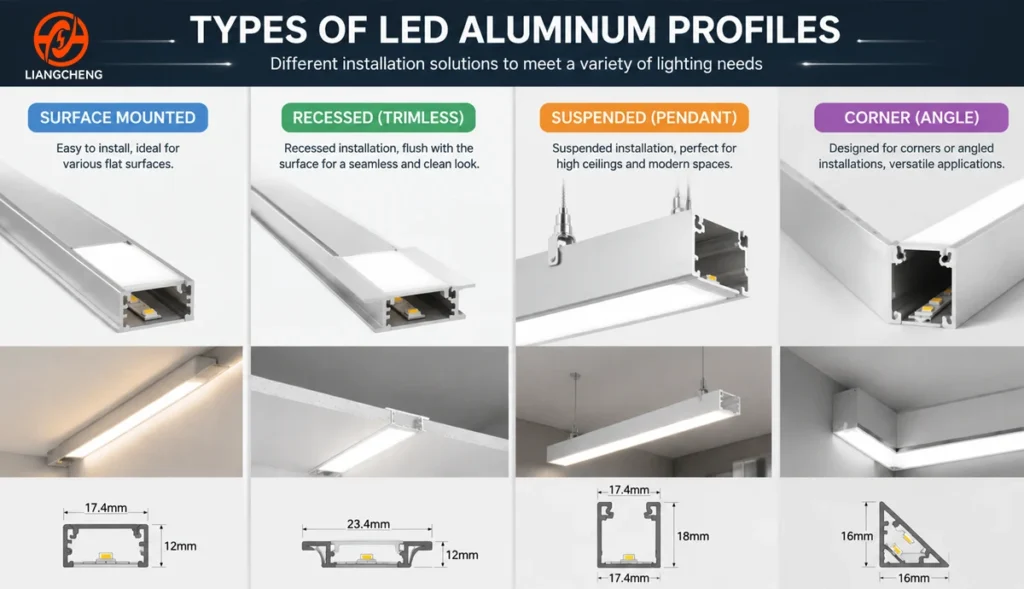
The four main LED aluminum profile types — surface mounted, recessed, suspended, and corner — each solve a different problem. They differ in how they mount, how they manage light output, what they require during installation, and which project environments they suit. Understanding these differences before specifying or sourcing a profile is what separates a clean, professional result from a project that disappoints.
This guide covers each profile type in full: how it works, where it excels, what it demands technically, and how to choose the right one for a given application.
What Is an LED Aluminum Profile and Why Does the Type Matter?
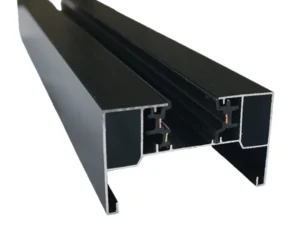
An LED aluminum profile is a precision-extruded aluminum housing designed to mount LED strip lights while managing three critical functions: heat dissipation, mechanical protection, and optical output control. The profile body is typically manufactured from 6063-T5 aluminum alloy — chosen for its thermal conductivity of approximately 200 W/m·K, excellent anodizing performance, and dimensional precision during extrusion. A PC or PMMA diffuser cover clips onto the open face, softening light output and concealing the LED strip.
The profile type — how the housing is shaped and how it attaches to a surface — determines nearly everything about the installation outcome: the amount of structural modification required, the visual result, the light distribution pattern, and the ease of future maintenance. Getting this decision right at the specification stage avoids costly rework and ensures the finished installation meets the design intent.
Surface Mounted LED Aluminum Profile
How It Works
A surface mounted LED profile has a flat base and a U-shaped or rectangular cross-section that sits directly on any mounting surface. The profile is fixed using mounting clips, adhesive tape, or screws driven through the base. No routing, cutting, or substrate modification is required. The LED strip slides into the channel, the diffuser cover snaps over the open face, and the installation is complete.
This is the most widely used profile type globally, and for good reason: it installs faster than any other type, works on virtually any substrate — wood, drywall, concrete, metal, glass — and can be removed and relocated without damaging the surface it was mounted to.
Where Surface Mounted Profiles Work Best
Surface mounted profiles perform reliably in applications where installation speed, substrate flexibility, and future accessibility matter more than the visual flush finish.
Common applications include under-cabinet and under-shelf lighting in kitchens and storage areas, where the profile sits on a horizontal surface and directs light downward onto a work surface. Display lighting in retail shelving and merchandise fixtures is another strong use case — the profile can be repositioned as merchandising layouts change. Wardrobe and closet lighting, bookcase lighting, toe-kick lighting in furniture, and interior lighting for display cases all suit the surface mounted type.
In commercial settings, surface mounted profiles are frequently used for secondary accent or ambient lighting elements where the profile is either visually accessible and part of the design intent, or positioned out of the primary sightline.
Technical Performance
The U-channel cross-section of a standard surface mounted profile provides direct contact between the LED strip’s circuit board and the aluminum base. This contact path is what enables effective thermal management. Heat generated at the LED junction transfers into the aluminum body and dissipates into the surrounding air through the profile’s exposed surfaces.
For high-power LED strips above 15W/m, surface mounted profiles should have a wall thickness of at least 1.2mm and a channel depth that provides adequate thermal mass. For standard decorative applications under 10W/m, slim profiles with 0.8–1.0mm wall thickness perform adequately.
Profile depth and light quality are directly connected. A shallow channel (under 10mm deep) places the LED strip close to the diffuser cover, which can produce visible individual LED dots — known as the “dotting effect” — rather than a smooth continuous light line. Channels 14mm or deeper allow sufficient distance for light to mix before reaching the diffuser, producing a more uniform output. For shallow profiles used with standard LED strips, switching to a high-density strip (120 LEDs/meter or above) or a COB (chip-on-board) strip minimizes the dotting effect without requiring a deeper profile.
Advantages and Limitations at a Glance
Surface mounted profiles offer the lowest installation barrier of any profile type. No surface preparation beyond cleaning is needed. Access to the LED strip for maintenance or replacement requires only removing the diffuser clip — the strip is then accessible without disturbing the mounting surface.
The primary limitation is visual prominence. The profile body protrudes from the surface by the full height of the cross-section (typically 6–20mm), which creates visible hardware. In design-conscious residential or hospitality environments where flush, seamless lighting is the goal, this visual presence may be unacceptable. In confined spaces — tight shelf gaps, narrow cabinet edges pressed against adjacent surfaces — the protrusion can also create physical clearance problems.
Perfil de aluminio LED empotrado
How It Works
A recessed LED aluminum profile is set into a pre-cut channel routed into the mounting substrate — most commonly wood, MDF, drywall, plaster, or concrete — so the diffuser face sits flush with the surrounding surface. Only the diffuser is visible; the aluminum body is completely hidden within the substrate. The light appears to emerge directly from the surface itself, with no visible hardware.
This installation method requires more planning and site preparation than surface mounting, but produces a fundamentally different visual result: continuous, seamless light with no visible fixture.
Where Recessed Profiles Work Best
Recessed profiles are the specification choice for any project where the design intent requires invisible hardware. High-end residential spaces — particularly living areas, master bedrooms, and bathrooms with continuous cove or tray ceiling lighting — frequently specify recessed profiles to achieve an architectural lighting effect rather than a visible fixture.
Commercial applications include hotel corridors and rooms where discreet ambient lighting is required, retail stores where ceiling or wall lighting must not compete visually with merchandise displays, office environments with integrated ceiling lighting, and restaurant interiors where lighting needs to create atmosphere without visible fixtures.
Recessed profiles are also specified for drywall applications in new construction, where the profile is embedded before finishing so the diffuser surface aligns with the final painted wall or ceiling. Dedicated plaster-in profile designs allow joint compound to be applied directly around the profile, creating a truly seamless integration with no visible perimeter.
Wall-washing applications — where a recessed profile at ceiling height directs light uniformly down a wall to reveal surface texture — are another common use, particularly in galleries, museums, and architecturally significant residential projects.
Technical Performance
The recessed installation geometry separates the LED strip from open air circulation, which changes the thermal management picture compared to a surface mounted profile. Heat must transfer through the aluminum body and into the surrounding substrate material. For this reason, thermal performance in recessed installations depends on both the profile’s aluminum mass (wall thickness and cross-section area) and the thermal properties of the surrounding material — wood and MDF have relatively low thermal conductivity compared to concrete or plaster.
For recessed applications using high-power LED strips above 12W/m, specifying a profile with increased wall thickness (1.2mm minimum, 1.5mm preferred) and confirming that the routed channel dimensions allow the aluminum body to make solid contact with the substrate walls on both sides is important. Air gaps between the profile body and the channel walls reduce thermal transfer efficiency.
The diffuser in a recessed profile is typically configured to sit exactly flush with the substrate surface or fractionally proud (0.5–1mm), allowing it to be removed for maintenance without tools. The LED strip itself can then be accessed by pulling it from the channel.
Advantages and Limitations at a Glance
The primary advantage of recessed profiles is the visual result — a clean, borderless light line with no visible hardware. Wiring is concealed within the substrate. The surface around the profile remains uninterrupted, and the lighting appears integrated with the architecture rather than added to it.
The limitations are installation complexity and cost. The routing or cutting must be dimensionally accurate — a channel that is too wide leaves visible gaps around the diffuser, while a channel that is too narrow prevents the profile from seating correctly. Routing straight channels over several meters in drywall or wood requires precision and appropriate tools.
Maintenance access is more limited than with surface mounted profiles. While the diffuser is still removable, the surrounding substrate constrains working space. In drywall or plaster-in installations, LED strip replacement requires more care to avoid damaging the finished surface around the profile.
For retrofit projects in finished spaces, the disruption and cost of routing channels into existing surfaces is substantial. Recessed profiles are most cost-effective when planned into new construction or major renovation projects from the start.
Suspended LED Aluminum Profile
How It Works
A suspended LED profile hangs from the ceiling via steel wire cables or rigid suspension rods, positioning the luminaire in mid-air rather than attached to a ceiling or wall surface. The profile body hangs at a designed height, and power is delivered either through the suspension cable itself (in systems designed for this purpose) or via a separate cable routed to a connection point at the ceiling.
Most suspended profiles are designed for linear lighting applications in commercial and open-plan environments. Many support bidirectional light emission — directing light downward for task illumination and upward toward the ceiling for indirect ambient light — through the use of double-sided diffuser configurations or transparent upper faces.
Where Suspended Profiles Work Best
Suspended profiles are the standard choice for overhead linear lighting in commercial spaces where ceiling height is sufficient to suspend the fixture at a working height while still leaving adequate clearance for occupants below. Office environments use suspended linear profiles extensively over workstations, where the combination of direct task light and indirect ceiling wash creates a comfortable, glare-controlled working environment.
Meeting rooms and conference spaces benefit from suspended linear profiles running parallel to or framing conference tables, providing uniform illumination across work surfaces without the glare of ceiling-flush downlights. Restaurant and hospitality environments use suspended profiles to define dining areas, outline architectural features, or create a sense of intimate scale in high-ceiling spaces by bringing a visible lighting element closer to the occupied zone.
Retail environments with high ceilings use suspended profiles to bring general illumination down to product display level, improving color rendering and visual clarity on merchandise without relying entirely on ceiling-height fixtures. Hotel lobbies, corporate reception areas, and commercial galleries also regularly specify suspended profiles as architectural lighting elements.
Technical Performance
Heat dissipation in suspended profiles is typically the most favorable of any profile type, because the aluminum body is fully exposed to circulating air on all sides. Convection cooling is unrestricted, making suspended profiles well-suited to higher power LED strip applications. A suspended profile with 1.0–1.2mm wall thickness and adequate cross-section area will manage heat effectively for most commercial LED strips.
The mechanical requirements of the suspension system add a design consideration not present in other profile types. The suspension points must be anchored to structural ceiling elements capable of carrying the profile’s weight — typically 0.8–2.5 kg/m depending on profile size and configuration — plus any dynamic load from cable tension. Anchor points in lightweight ceiling tiles or plasterboard without additional backing are insufficient.
Cable or rod length determines hanging height and must be calculated relative to ceiling height and the application. A standard office environment typically positions the suspended profile 600–900mm below the finished ceiling. The suspension hardware — typically threaded rods or stainless steel aircraft cable with adjustable cable grips — allows fine height adjustment after installation.
Advantages and Limitations at a Glance
Suspended profiles create visual impact that wall or ceiling-attached fixtures cannot achieve. The ability to position the luminaire at a specific height in a space, independent of the ceiling plane, gives designers precise control over both the functional and atmospheric qualities of the lighting. The option for bidirectional emission adds a further design dimension — managing both task light and ambient ceiling light from a single linear element.
The primary limitations are installation complexity and planning requirements. Suspension anchors must be planned before ceiling finishes are applied in new construction, or identified and reinforced in retrofit projects. Power routing to the suspension points requires either in-ceiling conduit or surface cable management. The total installed cost for a suspended system — including suspension hardware, ceiling anchors, and electrical connection — is higher than for comparable surface mounted or recessed linear systems.
Perfil de aluminio con LED de esquina
How It Works
A corner LED aluminum profile has an angled cross-section — most commonly 45° — designed to fit into a 90° corner where two surfaces meet. The profile body sits diagonally across the corner, with each flat face pressing against one of the two surfaces meeting at that corner. The LED strip inside the profile then emits light at 45° from the corner — directed outward and downward across the adjacent surface rather than straight down or straight out.
The angled emission geometry is the defining characteristic of corner profiles. Light exits at 45°, which means it illuminates the surface in front of the corner rather than the corner itself, and avoids the direct-view glare that would result from a strip mounted flat on one face with the emitting surface facing the viewer’s sightline.
Where Corner Profiles Work Best
Corner profiles are purpose-designed for junction locations — the intersection of two surfaces — and perform best where the goal is to light the surface areas on either side of the corner, not the corner itself.
The most common application is kitchen cabinet underlighting at corner positions. Standard surface mounted profiles attached to the underside of an upper cabinet work well along the front edge, but at the corner where two cabinet runs meet, a flat profile produces a dark zone and an awkward visible end cap. A corner profile fitted into that corner continues the lighting effect smoothly through the junction.
Retail display shelving uses corner profiles to light the front face of shelves and the surface directly below, improving product illumination at edge positions. Architectural cove lighting where a wall meets a ceiling at a 90° junction uses corner profiles to wash both adjacent surfaces simultaneously — the ceiling and the wall — from a single profile positioned at the junction.
Furniture and millwork applications include wardrobe interiors at corner positions, bookcase uprights at the meeting point of back and side panels, and staircase lighting where the stringer meets a wall.
Technical Performance
Corner profiles are typically more compact in cross-section than surface mounted or recessed profiles, because the angular mounting geometry positions the profile at a corner where space is limited. This compactness has a direct impact on strip compatibility. Profiles with internal widths of 8mm suit standard 8mm LED strips; profiles accommodating 10mm strips have slightly larger cross-sections. Wide strips of 12mm or above may not fit in all corner profile sizes — verifying internal dimensions against strip width before ordering is important.
Thermal performance in corner profiles is constrained by the smaller aluminum body area relative to other profile types. For most corner lighting applications — cabinet accent lighting, display lighting, cove effects — the strip power density is low (typically 5–10W/m), and the corner profile’s thermal capacity is adequate. For higher-power applications in a corner profile geometry, confirming wall thickness and cross-section area against the strip’s wattage specification avoids thermal issues.
The 45° emission angle produces a characteristic light pattern — wider coverage across the adjacent surface than a flat-mounted strip would produce from the same position. This broader distribution improves uniformity on the lit surface and reduces direct glare toward viewers standing in front of the cabinet or display.
Advantages and Limitations at a Glance
Corner profiles solve a specific installation problem — continuity of lighting through corner junctions — that no other profile type addresses as effectively. Their compact form allows them to disappear visually into corners, making only the diffuser visible. The 45° light distribution improves illumination quality on adjacent surfaces while reducing glare.
The limitation is specificity. Corner profiles are not interchangeable with surface mounted or recessed types, and using them outside of corner junction applications produces neither the correct light output angle nor a workable mechanical fit. The narrower internal width also limits LED strip compatibility compared to the other profile types.
Comparing All Four Profile Types Side by Side
| Factor | Surface Mounted | Recessed | Suspended | Corner |
|---|---|---|---|---|
| Installation complexity | Bajo | Alto | Medium–High | Bajo |
| Surface modification required | None | Yes — routing/cutting | Ceiling anchors required | None |
| Visual result | Visible hardware | Flush / invisible | Suspended in space | Concealed in corner |
| Best ceiling height | Any | Any | High (3m+) preferred | Any |
| Heat dissipation | Bien | Moderate (substrate-dependent) | Excelente | Moderado |
| LED strip wattage range | Up to 20W/m | Up to 15W/m | Up to 25W/m | Up to 12W/m |
| Compatible strip width | 8–20mm | 8–20mm | 8–20mm | 8–12mm |
| Retrofit suitability | Excelente | Moderate–Low | Bajo | Excelente |
| Maintenance access | Easy | Moderado | Easy | Easy |
| Typical application | Cabinets, shelves, general | Architecture, hospitality, coves | Offices, commercial | Corners, edges, junctions |
Choosing the Right Profile Type: A Decision Framework
Three questions narrow the choice for any application:
1. What does the finished installation need to look like? If the hardware must be invisible — only light visible — choose recessed. If the profile can be seen but should sit on a surface, choose surface mounted. If it should hang in space and define the visual field, choose suspended. If it needs to disappear into a junction, choose corner.
2. What does the installation environment allow? Recessed requires substrate modification — confirm it’s possible before specifying. Suspended requires structural ceiling anchors and pre-planned power routing — confirm ceiling construction allows this. Surface mounted and corner profiles can be fitted without substrate preparation, making them the right choice for retrofit and renovation projects with finished surfaces.
3. What is the LED strip’s wattage, and does heat dissipation matter? High-power strips above 15W/m need profiles with adequate aluminum mass. Surface mounted and suspended profiles handle high power well. Recessed profiles in non-conductive substrates (wood, MDF) require attention to thermal specification. Corner profiles are generally suited to lower power densities.
When these three questions are answered, the profile type choice is typically clear. When more than one type could work, the deciding factor is usually the balance between installation cost (recessed and suspended cost more to install) and visual quality (recessed and suspended produce superior design outcomes).
Diffuser Cover Options Across Profile Types
Every profile type is available with multiple diffuser cover options, and the choice affects both light quality and ambiance:
Clear cover — maximum light output, LED strip remains visible through the diffuser. Best for applications where brightness is prioritized over appearance. Not suitable where the dotting effect would be objectionable.
Frosted (milky) cover — softens light output and reduces the visibility of individual LEDs while retaining good lumen transmission (typically 85–92% of clear cover output). The standard choice for most residential and commercial installations.
Opal (high-opacity) cover — maximum diffusion, individual LEDs not visible, produces the smoothest light line appearance. Lower lumen transmission (typically 65–80%) compared to frosted. Preferred for high-end architectural applications where light uniformity is paramount.
The choice of diffuser interacts with profile depth: a shallow profile with a clear or lightly frosted cover will show individual LED dots. The same strip in a deeper profile with an opal cover will produce a smooth, uniform light line. When specifying shallow profiles, always pair with denser LED strips or opal diffusers.
Preguntas frecuentes
Can a surface mounted profile be converted to a recessed installation? No — these are different products with different structural designs. Surface mounted profiles have a flat base designed to sit on a surface; recessed profiles have a wider flanged top designed to bridge a routed channel and sit flush with the surrounding substrate. Using a surface mounted profile in a routed channel will not produce a flush result.
What is the minimum ceiling height for a suspended profile? Functionally, a suspended profile can operate at any ceiling height as long as the suspension depth leaves adequate headroom below the fixture. In practice, ceiling heights below 2.7m rarely have sufficient clearance for suspended pendants at a comfortable working height. The most effective suspended installations are in spaces with 3m or higher ceilings.
Do corner profiles work for external (convex) corners as well as internal (concave) corners? Standard 45° corner profiles are designed for internal 90° corners. External or convex corner applications require a different profile geometry or a standard surface mounted profile with appropriate end treatments. Confirm corner type — internal or external — before specifying.
What profile type gives the best light uniformity? All four types can produce excellent uniformity when specified correctly. The key variables are profile depth, diffuser opacity, and LED strip density. Deeper profiles (14mm+) with high-opacity opal covers and high-density strips (120 LEDs/m and above or COB) produce the most uniform output regardless of profile type.
Can LED aluminum profiles be used outdoors? The 6063-T5 aluminum body is corrosion-resistant and suitable for exterior environments. However, for outdoor installation, the complete profile system — including diffuser retention, end caps, and cable entry points — must achieve a minimum IP65 rating. Standard snap-on diffuser profiles without sealing are not suitable for outdoor use. Specify waterproof profiles with silicone sealing and sealed end caps with cable glands for any outdoor or high-humidity application.
¿Necesita soluciones de iluminación de riel personalizadas?
Contacte a Liangcheng Lighting para obtener soluciones profesionales de rieles de aluminio OEM/ODM y soporte de iluminación profesional.