








Estimated reading time: 6 minutes
A 6-wire track rail is a multi-conductor lighting track designed to carry several electrical paths through one continuous aluminum rail. Compatible adapters connect each track light to the required power or control path, so fixtures on the same rail can be assigned to different switching groups. The result is a cleaner ceiling layout with more control flexibility than a basic single-circuit track.
The important qualification is that “6-wire” is a product-family description, not a universal wiring diagram. The six conductors may be allocated differently according to the manufacturer, market, voltage system, and control method. Before specifying or installing any system, confirm the terminal schedule, compatible adapter, rated voltage and current, earthing method, and local electrical requirements for the exact model.
What is inside a 6-wire track rail?
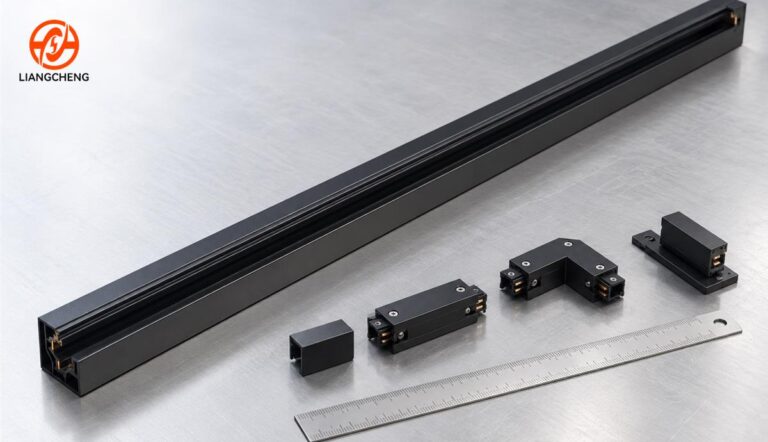
A typical 6-wire rail combines a rigid aluminum profile with insulated conductive paths. The profile supports the luminaires and keeps the contact system aligned. Copper conductors run along the rail inside insulating carriers, while the open channel accepts a matching track-light adapter.
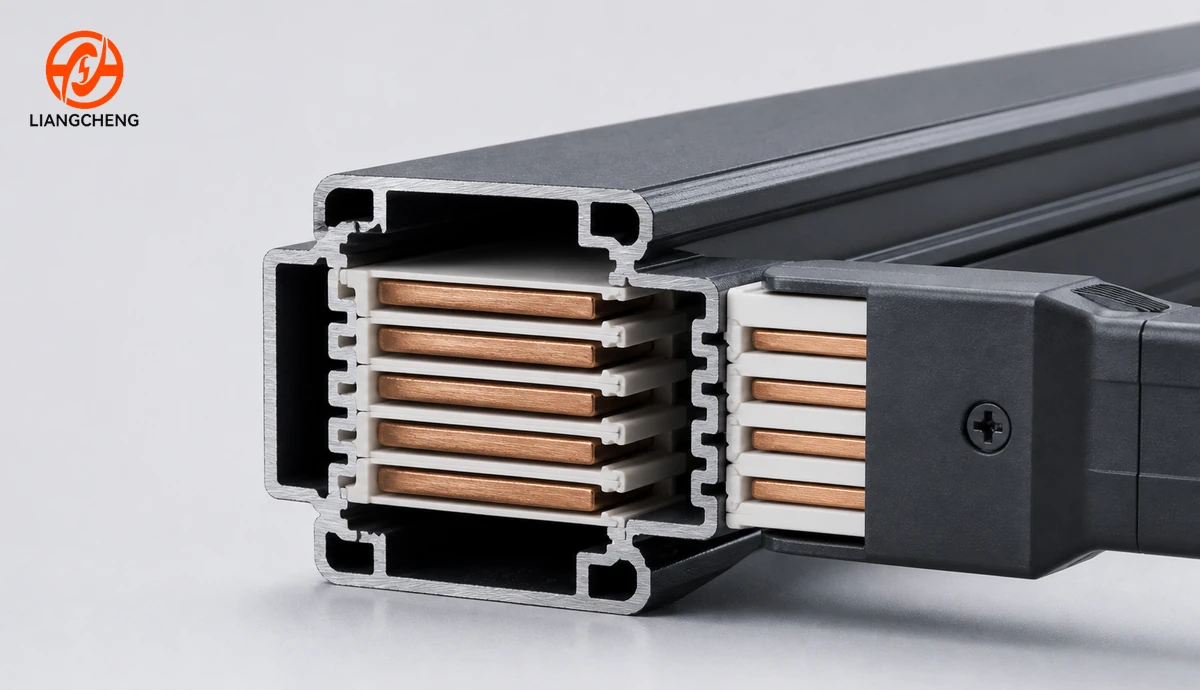
The main parts work together as one engineered system:
- Aluminum housing: provides mechanical strength, holds the internal components, and may participate in the protective earthing arrangement when the system is designed and certified that way.
- Insulating carriers: keep conductive strips separated from one another and from the housing.
- Copper conductors: distribute electrical power or other specified functions along the rail.
- Power feed: connects the building supply and control groups to the correct rail terminals.
- Fixture adapter: locks into the rail and places its contacts on the intended conductive paths.
- Connectors and end caps: continue, turn, terminate, and protect the system while preserving conductor alignment and polarity.
If you need a broader introduction to the basic construction, terminology, and applications, see this guide to how LED lighting track works.
How does a 6-wire track rail control different light groups?
The rail acts as a continuous distribution path. At the feed point, an electrician connects the available supply or control groups to the terminals defined by the system documentation. Each compatible luminaire adapter then connects to a selected group. Fixtures can share the same physical rail but respond to different wall switches, relays, or lighting-control outputs.
For example, a retail project may assign window lights to one group, wall displays to another, and central merchandise lighting to a third. The store can change the scene without moving the rail or installing separate track runs for every zone. The number of usable groups is determined by the complete electrical design, not by the word count in the product name alone.

This grouping capability is especially useful when display priorities change regularly. It supports flexible commercial lighting layouts while keeping fixture positions adjustable. Our related article explains in more detail how track rail systems support commercial lighting design.
Does six wires always mean six independent circuits?
No. Never assume a universal one-wire-per-circuit relationship. An electrical circuit normally needs a defined current path, and a track system may use conductors for line connections, a shared neutral, protective earth, control signals, or another documented function. Some catalogs also use “wire,” “line,” and “circuit” as commercial family names rather than strict electrical definitions.
On this website, the 6-wire range is presented as a six-circuit track rail family. However, buyers and installers should still obtain the exact terminal diagram for the selected SKU. The product drawing and test documentation, not a generic online explanation, must govern the final wiring.
| Item to verify | Why it matters | Where to confirm it |
|---|---|---|
| Terminal allocation | Defines the purpose of every conductive path | Model wiring diagram |
| Rated voltage and current | Prevents electrical and thermal overload | Rail, feed, connector, and adapter labels |
| Earthing method | Maintains protective continuity | Installation instructions and local code |
| Adapter selection | Determines contact position and group assignment | Compatibility chart or sample test |
| Connector orientation | Preserves polarity through corners and joints | Connector markings and layout drawing |
| Control architecture | Confirms whether conductors carry mains power or control functions | Electrical schedule and control specification |
How is it different from 2-wire, 3-wire, and 4-wire track?
The practical difference is control capacity and system complexity. A basic rail usually suits spaces where many fixtures switch together. A higher-conductor rail is intended for projects that need more independently assigned groups or a more specialized electrical arrangement. More conductors do not automatically mean better lighting; they are valuable only when the control plan uses them.
| Track type | Typical design priority | Best fit | Planning effort |
|---|---|---|---|
| 2-wire | Simple shared switching | Small, straightforward layouts | Low |
| 3-wire | System-specific power and earthing arrangement | Projects matched to that rail standard | Moderate |
| 4-wire or 3-circuit family | Several selectable lighting groups | Retail, galleries, and flexible commercial spaces | Moderate |
| 6-wire family | Higher-density multi-group or specialized control | Large or control-intensive commercial projects | High |
For a side-by-side explanation of common lower-conductor systems, read 2-wire, 3-wire, and 4-wire track rail types. If the project uses a regional standard such as H, J, or L type, also check the track-light compatibility guide; similar-looking adapters are not necessarily interchangeable.
Where does a 6-wire rail make sense?
A 6-wire rail is most useful when a project requires several control groups along the same route and expects lighting scenes to change over time. Suitable applications may include large retail floors, exhibition spaces, galleries, hospitality venues, showrooms, and multi-use commercial interiors.
It may be unnecessary for a small room where every luminaire operates together. In that case, a simpler rail can reduce component cost, commissioning time, and the risk of mixing incompatible parts. The correct decision starts with a circuit and control schedule, not with the largest available conductor count.
What must be checked before installation?
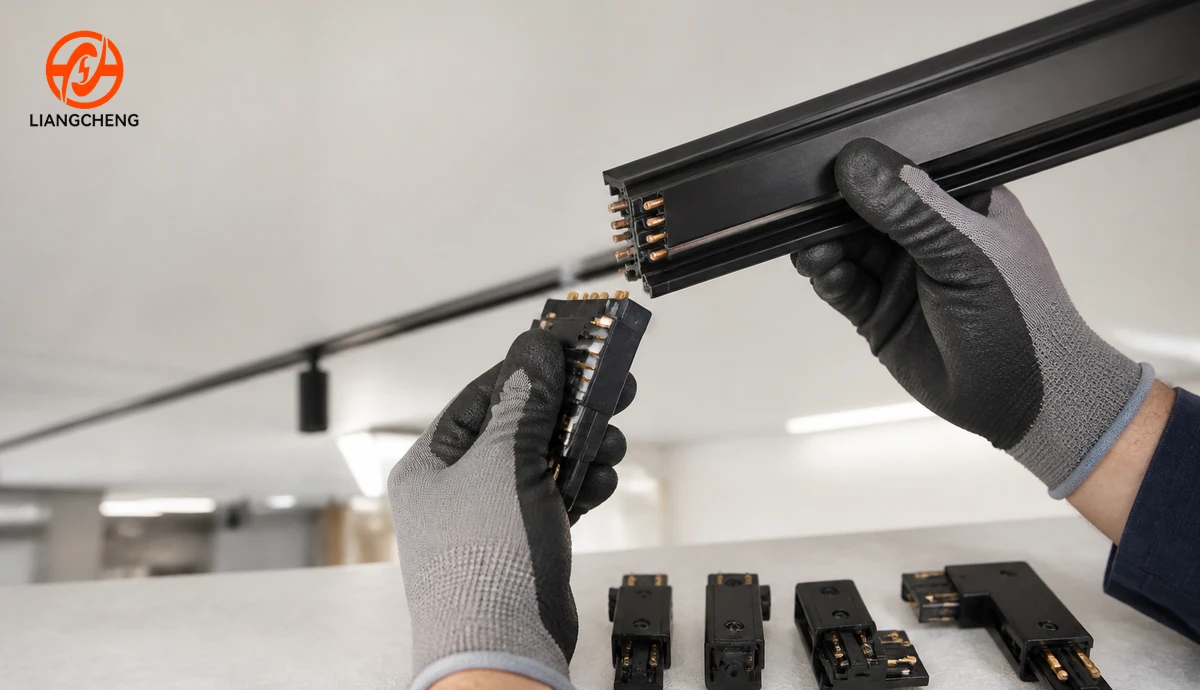
- Define the control groups. List which luminaires must operate together before choosing the rail.
- Confirm one complete system. Match the rail, feed, straight and corner connectors, adapters, end caps, and suspension or mounting parts.
- Review the terminal diagram. Verify every conductor function and connector orientation for the exact model.
- Check electrical ratings. Calculate connected loads and apply the limits stated for every component in the run.
- Plan mechanical support. Account for rail length, joint locations, fixture weight, ceiling structure, and mounting intervals.
- Commission each group. With the supply safely isolated during installation, verify continuity, polarity, protective earth, insulation, and switching behavior using the procedure required by local regulations.
Track lighting is not a mix-and-match product category. Even when two rails have similar dimensions, their contact positions, polarity, locking geometry, and ratings may differ. A physical fit does not prove electrical compatibility. For broader purchasing criteria, refer to the aluminum track rail buying guide.
What are the main advantages and limitations?
The main advantage is flexible zoning within a tidy ceiling system. Fixtures can be repositioned while their control assignment remains planned through compatible adapters and feeds. This can reduce the need for parallel rails and makes future display changes easier.
The tradeoff is greater design discipline. A 6-wire system involves more terminals, more compatibility checks, and potentially more complex feeds and connectors. Replacement components must remain available and correctly matched. Installation and commissioning should be performed by a qualified electrician in accordance with the product documentation and applicable local rules.
Frequently asked questions
Can any track light fit a 6-wire rail?
No. The fixture needs an adapter designed for the rail’s mechanical profile, contact positions, polarity, ratings, and control arrangement. Use a documented compatibility match.
Can one fixture be moved to another control group?
Often, a compatible selectable adapter can be reassigned, but the method is system-specific. Isolate power and follow the manufacturer’s instructions; never change an adapter setting while energized.
Is a 6-wire rail the same as a magnetic track?
No. Conductor count and magnetic retention describe different characteristics. Magnetic track systems may also operate at a different voltage and use a different adapter architecture.
Is 6-wire track rail only for large projects?
Not exclusively, but its benefits are strongest where several lighting groups share one route. For a simple single-zone layout, a lower-complexity system may be more economical.
Final takeaway
A 6-wire track rail provides multiple conductive paths inside one mechanical rail, allowing compatible fixtures to be organized into flexible control groups. Its real capability depends on the exact terminal allocation, adapter design, ratings, and control architecture. Start with the lighting-control plan, select all components as one verified system, and use the model-specific wiring diagram for installation.
Need Custom Track Lighting Solutions?
Contact Liangcheng Lighting for OEM/ODM aluminum track rail solutions and professional lighting support.
Related