







Read Time: 12 min read
Demand for flexible LED lighting systems has grown fast across retail, hospitality, and commercial interiors, and the aluminum track lighting rail sits at the center of that shift. It’s the structural and electrical backbone of any track lighting system — the part that determines how well the whole setup performs, how long it lasts, and how easily it can be reconfigured as a space changes.
Aluminum has become the material of choice for track rails for a few clear reasons:
- Lightweight — easy to ship, handle, and mount without extra structural support
- Excellent heat dissipation — protects LED components and extends fixture life
- Durable structure — holds up to daily use in high-traffic commercial spaces
- Easy installation — works with surface-mounted, recessed, or suspended setups
- Modern appearance — anodized and powder-coated finishes suit contemporary interiors
You’ll find aluminum track lighting rail systems doing the heavy lifting in retail stores, shopping malls, hotels, offices, museums, and increasingly in residential lighting design. But not all track rail is built the same, and for buyers — whether you’re a distributor, a lighting brand, or a project contractor — getting the specification wrong can mean compatibility issues, premature failure, or a system that simply can’t grow with the project. This guide walks through what an aluminum track lighting rail actually is, what to check before you buy, and how to evaluate a manufacturer you can rely on for the long term.
1. What Is an Aluminum Track Lighting Rail?
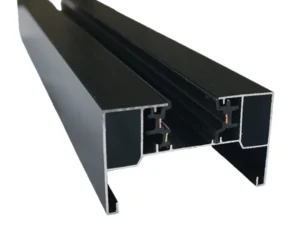
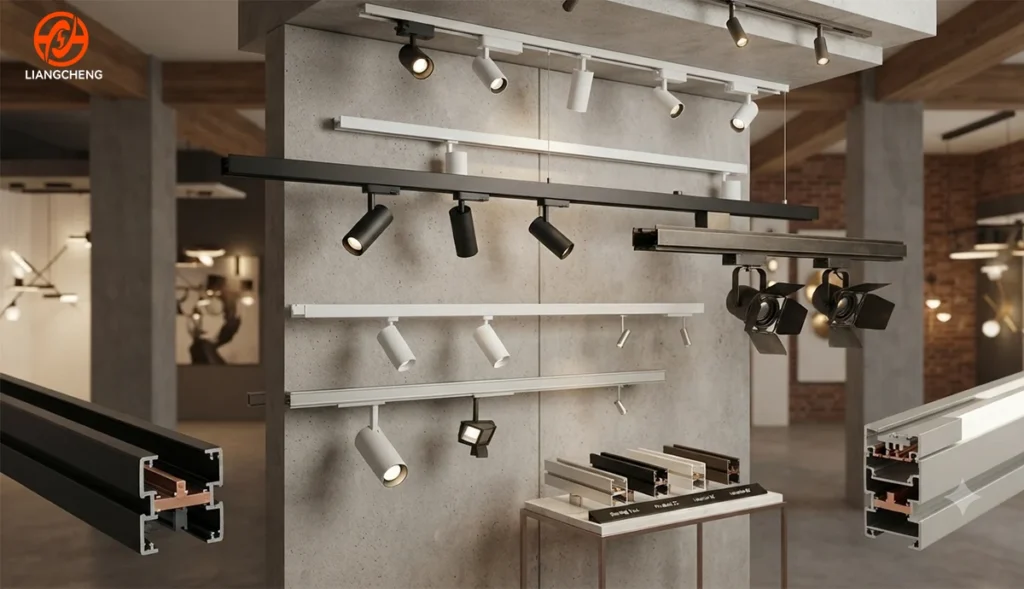
An aluminum track lighting rail is the extruded aluminum channel that carries electrical current along its length and provides the physical mounting structure for track light fixtures. Rather than wiring each fixture individually, a track system lets you power and reposition multiple fixtures along a single continuous rail — which is exactly why it’s become the standard for spaces that need flexible, adjustable lighting.
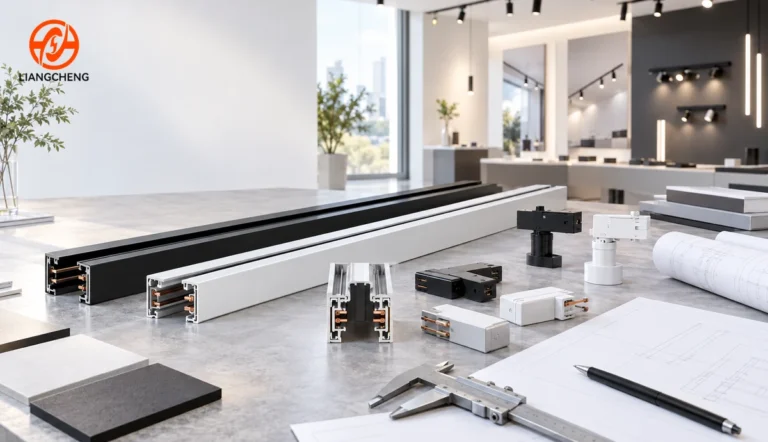
A complete track lighting system is built from a few core components:
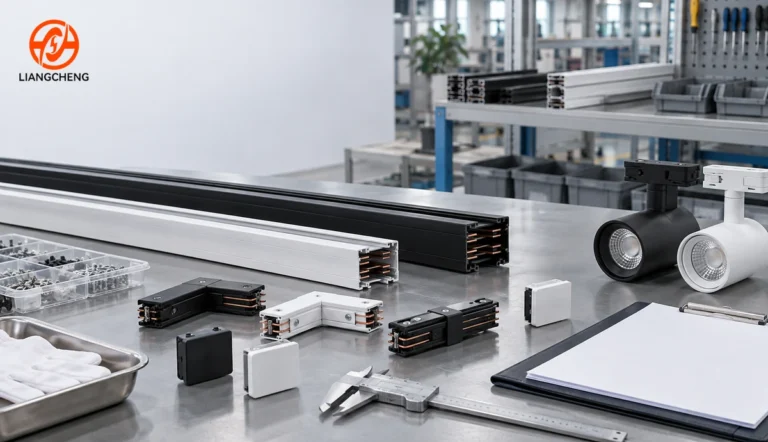
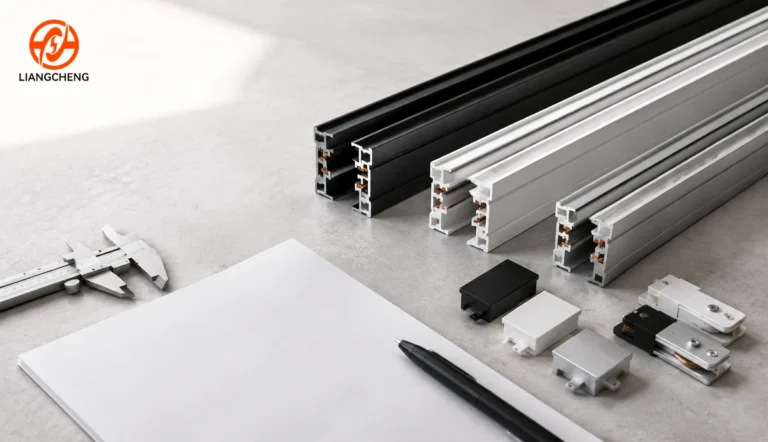
Aluminum Track Rail — the extruded profile that supplies power and provides the mounting structure for the rest of the system. This is the part manufactured through aluminum extrusion, precision cutting, and surface finishing.
Track Light Fixtures — the light-emitting components that clip or twist into the rail, such as LED spotlights, pendant lights, or magnetic light heads. Fixture selection is typically handled separately from rail sourcing, since rail and fixture compatibility depends on connector type and voltage rather than on both coming from the same source.
Connectors — L connectors, T connectors, cross connectors, and flexible connectors that let the rail turn corners, branch into multiple directions, or follow non-linear ceiling layouts.
Power Adapter — supplies and regulates electricity into the track system, converting mains voltage to whatever the track and fixtures require.
(Suggested visual: an aluminum track lighting rail structure diagram showing the rail cross-section, connector points, and power feed.)
2. Why Choose Aluminum for Track Lighting Rails?
2.1 Lightweight and Easy Installation
Weight matters more than it seems once you’re installing overhead, often on a ladder, often against a deadline.
| Material | Weight | Installation |
|---|---|---|
| Aluminum | Lightweight | Easy — minimal structural support needed |
| Steel | Heavy | More difficult — often needs reinforced mounting |
| Plastic | Light | Fast to install, but less durable over time |
Aluminum sits in the sweet spot: light enough for fast, low-labor installation, but structurally sound enough to support commercial-grade fixture loads.
2.2 Excellent Heat Dissipation
LEDs are efficient, but they still generate heat that has to go somewhere — and heat is the single biggest factor shortening LED lifespan. Aluminum’s thermal conductivity lets the rail itself act as a passive heat sink, pulling heat away from the fixture and dissipating it into the surrounding air. That matters most in commercial environments where lights run long hours every day — retail floors, offices, and hotel lobbies all put sustained thermal load on a track system that a lower-conductivity material simply can’t manage as well.
2.3 Corrosion Resistance
Properly treated aluminum resists oxidation far better than uncoated steel, which is a meaningful advantage in commercial environments exposed to humidity, temperature swings, or coastal air. A track rail that starts corroding at the seams doesn’t just look bad — it compromises the electrical contact points that keep the whole system running safely.
2.4 Modern Appearance
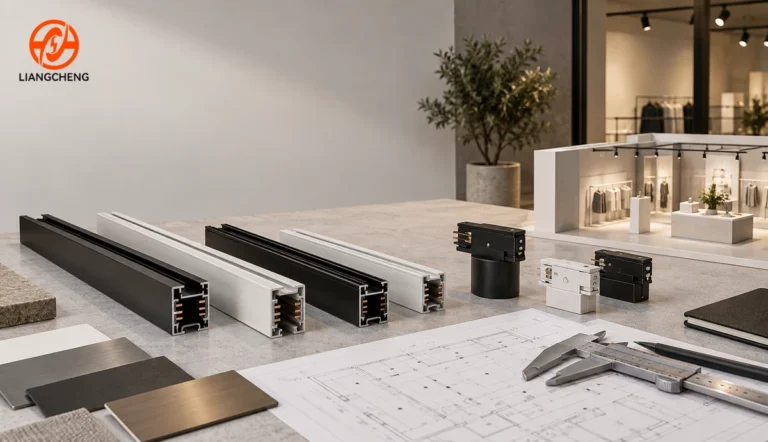
Beyond performance, aluminum track rail is simply easier to make look good. Anodized finishes give a clean, factory-grade look; black and white powder-coated options let the rail disappear into a ceiling design or become a visible architectural line, depending on what the space calls for. For premium retail and hospitality projects, that finish quality is often as important to the buyer as the electrical spec.
3. Types of Aluminum Track Lighting Rails
3.1 Single Circuit Track Rail
One power circuit, simple on/off control, and the most cost-effective option in the category. Best suited to small shops, homes, and offices where the whole track runs as one lighting zone.
3.2 Two Circuit Track Rail
Two independent circuits let you control separate groups of fixtures on the same rail — useful for retail stores, galleries, and hotels that want to separate general lighting from accent or feature lighting without installing two physically separate tracks.
3.3 Three Circuit Track Rail
The most flexible configuration, giving professional-level control over multiple lighting zones from a single rail. This is the standard choice for large commercial projects where different areas of a space need independently adjustable lighting — retail departments, exhibition halls, and multi-zone hospitality interiors.
3.4 Magnetic Track Lighting Rail
A newer format that replaces mechanical connectors with a magnetic strip, letting fixtures snap on and off without twisting or clipping mechanisms. It’s faster to reconfigure and has become a strong trend in modern retail and gallery lighting design, where fixture layouts change frequently.
4. Important Specifications When Buying Aluminum Track Lighting Rail
4.1 Aluminum Alloy Selection
The alloy used in extrusion directly affects the rail’s finish quality, strength, and long-term performance. The two most common choices are:
- 6063 aluminum alloy — widely used for track lighting rail because of its good extrusion performance, smooth surface finish, and excellent anodizing/coating results. It’s the industry-standard choice when appearance and precision extrusion matter.
- 6061 aluminum alloy — offers higher mechanical strength, sometimes used where structural load is a bigger factor than surface finish.
For most track lighting applications, 6063 is preferred specifically because it extrudes cleanly into the narrow, detailed profiles a track rail needs, with a surface that finishes well under anodizing or powder coating.
4.2 Track Rail Length
Common stock lengths are 1 meter, 1.5 meters, and 2 meters, with custom lengths available for project-specific runs. Choosing the right length comes down to three practical factors:
- Project size — how much continuous run the space actually needs
- Transportation requirements — longer rail sections cost more to ship and are more prone to handling damage
- Installation layout — how many joints and connectors the layout can accommodate without compromising the finished look
4.3 Track Rail Width and Design
Width and profile design affect three things at once: which fixtures the rail is compatible with, how much load it can carry, and how it reads visually once installed. A narrower, more minimal profile suits residential and boutique retail; wider profiles typically carry higher load capacity for heavier commercial fixtures.
4.4 Surface Treatment
Anodized Aluminum — an electrochemical finishing process that produces a durable, scratch-resistant surface with a premium look. It’s the standard finish for commercial track rail because it holds up to repeated handling and cleaning.
Powder Coating — offers a much wider color range and supports custom branding, which matters for lighting brands and distributors building a distinct product line. It trades some of anodizing’s scratch resistance for far greater color flexibility.
4.5 Load Capacity
Load capacity isn’t a single number you can compare across suppliers without context — it depends on aluminum thickness, the internal track design, how the rail is mounted, and the total weight of fixtures attached to it. A buyer sourcing rail for heavier pendant fixtures needs a materially different spec than one sourcing for lightweight LED spotlights, even if the rail looks identical from the outside.
5. How to Choose the Right Aluminum Track Lighting Rail for Different Applications
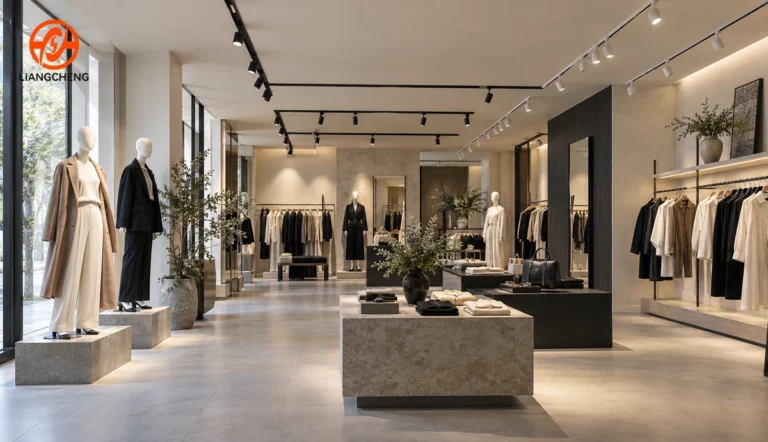
Retail Store Lighting — needs flexible adjustment, high brightness capability, and easy maintenance for a space that gets rearranged often. Two-circuit or three-circuit track systems are typically the better fit, since they let merchandising lighting change independently from general ambient lighting.
Hotel Lighting — prioritizes elegant appearance, long lifespan, and customized design that matches the property’s interior identity rather than a generic commercial look.
Office Lighting — centers on energy efficiency and comfortable, glare-free lighting for sustained daily use.
Home Lighting — favors easy installation and affordable solutions, usually single-circuit systems that don’t require the flexibility a commercial project demands.
6. Aluminum Track Lighting Rail Installation Guide
Surface Mounted Installation — the fastest and simplest method, well suited to renovation projects where running conduit into the ceiling isn’t practical.
Recessed Installation — sets the rail flush with the ceiling for a clean, minimal look, favored in modern architectural interiors where the rail itself should be nearly invisible.
Suspended Installation — hangs the rail from cables or rods, ideal for high ceilings and open commercial spaces like warehouses converted into retail or exhibition use.
7. Common Mistakes When Buying Aluminum Track Lighting Rail
Mistake 1: Choosing Low-Quality Aluminum. Cheaper, lower-grade aluminum dissipates heat poorly and shortens the working life of everything connected to it — the savings on the rail get erased by fixture replacements down the line.
Mistake 2: Ignoring Compatibility. Track type, voltage, and connector system all need to match across the rail, fixtures, and power adapter. Assuming compatibility without checking specs is one of the most common (and expensive) sourcing errors.
Mistake 3: Buying Without Considering Future Expansion. A rail system that can’t extend or reconfigure locks a project into its original layout. Modular track systems, by contrast, let a space grow or change without a full re-fit.
Mistake 4: Only Comparing Price. The lowest quote rarely accounts for material quality, production capability, or quality control — three factors that determine whether the rail performs to spec five years from now, not just on installation day.
8. How to Select a Reliable Aluminum Track Lighting Rail Manufacturer
For B2B buyers, the manufacturer relationship matters as much as the product spec. A short checklist to evaluate against:
Manufacturing Capability — Does the factory control the full production process in-house, including aluminum extrusion, CNC machining, surface treatment, and assembly? Vertical integration generally means tighter quality control and more consistent output across orders.
Quality Control — Look for documented material inspection, dimensional testing, and electrical safety testing at each stage of production, not just a final check before shipping.
OEM/ODM Capability — Important for lighting brands, distributors, and project suppliers who need custom specifications, branding, or packaging rather than an off-the-shelf product.
Export Experience — International certifications, export-grade packaging standards, and a track record of reliable shipping matter as much as the product itself when you’re sourcing across borders.
9. Aluminum Track Lighting Rail Wholesale Buying Guide
For distributors and importers evaluating suppliers at volume, a few areas deserve specific attention:
MOQ — Liangcheng Lighting’s minimum order quantity is 10 meters.
Customization Options — Length, color/surface finish, logo/branding, and packaging can all be customized to meet customer requirements.
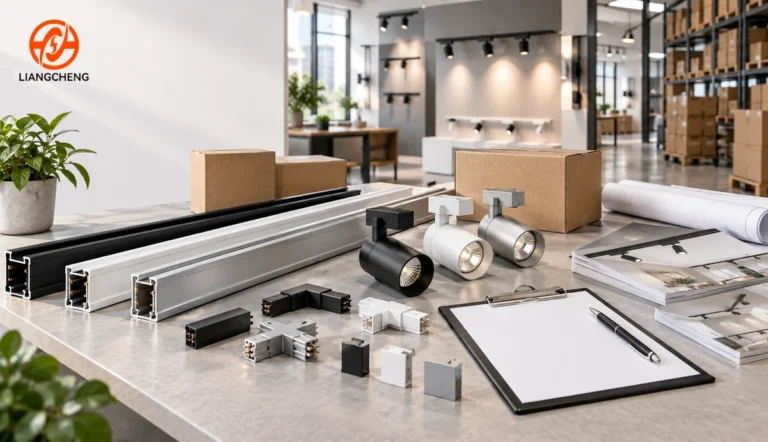
Packaging Requirements — We use sturdy cardboard boxes for packaging to ensure the product does not deform or wear. We have successfully exported to many countries.
10. Frequently Asked Questions
What is the best aluminum alloy for track lighting rail? 6063 aluminum alloy is the most widely used, thanks to its clean extrusion performance and smooth, finish-ready surface. 6061 is sometimes chosen where higher mechanical strength is the priority.
How long does aluminum track lighting rail last? A well-manufactured aluminum rail with proper surface treatment can last well over a decade in normal commercial use, since aluminum resists corrosion and doesn’t degrade under sustained thermal load the way lower-grade materials do.
Can aluminum track rails be customized? Yes — length, width, finish, color, and branding can typically all be customized for both project-specific orders and wholesale/private-label programs.
What size aluminum track lighting rail should I buy? It depends on project layout and transportation logistics. Standard lengths (1m, 1.5m, 2m,3m) suit most installations; custom lengths are available for projects with specific run requirements.
Are magnetic track rails better than traditional track rails? They’re not strictly “better” — they solve a different problem. Magnetic systems make fixture swaps faster and are well suited to spaces that reconfigure lighting often, while traditional connector-based rails remain a reliable, cost-effective choice for fixed layouts.
How do I find a reliable aluminum track lighting rail supplier in China? Evaluate manufacturing capability (in-house extrusion, CNC, and finishing), documented quality control processes, OEM/ODM flexibility, and export experience — including certifications and packaging standards — rather than price alone.
Conclusion: Choose the Right Aluminum Track Lighting Rail Supplier
Material quality, the right track type for the application, and a manufacturer capable of consistent, exportable quality are the three factors that separate a track lighting system that performs for years from one that needs replacing within twelve months. Whether you’re specifying rail for a single retail buildout or sourcing at wholesale volume for a distribution business, the questions in this guide — alloy, finish, load capacity, and manufacturer vetting — are the ones worth asking before you commit.
Looking for a professional aluminum track lighting rail manufacturer? Contact us for wholesale pricing, OEM solutions, and project support.
Need Custom Track Lighting Solutions?
Contact Liangcheng Lighting for OEM/ODM aluminum track rail solutions and professional lighting support.