







وقت القراءة: 12 دقيقة قراءة
ازداد الطلب على أنظمة الإضاءة المرنة بتقنية LED بسرعة في قطاعات التجزئة والضيافة والديكورات الداخلية التجارية، و قضيب إضاءة بألومنيوم يجلس في وسط هذا التحول. إنه العمود الفقري الهيكلي والكهربائي لأي نظام إضاءة مسار - الجزء الذي يحدد مدى جودة أداء الإعداد بأكمله، ومدة بقائه، ومدى سهولة إعادة تكوينه مع تغير المساحة.
أصبح الألمنيوم المادة المفضلة لقضبان السكك الحديدية لبضعة أسباب واضحة:
- خفيف الوزن — سهلة الشحن والمناولة والتركيب بدون الحاجة لدعم هيكلي إضافي
- تبديد حرارة ممتاز — يحمي مكونات LED ويطيل عمر التركيبات
- هيكل متين — تتحمل الاستخدام اليومي في المساحات التجارية ذات الحركة المرورية العالية
- تركيب سهل — يعمل مع الإعدادات المثبتة على السطح، أو الغائرة، أو المعلقة
- مظهر عصري — الأسطح المؤكسدة والمطلية بالمسحوق تناسب الديكورات الداخلية المعاصرة
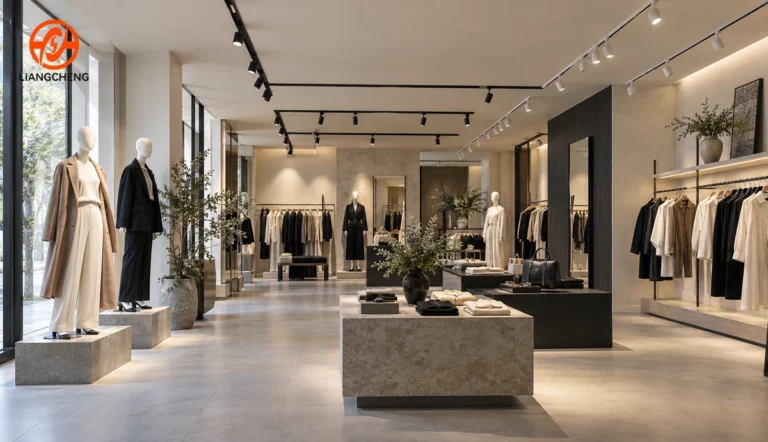
ستجد أن أنظمة مسارات الإضاءة المصنوعة من الألمنيوم تقوم بالعمل الشاق في متاجر التجزئة ومراكز التسوق والفنادق والمكاتب والمتاحف، وبشكل متزايد في تصميم الإضاءة السكنية. ولكن ليس كل المسارات مبنية بنفس الطريقة، وبالنسبة للمشترين - سواء كنت موزعًا أو علامة تجارية للإضاءة أو مقاول مشروع - فإن تحديد المواصفات الخاطئة يمكن أن يعني مشاكل في التوافق أو فشل مبكر أو نظام لا يمكنه ببساطة النمو مع المشروع. هذا الدليل يشرح ما هو نظام مسار الإضاءة المصنوع من الألمنيوم بالفعل، وما يجب التحقق منه قبل الشراء، وكيفية تقييم شركة تصنيع يمكنك الاعتماد عليها على المدى الطويل.
1. ما هو مسار الإضاءة الألومنيوم؟
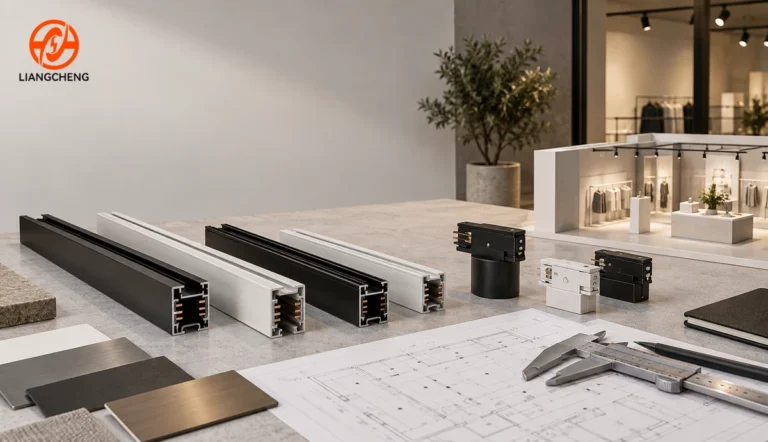
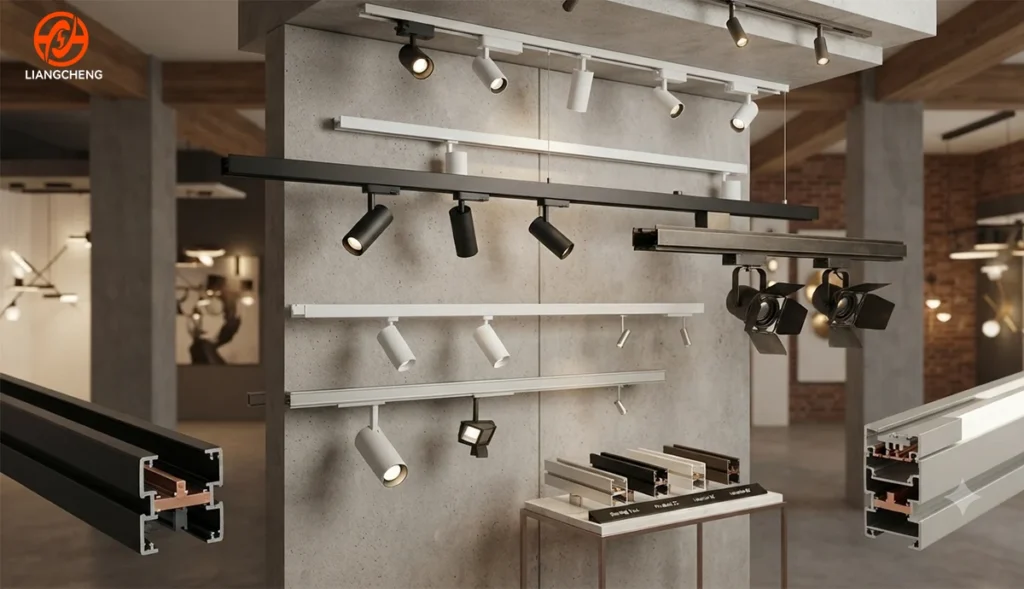
أن راي إضاءة مسار ألومنيوم"L" هو القناة المصنوعة من الألومنيوم المبثوق والتي تحمل التيار الكهربائي على طولها وتوفر الهيكل المادي لتركيب تركيبات الإضاءة المسارية. بدلاً من توصيل كل تركيب على حدة، يسمح لك نظام المسار بتشغيل وإعادة وضع تركيبات متعددة على طول سكة واحدة مستمرة - وهذا هو السبب الدقيق الذي جعلها المعيار للمساحات التي تحتاج إلى إضاءة مرنة وقابلة للتعديل.
نظام إضاءة المسار الكامل يتكون من عدة مكونات أساسية:
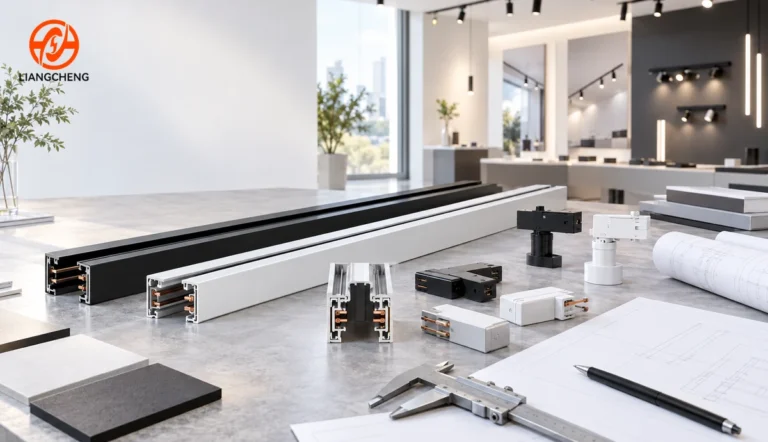
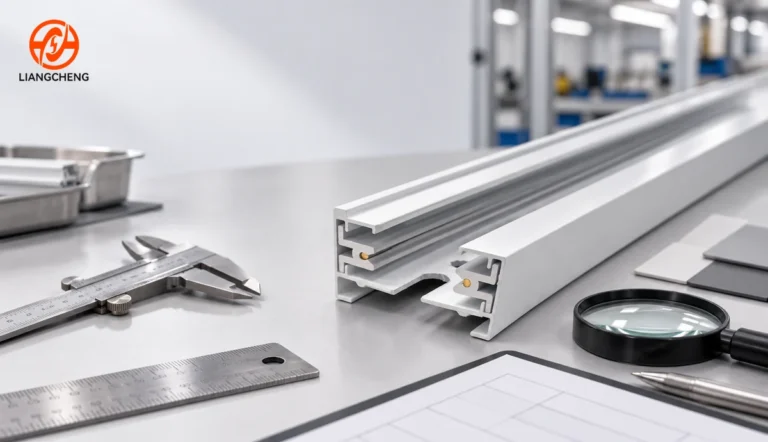
قضيب ألومنيوم — المقطع المبثوق الذي يزود النظام بالطاقة ويوفر هيكل التثبيت لبقية أجزاء النظام. وهذا هو الجزء الذي يتم تصنيعه من خلال عملية بثق الألومنيوم، والقطع الدقيق، وتشطيب السطح.
تركيبات الإضاءة المسارية — المكونات التي تبعث الضوء والتي يتم تثبيتها أو لفها في القضبان، مثل أضواء الكشافات LED، أو أضواء المعلقات، أو رؤوس الإضاءة المغناطيسية. يتم التعامل مع اختيار التركيبات عادةً بشكل منفصل عن مصدر القضبان، حيث تعتمد توافقية القضبان والتركيبات على نوع الموصل والجهد بدلاً من أن يأتي كلاهما من نفس المصدر.
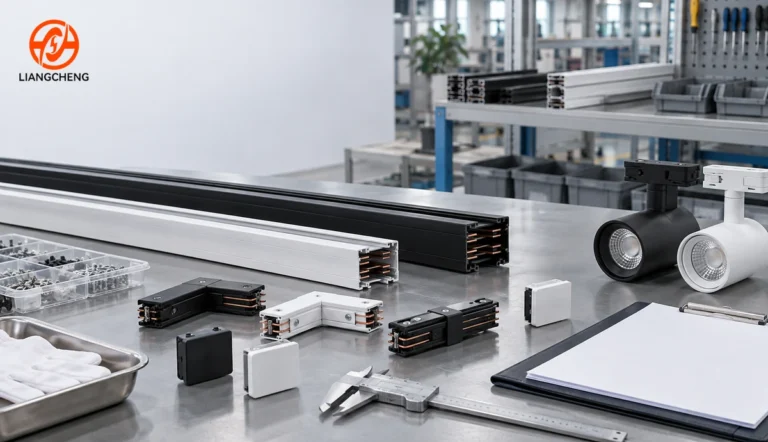
الموصلات — موصلات حرف L، وصلات حرف T، وصلات متقاطعة، ووصلات مرنة تتيح للسكك الانتقال حول الزوايا، أو التفرع في اتجاهات متعددة، أو اتباع تخطيطات الأسقف غير الخطية.
محول الطاقة — توفير الكهرباء وتنظيمها إلى نظام المسار، وتحويل جهد التيار الرئيسي إلى ما يحتاجه المسار والتركيبات.
(صورة مقترحة: رسم تخطيطي لهيكل مسار إضاءة ألومنيوم يوضح مقطع المسار، ونقاط التوصيل، وتغذية الطاقة.)
لماذا تختار الألومنيوم لقضبان إضاءة المسار؟
2.1 خفيف الوزن وسهل التركيب
يكتسب الوزن أهمية أكبر مما يبدو عليه الأمر عندما تقوم بتركيب الأجهزة المعلقة، غالبًا على سلم، وغالبًا في ظل ضغوط المواعيد النهائية.
| مادة | وزن | تثبيت |
|---|---|---|
| الألومنيوم | خفيف الوزن | سهل — لا يتطلب سوى الحد الأدنى من الدعم الهيكلي |
| صلب | ثقيل | أكثر صعوبة — غالبًا ما يتطلب تركيبًا مُعزَّزًا |
| بلاستيك | ضوء | سهل التركيب، ولكن أقل متانة بمرور الوقت |
الألومنيوم يحتل المكانة المثالية: خفيف بما يكفي للتركيب السريع الذي يتطلب عمالة قليلة، ولكنه قوي هيكليًا بما يكفي لدعم أحمال التركيبات التجارية.
2.2 تبديد حرارة ممتاز
تتميز مصابيح LED بكفاءتها، لكنها لا تزال تولد حرارة يجب التخلص منها — وتعد الحرارة العامل الأكبر الذي يقصر من عمر مصابيح LED. تتيح الموصلية الحرارية للألمنيوم أن يعمل السكة نفسها كمشتت حراري سلبي، حيث تسحب الحرارة بعيدًا عن وحدة الإضاءة وتبددها في الهواء المحيط. ويكتسب ذلك أهمية قصوى في البيئات التجارية حيث تعمل المصابيح لساعات طويلة كل يوم — فمساحات البيع بالتجزئة والمكاتب وردهات الفنادق تضع جميعها حملًا حراريًا مستمرًا على نظام السكك، وهو ما لا تستطيع المواد ذات الموصلية الحرارية الأقل التعامل معه بنفس الكفاءة.
2.3 مقاومة التآكل
يقاوم الألمنيوم المعالج بشكل صحيح التآكل بشكل أفضل بكثير من الفولاذ غير المطلي، وهي ميزة هامة في البيئات التجارية المعرضة للرطوبة، وتقلبات درجات الحرارة، أو الهواء الساحلي. قضيب مسار يبدأ في التآكل عند الدرزات لا يبدو سيئًا فحسب، بل إنه يضر بنقاط الاتصال الكهربائية التي تبقي النظام بأكمله يعمل بأمان.
2.4 المظهر العصري
وبصرف النظر عن الأداء، فإن قضبان الألمنيوم أسهل بكثير في إضفاء مظهر جمالي جذاب. فاللمسات النهائية المطلية بالأنود تمنحها مظهرًا أنيقًا على مستوى الجودة الصناعية؛ أما الخيارات المطلية بالمسحوق باللونين الأسود والأبيض فتسمح للقضيب بالاندماج في تصميم السقف أو أن يصبح خطًا معماريًا بارزًا، حسب متطلبات المساحة. وبالنسبة لمشاريع التجزئة والضيافة الفاخرة، غالبًا ما تكون جودة التشطيب هذه مهمة للمشتري بقدر أهمية المواصفات الكهربائية.
3. أنواع مسارات إضاءة الألومنيوم
3.1 قضيب مسار أحادي الدائرة
One power circuit, simple on/off control, and the most cost-effective option in the category. Best suited to small shops, homes, and offices where the whole track runs as one lighting zone.
3.2 Two Circuit Track Rail
Two independent circuits let you control separate groups of fixtures on the same rail — useful for retail stores, galleries, and hotels that want to separate general lighting from accent or feature lighting without installing two physically separate tracks.
3.3 Three Circuit Track Rail
The most flexible configuration, giving professional-level control over multiple lighting zones from a single rail. This is the standard choice for large commercial projects where different areas of a space need independently adjustable lighting — retail departments, exhibition halls, and multi-zone hospitality interiors.
3.4 Magnetic Track Lighting Rail
A newer format that replaces mechanical connectors with a magnetic strip, letting fixtures snap on and off without twisting or clipping mechanisms. It’s faster to reconfigure and has become a strong trend in modern retail and gallery lighting design, where fixture layouts change frequently.
4. Important Specifications When Buying Aluminum Track Lighting Rail
4.1 Aluminum Alloy Selection
The alloy used in extrusion directly affects the rail’s finish quality, strength, and long-term performance. The two most common choices are:
- 6063 aluminum alloy — widely used for track lighting rail because of its good extrusion performance, smooth surface finish, and excellent anodizing/coating results. It’s the industry-standard choice when appearance and precision extrusion matter.
- 6061 aluminum alloy — offers higher mechanical strength, sometimes used where structural load is a bigger factor than surface finish.
For most track lighting applications, 6063 is preferred specifically because it extrudes cleanly into the narrow, detailed profiles a track rail needs, with a surface that finishes well under anodizing or powder coating.
4.2 Track Rail Length
Common stock lengths are 1 meter, 1.5 meters, and 2 meters, with custom lengths available for project-specific runs. Choosing the right length comes down to three practical factors:
- Project size — how much continuous run the space actually needs
- Transportation requirements — longer rail sections cost more to ship and are more prone to handling damage
- Installation layout — how many joints and connectors the layout can accommodate without compromising the finished look
4.3 Track Rail Width and Design
Width and profile design affect three things at once: which fixtures the rail is compatible with, how much load it can carry, and how it reads visually once installed. A narrower, more minimal profile suits residential and boutique retail; wider profiles typically carry higher load capacity for heavier commercial fixtures.
4.4 Surface Treatment
الألومنيوم المؤكسد — an electrochemical finishing process that produces a durable, scratch-resistant surface with a premium look. It’s the standard finish for commercial track rail because it holds up to repeated handling and cleaning.
Powder Coating — offers a much wider color range and supports custom branding, which matters for lighting brands and distributors building a distinct product line. It trades some of anodizing’s scratch resistance for far greater color flexibility.
4.5 Load Capacity
Load capacity isn’t a single number you can compare across suppliers without context — it depends on aluminum thickness, the internal track design, how the rail is mounted, and the total weight of fixtures attached to it. A buyer sourcing rail for heavier pendant fixtures needs a materially different spec than one sourcing for lightweight LED spotlights, even if the rail looks identical from the outside.
5. How to Choose the Right Aluminum Track Lighting Rail for Different Applications
Retail Store Lighting — needs flexible adjustment, high brightness capability, and easy maintenance for a space that gets rearranged often. Two-circuit or three-circuit track systems are typically the better fit, since they let merchandising lighting change independently from general ambient lighting.
Hotel Lighting — prioritizes elegant appearance, long lifespan, and customized design that matches the property’s interior identity rather than a generic commercial look.
Office Lighting — centers on energy efficiency and comfortable, glare-free lighting for sustained daily use.
Home Lighting — favors easy installation and affordable solutions, usually single-circuit systems that don’t require the flexibility a commercial project demands.
6. Aluminum Track Lighting Rail Installation Guide
Surface Mounted Installation — the fastest and simplest method, well suited to renovation projects where running conduit into the ceiling isn’t practical.
Recessed Installation — sets the rail flush with the ceiling for a clean, minimal look, favored in modern architectural interiors where the rail itself should be nearly invisible.
Suspended Installation — hangs the rail from cables or rods, ideal for high ceilings and open commercial spaces like warehouses converted into retail or exhibition use.
7. Common Mistakes When Buying Aluminum Track Lighting Rail
Mistake 1: Choosing Low-Quality Aluminum. Cheaper, lower-grade aluminum dissipates heat poorly and shortens the working life of everything connected to it — the savings on the rail get erased by fixture replacements down the line.
Mistake 2: Ignoring Compatibility. Track type, voltage, and connector system all need to match across the rail, fixtures, and power adapter. Assuming compatibility without checking specs is one of the most common (and expensive) sourcing errors.
Mistake 3: Buying Without Considering Future Expansion. A rail system that can’t extend or reconfigure locks a project into its original layout. Modular track systems, by contrast, let a space grow or change without a full re-fit.
Mistake 4: Only Comparing Price. The lowest quote rarely accounts for material quality, production capability, or quality control — three factors that determine whether the rail performs to spec five years from now, not just on installation day.
8. How to Select a Reliable Aluminum Track Lighting Rail Manufacturer
For B2B buyers, the manufacturer relationship matters as much as the product spec. A short checklist to evaluate against:
Manufacturing Capability — Does the factory control the full production process in-house, including aluminum extrusion, CNC machining, surface treatment, and assembly? Vertical integration generally means tighter quality control and more consistent output across orders.
Quality Control — Look for documented material inspection, dimensional testing, and electrical safety testing at each stage of production, not just a final check before shipping.
OEM/ODM Capability — Important for lighting brands, distributors, and project suppliers who need custom specifications, branding, or packaging rather than an off-the-shelf product.
Export Experience — International certifications, export-grade packaging standards, and a track record of reliable shipping matter as much as the product itself when you’re sourcing across borders.
9. Aluminum Track Lighting Rail Wholesale Buying Guide
For distributors and importers evaluating suppliers at volume, a few areas deserve specific attention:
MOQ — Liangcheng Lighting’s minimum order quantity is 10 meters.
خيارات التخصيص — Length, color/surface finish, logo/branding, and packaging can all be customized to meet customer requirements.
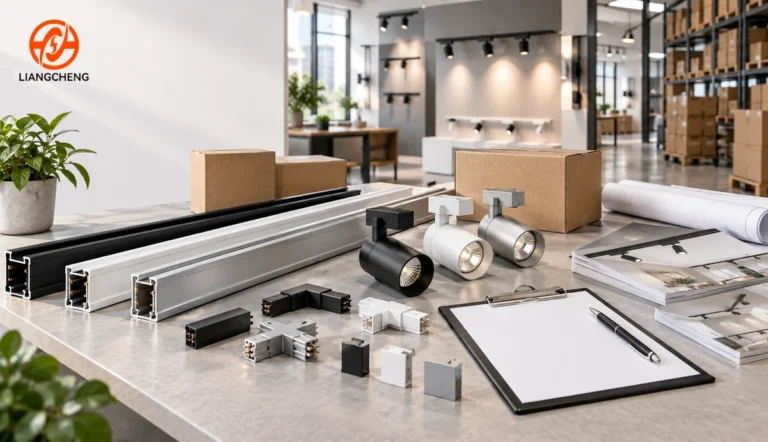
Packaging Requirements — We use sturdy cardboard boxes for packaging to ensure the product does not deform or wear. We have successfully exported to many countries.
10. Frequently Asked Questions
What is the best aluminum alloy for track lighting rail? 6063 aluminum alloy is the most widely used, thanks to its clean extrusion performance and smooth, finish-ready surface. 6061 is sometimes chosen where higher mechanical strength is the priority.
How long does aluminum track lighting rail last? A well-manufactured aluminum rail with proper surface treatment can last well over a decade in normal commercial use, since aluminum resists corrosion and doesn’t degrade under sustained thermal load the way lower-grade materials do.
Can aluminum track rails be customized? Yes — length, width, finish, color, and branding can typically all be customized for both project-specific orders and wholesale/private-label programs.
What size aluminum track lighting rail should I buy? It depends on project layout and transportation logistics. Standard lengths (1m, 1.5m, 2m,3m) suit most installations; custom lengths are available for projects with specific run requirements.
Are magnetic track rails better than traditional track rails? They’re not strictly “better” — they solve a different problem. Magnetic systems make fixture swaps faster and are well suited to spaces that reconfigure lighting often, while traditional connector-based rails remain a reliable, cost-effective choice for fixed layouts.
How do I find a reliable aluminum track lighting rail supplier in China? Evaluate manufacturing capability (in-house extrusion, CNC, and finishing), documented quality control processes, OEM/ODM flexibility, and export experience — including certifications and packaging standards — rather than price alone.
Conclusion: Choose the Right Aluminum Track Lighting Rail Supplier
Material quality, the right track type for the application, and a manufacturer capable of consistent, exportable quality are the three factors that separate a track lighting system that performs for years from one that needs replacing within twelve months. Whether you’re specifying rail for a single retail buildout or sourcing at wholesale volume for a distribution business, the questions in this guide — alloy, finish, load capacity, and manufacturer vetting — are the ones worth asking before you commit.
Looking for a professional aluminum track lighting rail manufacturer? Contact us for wholesale pricing, OEM solutions, and project support.
هل تحتاج إلى حلول إضاءة مسارات مخصصة؟
اتصل بـ Liangcheng Lighting لحلول قضبان الألومنيوم OEM/ODM ودعم الإضاءة الاحترافي.
ذو صلة