








Примерное время чтения: 13 минут
A 4-wire track rail should be purchased as a complete multi-circuit lighting system, not as an aluminum channel priced only by the meter. A reliable order defines the four conductor functions, protective-earth arrangement, rail cross-section, compatible circuit-selecting adapter, feeds, handed connectors, mounting method, electrical ratings, finish, sample criteria, packaging, and repeat-order controls. The safest buying decision is the system that produces the required lighting zones and can be verified before bulk production.
This 4-wire track rail ultimate buying guide is written for distributors, importers, lighting brands, contractors, and project buyers. The guide concentrates on decisions that affect quotation accuracy, compatibility, installation, quality, and long-term supply. Readers who only need a basic comparison of conductor labels can first review the 2-wire, 3-wire, and 4-wire track rail overview.
What does 4-wire track rail usually mean?
A 4-wire track rail commonly refers to a multi-circuit mains-voltage system with three selectable live conductors and one neutral conductor. A separate protective-earth path is normally provided through a dedicated contact or the conductive rail body, depending on the approved system design. A compatible fixture adapter selects one live conductor, which allows luminaires on the same physical rail to operate in as many as three independently controlled groups.
The 4-wire label is not a complete international specification because suppliers do not always count conductors in the same way. One catalog may count only current-carrying strips, while another may include the protective-earth contact in the wire total. A buyer should therefore request a conductor-function diagram that identifies every contact as L1, L2, L3, neutral, earth, data, or another defined function. The exact product drawing and electrical documentation must control the order, not an informal product name.
| Question | Minimum evidence | Why it matters |
|---|---|---|
| What do the four conductors do? | Terminal or conductor-function diagram | Prevents confusion between wire count, circuit count, and grounding |
| How is protective earth provided? | Cross-section drawing and continuity requirement | Confirms the intended safety path and adapter contact |
| How does a fixture choose a circuit? | Matching adapter drawing or approved sample | Confirms that zoning works mechanically and electrically |
| What supply arrangement is permitted? | Model datasheet and project electrical design | Determines protection, switching, loading, and commissioning |
When is a 4-wire multi-circuit system the right choice?
A 4-wire multi-circuit track is appropriate when one rail route must support several lighting groups that can be switched or dimmed separately. A fashion retailer can put window lighting on one group, feature displays on a second group, and general merchandise lighting on a third group. A gallery can separate artwork accent lighting, circulation lighting, and a reserve group for future exhibitions without installing three parallel rails.
A multi-circuit rail creates flexibility only when the project will use it. A small room with one fixed lighting scene may be better served by a simpler single-circuit system. A project that requires individual fixture addressing, complex scene recall, or building-wide data control may need a control-enabled track or another architecture rather than a standard four-conductor power rail. The buying decision should begin with the control task, not with the assumption that more conductors are automatically better.

How does 4-wire track rail differ from 2-wire, 3-wire, and control track?
Wire-count names should be treated as supplier shorthand rather than universal system standards. A two-conductor rail often supports a simple power path, while a conventional three-wire mains rail commonly adds protective earth to a single-circuit arrangement. A four-conductor rail commonly supports multiple selectable circuits, but the grounding path may be counted separately. A control track may add dedicated signal conductors, making its adapter and accessory family different from a standard 4-wire product.
| Common market label | Typical buyer task | Main verification |
|---|---|---|
| 2-wire rail | Simple lighting group or product-family-specific use | Voltage, conductor functions, adapter, and installation scope |
| 3-wire rail | Conventional earthed single-circuit mains track | Line, neutral, earth, profile, and fixture compatibility |
| 4-wire rail | Multiple selectable lighting groups on one rail | Live groups, neutral, earth path, selector, and handed parts |
| Control-enabled rail | Addressable fixtures or data-based scene control | Power conductors, data pair, protocol, driver, and control components |
The single-circuit versus multi-circuit track guide explains the control distinction in more detail. The present guide addresses the next stage: how to turn a chosen 4-wire system into a controlled B2B purchase.
What should buyers inspect inside a 4-wire rail?
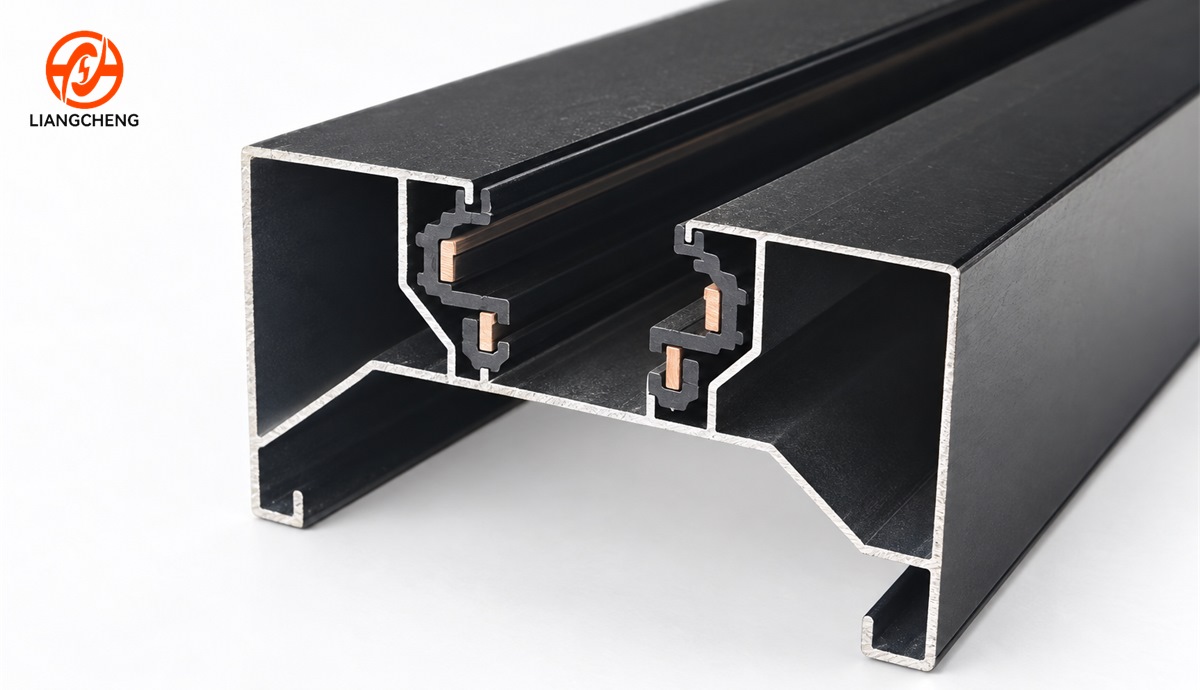
A cross-section inspection should confirm the number, position, separation, and retention of the copper conductors. Each conductor should remain correctly seated in its insulating carrier along the rail length. The insulation should not be cracked, distorted, loose, or contaminated with conductive debris. The earth-contact feature should be identifiable, and the rail should include a physical orientation method that prevents an adapter from being inserted incorrectly.
The aluminum extrusion determines straightness, rigidity, mounting fit, and connector alignment. A buyer should approve the external dimensions, wall sections that affect function, internal channel geometry, cut-end condition, and specified tolerances. The coating should be evaluated for color, gloss, coverage, adhesion, and resistance to normal packing and installation handling. A visually attractive finish cannot compensate for a rail profile that prevents reliable contact or connector engagement.
Why is adapter compatibility the highest-risk interface?
The adapter must fit the rail mechanically, connect to the intended conductor paths, engage the earth feature, retain the fixture load, and select the correct circuit. A similar outline or the same four-wire label does not prove that two systems are compatible. Small differences in contact height, key position, insertion angle, locking travel, or rail width can produce intermittent contact, incorrect circuit selection, weak retention, or installation damage.
A buyer should approve the rail and adapter as a controlled pair. The approval record should include drawings, part numbers, revision levels, insertion and removal checks, circuit-selection checks, continuity results, earth continuity where applicable, load-retention evidence, and repeated cycling. If components from different sources will be combined, the responsible technical party should provide written compatibility evidence for the exact models. The track light adapter compatibility checklist provides a dedicated approval method.
How should three lighting groups be planned?
A three-group plan should assign each luminaire to a functional zone before the bill of materials is finalized. The zone schedule should state which circuit serves each lighting task, how that circuit is switched or dimmed, how many fixtures are connected, and what future changes are expected. A clear schedule prevents installers from making circuit assignments by convenience rather than by the design intent.
| Zone field | Example question | Procurement consequence |
|---|---|---|
| Lighting task | Is the group for windows, displays, circulation, or ambient light? | Determines fixture type, beam, output, and quantity |
| Operating schedule | Must the group switch independently after business hours? | Determines circuit, controls, and commissioning tests |
| Change frequency | Will displays or exhibition layouts move regularly? | Determines spare capacity and adapter flexibility |
| Failure consequence | Would one group loss close a critical area? | Influences circuit distribution and maintenance planning |
The circuit selector on each compatible adapter should be accessible and clearly indexed. During commissioning, the team should set one group at a time, energize only that group, and verify every fixture assignment. A section installed in the opposite orientation can change the relationship between physical conductor position and circuit number, so orientation marks must remain consistent through straight joints, corners, T connections, and crosses.
How should electrical loading be evaluated?
Electrical capacity must be taken from the exact rail, adapter, connector, fixture, driver, supply, and protective-device documentation. A catalog current rating alone does not state how many LED fixtures can be installed. The project calculation must consider the permitted supply topology, conductor and neutral loading, continuous operating current, fixture input power, power factor, driver inrush current, switching equipment, dimming method, ambient conditions, and applicable installation requirements.
A practical buyer should request a circuit schedule with fixture quantity, rated input power, driver model, steady-state current, and inrush information for every group. Driver inrush can limit the number of fixtures on one switched circuit even when the steady-state wattage appears low. An electrical designer or qualified installer should select protective and control devices for the destination market; a track rail supplier should not replace that project-level responsibility with a generic maximum fixture count.
What belongs in a complete 4-wire system bill of materials?
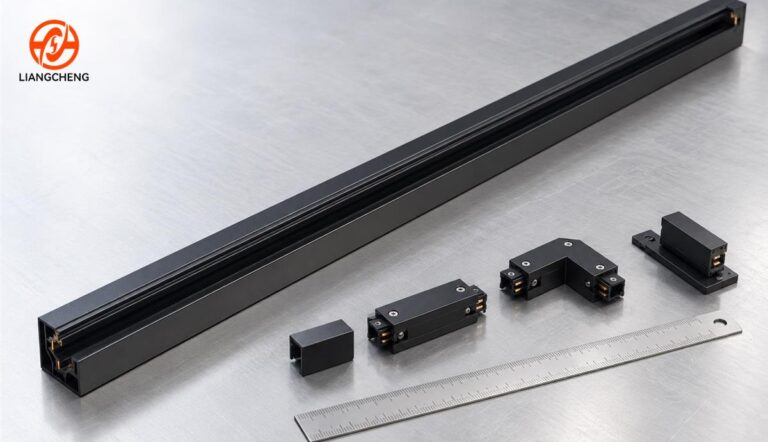
A complete bill of materials includes rail lengths, live-end or center feeds, straight couplers, electrically isolated couplers when required, L connectors, T connectors, cross connectors, flexible connectors, dead-end caps, mounting clips or suspension kits, compatible fixture adapters, track heads, and any control components. Recessed or trimless installation may also require a dedicated housing, flange, plaster-in profile, or ceiling support detail.
Directional connectors may be handed because the earth and conductor orientation must continue through every branch. A plan that lists one generic corner without left or right orientation can arrive on site with the wrong parts. The buyer should mark rail orientation and feed direction on the reflected ceiling plan, then assign a specific part number and quantity to each junction. The complete track rail accessories guide explains how to convert a layout into an accessory schedule.
Which mechanical specifications should be fixed before quotation?
The mechanical specification should state stock or cut length, external width and height, critical internal geometry, mounting interface, finish, conductor material, insulating material, section mass when relevant, straightness, twist, cut-end quality, and connector fit. Surface-mounted, suspended, recessed, and trimless installations require different dimensional evidence. Recessed products also need flange dimensions, cutout requirements, ceiling-void depth, and coordination with the ceiling system.
Nominal size is not enough for compatibility. Two profiles with similar catalog dimensions may place conductors or keying features differently. A dimensioned cross-section and an approved physical interface sample provide stronger evidence than a photograph. Buyers planning renovation work can use the руководство по размерам направляющих для трекового освещения to measure an existing system without relying on visual identification.
What information should a 4-wire track rail RFQ contain?
A purchase-ready RFQ should identify the application, destination market, project supply information, conductor-function diagram, earth method, circuit count, control method, rail profile, mounting type, lengths, finish, quantity by SKU, fixture and adapter interface, complete accessory schedule, samples, testing evidence, packaging, marking, delivery terms, and required documents. The RFQ should ask suppliers to list exceptions instead of silently substituting their standard configuration.
Commercial quotations should separate rail, accessories, adapters, fixtures, tooling, sample charges, testing, packaging, and freight-related dimensions. This separation makes offers comparable and exposes missing components. A low rail price can become an expensive system when essential feeds, connectors, adapters, or protective packing are excluded. The track rail RFQ checklist provides a reusable structure for collecting technical and commercial answers.
How should samples be approved before a bulk order?
Sample approval should move through four controlled gates: document review, interface sample, functional system sample, and pilot order. Document review confirms the drawing, conductor functions, part numbers, ratings, materials, finish, and revision. The interface sample confirms rail-to-adapter and rail-to-connector fit. The functional system sample confirms circuit selection, continuity, earth path where applicable, fixture retention, switching, dimming if specified, and accessory orientation.
A short cut sample can reveal the cross-section but cannot prove full-length straightness, finish uniformity, packing protection, or production repeatability. A pilot quantity should therefore include representative rail lengths, every important connector type, adapters, finished fixtures, normal labels, and production packaging. The approval record should state which sample is the master reference and what changes require reapproval. The track rail sample approval process explains the handoff from drawing to pilot run.
What should quality control verify during mass production?
Incoming control should identify the aluminum, copper conductor, insulating material, coating materials, and purchased accessories required by the approved specification. In-process checks should monitor profile dimensions, conductor seating, insulation condition, straightness, cutting, hole or slot position, coating appearance, and assembly. Final inspection should verify identified samples for dimensions, circuit continuity, short-circuit absence, earth continuity when applicable, adapter engagement, selector operation, connector fit, finish, marking, quantity, and packaging.
Inspection results should be linked to a batch or production order. A passed golden sample does not prove that every later production lot is identical. Repeat buyers should require notification before changes to extrusion dies, conductor dimensions, insulation materials, coatings, accessory tooling, subcontractors, or packing methods. Change control is especially important for distributors because one unannounced interface change can make existing inventory and customer fixtures unusable.

How should long 4-wire rails be packed and shipped?
Long aluminum rails need protection against bending, twist, abrasion, impact, moisture, and movement inside the carton. A practical pack uses individual sleeves or protective film, separators between coated surfaces, reinforced end protection, controlled bundle size, rigid cartons or suitable outer reinforcement, and restraints that prevent sliding. Accessories should be bagged and identified separately so metal parts cannot scratch the rail finish.
The packaging test should use the actual rail length and shipping route. A strong one-meter carton does not prove that a three-meter package will survive stacking, forklift handling, and container vibration. Buyers should approve pack quantity, gross weight, carton dimensions, support points, pallet or crate method, labels, and unloading limitations before shipment. The guide to packaging long track rails covers bending and scratch prevention in greater detail.
How should buyers compare 4-wire track rail prices?
A useful price comparison calculates the delivered cost of an installable and repeatable system. The calculation should include rail, feeds, connectors, end caps, adapters, mounting hardware, fixtures when included, samples, testing, packaging, inland transport, export charges, freight, duties, local delivery, expected damage, missing-part risk, and rework. Comparing only the rail price per meter rewards incomplete quotations.
Usable cost also includes inventory compatibility. A slightly lower-cost rail can create a larger loss if it requires a separate adapter family, lacks replacement connectors, or changes profile between orders. Distributors should compare the cost of supporting one documented ecosystem against the cost of stocking several visually similar but incompatible systems. The article on wholesale track rail pricing provides a broader landed-cost framework.
How should a distributor build a 4-wire product line?
A distributor should launch the smallest complete SKU matrix that can build real projects. The starting range normally needs the chosen rail lengths and finishes, one feed strategy, straight couplers, required handed corners and branches, end caps, mounting choices, compatible selectable-circuit adapters, and a focused fixture family. Every item should share one documented system interface and one naming convention.
The distributor should also create a compatibility chart, layout worksheet, part-number guide, installation boundary statement, and spare-parts policy. Sales teams need a simple rule: never promise compatibility from wire count alone. Warehouse teams need separate bin locations for look-alike connectors. Technical support needs approved drawings and reference samples so customer photographs can be compared against evidence rather than memory.
Which warning signs should stop a purchase?
- The supplier cannot provide a conductor-function diagram for the exact model.
- The quotation uses 4-wire, 3-circuit, and 3-phase as interchangeable terms without defining the supply arrangement.
- The rail and adapter are offered without an interface drawing, matching sample, or circuit-selection test.
- Directional connectors are listed without orientation, handed part numbers, or a layout review.
- Electrical capacity is expressed only as a maximum number of fixtures without driver and protection data.
- A short profile sample is treated as proof of full-length straightness and shipping protection.
- The supplier cannot identify revisions, production batches, or material changes.
- The packaging proposal does not state rail length, bundle quantity, support, or end protection.
What is the final 4-wire track rail buying checklist?
- Define the lighting zones and confirm that a multi-circuit rail is necessary.
- Obtain a diagram for all four conductor functions and the protective-earth path.
- Confirm the permitted voltage, supply topology, protection, switching, and control method with qualified project personnel.
- Approve the rail cross-section, dimensions, tolerances, finish, and mounting method.
- Approve the exact adapter for mechanical fit, contacts, earth, retention, and circuit selection.
- Convert the ceiling plan into a handed, part-numbered bill of materials.
- Compare quotations on the same technical scope and delivered system cost.
- Approve drawings, interface samples, functional samples, and a representative pilot.
- Define production inspection, batch traceability, packaging, and change-control requirements.
- Keep approved samples and documents for incoming inspection and repeat orders.
Frequently asked questions about 4-wire track rail
Is every 4-wire track rail a three-circuit system?
No. A 4-wire track rail commonly supports a three-circuit arrangement, but naming conventions vary. Buyers must confirm the function of every conductor and the earth path from the exact model drawing.
Can a 3-wire track light fit a 4-wire rail?
Compatibility should never be assumed. A 3-wire single-circuit adapter and a 4-wire multi-circuit rail usually have different geometry, contacts, and locking arrangements. Use only an approved adapter-and-rail combination.
Does a 4-wire rail provide individual control of every fixture?
A standard 4-wire multi-circuit rail normally assigns each compatible fixture to one of several shared circuit groups. Individual addressing generally requires additional control capability in the track, adapter, fixture, or wireless control architecture.
Can different fixture types share the same 4-wire rail?
Different spotlights, wallwashers, linear luminaires, or pendant adapters can share one rail when every product uses the approved interface and remains within the electrical and mechanical design limits. Similar appearance alone is not evidence of compatibility.
Can 4-wire rail be cut on site?
Some systems permit site cutting under defined instructions, while others require factory-prepared ends or conductor adjustment. The model installation instructions should define the permitted cut end, finishing method, insulation checks, and replacement end cap.
What should a buyer send for an accurate quotation?
An accurate quotation needs the destination market, application, ceiling layout, rail lengths, mounting type, finish, lighting zones, conductor and earth requirements, fixtures, adapter interface, accessories, quantities, sample plan, packaging, delivery terms, and required documents.
Source a complete 4-wire track rail system from Liangcheng Lighting
Liangcheng Lighting supports wholesale and customized track lighting rail requirements for B2B buyers. A useful inquiry should include your destination market, layout or estimated rail lengths, mounting method, finish, required lighting groups, fixture or adapter reference, accessory list, order quantity, and packaging expectations. These details allow the technical and commercial scope to be reviewed as one system.
Contact Liangcheng Lighting through lclights.com to discuss 4-wire track rail samples, compatible components, customized specifications, packaging, and bulk supply. Requesting a documented system before comparing unit prices is the most reliable way to protect installation compatibility and repeat-order value.
Нужны индивидуальные решения для трекового освещения?
Свяжитесь с Liangcheng Lighting для получения решений OEM/ODM по алюминиевым трековым системам и профессиональной светотехнической поддержке.
Относительный