






Read time: 15 minutes
Every year, international buyers lose money sourcing LED aluminum profiles from China — not because good manufacturers don’t exist, but because they chose the wrong one. A supplier who presents well on Alibaba but operates from a rented warehouse. A factory with impressive photos but recycled aluminum in the billets. A manufacturer with CE certificates that don’t cover the product configuration you ordered.
O best LED aluminum profile manufacturers in China offer something genuinely valuable: deep extrusion expertise, in-house surface treatment, engineering support for custom development, and the production discipline to deliver consistent quality at container volumes. The challenge is finding them and distinguishing them from the large number of trading companies, low-quality producers, and misrepresented suppliers competing for the same inquiry.
This guide gives you a systematic evaluation framework — the same questions, checks, and verification steps that experienced importers use to build reliable sourcing relationships. Work through these criteria before placing an order, and you’ll eliminate most of the risk that causes procurement problems.
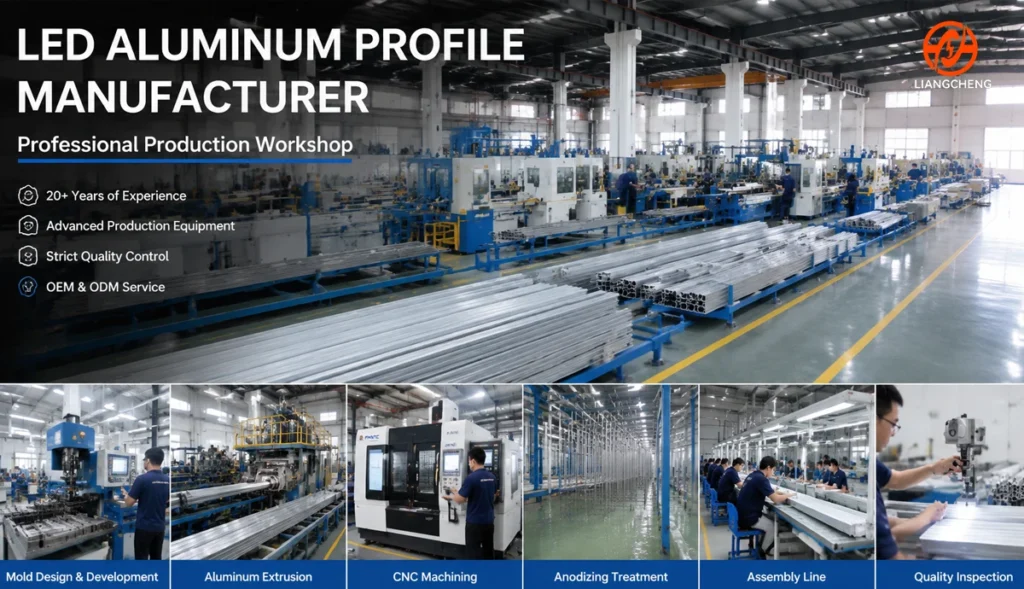
Why China Leads Global LED Aluminum Profile Manufacturing
China’s position as the dominant manufacturing source for LED aluminum profiles isn’t accidental — it reflects structural supply chain advantages that other regions cannot replicate at the same cost.
Integrated aluminum supply chain. The provinces of Guangdong, Jiangsu, and Shandong contain dense clusters of aluminum billet producers, die makers, extrusion factories, anodizing specialists, and accessory manufacturers within short distances of each other. This proximity reduces lead times and eliminates the supply chain gaps that affect manufacturers in regions where these inputs must be imported.
Extrusion technology maturity. China’s aluminum extrusion industry has operated at significant scale for over three decades. The technical knowledge required to produce precision LED profiles — tight dimensional tolerances, consistent alloy composition, controlled anodizing bath chemistry — has been built into the manufacturing base through years of production and export experience.
OEM and tooling infrastructure. Die manufacturing shops capable of producing custom aluminum extrusion tools are widely available across China’s manufacturing clusters. This makes custom profile development — new cross-sections, proprietary shapes, modified standard designs — accessible to international buyers at price points that would be unworkable in European or North American tooling environments.
Export-oriented operations. The most established Chinese LED profile manufacturers export to multiple countries simultaneously and have dealt with CE, RoHS, LVD, EMC, CB, and UL certification requirements as a matter of routine. Documentation handling, English communication, and export logistics are developed capabilities rather than exceptional accommodations.
Who Benefits Most from Direct Factory Sourcing
Buyers who gain the greatest advantage from sourcing directly from Chinese LED aluminum profile manufacturers fall into several categories. LED lighting brands building product lines need OEM customization and private label capability. Importers and electrical wholesalers serving distribution networks need consistent quality at container volumes. Lighting distributors need broad product range and reliable lead times. Construction contractors and interior design companies serving specification-grade projects need certified products with technical documentation. Smart lighting solution providers need technical support for integration between profile systems and control components.
What these buyers share is that they’re purchasing at sufficient volume and frequency that the quality, consistency, and certification of their profile supplier directly affects their business outcomes — not just the cost of a single order.
Define Your Product Requirements Before Contacting Any Supplier
The most common mistake international buyers make at the start of a sourcing process is reaching out to suppliers before defining exactly what they need. Vague inquiries produce vague responses. A well-specified inquiry produces comparable, accurate quotations and signals to the supplier that you are a serious buyer.
Choose the Right Profile Type for Your Application
LED aluminum profiles divide into five primary types, each engineered for a different installation context. Specifying the wrong type at the sourcing stage leads to products that don’t fit the application — a mistake that becomes expensive on commercial projects.
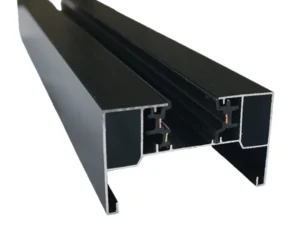
Surface mounted profiles attach directly to flat surfaces using clips or screws, requiring no substrate modification. They are the fastest to install and the most widely used type globally. The aluminum body protrudes from the surface by the full height of the cross-section, which is the primary visual limitation in design-conscious environments.
Recessed profiles are set into routed or pre-cut channels in the substrate — wood, drywall, plaster, or concrete — so the diffuser sits flush with the surrounding surface. They produce a seamless, hardware-invisible lighting effect and are the standard choice for architectural and high-end hospitality applications. Installation requires accurate substrate preparation and is most cost-effective when planned into new construction.
Suspended profiles hang from the ceiling via wire cable or rigid rod systems, positioning the luminaire in open space rather than attached to a surface. Most support bidirectional light emission — downward for task illumination, upward for indirect ambient light. Standard for commercial and office environments with sufficient ceiling height.
Corner profiles are designed with a 45° angled cross-section to fit into 90° junctions where two surfaces meet, directing light outward at 45° from the corner. Used for cabinet underlighting at corner positions, display case edges, cove junctions, and furniture lighting at panel intersections.
Architectural linear profiles are larger-format profiles designed for commercial specification projects requiring high lumen output and structural integration. They typically accommodate high-power LED strips above 15W/m and may include features such as anti-glare baffles, secondary optic mounting, or junction box connectivity.
Define Technical Specifications in Your Inquiry
A complete technical specification inquiry should include the following parameters:
- Profile cross-section dimensions — width and height in millimeters
- Aluminum alloy — specify 6063-T5 as the required grade
- Espessura da parede — minimum acceptable specification in mm
- Diffuser material — PC (polycarbonate, better impact resistance) or PMMA (acrylic, higher optical clarity)
- Diffuser opacity — clear, frosted (milky), or opal
- Acabamento da superfície — silver anodized, black anodized, white powder coat, or custom
- Comprimento — standard 1m, 2m, or 3m, or custom cut lengths
- Método de instalação — surface mount, recessed, suspended, corner
- LED strip compatibility — strip width (8mm, 10mm, 12mm) and maximum wattage per meter
- Certifications required — CE, RoHS, CB, UL, or others based on destination market
Providing this specification package in your initial inquiry eliminates back-and-forth clarification and lets you directly compare quotes from multiple suppliers on an apples-to-apples basis.
Verify That You Are Talking to a Real Manufacturer
The most consequential verification step in China sourcing is confirming that the entity you’re contacting is actually the manufacturer of the product — not a trading company representing someone else’s factory.
Factory vs. Trading Company: What the Difference Costs You
Trading companies serve a legitimate function in the Chinese export market — they aggregate products from multiple factories and provide a single-point commercial interface. But buying LED aluminum profiles through a trading company rather than a factory has concrete costs:
| Fator | Direct Factory | Trading Company |
|---|---|---|
| Unit pricing | Manufacturing cost + margin | Factory price + trading margin (typically +8–20%) |
| Technical support | Engineers who designed and made the product | Sales staff with indirect access to factory |
| Controle de qualidade | Direct production oversight | Dependent on factory; trading company may not be informed of issues |
| Customization | Full OEM capability with engineering team | Dependent on factory’s willingness; slower communication chain |
| Lead time | Controlled by factory schedule | Subject to factory availability and trading company ordering position |
| Certification documents | Issued for factory’s own products | May not apply to actual production source |
The price difference alone justifies the effort of confirming supplier type. For a container-load order, the 8–20% price differential that a trading company margin adds can represent thousands of dollars.
How to Verify Manufacturer Status
Request the supplier’s business license (营业执照). A manufacturing company’s registered scope will include 生产 (production/manufacturing). A trading company’s scope will typically show 销售 (sales) without manufacturing activities. You can also request the manufacturing permit (生产许可证) for aluminum products, which factories hold but trading companies do not.
Ask for photos and a video of the extrusion press lines — not the office or showroom. Extrusion presses are large, distinctive machines that cannot be faked in a photo. Ask specifically: how many press lines do you operate, what are their tonnage ratings, and where is the factory located? Inconsistency between these answers and the factory photos is a signal worth investigating.
Qualifying Questions for Your First Supplier Conversation
These questions, used in early supplier conversations, distinguish serious manufacturers from trading companies and undercapitalized factories:
- How many aluminum extrusion lines do you operate, and what press tonnages?
- What is your monthly production capacity for LED profiles in linear meters?
- How many years have you been exporting, and to which countries?
- Do you provide OEM/ODM customization with your own engineering team?
- Is your anodizing line in-house or outsourced?
- Can you provide material certificates showing alloy grade for each batch?
Manufacturers who answer these questions specifically, consistently, and without deflection are almost always genuine factories. Trading companies tend to deflect, generalize, or promise to check with their “partner factory.”
Evaluate Manufacturing Capabilities Systematically
Not all factories are equally capable. The difference between a factory that produces 5,000 tons per year and one that produces 100,000 tons is not just scale — it’s the level of process control, equipment investment, and quality management that the larger volume justifies.
The Complete Production Process for LED Aluminum Profiles
A professional LED aluminum profile manufacturer controls each of the following stages internally:
Extrusão de alumínio — heated aluminum billets (6063 alloy, typically 470–510°C) are pressed through a precision steel die under 1,000–4,000 tons of force, emerging as a continuous profile matching the die’s cross-section. Temperature consistency and die maintenance directly determine dimensional accuracy.
Cooling and stretching — extruded profiles are cooled under controlled conditions and stretched to relieve internal stress. Poor stretching produces warped profiles that won’t install flush.
Corte de precisão — profiles are cut to standard lengths (most commonly 2m or 3m) using automated saws. Cut-face quality — absence of burrs, perpendicular cuts — reflects overall production discipline.
Usinagem CNC — for custom profiles requiring notching, drilling, slot cutting, or other secondary operations.
Surface treatment: anodizing — the profile undergoes chemical pre-treatment, electrochemical anodizing in a sulfuric acid bath, and sealing. Anodizing thickness (10–25 microns standard; 25+ microns for outdoor) and color consistency across the bath are quality-critical parameters.
Surface treatment: powder coating — electrostatic application of thermosetting polymer powder, then curing at 180–200°C. Used for custom colors and outdoor-rated applications.
Assembly — insertion of LED strips (for assembled products), installation of diffuser covers, end caps, and mounting clips.
Inspeção de qualidade — dimensional verification, surface inspection, electrical testing for track rail systems.
Embalagem — protective film application, carton packing, and export labeling.
Equipment That Signals Manufacturing Seriousness
When evaluating a factory’s capability, specific equipment types indicate investment in quality and process control:
Automatic extrusion lines with PLC control — automated temperature and pressure management produces more consistent output than manually operated presses.
CNC processing centers — precision machining capability for complex profiles and accessories.
Automated anodizing lines — controlled bath chemistry, temperature, and timing produces consistent anodizing results across batches. Manual or semi-automated anodizing introduces more color variation.
Coordinate measuring machines (CMM) or optical profile projectors — dimensional verification equipment that confirms profiles meet drawing tolerances, not just visual inspection.
Spectrophotometers for color measurement — objective color consistency verification across batches, which matters for projects requiring multiple deliveries.
Assess Aluminum Material Quality
Material quality is the most important — and least visible — quality factor in LED aluminum profiles. A profile made from recycled or blended aluminum may look identical to a 6063-T5 profile but will underperform on heat dissipation, anodizing quality, and long-term durability.
Why 6063-T5 Is the Industry Standard
6063-T5 aluminum alloy is the specification used by serious LED profile manufacturers globally. Understanding why helps you evaluate supplier claims.
| Propriedade | 6063-T5 Valor | Why It Matters for LED Profiles |
|---|---|---|
| Condutividade térmica | ~200 W/m·K | Effective heat transfer from LED strip reduces junction temperature and extends LED lifespan |
| Resistência à tração | 145–195 MPa | Structural integrity for profiles under load or spanning distances |
| Elongation | 8% | Ductility allows extrusion of complex cross-sections without cracking |
| Qualidade de anodização | Excelente | Consistent surface oxide layer, uniform color, strong adhesion |
| Desempenho da extrusão | Excelente | Enables tight dimensional tolerances on complex cross-sections |
| Resistência à corrosão | Bom | Adequate for indoor applications; enhanced by anodizing for outdoor |
The T5 temper designation indicates artificial aging after extrusion — this improves mechanical properties without requiring solution heat treatment, making it the practical choice for LED profile production. 6061-T6, while stronger, is harder to extrude into complex shapes and anodizes less uniformly, making it less suitable for most LED profile applications.
Material Inspection Checklist
Request or verify the following material documentation from any serious supplier:
- Alloy composition certificate — documents actual chemical composition of the batch, confirming it falls within 6063 specification limits
- Mechanical properties report — confirms tensile strength, yield strength, and elongation meet T5 temper requirements
- Wall thickness specification — minimum wall thickness for each profile model, stated in the product spec sheet (not “standard thickness”)
- Hardness test — Vickers hardness for the T5 temper should be in the range of 58–78 HV
- Surface flatness tolerance — straightness over length, critical for clean installation on flat surfaces
A supplier who cannot provide alloy documentation for their material is either using non-traceable material or does not understand their own production process. Neither is acceptable for a long-term supply relationship.
Evaluate Surface Finishing Quality
Surface treatment quality determines both the appearance and the service life of LED aluminum profiles. It is also one of the areas where cost-cutting produces the most visible defects.
Common Surface Treatments and When to Specify Each
Silver anodized (natural anodized) — the standard finish for most indoor commercial and residential applications. The electrochemical surface treatment produces a characteristic matte aluminum appearance with excellent scratch and corrosion resistance. Anodizing thickness of 10–15 microns is standard for interior applications.
Matte black anodized — the second most specified finish, particularly for commercial, hospitality, and retail applications where the profile serves a design function as well as an optical one. Achieving consistent black anodizing color across batches requires careful bath chemistry control — color variation between batches is a common quality failure.
White powder coating — the standard choice for residential applications where profiles will be visible against white or light-colored surfaces. Powder coating provides excellent durability and the ability to match specific white tones (warm white, cool white, RAL 9010, RAL 9016).
Cores personalizadas — powder coating in any RAL color, or custom anodize colors with minimum order quantities. Custom colors require setup charges and minimum batch sizes — confirm these requirements with suppliers before specifying.
Surface Defects That Indicate Quality Problems
When evaluating samples, these surface defects indicate manufacturing or process control problems that will recur in production:
Uneven anodizing color — visible variation in shade along the length of a profile, or between profiles in the same batch. Caused by inconsistent bath temperature, contaminated anodizing solution, or inadequate pre-treatment cleaning. This defect is particularly visible when multiple profiles are installed side by side.
Scratches and handling damage — surface marks introduced during production handling or packaging. A factory that doesn’t apply protective film during production or that handles profiles carelessly will deliver damaged goods.
Oxidation marks or water stains — white or dark marks from water contact before anodizing is sealed, or from condensation during storage. Sign of inadequate sealing or improper post-treatment procedures.
Surface bubbles or pitting — caused by hydrogen gas inclusion during anodizing, typically from contaminated material or incorrect bath chemistry.
Color inconsistency between batches — critical for projects requiring multiple deliveries. Confirm whether suppliers can provide color standard samples with each batch and what their color tolerance specification is.
Burrs on cut faces — rough or sharp edges on profile ends from cutting operations. Indicates low-quality cutting equipment or poor blade maintenance.
Review the Quality Management System
A manufacturer’s quality management system determines whether the quality you see in samples is what you receive in production. Professional manufacturers manage quality as a system, not as a final inspection step.
Three-Stage Quality Control Architecture
Inspeção de materiais recebidos controls what enters production. Every aluminum billet batch should be checked for alloy composition (via spectrometer or certificate verification), dimensional conformity, and surface condition before entering the extrusion process. Factories that accept any material without verification cannot guarantee consistent product quality.
In-process quality control catches problems during production rather than after. Dimensional checks during extrusion (profile width, height, wall thickness), surface inspection after treatment (color uniformity, absence of defects), and accessory fit verification before assembly are the key in-process control points. Automated inspection equipment reduces reliance on individual inspector judgment.
Final product inspection before packaging verifies the complete product against specification: dimensions, straightness, surface finish, accessory fit, and packaging integrity. For track rail systems with electrical conductors, conductor continuity and insulation resistance testing should be included.
What to Verify in the QC System
Ask potential suppliers to describe their quality management process — not just show you certificates. Specific questions that reveal the actual system:
- What is your incoming material inspection procedure for aluminum billets?
- How often do you check dimensional tolerances during extrusion production?
- What is your anodizing color measurement process, and what is the tolerance?
- What percentage of finished products are inspected before shipment?
- How do you document QC results, and can you provide batch inspection reports?
Factories that can answer these questions with specific procedures are operating quality management as a system. Factories that give vague answers about “experienced workers checking quality” are relying on informal individual judgment that produces inconsistent results.
Verify Certifications and Compliance
Certifications are not optional for most international markets — they are the legal prerequisite for selling LED products and are increasingly scrutinized at customs. Getting this wrong doesn’t just create inconvenience; it can result in shipments being seized or products being recalled.
Required Certifications by Market
| Certification | Scope | Required For |
|---|---|---|
| CE + LVD | EU Low Voltage Directive — electrical safety | All LED products sold in EU (mandatory) |
| CE + EMC | EU electromagnetic compatibility | All LED products sold in EU (mandatory) |
| RoHS | Restriction of hazardous substances | EU, UK, many global markets |
| REACH | Chemical substance compliance | EU, EEA |
| CB | IECEE international safety certification | Accepted in 50+ countries via mutual recognition |
| ISO 9001 | Quality management system | Buyer confidence; required by some purchasers |
| TÜV GS | German safety mark via technical inspection | EU premium market positioning |
| UL/cUL | US/Canada electrical safety | North American market |
How to Verify Certifications Are Valid
Certificate verification requires more than looking at a logo. Three verification steps are essential:
Check the product scope — a CE certificate that covers one product model does not automatically cover a different configuration of the same product family. Ask the supplier to confirm that the certificate covers the specific product model, amperage rating, and circuit configuration you are ordering.
Check the issue and expiry dates — certificates are valid for defined periods. An expired certificate provides no legal protection and indicates that the supplier has not maintained their compliance program.
Cross-reference the certificate number — CE notified body certificates have reference numbers that can be verified through the EU NANDO database. RoHS compliance is self-declared, but should be supported by test reports from accredited laboratories. Request the underlying test reports, not just the declaration of conformity.
Evaluate OEM and Custom Manufacturing Capabilities
For lighting brands and distributors building differentiated product lines, OEM capability is not a secondary feature — it is the core of the value proposition. The depth of a manufacturer’s OEM capability determines how much product differentiation you can achieve.
Available Customization Options
Seção transversal do perfil personalizado — new extrusion die development for a proprietary profile shape. This is the highest level of OEM: no other buyer can replicate your profile without their own die. Once developed, the die is typically owned by the buyer (confirm this in the tooling agreement).
Comprimento personalizado — profiles cut to specification rather than standard lengths. Useful for retail programs with defined display systems or projects where standard lengths create material waste.
Custom surface finish — custom anodize colors (requiring minimum batch quantities for bath setup) or custom RAL powder coat colors.
Logo engraving or printing — brand marks on the profile body, end caps, or accessory packaging. Important for brands building identity at the product level.
Embalagem personalizada — branded retail cartons, custom carton markings, private label documentation. Critical for brands distributing through channels where the packaging is part of the brand experience.
Complete system customization — for track rail systems, custom current rating, custom circuit configurations, and custom accessory design.
Mold Development: What to Clarify Before Committing
Custom profile die development involves decisions that affect your long-term supply flexibility:
Die ownership — confirm in writing whether the die you pay for is yours or the factory’s. In a standard OEM arrangement, the buyer pays for die development and owns the die. This means you can move production to a different factory and take the die with you. Some factories retain die ownership regardless of who paid — clarify this before any deposit is paid.
Die development lead time — typically 7–15 days for a standard complexity LED profile die. Complex profiles with multiple interlocking parts may take 20–30 days. First samples from the new die typically follow within 3–5 days of die completion.
Engineering support — professional OEM manufacturers provide design feedback before die cutting. An experienced tooling engineer can advise on dimensional adjustments that improve extrudability, surface quality, or LED strip compatibility before the die is made. This is more valuable than it sounds: design changes after the die is made require die modification (cost: RMB 500–2,000) or new die cutting (full cost again).
Tooling cost range — standard LED profile dies: RMB 3,000–8,000. Complex architectural or multi-part profiles: RMB 8,000–20,000. Unusually low tooling quotes often indicate thin-wall dies that wear quickly and produce dimensional drift after a few production runs.
Compare Pricing Beyond Unit Cost
The factory unit price is one component of a complex cost structure. Buyers who optimize only for unit price routinely find that their total landed cost is significantly higher than expected — and sometimes higher than a supplier with a slightly higher unit price would have produced.
Factors That Determine the Unit Price
Understanding what drives the price helps you evaluate whether a quote is realistic or suspiciously low:
custo do material de alumínio — aluminum commodity prices fluctuate with LME (London Metal Exchange) pricing. A responsible factory quotes based on current aluminum price and may include a price adjustment clause for large orders. Quotes significantly below the aluminum spot price plus processing cost are a signal that material quality is being compromised.
Espessura da parede — thicker walls use more aluminum. A price significantly lower than comparable products may reflect thinner walls than specified. Always measure wall thickness on samples before bulk order.
Tratamento de superfície — anodizing and powder coating add cost. In-house treatment is more cost-effective and quality-controlled than outsourced; both cost more than mill finish. Custom colors add setup charges.
Acessórios incluídos — profiles priced as complete kits (profile body + diffuser + end caps + mounting clips) should cost more than profiles priced alone. Confirm what is included in the unit price before comparing quotes.
Quantidade do pedido — volume price breaks are significant. The price difference between 200 meters, 1,000 meters, and container-load quantities (typically 5,000–10,000+ meters depending on profile weight) is substantial. Always request pricing at multiple quantity tiers.
Calculating Total Landed Cost
The true cost of sourcing from China includes every element from factory gate to your warehouse:
| Cost Component | Notes |
|---|---|
| Ex-Works price | Factory gate price per linear meter or per piece |
| Tooling cost | One-time charge; amortize across projected order volume |
| Domestic trucking (China) | Factory to port, typically $100–300 USD per FCL |
| Sea freight (FCL) | Varies by origin port and destination; $1,200–3,500+ USD per 20′ container |
| Destination port charges | THC, documentation fees, varies by port |
| Customs duties / tariffs | Confirm applicable HS code and duty rate for your market |
| VAT at import | Varies by country; may be recoverable |
| Third-party inspection | $250–450 USD per pre-shipment inspection |
| Local trucking (destination) | Port to warehouse |
For aluminum track rail profiles, the most common HS codes are 7610.10 (aluminum structures and parts of structures) or 8547.90 (electrical conduit and fittings) — the correct code affects duty rates and should be confirmed with your customs broker before importing.
Assess Export Experience and After-Sales Support
A manufacturer’s export track record and post-sale support capabilities are as important to a long-term supply relationship as product quality — because problems will occur, and how they are handled determines whether the relationship is sustainable.
Signs of an Experienced Export Manufacturer
Multi-country export portfolio — factories exporting to Europe, North America, Australia, and the Middle East simultaneously have dealt with the regulatory, logistics, and documentation requirements of multiple markets. This experience converts into practical help for buyers navigating certification or customs requirements.
English-speaking technical sales team — the quality of export communication directly affects problem resolution speed. A team that can discuss specifications, resolve quality claims, and provide technical documentation in English reduces friction throughout the supply relationship.
Organized technical documentation — product datasheets, installation guides, test reports, and compliance documentation that are organized, current, and readily available indicate an operation that takes quality and compliance seriously.
Consistent production scheduling — experienced export manufacturers maintain production planning systems that can give you reliable lead time commitments and fulfillment of those commitments. Ask for the last three orders’ on-time delivery rate.
After-Sales Questions to Ask Before the First Order
- What is your warranty policy for LED aluminum profiles?
- What is your process for handling a quality claim after shipment?
- How do you handle replacement supply for confirmed defective batches?
- Can you provide engineering technical support if we have application-specific questions?
- Do you maintain minimum stock of standard profiles for emergency replenishment?
A factory that answers these questions with specific policies — not vague assurances — has built systems for managing post-sale issues. Factories that deflect these questions or give inconsistent answers will become difficult to work with when a real problem arises.
Conduct Factory Verification: Audit or Remote Assessment
Visiting a factory before placing a significant order is the gold standard for supplier verification. When physical visits aren’t practical, structured remote assessment methods can provide adequate verification for initial orders.
What to Evaluate During a Physical Factory Audit
Production scale and equipment — the number, size, and condition of extrusion presses and surface treatment lines. This confirms production capacity claims and reveals whether the equipment can actually support your order volumes.
Factory cleanliness and organization — a well-managed factory has organized material storage, labeled product areas, visible quality checkpoints, and clean production floors. Disorder in production typically corresponds to disorder in quality management.
Warehouse management — proper finished goods storage with protection from dust, moisture, and physical damage. Profiles stored without protective film or stacked carelessly indicate poor handling practices that will carry into shipment.
Quality control stations — visible inspection equipment, documented procedures on the production floor, and QC staff who can explain their inspection process indicate a functioning quality management operation.
Staff experience — production staff who can answer basic questions about the process, and technical staff who understand the product specifications, indicate a factory investing in workforce competence.
Remote Assessment Options When You Cannot Visit China
Live video factory tour — a structured video call where a factory representative walks you through production areas in real time. Request to see specific equipment: the extrusion press, the anodizing line, the QC inspection area. Pre-specify what you want to see rather than accepting a staged showroom tour.
Third-party factory audit — firms including SGS, Bureau Veritas, Intertek, and TÜV operate pre-audit services in China’s major manufacturing regions. A structured third-party audit provides independent verification of factory capability, quality systems, and stated production capacity. Cost: typically $400–800 USD.
Sample evaluation program — order a structured sample set covering multiple profile types, multiple surface finishes, and accessories before any bulk order. Evaluate samples against a written specification checklist: dimensions, wall thickness, surface quality, diffuser fit, color accuracy. Samples that pass a rigorous evaluation give reasonable confidence in production quality.
Production update documentation — professional factories can provide production photographs at key milestones (material arrival, extrusion in progress, surface treatment, final inspection) at no additional cost. This is a standard service that demonstrates production transparency.
Common Mistakes That Cause Sourcing Problems
These are the errors that experienced importers of LED aluminum profiles make once, and then systematically avoid. Learning them before your first order saves money and time.
Choosing by Price Alone
A profile priced 25% below market comparables is almost never the result of exceptional efficiency — it is almost always the result of compromised material specification, thinner walls than stated, or substandard surface treatment. The visible cost is the price difference; the hidden cost is quality failures in the field, replacement costs, and relationship damage with end customers.
Ignoring Production Capacity
A factory with two extrusion press lines cannot reliably fulfill a 10,000 meters per month order alongside its other customers. Accepting a manufacturer whose capacity is marginal relative to your volume requirements creates scheduling pressure that produces late deliveries, quality shortcuts, and supply disruptions during peak demand periods.
Skipping Sample Testing
Every factory can produce a sample that looks good. The question is whether production maintains the same standard. Test samples against your written specification checklist before approving bulk production, and retain approved samples for comparison against production deliveries. Factories that produce good samples and poor production exist — retained samples give you objective evidence when there’s a dispute.
Overlooking Certification Specifics
Accepting a certificate without verifying its scope, product coverage, and validity date is not certification compliance — it is certification theater. CE certification for one product configuration does not extend to different configurations of the same product family. Take the extra step to verify that the certificate actually covers what you are ordering.
Not Verifying Export Track Record
A factory’s first export order to your market is a learning experience for them. If your order is their first shipment to Europe, or their first time preparing CE documentation for electrical products, or their first use of a freight forwarder you don’t control, the risk is higher. Established export experience to your target market, or to similar regulatory environments, reduces this risk substantially.
Why Long-Term Partnerships Outperform Transactional Sourcing
Buyers who switch LED aluminum profile suppliers frequently in search of marginally lower prices consistently achieve worse outcomes than buyers who invest in building long-term manufacturing partnerships. The economics and operational benefits of supplier continuity are significant.
Measurable Benefits of Working with One Reliable Manufacturer
Stable quality — a manufacturing partner who knows your specifications, your quality standards, and your end market requirements maintains product consistency without repeated re-specification. Quality deviations are caught and resolved quickly because the context is shared.
Priority production scheduling — long-term buyers receive preferred treatment in production scheduling, particularly during high-demand periods when capacity is constrained. A factory that depends on your continued business will protect your lead time before filling orders from new or occasional buyers.
Progressive pricing improvement — suppliers extend better pricing to buyers who provide predictable volume, reliable payments, and long-term commitment. The pricing available to a buyer on their tenth container order from the same factory is consistently better than the pricing available to a new buyer for the same product.
Continuous product development access — an established supplier relationship provides access to new product development as the manufacturer introduces new profile designs, surface finishes, or accessory options. Long-term partners are often included in product development discussions rather than simply offered finished products.
Characteristics of an Ideal Manufacturing Partner
The manufacturing partners who provide the most sustainable long-term value share several characteristics: transparent communication about production status and quality issues; consistent quality delivery across batches and over time; flexible OEM capability without requiring excessively high minimum orders for customizations; competitive pricing with clear, documented pricing structures; and engineering support that helps you solve specification problems rather than simply taking orders.
Finding a manufacturer who exhibits all of these characteristics requires the evaluation process described in this guide. The investment of time upfront — verifying factory credentials, testing samples, checking certifications, assessing OEM capability — pays back over years of reliable supply.
Perguntas frequentes
What is the best aluminum alloy for LED profiles, and why? 6063-T5 aluminum is the industry standard for LED profile manufacturing and the specification you should require. It combines excellent extrudability (enabling tight dimensional tolerances on complex cross-sections), thermal conductivity of approximately 200 W/m·K (effective heat transfer from LED strips), outstanding anodizing performance (consistent, durable surface finish), and adequate mechanical strength for structural profiles. 6061-T6 is stronger but harder to extrude and anodizes less uniformly, making it less suitable for most LED profile applications. Any supplier who cannot specify the alloy grade of their material should be disqualified.
What certifications should an LED aluminum profile manufacturer hold? The required certifications depend on your target market. For European markets, CE marking incorporating LVD (Low Voltage Directive) and EMC compliance is legally mandatory for electrical products, alongside RoHS and REACH compliance. For North American markets, UL or cUL certification is required. The CB certificate is accepted in over 50 countries through the IECEE mutual recognition scheme and provides the broadest international coverage. ISO 9001 is a quality management system certification that signals organized production processes; it is required by some purchasers and provides additional confidence for others.
Can I develop a custom LED aluminum profile with a Chinese manufacturer? Yes — custom profile development is standard practice among established Chinese LED profile manufacturers. The process involves specifying the desired cross-section dimensions and performance requirements, the manufacturer producing a tooling proposal and die design, die fabrication (typically 7–15 days), first sample production and review, and then mass production after sample approval. Confirm die ownership in writing before authorizing tooling costs. Standard complexity LED profile dies cost RMB 3,000–8,000; complex architectural profiles may cost more.
What is the typical minimum order quantity for LED aluminum profiles from China? For standard catalog profiles: 200–500 linear meters per SKU is the common minimum for established export manufacturers. For custom profile development: typically 500–1,000 meters minimum to justify die development costs. For complete track lighting systems: MOQs may be higher due to component assembly complexity. These thresholds vary between manufacturers — confirm MOQs specific to your product type and customization level in your initial inquiry.
What is the typical production lead time? For standard catalog profiles without customization: 10–20 days from order confirmation, depending on surface finish and production scheduling. For orders requiring custom colors or special surface treatments: add 5–7 days for treatment setup. For custom profile development (new die): die fabrication 7–15 days, first sample review 3–5 days, production after approval 15–20 days. Total for first custom production: approximately 30–45 days from tooling authorization to shipment.
Is it better to buy directly from a factory rather than a trading company? For most international buyers sourcing LED aluminum profiles at volume, direct factory purchasing is consistently better on pricing (8–20% lower without trading margin), quality control (direct access to production issues), technical support (engineers rather than intermediary sales staff), OEM capability (direct engineering engagement), and certification clarity (certificates issued for the actual manufacturing entity). Trading companies can be appropriate for small initial orders where the buyer needs sourcing support, but for ongoing supply relationships and OEM programs, direct factory partnerships produce better outcomes.
Conclusion: Build a Supply Chain, Not Just a Transaction
Choosing the best LED aluminum profile manufacturer in China is not a single decision — it is the result of a systematic evaluation process that covers manufacturing capability, material standards, quality management, certifications, OEM services, export experience, and the economics of the complete landed cost.
The evaluation criteria in this guide reflect what distinguishes manufacturers who deliver consistent quality over time from suppliers who perform well on initial samples and then disappoint in production. Working through these criteria before placing an order requires more effort than sending an inquiry to the cheapest option — and it consistently produces better outcomes.
The goal is not the lowest unit price on one order. It is a reliable supply relationship that delivers consistent quality, predictable lead times, and the product development capability to grow as your business grows. That goal requires a manufacturing partner with the systems, experience, and technical capability to support it — and this guide gives you the framework to find one.
Contatar Liangcheng Lighting with your project specifications, circuit requirements, or OEM inquiry to receive a complete solution proposal.
Precisa de Soluções Personalizadas de Iluminação de Trilhos?
Entre em contato com a Liangcheng Lighting para soluções de trilhos de alumínio OEM/ODM e suporte profissional de iluminação.