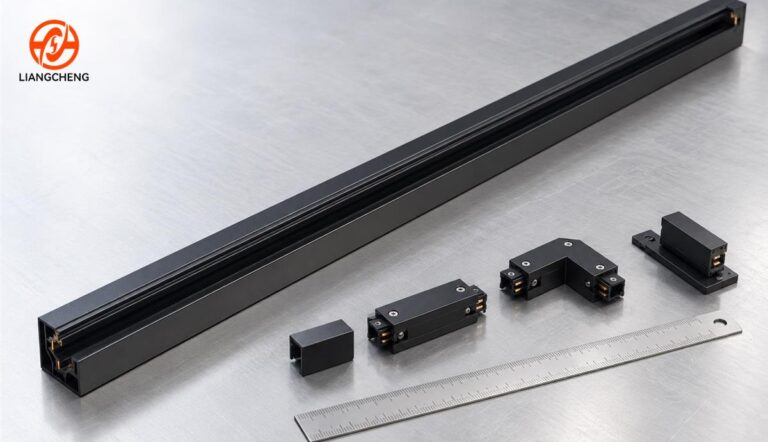









Quick answer: a curved track rail is a lighting track profile that is bent into an arc, a full circle or an S-shape so that track lights can follow round ceilings, curved walls, circular displays and atriums. For mains-voltage aluminum rails, curves are normally produced in the factory on profile-specific bending tools, because bending on site easily distorts the profile, cracks the conductor insulation and changes the slot width that adapters rely on. The achievable minimum radius depends on the rail profile, bending direction, alloy temper, conductor layout and finish, and slim single-circuit profiles can usually be bent tighter than deep multi-circuit profiles. Adapters stay compatible on a curve only when the radius is large enough for the straight adapter body to sit in the curved slot without binding, so the radius must always be checked against the adapters and fixtures that will be used.
How this guide is different: most information about curved track focuses on low-voltage cable or flexible monorail systems that are bent by hand. This guide covers rigid aluminum track rails, the kind used for 2-wire, 3-wire, 4-wire and 6-wire track lighting, and explains radii, bending limits, adapter fit, wiring, specifications, applications and procurement. For general rail layouts, see the track lighting rail accessories system guide.
What is a curved track rail?
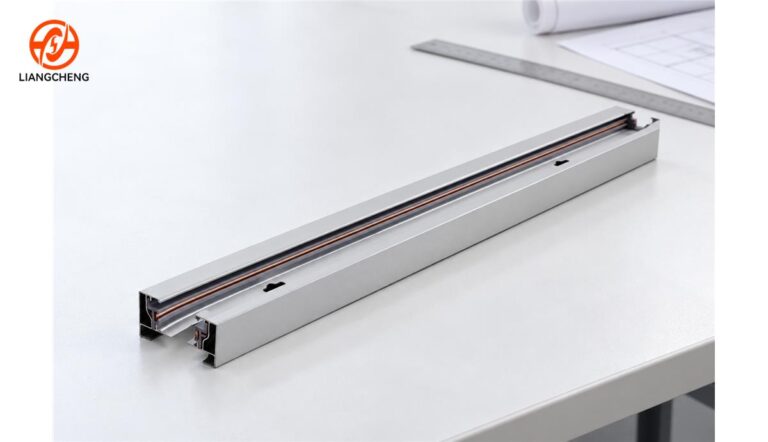
A curved track rail is a standard track lighting profile, including its copper conductors and insulating inserts, that has been bent to a defined radius while keeping the electrical channel and the adapter slot intact. Once installed, it behaves like a straight rail: adapters click in, select a circuit and draw power along the curve. The difference is geometric, because the rail now follows an arc instead of a straight line.
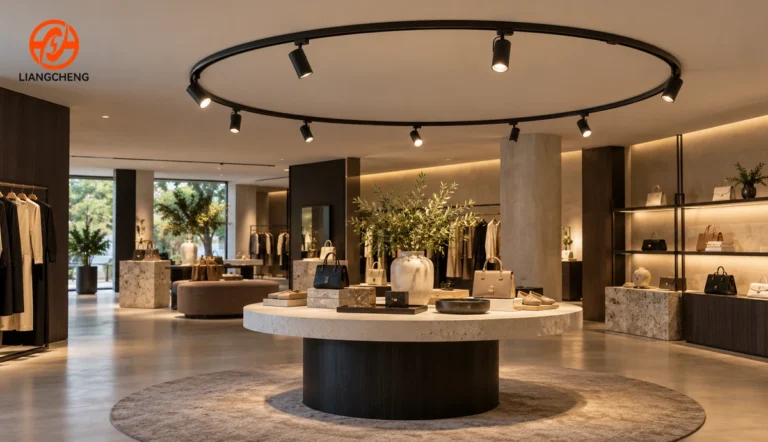
Curved rails are used when straight runs joined by corner connectors would look angular or would not follow the architecture. A circular ceiling coffer, a round display table, a curved shop front or an elliptical reception desk all read more naturally when the lighting track follows the same line. Curved rails are part of the same product family as straight rails, so feeds, joiners, end caps and adapters can usually be shared across straight and curved sections of a project.
What types of curved track systems exist?
Curved track systems fall into four main types, and each type suits different radii, voltages and project needs. Factory-bent rigid rails give the cleanest appearance and accurate radii. Field-bendable rails can be shaped on site but are mostly low-voltage designs. Segmented layouts approximate a curve with short straight rails and angle connectors. Flexible connectors join straight rails at adjustable angles without bending the profile itself.
| System type | How the curve is made | Uso típico | Main limitation |
|---|---|---|---|
| Factory-bent rigid rail | Profile bent on tooling before delivery | Mains-voltage 2-, 3-, 4- and 6-wire rails | Radius must be fixed before ordering |
| Field-bendable rail | Bent by hand or with a simple tool on site | Low-voltage monorail and cable systems | Lower load and voltage; less precise |
| Segmented polygon | Short straight rails joined at small angles | Large radii, budget projects | Faceted look instead of a smooth arc |
| Flexible connector | Adjustable hinge joiner between straight rails | Angles that are not 90 degrees | Creates a corner, not a curve |
For commercial mains-voltage track lighting, factory-bent rigid rails are the most common solution when a true curve is required, while segmented layouts with flexible connectors are a practical alternative for very large radii or when the exact geometry is uncertain.
How is the radius of a curved track rail defined?
The radius of a curved track rail should be defined on a drawing with a clear reference line, because a rail has an inner edge, a centerline and an outer edge that each have a different radius. Most manufacturers specify the centerline radius, but architects often dimension the inner or outer edge, and on a rail that is around 35 mm wide the difference can be enough to make a ring fail to close or to leave a visible gap at a wall. The drawing should state which edge or line the radius refers to.
The bending direction also has to be stated. A rail can be curved in plan, so that it follows a round shape on a flat ceiling, or curved in elevation, so that it follows a barrel-vault ceiling or a curved wall surface. These are different bends with different limits, and a rail that bends easily in one direction may not bend at all in the other. The specification should also give the arc angle or arc length, the chord length, and whether the adapter slot faces the inside or the outside of the curve when the rail is curved in elevation.
Arc geometry can be checked with two simple formulas. Arc length equals radius multiplied by the angle in radians, and chord length equals two times the radius multiplied by the sine of half the angle. For example, a quarter circle with a 1,000 mm centerline radius has an arc length of about 1,571 mm and a chord of about 1,414 mm.
What limits how tightly a track rail can be bent?
How tightly a track rail can be bent is limited by the profile geometry, the material, the internal electrical components and the surface finish. A deeper profile is stiffer in the bending direction and needs a larger radius. Thin walls can buckle or ripple on the inside of the bend. The aluminum temper affects ductility: a harder temper resists bending and may crack, while a softer temper bends more easily but is less rigid. The relationship between tempers is explained in T5 vs T6 aluminum temper for track lighting rails.
The electrical parts often set the real limit. Copper conductors on the outside of the bend are stretched and those on the inside are compressed, insulating carriers made of plastic can crack or creep out of position, and the slot that holds the adapter can narrow or widen. Finishes also matter: powder coating usually tolerates bending better than a thick anodized layer, which can craze on the outer surface. A bending limit is therefore not one number for all rails, but a property of a specific profile, conductor system and finish.
| Fator | Effect on minimum radius |
|---|---|
| Profile depth in bending direction | Deeper profile needs larger radius |
| Number of conductors | More conductors and wider carriers usually need larger radius |
| Espessura da parede | Very thin walls can ripple; very thick walls need more force |
| Alloy temper | Harder tempers resist bending and may crack |
| Terminar | Anodized surfaces can craze; powder coat is usually more tolerant |
| Bending direction | Bending against the deeper axis requires a larger radius |
What radii are common for curved track rails?
Common radii for factory-bent track rails depend on the profile, but several practical ranges appear repeatedly in projects. Slim single-circuit 2-wire and 3-wire profiles bent in plan are often produced from around 500 mm radius upward, while deeper 4-wire three-circuit and 6-wire profiles typically need larger radii, often from around 800 mm to 1,000 mm or more. Curves in elevation generally need larger radii than curves in plan for the same profile. Very large radii of several meters are straightforward and are common in atriums and curved shop fronts.
These figures are planning guidance, not guaranteed limits, because each profile and conductor system behaves differently. The binding value is the minimum radius confirmed by the manufacturer for the exact profile, finish and bending direction, ideally proven by a bent sample. When a design needs a radius close to the limit, a sample curve should be made and tested before the layout is finalized.
How are curved track rails manufactured?
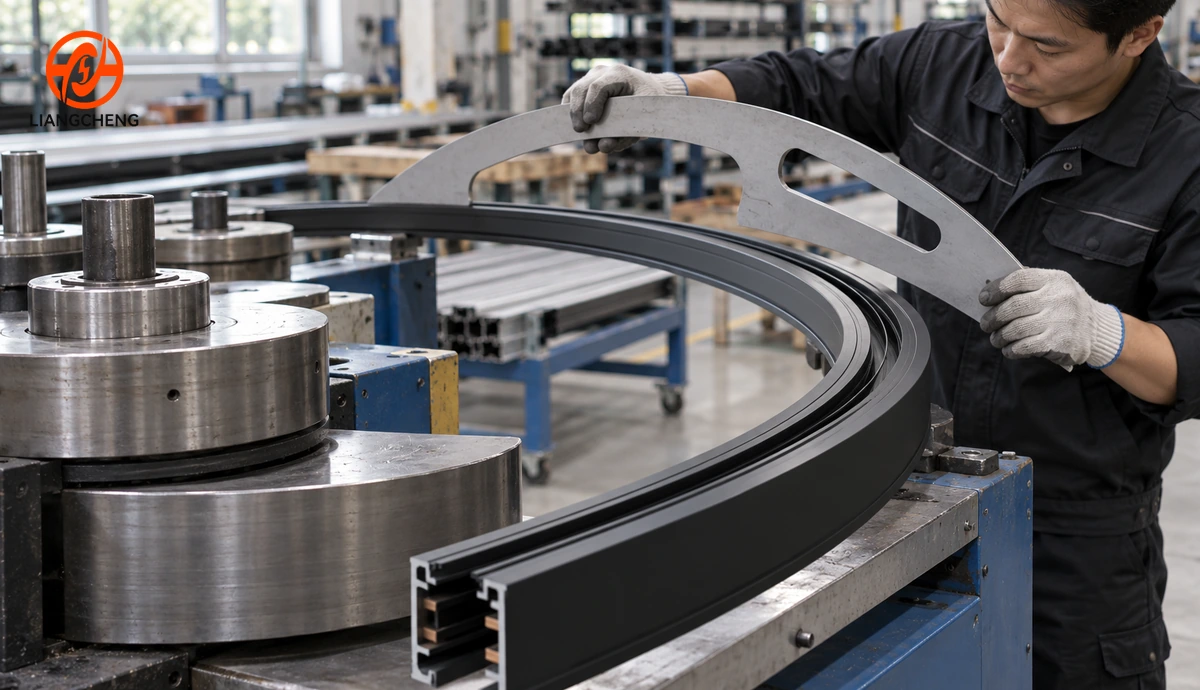
Curved track rails are usually manufactured by roll bending, in which the profile passes through a set of rollers that gradually form it to the required radius. The rollers are shaped to support the profile cross-section so that the slot and walls do not collapse. Large radii can be reached in one pass, while tighter radii are formed in several passes with measurement between them to control springback, which is the tendency of aluminum to relax slightly after bending.
Depending on the system, conductors and insulating carriers are either inserted before bending and bent together with the profile, or inserted after the profile has been formed. After bending, each section should be checked for radius against a template, twist, flatness of the mounting surface, slot width at several points, finish damage, conductor position and electrical continuity. A well-controlled process produces arcs that close accurately into rings and that join straight rails without steps.
Are standard adapters compatible with curved track rails?
Standard adapters are compatible with curved track rails when the radius is large enough for the adapter to enter, lock and make contact in the curved slot. An adapter body is straight, while the slot is curved, so the middle of the adapter deviates from the curve by a small distance called the sagitta. The sagitta grows as the radius decreases and as the adapter gets longer. If the slot clearance cannot absorb this deviation, the adapter binds, does not lock fully or makes poor contact.
| Centerline radius | Sagitta for 100 mm adapter | Sagitta for 150 mm adapter |
|---|---|---|
| 300 mm | about 4.2 mm | about 9.5 mm |
| 500 mm | about 2.5 mm | about 5.7 mm |
| 800 mm | about 1.6 mm | about 3.5 mm |
| 1,000 mm | about 1.3 mm | about 2.8 mm |
The table shows why the same rail can accept short spotlight adapters on a moderate curve but not longer adapters or long linear fixtures. A practical rule is to test the actual adapter on a sample of the curved rail at the intended radius, insert and lock it at several positions, select each circuit and confirm contact. The track light adapter compatibility checklist explains the general checks, and the H-type vs J-type vs L-type guide explains profile families.
Which fixtures work well on curved track rails?
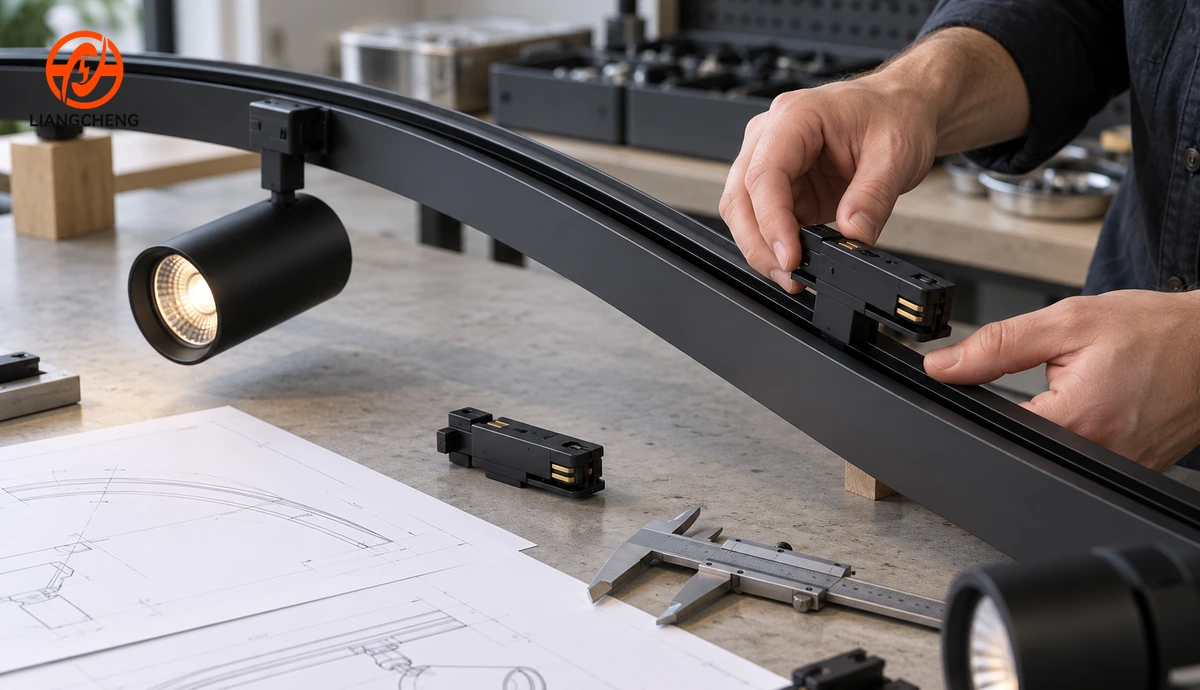
Compact track spotlights, small floodlights and pendants work well on curved track rails, because their adapters are short and their heads can be aimed independently of the rail direction. Long linear track fixtures and wall-washers with rigid bodies are generally unsuitable for tight curves, because the fixture body cannot follow the arc and its adapter is often long. On large radii, short linear fixtures may still be possible if the manufacturer confirms clearance.
Aiming also changes on a curve. Spotlights on a circular rail above a round display naturally point inward toward the center, which produces even lighting of the display from all sides. On a curved wall, fixtures can be aimed perpendicular to the wall surface at each point, which keeps the light distribution consistent along the curve. Beam selection is covered in track light beam angles explained.
How is a curved track rail wired?
A curved track rail is wired in the same way as a straight rail of the same system, because the conductors simply continue around the arc. A 2-wire or 3-wire rail carries a single circuit, a 4-wire rail typically carries three circuits plus neutral, and a 6-wire rail carries several circuits or control lines depending on design. Power enters through a live end feed or a middle feed, and joiners carry the circuits from one section to the next.
Curved sections often need straight end lengths, sometimes called tails, of around 100 to 200 mm at each end so that standard joiners, feeds and end caps can be fitted, because these components are designed for straight profiles. The layout should therefore place joints and feeds on straight parts of the run. On multi-circuit rails, the conductor orientation must stay consistent through every joint so that each circuit remains on the same conductor around the curve. Wiring options are compared in 2-wire vs 4-wire track rail.
How should curved track rails be installed?
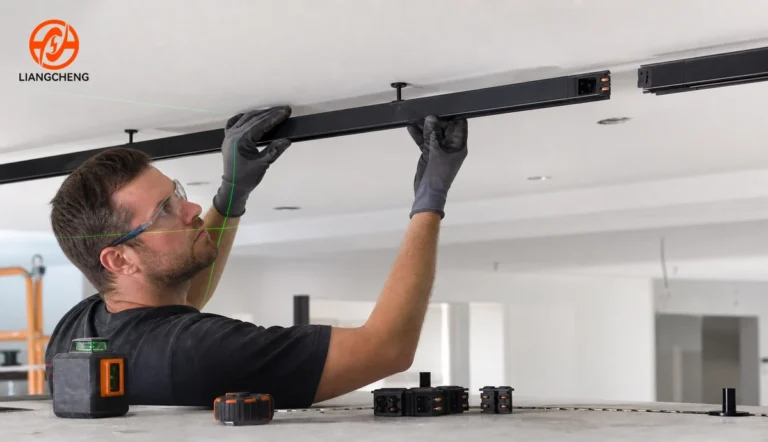
Curved track rails should be installed from a verified ceiling setting-out, not from drawing dimensions alone, because real ceilings and walls are rarely perfect arcs. The installer should mark the curve on the ceiling with a template or a radius line, confirm that the delivered arc matches the marking before drilling, and position fixings closer together than on straight runs, because a curved rail tends to spring away from the ceiling at its midpoint. Fixings near both ends and at regular intervals along the arc keep the rail tight to the surface.
Full circles are normally made of two, three or four arcs joined with straight joiners at prepared straight tails, and the joints should be aligned carefully to avoid steps in the slot. Suspended curved rails need suspension points at closer spacing and sometimes a stiffening bracket to prevent rotation. General installation steps are explained in how to install a surface-mounted track lighting rail, and mounting options in surface-mounted vs recessed vs suspended installation.

What are the advantages and limitations of curved track rails?
The main advantage of curved track rails is that lighting follows the architecture, which creates a cleaner, more intentional appearance in round or curved spaces. Curved rails also keep the flexibility of track lighting, because fixtures can still be added, moved and re-aimed along the arc. Compared with segmented layouts, a true curve has no visible corners and gives more consistent spacing and aiming of fixtures.
The limitations are cost, lead time and inflexibility of geometry. Each radius usually requires a dedicated bending setup, curved sections cannot be cut and reshaped on site like straight rails, and a measuring error means the section has to be remade. Tight radii restrict which adapters and fixtures can be used, and curved sections are more difficult to pack and ship. For very large radii or uncertain geometry, a segmented layout with flexible connectors can be the more practical option.
What specifications should a curved track rail order include?
A curved track rail order should include every parameter needed to reproduce the curve and connect it to the rest of the system. The table below lists the common specification items.
| Specification item | What to state |
|---|---|
| Rail system | 2-wire, 3-wire, 4-wire or 6-wire, and profile model |
| Radius and reference | Centerline, inner or outer edge radius |
| Bending direction | In plan or in elevation; slot facing in or out |
| Arc size | Arc angle or arc length, and chord length |
| Straight tails | Length of straight ends for joiners and feeds |
| Quantity of arcs | Number of sections per ring or run |
| Finish and color | Powder coat or anodized; color code |
| Método de montagem | Surface, suspended or recessed |
| Acessórios | Feeds, joiners, end caps, clips, suspension parts |
| Adapters and fixtures | Models to be used for compatibility testing |
A dimensioned drawing in DWG or PDF format, ideally with a ceiling plan, is the best way to communicate the curve. A complete RFQ structure is described in what information to include in a track rail RFQ.
What should buyers check before ordering curved track rails in bulk?
Before ordering curved track rails in bulk, buyers should approve a bent sample at the actual radius, test the planned adapters and fixtures on it, and confirm the manufacturer’s radius tolerance. The sample should be checked for radius, twist, slot width at several points, finish quality on the outer face, conductor position, continuity of each circuit and insulation resistance. Joining the sample to a straight rail confirms that the transition is flush.
Buyers should also confirm lead time, because each new radius needs setup and inspection, and packaging, because curved sections need rigid supports to prevent flattening or distortion in transit. Guidance on protecting long rails is available in how to package long track rails. Ordering a small number of spare arcs is wise for large projects, since remaking a single curve later takes time.
Where are curved track rails used in projects?
Curved track rails are used wherever the architecture or the merchandising layout is round or flowing. Typical applications include circular ceiling coffers and domes, round display tables in fashion and jewelry stores, curved shop fronts and window displays, museum and gallery rooms with curved walls, hotel lobbies and atriums, restaurant and bar counters, car showroom turntables and exhibition stands.
In retail, a circular rail above a central display lets every product be lit from several directions. In hospitality, curved rails follow bar counters and seating areas and add a design feature to the ceiling. In galleries, curved rails keep a constant distance from curved walls so that artwork is lit evenly. Related design guidance is available in how to design track lighting for fashion retail stores.
Perguntas frequentes
Can a straight track rail be bent on site?
Rigid mains-voltage aluminum track rails should not be bent on site, because bending without profile-specific tooling distorts the slot, damages conductor insulation and can create electrical safety risks. Curves should be ordered from the manufacturer at the required radius.
What is the smallest radius for a curved track rail?
The smallest radius depends on the profile, conductor system, finish and bending direction. Slim single-circuit profiles can usually be bent tighter than deep multi-circuit profiles, and the minimum value should always be confirmed with a bent sample from the manufacturer.
Can curved and straight rails be combined in one run?
Yes. Curved and straight sections of the same rail system are joined with standard joiners at straight tails, and the circuits continue through the joints. Joints and feeds should be planned on straight parts of the run.
Do magnetic track systems come in curved versions?
Some low-voltage magnetic track systems offer curved sections, but radii, fixture compatibility and drivers differ from conventional mains-voltage rails. The differences between the two systems are explained in track rail vs magnetic track.
How long does it take to produce curved track rails?
Curved rails usually take longer than straight rails because each radius needs bending setup, inspection and special packaging. Lead time depends on quantity, radius and finish, and approving a sample curve early keeps the project schedule on track.
Order custom curved track rails from Liangcheng Lighting
Liangcheng Lighting manufactures trilhos de pista curva and straight track rail systems in 2-wire, 3-wire, 4-wire and 6-wire versions, with matching feeds, joiners, end caps and acessórios de iluminação de trilho. We bend rails to project-specific radii and arc lengths, supply bent samples for adapter testing, offer custom finishes and private-label packaging, and protect curved sections with dedicated packaging for export. Learn more about Liangcheng Lighting and see typical aplicativos.
Planning a project with round ceilings, curved walls or circular displays? Send your ceiling drawing, required radius, arc lengths, rail system, finish and quantities through the Liangcheng Lighting contact page. Our engineers will confirm the achievable radius for your profile, recommend compatible adapters and connectors, and prepare a sample and a wholesale or custom quotation for your order.
Precisa de Soluções Personalizadas de Iluminação de Trilhos?
Entre em contato com a Liangcheng Lighting para soluções de trilhos de alumínio OEM/ODM e suporte profissional de iluminação.
Relacionado