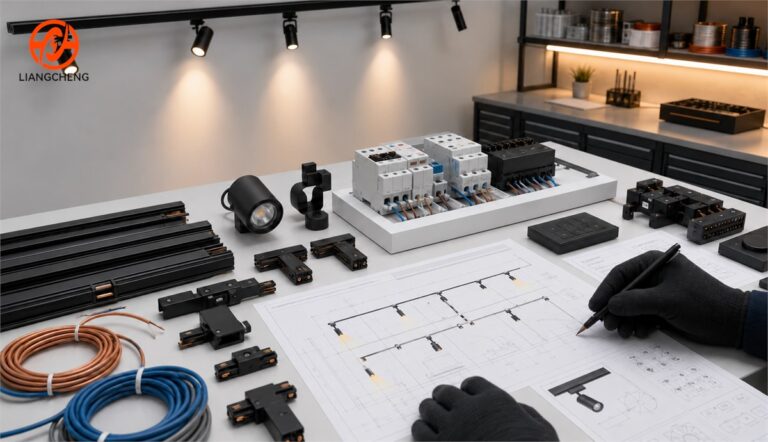









Quick answer: a 2-wire track rail is a single-circuit lighting track that carries two current-carrying conductors, line and neutral, inside an aluminum profile. Every fixture clicked into the rail receives the same supply and is switched or dimmed together from one circuit. Power enters through a live end or middle feed, travels along two insulated copper conductors, and reaches each fixture through spring contacts in the track adapter. Protective earthing is provided either through the aluminum profile and an earth contact on the adapter, or by using double-insulated fixtures, depending on the system design. Before buying, check the profile and adapter standard, conductor material and size, the earthing method, voltage and current rating, dimming compatibility, insulation and temperature performance, and the accessories available in the same system.
How this guide is different: commercial buying steps, quotations and wholesale pricing for 2-wire rails are covered in the 2-wire track rail buying guide and wholesale 2-wire track rail price. Comparisons with other systems are in 2-wire vs 3-wire track rail and 2-wire vs 4-wire track rail. This article explains how a 2-wire rail works electrically and mechanically, and which technical checks confirm that a rail is safe and suitable before an order is placed.
What is a 2-wire track rail?
A 2-wire track rail is a lighting rail with two internal conductors that form one electrical circuit. One conductor carries the line (live) supply and the other carries the neutral return. The conductors are held in an insulating carrier inside an extruded aluminum profile, and the open slot of the profile allows track lights, pendants and other fixtures to be inserted, locked and moved along the rail. Because there is only one circuit, all fixtures on the same rail switch on and off together.
The name describes the number of conductors, not the quality or price of the rail. 2-wire rails are also called single-circuit rails, and in many markets they are the most common format for shops, homes, galleries and small commercial projects where one switching group per rail is sufficient. The difference between a rail and the fixtures it carries is explained in szyna torowa kontra oświetlenie torowe.
What parts make up a 2-wire track rail?
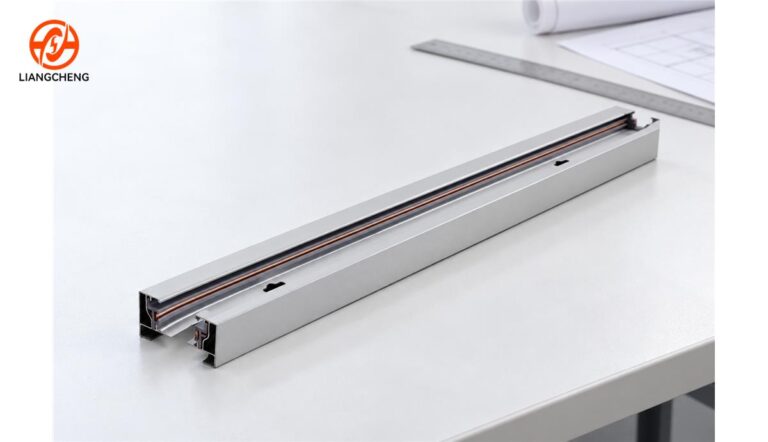
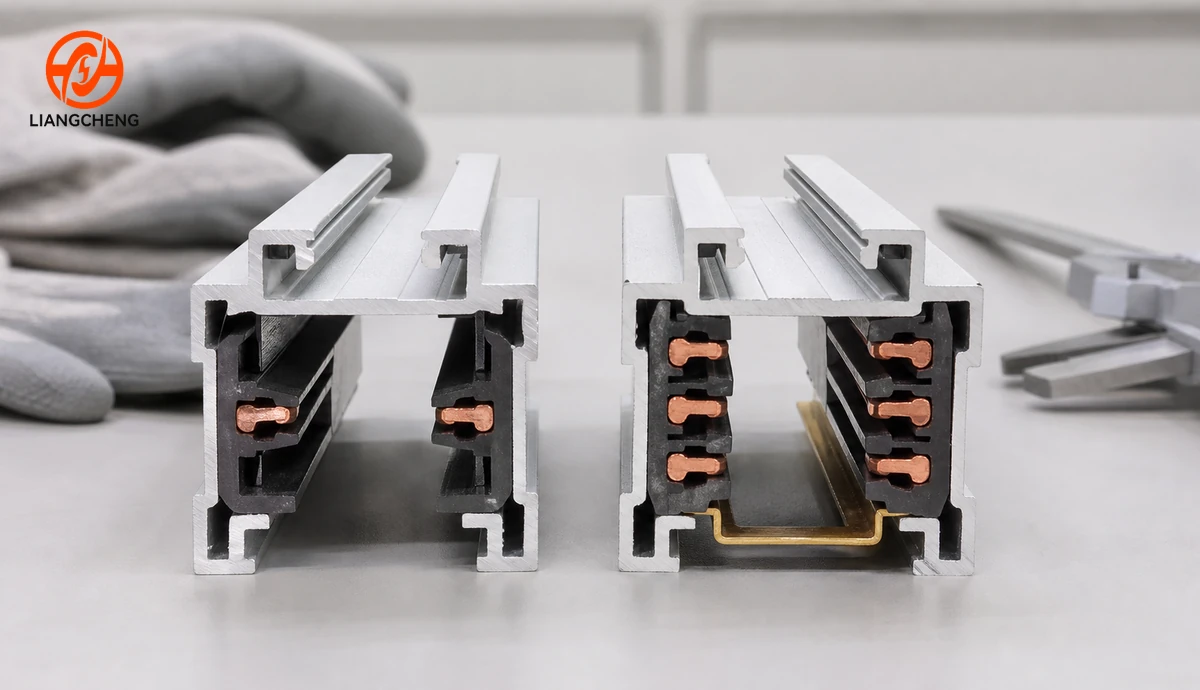
A 2-wire track rail is made of five main parts: the aluminum profile, the insulating carrier, the two conductors, the mounting features and the end accessories. The aluminum profile provides strength, the visible finish and the slot geometry that guides the adapter. The insulating carrier, usually a flame-retardant plastic, holds the conductors at a fixed position and isolates them from the profile and from each other. The conductors are typically copper, either as flat strips or round wires, and their cross-section determines how much current the rail can carry.
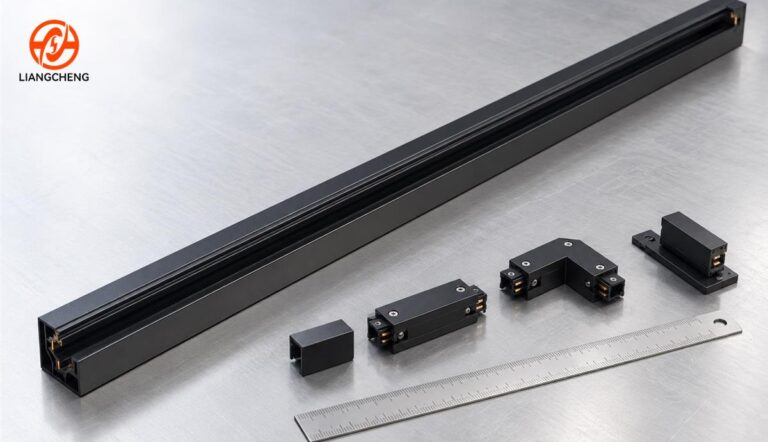
Mounting features include grooves or holes for surface clips, suspension hardware or recessed frames. End accessories include the live end feed that connects the supply cable, straight joiners, corner and branch connectors, and end caps that close and insulate the open ends. All of these must belong to the same system, because they connect to the conductors at fixed positions. A full overview is available in the track lighting rail accessories system guide.
| Part | Function | What to check |
|---|---|---|
| Aluminum profile | Structure, finish, adapter guidance | Wall thickness, straightness, slot dimensions |
| Insulating carrier | Holds and isolates conductors | Flame-retardant material, fit, heat resistance |
| Conductors | Carry line and neutral | Copper material, cross-section, continuity |
| Feed and joiners | Connect supply and link rails | Terminal quality, contact force, rating |
| End caps and clips | Insulate ends and fix the rail | Secure fit, matching finish |
How does a 2-wire track rail deliver power to the lights?
A 2-wire track rail delivers power through a simple chain: supply cable, live end feed, rail conductors, adapter contacts and fixture driver. The supply cable from the switch or dimmer is connected to the terminals of the live end feed. The feed is inserted into the rail and its contacts press against the two conductors. Current then flows along the full length of the rail, through joiners into connected rails, and into every adapter that is locked in place.
Each track adapter has two spring-loaded contacts that touch the line and neutral conductors when the adapter is rotated or pushed into its locked position. From the adapter, short internal wires carry power to the LED driver in the fixture, which converts mains voltage into the current the LED module needs. Because the adapter can be unlocked and moved, fixtures can be repositioned without rewiring, which is the main advantage of track lighting.
How is a 2-wire track rail earthed?
A 2-wire track rail is earthed in one of two ways, and buyers must know which one a system uses. In many designs the aluminum profile itself acts as the protective earth path: the live end feed has an earth terminal that bonds the supply’s protective conductor to the profile, joiners maintain metal continuity between rails, and the adapter has an earth contact that touches the profile so that the fixture housing is earthed. In other designs, the rail and fixtures are intended to be double insulated, so no protective earth is carried to the fixture.
The earthing method determines which fixtures may be used and whether the installation meets local regulations. A metal-bodied fixture that relies on protective earth must not be used on a system that does not provide one. Buyers should ask for the earthing concept in writing, check that the feed has an earth terminal where required, and test continuity from the feed earth terminal to the far end of the rail and to the adapter earth contact. The way a third conductor changes this arrangement is explained in what is a 3-wire track rail.
How are 2-wire track rails wired at the feed?
A 2-wire track rail is wired by connecting the line conductor of the supply cable to the line terminal of the live end feed, the neutral conductor to the neutral terminal, and the protective earth conductor to the earth terminal where the system provides one. The feed is then inserted into the rail in the correct orientation, which is usually marked by a polarity line or groove on the profile, so that the feed contacts meet the matching conductors.
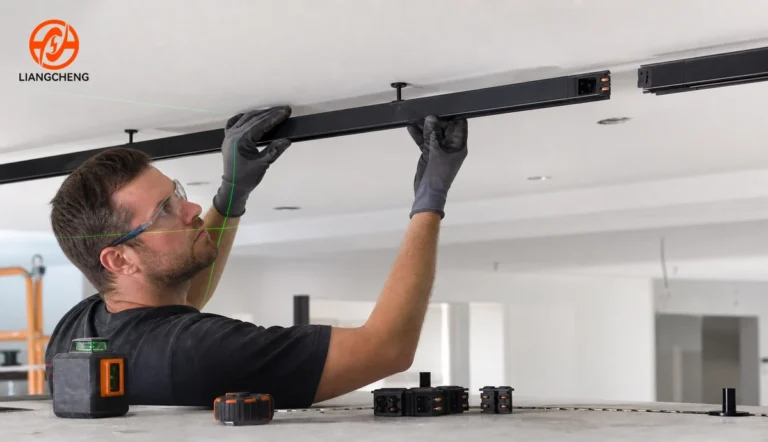
Polarity matters even in a single-circuit system. If line and neutral are reversed, many fixtures will still light, but switches may interrupt the neutral instead of the line, leaving parts of the fixture live when switched off. Joiners and corner connectors also have an orientation, and reversing one can swap the conductors in the next rail. A mains connection should always be made by a qualified electrician following local codes. Installation steps are described in how to install a surface-mounted track lighting rail.
How much load can a 2-wire track rail carry?
The load a 2-wire track rail can carry is limited by the current rating of the conductors and accessories, the rating of the supply circuit breaker and the mechanical capacity of the rail and fixings. The current rating depends mainly on conductor cross-section and contact design, and it should be stated by the manufacturer for the rail, feed and joiners. The lowest rating in the chain is the one that applies.
To check a design, add the input wattage of all fixtures on the rail and divide by the supply voltage to estimate current. For example, fifteen 25 W LED spotlights on a 230 V supply draw about 1.6 A, which is well within the rating of most rails, while the same fixtures on a 120 V supply draw about 3.1 A. Mechanical load matters as well, especially with pendants or heavy fixtures, so fixing spacing should follow the manufacturer’s guidance. LED fixtures also produce inrush current at switch-on, which can affect breaker and switch selection on long runs with many drivers.
Can 2-wire track lighting be dimmed or controlled?
2-wire track lighting can be dimmed as a single group when the fixtures use drivers that are compatible with the chosen dimmer, most often phase-cut dimming in leading-edge or trailing-edge form. Because the rail has only line and neutral, it cannot carry a separate wired control signal such as 0-10 V or wired DALI to each fixture. All fixtures on the rail therefore receive the same dimming level unless they are controlled individually by other means.
Individual control on a 2-wire rail is possible with fixtures that contain wireless control receivers, for example for mesh lighting networks, which receive commands without extra conductors. Mixing dimmable and non-dimmable drivers on the same dimmed rail should be avoided, because it can cause flicker or damage. Dimmer and driver matching is explained in why do track lights flicker, and multi-group control options in oświetlenie szynowe jednoobwodowe a wieloobwodowe.
How can several 2-wire rails create lighting zones?
Several 2-wire rails can create lighting zones by giving each rail, or each group of connected rails, its own feed and its own switch or dimmer. For example, a shop can use one rail run for window displays, another for wall shelving and a third for the central floor area, each controlled separately. Rails that belong to different zones should not be joined with standard joiners, because joiners connect the conductors and would merge the circuits; instead, the runs are separated by a gap or an insulating end cap.
This approach keeps the simplicity and low cost of 2-wire components while providing basic scene control. It requires more feed points and more cable runs from the switchboard than a single multi-circuit rail, so the choice depends on the ceiling layout, the number of zones and how often the layout will change. When more than two or three zones are needed along the same line, a multi-circuit rail is usually neater and easier to rearrange.
Which fixtures and adapters are compatible with a 2-wire rail?
Fixtures and adapters are compatible with a 2-wire rail only when the adapter matches the rail profile family and conductor positions. Many 2-wire rails use proprietary or regional profile designs, and two rails that look similar can differ in slot width, lip shape, conductor height or earth contact position. An adapter that fits loosely may arc or overheat, while an adapter that is too tight may not lock or may damage the conductors.
Compatibility should always be confirmed with physical samples: insert and lock the adapter at several positions, check contact pressure and continuity, confirm the earth contact where applicable, and test the fixture under power. 2-wire adapters are generally not interchangeable with 3-wire or multi-circuit rails. The track light adapter compatibility checklist describes the checks in detail.
What are the common specifications of 2-wire track rails?
2-wire track rails share a set of common specifications that define their performance and compatibility. The table below lists typical values; exact figures depend on the product and must be confirmed with the manufacturer’s datasheet.
| Specification | Common options |
|---|---|
| Circuits | One circuit: line and neutral |
| Voltage | Mains voltage, typically 100-240 V AC depending on market |
| Current rating | Stated by manufacturer for rail and accessories |
| Conductor | Copper strip or round copper wire |
| Profile material | Extruded 6063 aluminum alloy |
| Skończ | Powder coating or anodizing; white, black, silver, custom colors |
| Standard lengths | 1 m, 1.5 m, 2 m, 3 m; custom lengths |
| Mounting | Surface, suspended, recessed (profile-dependent) |
| Akcesoria | Live end feed, middle feed, joiners, L/T/X connectors, end caps, clips |
Profile dimensions and lengths are discussed in the przewodnik po wymiarach szyn oświetleniowych.
What are the advantages and limitations of a 2-wire track rail?
The main advantages of a 2-wire track rail are simplicity, lower cost and easy installation. With only two conductors, the profile can be slim, the feed wiring is straightforward and installers rarely make circuit errors. Fixtures are simple and widely available, and the system is easy for end users to understand. For spaces where all lights on a rail are switched together, a 2-wire rail delivers the flexibility of track lighting at the lowest system cost.
The main limitation is control: a 2-wire rail provides only one switching or dimming group per rail, so projects that need separate scenes for display, ambient and window lighting require several rails, wireless control in each fixture, or a multi-circuit system. Earthing depends on the profile design, which must be verified, and many 2-wire profiles are proprietary, which limits the choice of compatible fixtures from other suppliers.
| Advantages | Limitations |
|---|---|
| Simple wiring and installation | Only one switching or dimming group |
| Slim profile and clean appearance | No wired control signal to individual fixtures |
| Lower rail and fixture cost | Earthing method must be verified |
| Easy to maintain and expand | Adapters are often profile-specific |
Where are 2-wire track rails used?
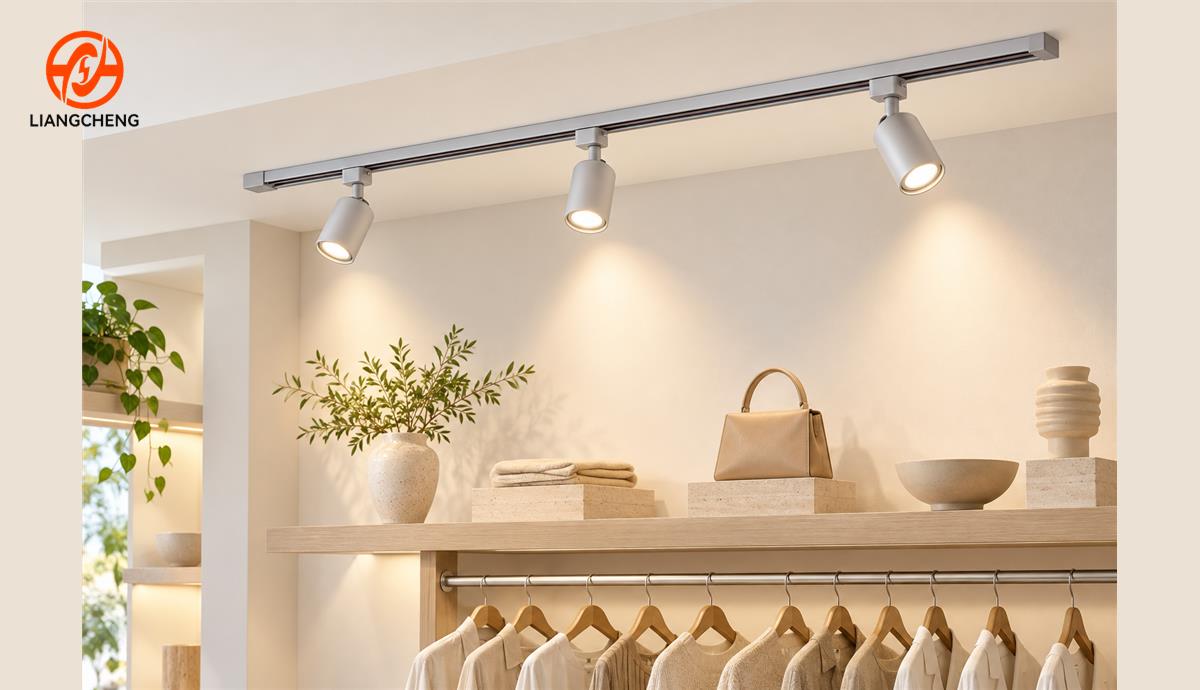
2-wire track rails are used where one control group per rail is sufficient and cost and simplicity matter. Typical applications include small and medium retail stores, boutiques, showrooms, cafes and restaurants, residential kitchens and living areas, offices, hotel rooms and corridors, galleries with single lighting scenes, and display areas in exhibitions. In larger stores, several 2-wire rails can be connected to separate switches to create zones without moving to a multi-circuit system.
2-wire rails are less suitable where one rail must carry several independently switched groups, such as large department stores, museums with complex scenes or flagship stores with day and night lighting modes. In those projects, multi-circuit rails or wireless fixture control are usually more practical. Retail design examples appear in how to design track lighting for fashion retail stores.
Which technical checks should be done before buying 2-wire track rails?
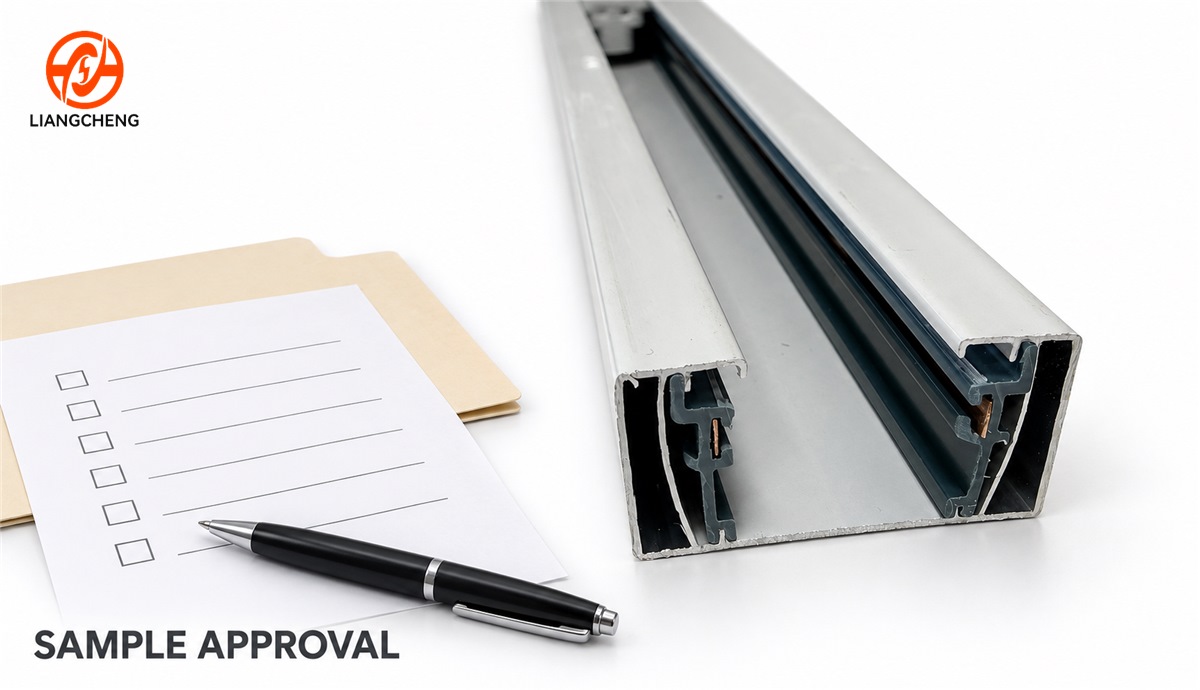
Before buying 2-wire track rails, buyers should verify the rail with samples and simple technical tests, not only with drawings and photos. The most useful checks confirm that the profile is accurate, the conductors are correct and continuous, the insulation is effective, the earthing works and the accessories match. These checks can be done on samples at the buyer’s site or by a testing laboratory.
| Check | How to perform it | What it confirms |
|---|---|---|
| Wymiary profilu | Measure slot width, wall thickness and straightness with calipers and a straightedge | Consistent adapter fit and strength |
| Conductor material and size | Inspect a cut section; request material declaration | Current capacity and contact reliability |
| Continuity | Measure resistance of each conductor end to end and across joiners | No breaks or poor joints |
| Insulation resistance | Test between conductors and between conductors and profile | Effective insulation |
| Earth continuity | Measure from feed earth terminal to profile end and adapter earth contact | Protective earth path where required |
| Adapter fit | Insert, lock and remove adapters repeatedly at several positions | Secure contact and smooth operation |
| Temperature rise | Run rated load and monitor contacts and feed | No overheating at full load |
Requesting test reports to recognized standards for electrical supply track systems, such as IEC 60570 or its regional equivalents, and certifications required in the target market strengthens the evaluation. Market-specific approvals are described in ENEC certification for track lighting and SAA approval for track lighting. Broader quality checks are explained in how to judge the quality of a lighting track rail.
What are the most common mistakes when choosing a 2-wire track rail?
The most common mistake when choosing a 2-wire track rail is assuming that all 2-wire rails accept the same adapters. Profiles differ between manufacturers and regions, and an adapter that seems to fit may not lock or may make poor contact. The second common mistake is not confirming the earthing method, which can lead to metal fixtures being used without a protective earth path.
Other frequent mistakes include choosing a 2-wire rail for a project that needs several control groups, mixing dimmable and non-dimmable fixtures on one dimmed circuit, ignoring the current rating of feeds and joiners, ordering rails without matching connectors in the same finish, and skipping sample testing. Each of these mistakes can be avoided by defining the control concept, confirming compatibility with samples and verifying ratings before ordering.
Często zadawane pytania
Is a 2-wire track rail the same as a single-circuit track?
Yes. A 2-wire track rail carries one circuit with line and neutral conductors, so it is commonly called a single-circuit track. All fixtures on it are switched together unless they have individual wireless control.
Does a 2-wire track rail have an earth connection?
It depends on the design. Many 2-wire rails use the aluminum profile as the protective earth path through an earth terminal in the feed and an earth contact on the adapter, while others are designed for double-insulated fixtures. The method must be confirmed with the manufacturer.
Can 2-wire and 3-wire track lights be mixed?
2-wire and 3-wire adapters are generally not interchangeable, because the conductor layout and profile shape differ. Fixtures should always be chosen for the specific rail system in use.
Can a 2-wire track rail be dimmed?
A 2-wire track rail can be dimmed as one group with a compatible dimmer and dimmable LED drivers. Individual fixture control requires fixtures with wireless control receivers, because the rail has no separate control conductor.
Can 2-wire track rails be cut to length?
Some 2-wire rails can be cut on site if the manufacturer allows it, followed by careful deburring and fitting of end caps. Others should be ordered in the required lengths. The manufacturer’s instructions should be followed.
Source 2-wire track rails from Liangcheng Lighting
Liangcheng Lighting manufactures 2-wire track rails with matching live end feeds, joiners, corner connectors, end caps and mounting accessories, including the 2-wire aluminum track rail for LED track lighting and wholesale 2-wire aluminum track rails. We offer custom lengths, colors and finishes, private-label packaging, adapter compatibility samples and technical documentation for distributors, lighting brands and project contractors. Explore our full track rail range and learn more about Liangcheng Lighting.
Planning a 2-wire track lighting line or project? Send your target market, voltage, lengths, colors, quantities and the adapters you plan to use through the Liangcheng Lighting contact page. Our team will confirm compatibility, share specifications and test data, and prepare samples and a wholesale or custom quotation for your order.
Potrzebują Państwo indywidualnych rozwiązań oświetlenia szynowego?
Skontaktuj się z Liangcheng Lighting w sprawie rozwiązań aluminiowych szyn kontaktowych OEM/ODM oraz profesjonalnego wsparcia oświetleniowego.
Powiązane