







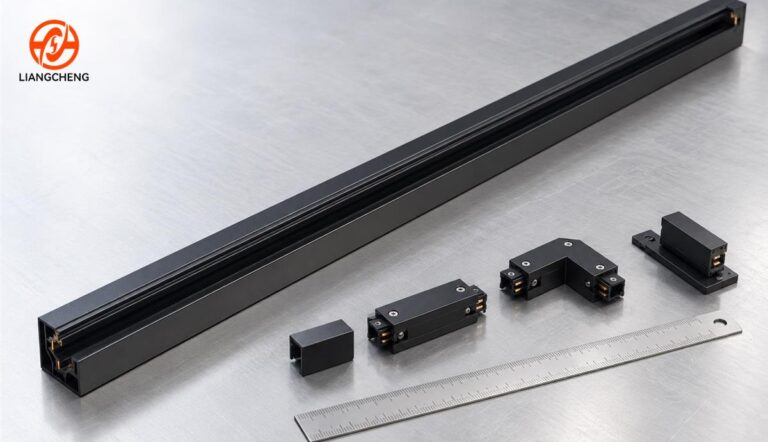

H type track rail dimensions cannot be confirmed by one width-and-height number. A purchase-ready H type specification needs the outer profile, usable channel opening, contact and polarity geometry, adapter engagement space, rail length, and the allowances added by feeds, joiners, end caps, and mounting hardware. H type usually names a conventional single-circuit track interface, not an extrusion that happens to resemble the letter H. Two rails may share similar outside dimensions while their fixture adapters and electrical contacts remain incompatible.
This guide concentrates on the dimensional questions behind an H type rail drawing, sample, ceiling layout, and wholesale order. Liangcheng Lighting already has a general track rail dimensions guide covering multiple rail families. The present article narrows the discussion to H style identification and the measurements that determine fit, wiring, installation, and repeat purchasing.
Szacowany czas czytania: 14 minut.
What does “H type” mean when measuring a track rail?
In conventional line-voltage track lighting, H type generally identifies an adapter-and-rail interface family. A common H style system has one lighting circuit with live, neutral, and a protective-earth arrangement. Its adapter contacts and keyed orientation are part of the system identity. The label does not mean that the rail’s cross-section is literally an H, and it does not define one universal metric drawing for every supplier or market.
H type should also be kept separate from the terms “3-wire” and “3-circuit.” Three electrical paths can serve a single circuit and grounding, while a three-circuit commercial rail supports multiple separately switched groups through a different conductor and adapter architecture. Ordering a rail from the number of visible metal strips alone can therefore produce the wrong feeds, heads, and controls. Liangcheng’s H, J, and L compatibility guide explains the family distinction in more detail.
For a replacement installation, identify the existing rail before taking measurements. Photograph the rail end, the lengthwise polarity feature, a working adapter, the feed, the product marking, and the mounting detail. Record the market voltage and the original component codes if available. A caliper reading becomes useful only after it is tied to a known orientation and interface family; an unlabeled 35 mm reading cannot prove an H match.
What are common H type rail sizes, and why do examples differ?
Published H style single-circuit products include an external profile around 34-36 mm wide and 16-18 mm deep, but those figures are illustrative planning examples, not a compatibility standard or a Liangcheng model specification. Other profiles, protective features, tolerances, mounting forms, and regional variants exist. The exact ordered drawing must define which direction is width, where the measurement is taken, and which dimensions control the adapter. A nominal outer envelope is useful for ceiling coordination, but it is too coarse for substitution.
H style sections are commonly sold in nominal 2, 4, 6, and 8 ft lengths in markets using that format. Liangcheng’s broader rail catalog also lists metric nominal lengths such as 0.5, 1, 1.5, 2, and 3 m for its rail range; availability for a specific H compatible model should be confirmed in the quotation. A nominal 4 ft or 1 m section does not necessarily produce that exact installed run after a feed, joiner, or end cap is included.
| Dimension or feature | What to record for an H type order | Why an outside size alone is insufficient |
|---|---|---|
| External width and depth | Maximum finished dimensions, orientation, and tolerance | Controls ceiling clearance but does not prove adapter fit |
| Channel mouth and retention lips | Opening, lip thickness, insertion depth, and datum | Controls whether the adapter enters and locks securely |
| Contact geometry | Each conductor centerline, side, insulation, and function | Prevents a mechanically plausible but electrically wrong match |
| Key or polarity feature | Groove or asymmetric profile position from one labeled end | Determines feed and adapter orientation |
| Length and cut end | Stock/cut length, tolerance, squareness, and burr rule | Determines run geometry and connector seating |
| Mounting interface | Hole or clip location, support spacing, and ceiling detail | Controls installation, load path, and visual alignment |
This table is a specification checklist, not a dimensional drawing. A buyer should request the current cross-section and accessory drawings for the exact rail SKU, then verify the drawing against a marked physical sample. Published market examples may help an architect reserve space, but they cannot authorize an adapter, feed, or replacement rail.
Which cross-section dimensions control adapter compatibility?
The critical mechanical dimensions are the channel opening, the internal insertion path, the supporting lips, the stop surfaces, and the space in which the adapter rotates or locks. An adapter can initially enter an oversized opening yet have excessive movement after locking. A tight opening can damage an adapter or prevent full engagement. Both outcomes can occur even when the outside rail width matches a catalog dimension.
Contact positions need a shared datum, not an approximate sketch. A useful drawing identifies a base or side reference surface, labels the rail orientation, and dimensions each conductor centerline, contact face, insulation edge, and polarity feature from that reference. A matching adapter drawing should show the contact positions in both insertion and locked states. This makes the interface testable rather than relying on a statement that a head “fits H track.”
Dimensional tolerance is as important as nominal size. The widest permitted adapter and narrowest permitted rail mouth may bind, while the narrowest adapter and widest rail may feel loose. Review the tolerance stack across rail extrusion, finish thickness, insulating insert, contact strip, and adapter molding. Test more than one sample and, for larger purchases, more than one lot. Liangcheng’s adapter compatibility checklist
How should an existing H type rail be measured?
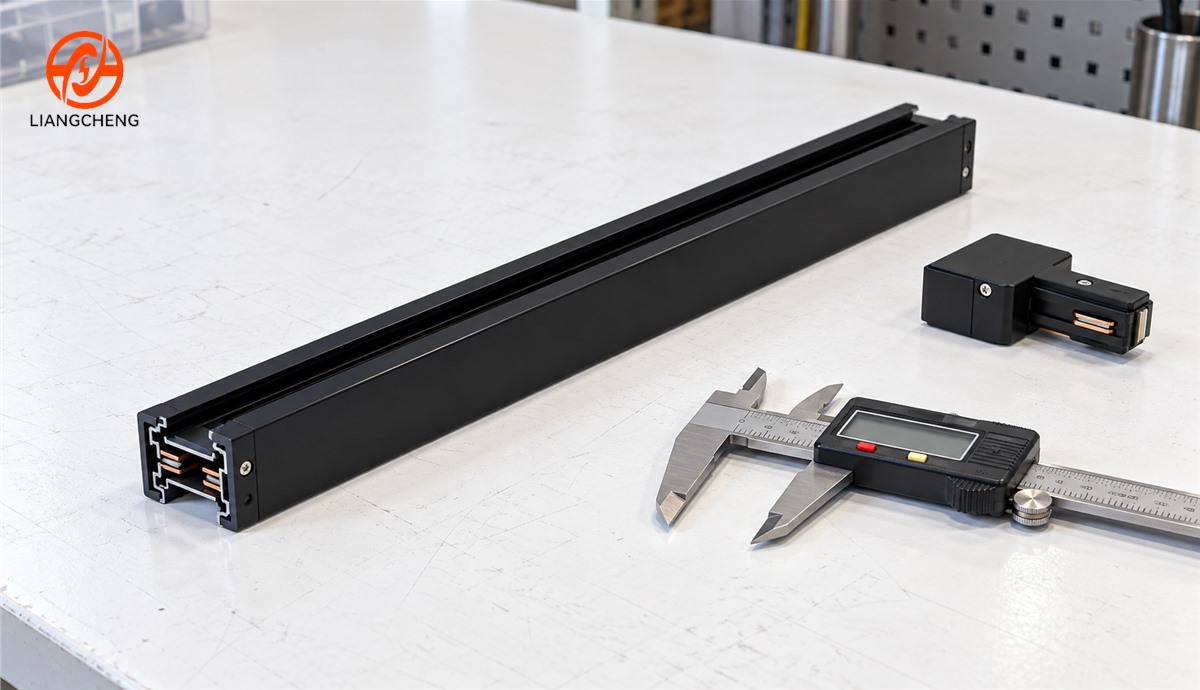
First isolate the system and have a qualified person make it safe before removing covers or handling conductive parts. Then mark the rail’s installed direction and one reference end. Use a calibrated caliper for short cross-section features, a tape or rule for length, and a straightedge or suitable fixture for straightness. Photograph each measurement in a way that shows the datum and orientation. A number without its measurement method can be misread when the rail is mirrored or rotated.
Measure the outer width and depth at several locations away from damaged ends. Next record the channel mouth, internal depth, lip dimensions, and any groove or asymmetric guide. For the electrical interface, document contact count, location, and insulation condition without assuming function from appearance. Compare the rail with the known adapter, feed, and joiner; record insertion and locking behavior according to the manufacturer instructions. A physical match must still be followed by the appropriate electrical checks.
Take measurements from at least two pieces when a project involves an old installation. Paint, deformation, impact, or a previously mixed repair can make one sample unrepresentative. If the installed system is unidentified, request a supplier review of the photographs and sample instead of naming it H type from one dimension. This is especially important for renovations where replacement heads must work with an existing feed and protective-earth path.
How do 2-wire, 3-wire, and H type dimensions relate?
A two-wire rail and an H type three-contact rail can look similar from a distance because both may be straight aluminum channels supporting adjustable lights. Their conductor count, grounding method, keying, contact placement, and adapter design can differ. A two-wire rail should not be described as H compatible merely because its external width is close or its adapter appears to rotate into place. Conversely, a three-wire marketing label does not by itself prove the conventional H style interface.
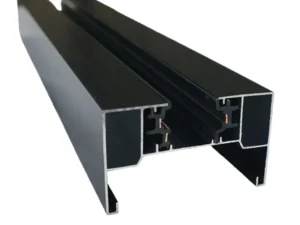
The supplied LY-014 image below is a Liangcheng two-wire reference shown with its full visible product form. It helps illustrate how a rail’s internal insulators and contacts matter more than its overall silhouette. The image is an illustrative edit based on the supplied product photograph; it is not an H type rail drawing or a measured H type sample. Buyers comparing the two formats should request model-specific sections and an approved adapter pair before specifying substitutes.
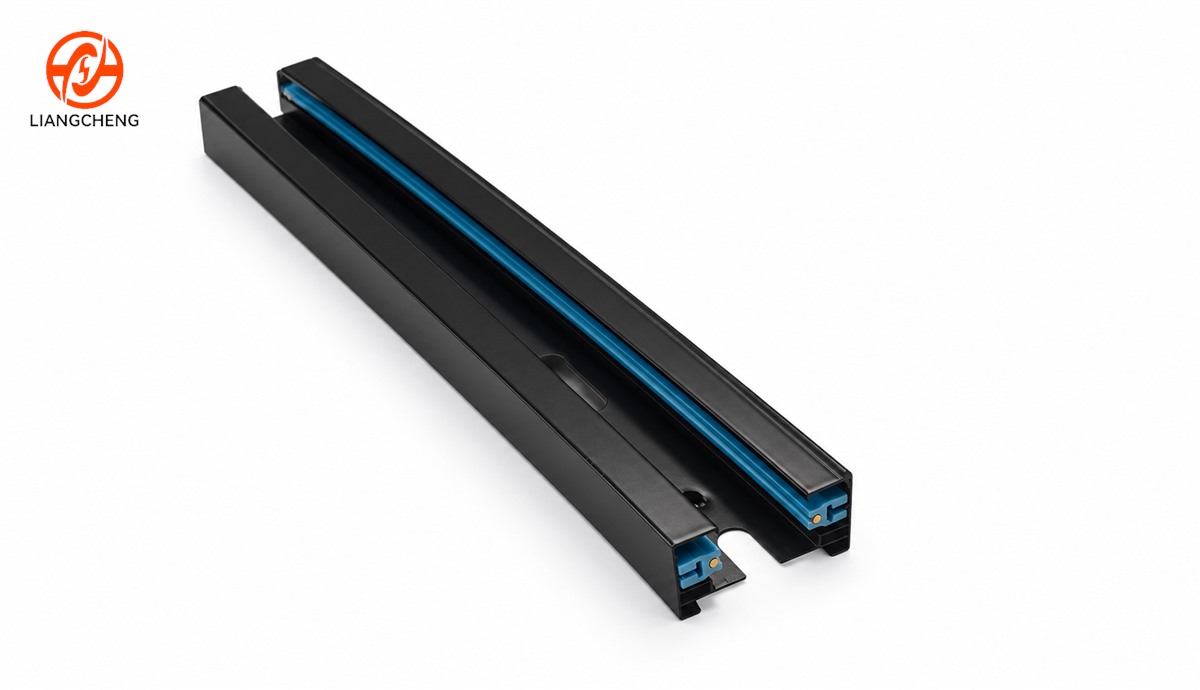
The practical wiring distinction is that a common H style single-circuit installation has one switched live path, a neutral path, and a protective-earth arrangement, while a simple two-wire system has fewer conductors and may follow a different product-specific safety design. Circuit count, terminal functions, earthing, voltage, current rating, and control method must be confirmed from the actual system documents. Electrical installation and testing should be performed by qualified personnel under local requirements, not inferred from the number of strips visible in an article photograph.
Why do nominal lengths differ from installed run lengths?
A rail’s cut length is only one term in the installed dimension. A live-end feed, straight joiner, corner connector, T branch, floating feed, or end cap may add length, consume insertion depth, or change where the visible rail begins. Wall clearance, service access, ceiling movement, and field-cut allowances can also affect the final cut list. A reflected-ceiling plan should therefore dimension the complete assembled route, not merely add nominal rail lengths.
For a straight run, calculate the clear ceiling distance first. Then identify the exact feed, rail sections, connector overlap, terminal cap, and any required end clearance. Confirm from accessory drawings whether each component adds to the visible run or inserts inside a rail. For an L or T layout, dimension from known centerlines and mark orientation; a connector that looks symmetrical from below may not preserve the intended polarity when mirrored.
Long rail shipping imposes another dimensional constraint. A 3 m length may suit a continuous ceiling line but can require different carton reinforcement, freight handling, elevator access, and site storage than shorter sections. More joiners reduce shipping length but add mechanical and visual joints. The preferred cut plan balances appearance, installation risk, package size, and replacement stock rather than assuming the longest available rail is always best.
What dimensions change for surface, recessed, and suspended H type projects?
Surface-mounted H style rail needs its outside envelope, mounting hole or clip position, feed-box clearance, end-cap size, and the distance between the ceiling and luminaire adapter. The ceiling structure must carry the rail and fixtures through the specified fasteners and spacing. The rail’s profile depth alone does not define the installed projection because the adapter and lamp body extend below it.
Recessed or trimless installations require additional evidence: cutout width, housing width, flange or plaster edge, ceiling cavity depth, fixing points, and service access. A surface rail with a shallow profile cannot be assumed to fit a recessed detail. The installed result also depends on board thickness and finishing tolerances. Liangcheng’s recessed track rail guide
Suspended runs need the suspension centerlines, rod or cable length, canopy size, electrical feed route, and permissible support span for the specified rail and fixture load. A rail can be straight on a table but appear wavy when suspended from poorly aligned points. Ask for the tested load and support conditions of the complete configuration; do not apply a generic per-meter loading claim to a new span or a heavier pendant arrangement.
How should feeds, joiners, and corners be dimensioned?
An H type feed must match the rail’s electrical contacts, keyed direction, and physical entry. Its drawing should show overall body size, rail insertion depth, cable or conduit clearance, mounting point, and orientation from the labeled rail end. A feed that fits the channel but reverses a polarity feature is not an acceptable substitute. The installer also needs space to terminate conductors and close the canopy without pinching insulation.
A straight joiner has at least two dimensional jobs: align adjoining profiles and maintain the intended electrical path if it is a powered connector. A purely mechanical joiner should never be assumed to provide continuity. Corner, T, and X connectors need overall dimensions plus branch centerlines, handedness, and the position of every current-carrying and protective contact. The layout drawing should give each junction a specific part code instead of a generic corner symbol.
End caps affect the visible termination and sometimes cover a cut end or maintain required protection. Record how far the cap protrudes, how it attaches, whether it can be removed for service, and which rail version it fits. A complete accessory schedule prevents a dimensionally correct straight rail from becoming an incomplete installation. Liangcheng’s track rail RFQ checklist
What are the advantages and limits of a standard H style size?
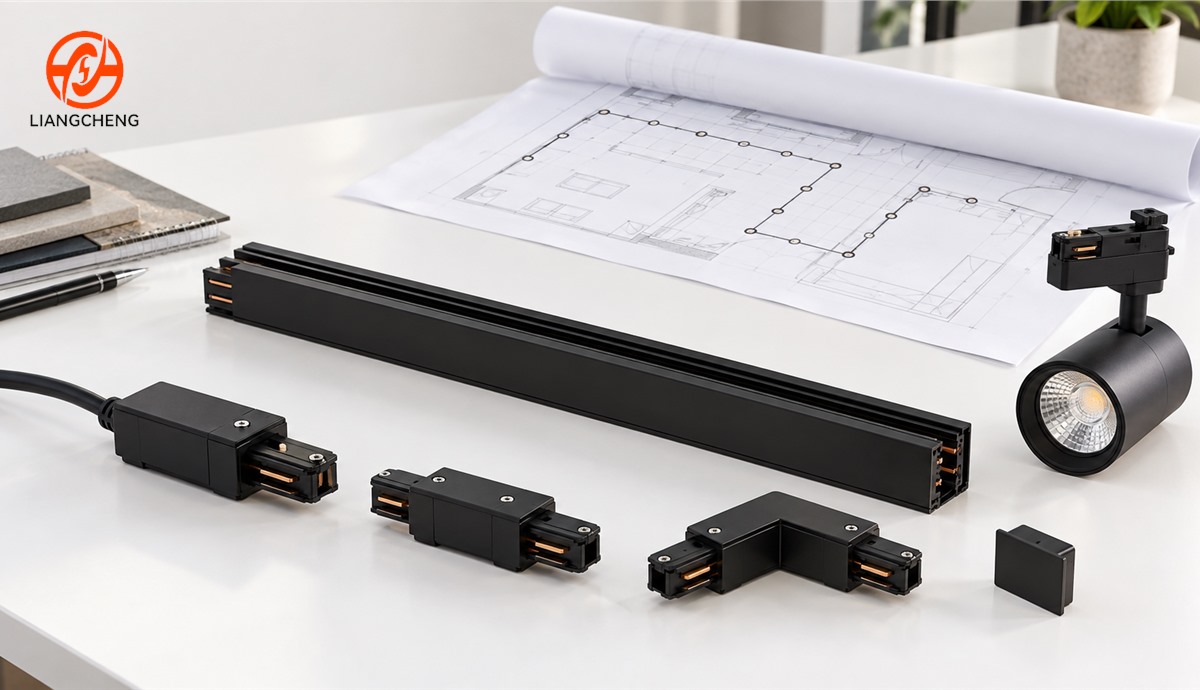
A familiar H style format can make a single-circuit replacement or expansion project easier to plan because rail sections, heads, and accessories may be available from several sources in some markets. Its simple control arrangement can suit one lighting zone in a gallery, small shop, hospitality display, or residential accent run. A compact profile can also reduce visual impact compared with larger multi-circuit systems.
The same simplicity becomes a limitation when a project needs independently switched groups on one physical run. A one-circuit H style rail cannot create three independent lighting zones simply by using a wider profile or a different head. A separate control design or a documented multi-circuit system may be required. The term “standard H” is also not a guarantee of cross-supplier compatibility; a replacement purchase still requires rail, adapter, feed, connector, and rating verification.
Custom dimensions are valuable when a ceiling detail, packaging requirement, or private-label assortment demands a different length, finish, or mounting arrangement. Customization may change adapter fit, accessory tooling, certification scope, minimum order quantity, and lead time. A buyer should approve the complete revised system, not just an altered extrusion. For a comparison of broader electrical formats, see Liangcheng’s 3-wire track rail buying guide.
Where do H type rails fit in lighting projects?
In a retail store, an H style single-circuit run can support repositionable accent heads over a merchandise display where the group normally switches together. The key dimensional issues are the rail route, connector space near partitions, head rotation clearance, and a mounting pattern that supports the chosen fixture weight. A store with separate window, wall-wash, and promotional zones may need more than one switched run or a different rail architecture.
In a gallery or showroom, a compact track can allow heads to move as displays change. A renovation requires special attention to the installed interface and the available ceiling structure, because a new rail with nearly the same outside size may not accept the existing heads. The buyer should compare the actual rail end and adapter sample before promising reuse. Lighting quality, dimming, and aiming requirements are separate from rail dimensions but must be considered in the system selection.
In hospitality corridors or residential settings, visual alignment and end details often matter as much as the raw profile size. Feeds, caps, bends, and suspended supports should be shown at scale on the reflected-ceiling plan. A small error repeated over several sections can move a fixture row away from the intended architectural line. Mock up one representative run before releasing a large order with custom cuts.
What should a wholesale buyer put on an H type rail drawing?
A purchase drawing should identify the rail model and revision, interface family, mounting version, external width and depth, cross-section datums, contact and insulation geometry, polarity feature, material and finish, stock and cut lengths, cut tolerance, straightness, twist, mounting features, and accepted accessory codes. Include the compatible adapter and feed models on the same approval package. If the destination market requires particular ratings or documentation, reference the exact product and version rather than a general catalog claim.
The buyer’s RFQ should then add order quantity by length and finish, intended application, destination market, packing method, labeling language, sample quantity, inspection method, lead time, and spare-parts requirement. Ask the supplier to list any proposed deviation in a separate column. A quotation that says “H compatible” without a controlled drawing or matched sample is incomplete, even if the price is attractive.
For quality approval, measure a first-article sample against the drawing, check the actual adapter insertion and locking, and inspect feeds and corners in the intended orientation. Confirm electrical functions with qualified personnel using appropriate procedures. Retain an identified approval sample for later lots. The B2B value of a drawing is not paperwork for its own sake: it makes replacement stock and repeat orders less dependent on memory or visual guesses.
Frequently asked questions about H type track rail dimensions
Is there one universal H type track rail width?
No. Published H style products can have similar outer envelopes, but the family name does not establish one universal width, depth, opening, contact position, or tolerance. Use a market example only for early space planning. Approve the exact model drawing and sample before claiming compatibility.
Does a 3-wire rail automatically count as H type?
No. Three electrical paths describe a conductor arrangement, while H type identifies a particular conventional adapter and rail interface family. A 3-wire product may use different keying, contacts, ratings, or mounting features. Obtain the manufacturer model and interface drawing before treating the terms as equivalent.
Can an H type adapter fit a two-wire rail with the same outside width?
No safe conclusion follows from matching outside width. The adapter must enter, rotate or lock, make the correct electrical contacts, and maintain the intended grounding and polarity behavior. A two-wire rail pictured in this guide is specifically a comparison reference, not evidence of H compatibility.
How much clearance should be allowed for an end feed?
The clearance must come from the selected feed drawing and installation instructions. It may need space for a body, conductor entry, termination, canopy, fasteners, and service access. Add that allowance to the assembled layout rather than assuming a feed occupies zero length beyond the nominal rail.
What should be tested before an OEM H style rail order?
Test the approved rail and adapter pair, feeds, straight and directional connectors, end caps, mounting parts, finish, and packaging. Review critical dimensions across more than one sample, then run a pilot lot against a frozen drawing. A successful single insertion test does not establish repeatable production compatibility.
Request an H type rail specification and wholesale quote from Liangcheng
Liangcheng Lighting manufactures track lighting rails for projects, wholesalers, distributors, and lighting brands, with factory-direct supply and OEM customization available for suitable programs. A productive H type inquiry should include the destination market, existing rail or target adapter sample, desired cross-section, length and finish, mounting method, feed and connector layout, expected volume, packaging, and required documentation. The engineering discussion can then identify an appropriate rail model or the changes needed for a custom system.
For a new project or a repeat-stock program, ask Liangcheng for the current dimensioned drawing, matching accessory list, sample plan, and a quotation tied to the exact revision. Review the company’s standard track rail range and contact Liangcheng Lighting to discuss wholesale track rail supply, OEM packaging, and project-specific dimensions.
Potrzebują Państwo indywidualnych rozwiązań oświetlenia szynowego?
Skontaktuj się z Liangcheng Lighting w sprawie rozwiązań aluminiowych szyn kontaktowych OEM/ODM oraz profesjonalnego wsparcia oświetleniowego.
Powiązane