







Temps de lecture : 14 minutes
Quick answer: A track light’s beam angle is the angular spread between points where luminous intensity falls to 50% of its center-beam value. Spot beams (about 10°–25°) create tight highlights. Medium beams (about 25°–40°) suit most accenting. Flood beams (40°–60°+) give soft, even coverage. Wall wash optics spread light evenly down a vertical surface. Choose by three inputs: distance to the subject, size of the subject, and the effect you want.
What Is a Track Light Beam Angle?
A track light beam angle describes the angular spread between directions where luminous intensity falls to 50% of the center-beam intensity. A 24° rating refers to this photometric boundary, not to a hard edge of visible light. Beam angle is one characteristic of the distribution; center-beam intensity, total lumens, and spill also matter.
Beam angle differs from field angle. The field angle is the wider cone where intensity falls to about 10% of the peak. Because light usually fades gradually rather than stopping at a hard edge, visible spill commonly extends beyond the stated beam angle. The actual field angle depends on the optic and must be checked in photometric data.
Beam angle also differs from lumens. Lumens measure total light output, while beam angle describes how that output is distributed. Two fixtures with similar lumens can look very different: a narrower optic generally concentrates more light on a smaller target, while a wider optic spreads it across a larger area. Optical efficiency and the full intensity distribution still affect the result.
Why Does Beam Angle Matter More Than Lumens Alone?
Beam angle controls how much light lands on the subject and how much is wasted on the surroundings. A narrow beam delivers high intensity to a small target, and a wide beam delivers lower intensity to a large target. The wrong angle makes a room look flat, glary, or patchy even when total brightness is adequate.
Consider a painting lit from a fixed distance. A 15° optic may cover only the center, whereas a 60° optic may spill well beyond the frame. A 24° or 36° option may fit better, but the correct choice depends on the painting’s dimensions, throw distance, actual photometric curve, and desired contrast.
Beam angle also affects mood and energy use. Narrow beams add contrast, shadow, and drama. Wide beams feel open and calm. Matching the angle to the task can reduce spill and improve useful illuminance; any change in fixture count should be confirmed in a layout calculation.
What Are the Four Main Track Light Beam Types?
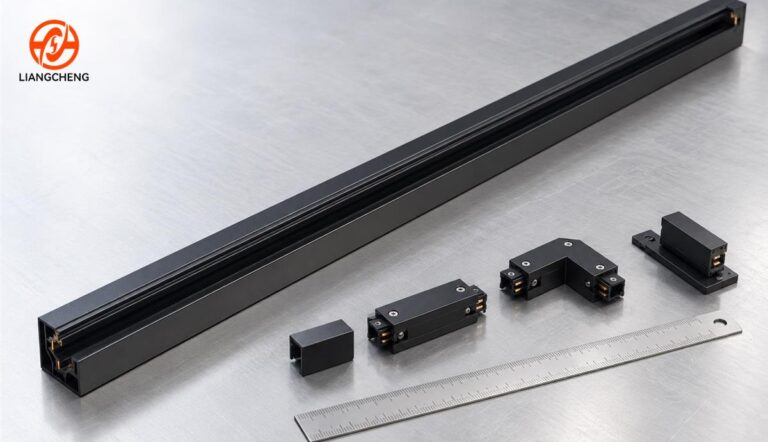
The rail supplies and supports compatible heads; beam distribution comes from the selected luminaire optic. For the hardware distinction, see rail de voie contre éclairage de voie. Track lighting beams fall into four practical categories: spot, medium, flood, and wall wash. Each has a typical angle range, use, and visual effect.
| Beam Type | Typical Angle | Visual Effect | Best For |
|---|---|---|---|
| Spot | 8°–25° | Tight, high-contrast highlight | Sculptures, small art, retail focal points, high ceilings |
| Medium (narrow flood) | 25°–40° | Defined but forgiving pool | Framed art, shelves, countertops, general accenting |
| Flood | 40°–60°+ | Soft, wide, even coverage | General light, kitchens, hallways, low ceilings |
| Wall wash | Asymmetric optic, often 60°–100°+ | Even sheet of light on a vertical surface | Textured walls, large art, bookcases |
Category boundaries are not standardized. One guide may call 16°–22° a spot, while another calls 25°–40° a spot. Always compare the actual degree value on the datasheet, not the label “spot” or “flood.”
How Does a Spot Beam Behave and When Should You Use It?
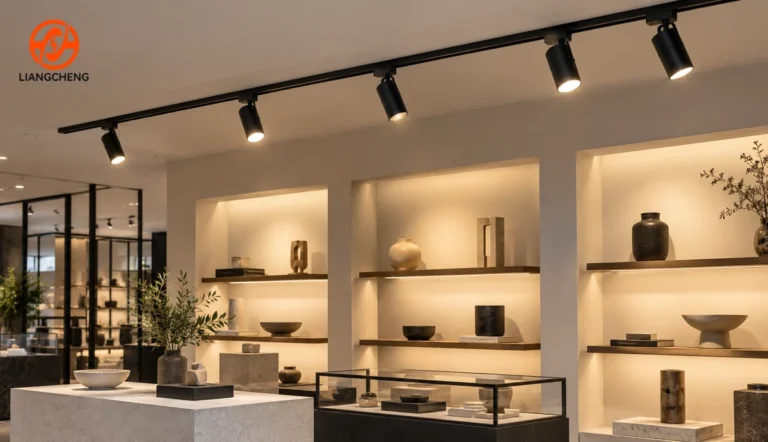
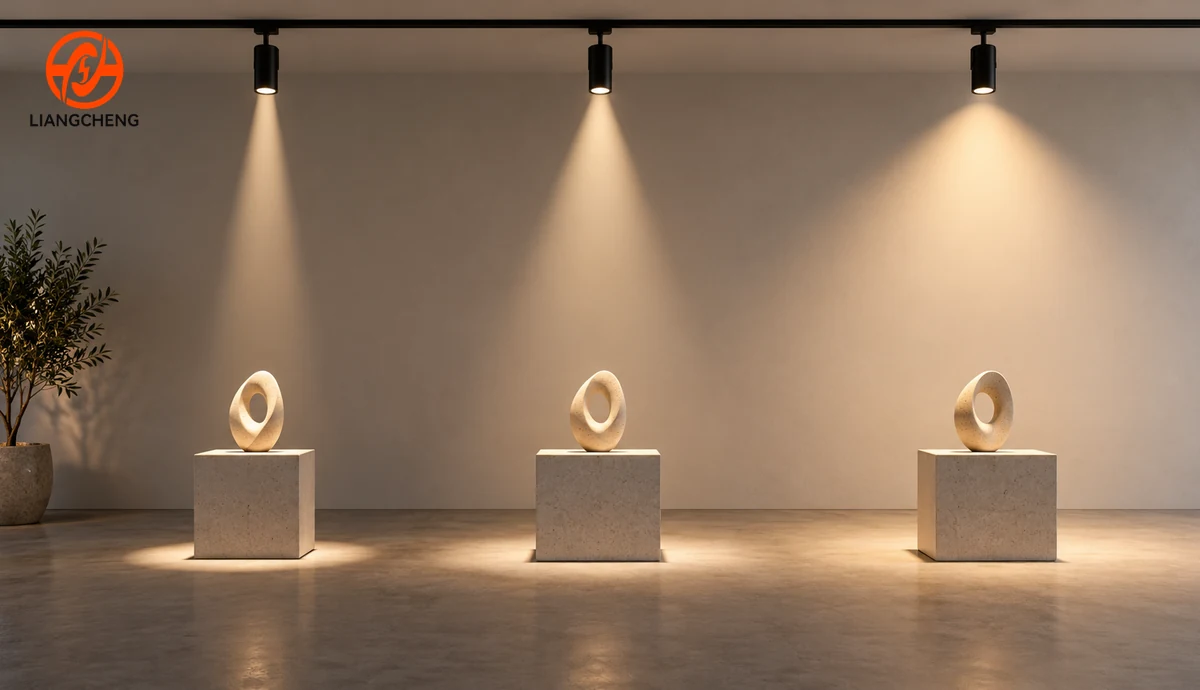
A spot beam concentrates light into a narrow cone, usually 10° to 25°, creating a bright, sharply defined pool with high contrast. Spot beams suit a single object that should stand out, or any fixture mounted far from its subject.
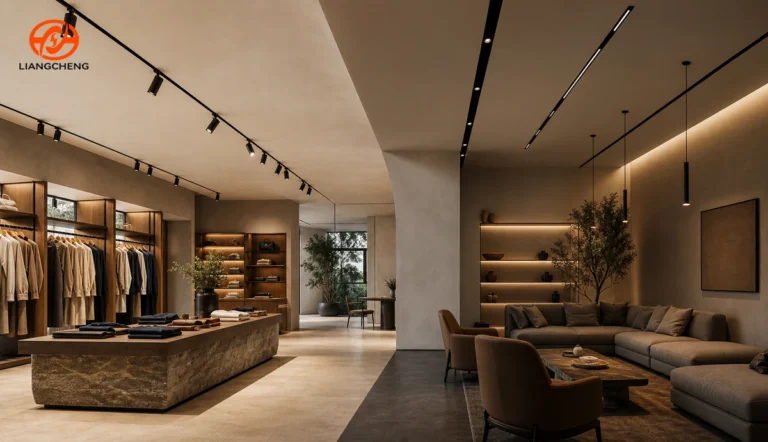
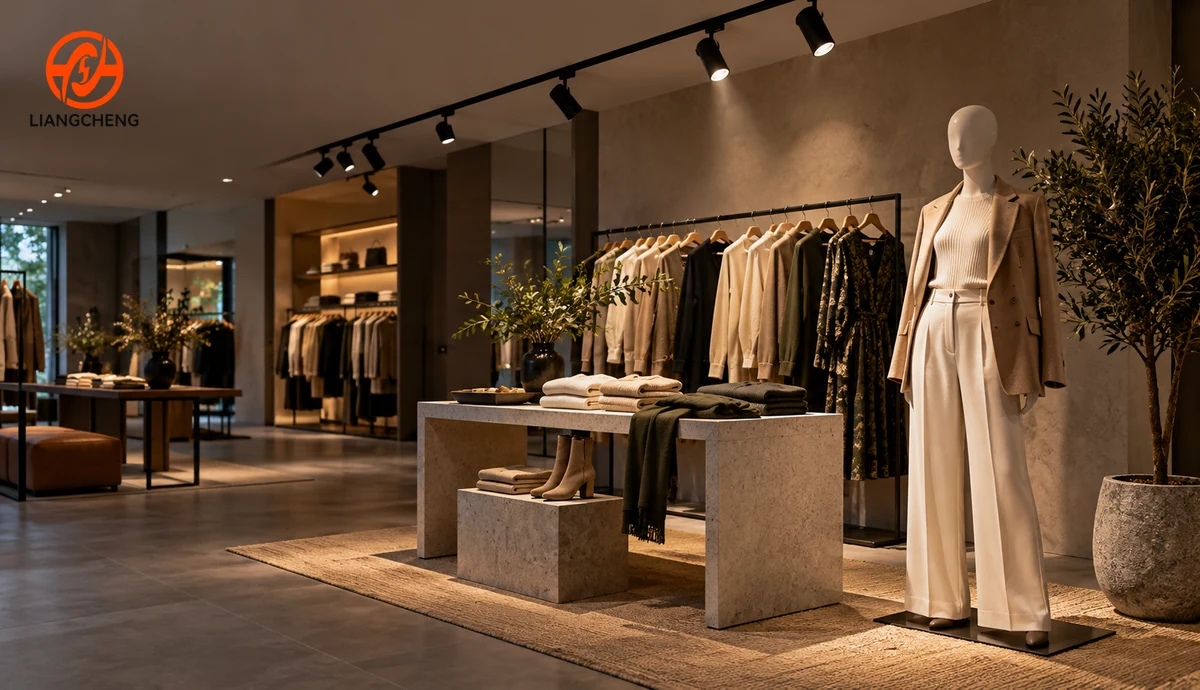
For a commercial example, see the fashion retail track lighting guide. Good spot targets include a sculpture on a pedestal, a vase on a console table, a single retail product, and a small framed print. The tight beam also creates shadows that give three-dimensional objects depth and texture. On tall ceilings of 12 feet (3.6 m) or more, a spot beam compensates for the way light spreads over distance.
The main risk is a hot spot, where the center is much brighter than the edges. Hot spots look harsh on flat artwork and create scalloped patterns when several spots sit side by side. Use spot beams on objects, not on large flat surfaces.
How Does a Medium Beam Behave and When Is It the Best Choice?
A medium beam, sometimes called a narrow flood, may span roughly 25° to 40°, although manufacturers use different labels. It offers a defined pool with gentler transitions than a tight spot. Around 24° to 36° can be a useful starting comparison for many accent tasks, but no angle is universally correct for a given ceiling height.
At a typical mounting distance of 5 to 8 feet, a 36° beam produces a pool roughly 3 to 5 feet wide. That suits framed art up to about 24 by 36 inches (60 by 90 cm), open shelving, kitchen islands, mantels, and dining tables. Because medium edges are soft, small aiming errors are less visible than they are with a spot.
How Does a Flood Beam Behave and When Should You Use It?
A flood beam often spans about 40° to 60° or more, producing a wider, softer area of light than a spot at the same throw distance. Floods suit general lighting in kitchens, offices, hallways, laundry rooms, and basements, and they suit low ceilings of 7 to 8 feet, where light has little distance in which to spread.
The trade-off is flatter-looking objects, because wide beams reduce shadow and texture. A room lit only by floods feels bright but uninteresting. Designers pair floods for background light with medium or spot heads for accents.
For ambient fill, some systems use linear track modules with symmetrical distribution of about 90° to 120° behind a diffuser. These replace recessed downlights as the base layer and soften shadows, while spot heads handle accents. Track lighting as a whole is better at targeted light than at uniform room lighting, so plan some dedicated ambient fixtures.
What Is a Wall Wash Track Light and How Is It Different From a Flood?
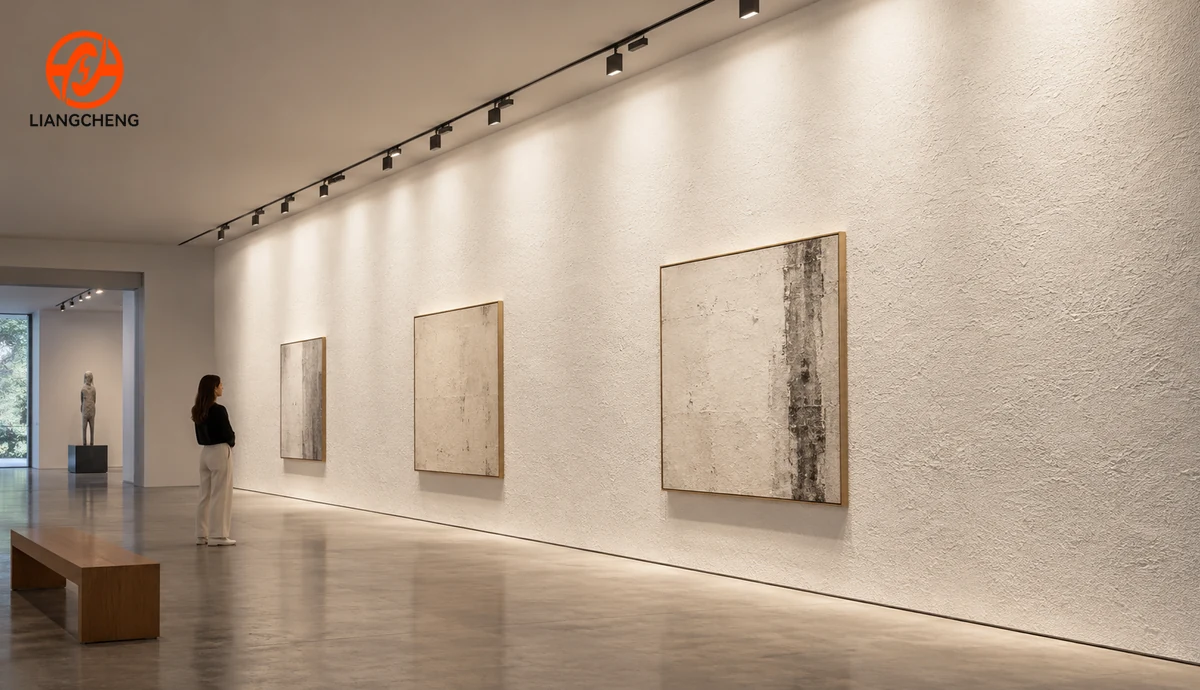
A wall wash track light uses an asymmetric lens or reflector to throw light sideways and downward so it spreads evenly over a vertical surface. A flood beam, by contrast, is a symmetrical cone that is brightest at its center, so aimed at a wall it leaves a bright oval. A properly designed wallwasher aims for a more even vertical distribution and fewer scallops than a standard symmetrical flood. The achieved uniformity depends on setback, spacing, wall height, and the luminaire’s photometry.
The optic does the work. Asymmetric optics send more light toward the far edge of the wall to compensate for the fact that points farther from the fixture receive less light. This avoids the bright-top, dark-bottom pattern that ordinary downlights create near walls.
Wall wash is the right tool when the wall itself is the subject: large paintings, gallery walls, curtains, and floor-to-ceiling bookcases. It also makes narrow rooms and hallways feel wider, because bright vertical surfaces increase perceived space.
Wall washing and wall grazing emphasize different visual effects. A wallwasher tends to reduce strong texture shadows, while close-set grazing accentuates them. Grazing places a narrow-beam fixture only inches from the wall so light rakes across it, which exaggerates texture on brick, stone, or plaster. Choose wall wash for smooth, even color, and grazing for dramatic texture.
How Do You Calculate Beam Diameter for Any Angle and Distance?
For a round, symmetrical beam aimed perpendicular to a flat target, the approximate diameter at the 50% intensity boundary equals two times the throw distance times the tangent of half the beam angle. Angled aiming, oval optics, spill, and nonuniform intensity require photometric review.
Diameter = 2 × Distance × tan(Beam Angle ÷ 2)
| Beam Angle | Diameter at 10 ft (3 m) | Diameter at 5 ft (1.5 m) |
|---|---|---|
| 15° | 2.6 ft (0.8 m) | 1.3 ft (0.4 m) |
| 24° | 4.3 ft (1.3 m) | 2.1 ft (0.64 m) |
| 36° | 6.5 ft (1.95 m) | 3.2 ft (0.98 m) |
| 60° | 11.5 ft (3.5 m) | 5.8 ft (1.75 m) |
| 90° | 20 ft (6 m) | 10 ft (3 m) |
The values describe the 50% intensity edge, so visible light extends slightly farther. To use the table, measure the distance to the subject and pick the angle whose diameter is slightly larger than the subject. A 3-foot-wide painting 5 feet from the fixture is well covered by a 36° beam (3.2 ft), while a 24° beam (2.1 ft) leaves its edges dark.
How Does Distance Change Brightness?
Brightness on a surface falls with the square of distance. Doubling the distance cuts illuminance to one quarter, and tripling it cuts illuminance to one ninth. This is the inverse square law.
The working formula is Illuminance (lux) = Candela ÷ Distance² (meters). Candela is the intensity at the beam center, and it is higher for narrow beams than for wide beams at the same lumen output. A fixture producing 2,000 candela delivers about 222 lux at 3 meters and about 889 lux at 1.5 meters, four times as much.
Distance has a second effect that is easy to miss: a given angle makes a larger pool the farther away it is. A 24° beam at 6 feet and a 15° beam at 10 feet produce nearly the same pool size, about 2.6 feet, but the nearer fixture delivers much higher illuminance. This is why moving a head closer often changes the result more than swapping the lamp.
How Do You Choose a Beam Angle for Your Ceiling Height?
The higher the track, the narrower the beam should be for accenting, because light spreads and loses intensity over distance. Use these starting ranges, then adjust for the subject:
- 7–8 ft (2.1–2.4 m): 36°–60°. Narrower beams make small, harsh pools at this height.
- 8–10 ft (2.4–3 m): 24°–36° for accents, 40° or wider for general light.
- 10–14 ft (3–4.3 m): 15°–24° for accents, around 36° for general light.
- Over 14 ft (4.3 m): 10°–15° for accents, and consider suspended fixtures to shorten the throw.
These assume a subject near eye level, about 5 feet above the floor. For floor-level targets such as rugs or plants, measure the distance from the fixture to the floor.
How Do You Choose a Beam Angle for the Size of the Object?
Pick the angle whose pool is 10% to 25% larger than the object at your throw distance. A pool much larger than the object wastes light and lowers contrast, and a pool smaller than the object leaves parts dark.
For a 2-foot sculpture 6 feet away, a target pool around 2.4 to 2.6 feet may allow modest coverage beyond the object. A 24° beam gives 2 × 6 × tan(12°) ≈ 2.55 feet at the nominal boundary, so it is a plausible starting point. For wall-sized paintings or full bookcases, no single standard beam fits, so use wall wash optics or several evenly spaced fixtures.
How Should You Aim Track Lights to Avoid Glare and Shadows?
Tilt the fixture about 30° from vertical when lighting wall-mounted art. This is often called the 30-degree rule, or museum angle. Light reaches the artwork without reflecting into a viewer’s eyes and without casting the viewer’s shadow across the piece.
Aiming too steeply creates a bright upper band and a shadow under the frame. Aiming too shallowly creates reflected glare on glossy surfaces. For three-dimensional objects, aim from slightly above and in front, and consider crossing two lower-intensity beams from opposite sides to avoid harsh shadows.
Project teams should check compatible heads and accessories together; the track rail accessories guide covers the broader system. Glare control accessories help. Snoots and cylinders narrow and shield the light, honeycomb grids block stray light at wide angles, and diffusers soften hard edges. Adding an accessory to an existing head is often cheaper than replacing it.
How Do You Space Wall Wash Fixtures?
As an initial sketch, some wallwasher systems use a setback near one third of the wall height, but spacing varies by optic. For an 8-foot wall, one third is about 32 inches (81 cm). Select the actual setback and spacing from the chosen fixture’s photometric guidance and a project mockup rather than transferring a generic rule between products.
These numbers are only starting points. A fixture too close to the wall can create bright patches near the top; one too far away can spill light into the room. Use the manufacturer’s wallwasher tables or IES photometric file to test vertical uniformity at the proposed setback and spacing. Keep the layout regular unless the photometric study supports a change.
How Do You Space Flood Fixtures for Even Coverage?
Space flood fixtures so their pools overlap at the working surface, typically at about half to one full beam diameter apart. Use the diameter formula at the throw distance to the surface that needs even light.
For example, a nominal 60° flood on a 9-foot ceiling above a 3-foot-high counter has a 6-foot vertical throw. The geometric 50% diameter is 2 × 6 × tan(30°) ≈ 6.9 feet. A preliminary spacing around half that diameter creates overlap, but actual uniformity also depends on aiming, intensity distribution, counter reflectance, and room geometry. Confirm the spacing in a lighting calculation.
How Do You Combine Beam Angles on One Track?
A compatible track system can carry flood or linear heads for background light, medium heads for furniture and shelving, and spot or wallwash heads for focal points. The number and output of each type should follow the target illuminance, desired contrast, and visual hierarchy; a fixed percentage split is not reliable across projects.
Le adapter compatibility checklist helps buyers verify the mechanical and electrical interface. Two practical checks make mixed beams work. First, verify that each head’s adapter fits the exact track profile, conductor layout, grounding arrangement, and electrical rating; letter labels used in some markets do not guarantee compatibility. Second, determine whether separate switching or dimming groups are required. For circuit planning, compare two-circuit and three-circuit track systems. A multi-circuit rail can support circuit separation only with the appropriate feeds, controls, and compatible luminaires; the number of circuits alone does not provide dimming.
Zoomable heads add flexibility. Some track heads adjust from about 15° to 55° without changing the lamp, which suits retail displays and galleries that rearrange often. The trade-off is a higher price and more moving parts.
How Can You Verify a Fixture’s Real Beam Angle?
Check the datasheet for the stated beam angle, center-beam intensity, field angle if given, and an IES or equivalent photometric file. The 50% and 10% thresholds describe different boundaries. A simple wall test can reveal obvious mismatch, but it cannot replace a photometric measurement.
For a rough visual check, aim a symmetrical fixture perpendicular to a flat wall from a measured distance and estimate the circle diameter. Then use Angle = 2 × arctan(Diameter ÷ (2 × Distance)); a 5-foot circle at 10 feet gives about 28°. Because the visible edge is subjective, this calculation does not verify the rated 50% beam angle.
A wall test is only a rough estimate, because your eye judges the visible edge somewhere between the 50% and 10% points, which makes the result read wider than the rated angle. Professionals use photometric software or goniophotometers for exact values, and manufacturers publish angles from standardized tests.
What Beam Angle Is Best for Each Room?
These starting points assume 8 to 10 foot ceilings:
- Living room art: 24°–36°, or wall wash for large pieces.
- Living room general light: 40°–60° floods.
- Kitchen counters and island: 36°–60° to avoid shadows on work surfaces.
- Dining table: 15°–24°, which limits spill beyond the table.
- Hallway: 36°–60°, spaced for even light along the length.
- Home office: 40°–60°, positioned to avoid screen reflections.
- Bookcases: wall wash, or 36°–60° heads covering the vertical face.
- Retail: 10°–24° for key products, 36° for shelves, wall wash for back walls.
- Gallery: 15°–36° adjustable, with wall wash for large works.
For accent lighting of art, fabric, food, or skin tones, choose fixtures with a color rendering index (CRI) of 90 or higher. A well-matched angle shows the subject, and high CRI shows its true color.
What Are the Most Common Beam Angle Mistakes?
The most common mistake is using one angle for every fixture, which produces flat or spotty lighting. The second is ignoring distance, since a 24° beam that fits at 6 feet looks too small at 12 feet. The third is using spot beams on large flat surfaces, which causes hot spots and scalloping.
Other frequent errors include aiming too steeply or shallowly, placing wall wash fixtures at the wrong setback, and dimming narrow beams without testing, because hot spots become more or less visible as brightness changes. Test one fixture in place before committing to a full layout.
Frequently Asked Questions About Track Light Beam Angles
What is the best all-purpose beam angle for track lighting? A beam angle between 24° and 36° suits most homes with standard ceilings. It is wide enough for typical objects and narrow enough to create contrast.
What is the difference between a 24° and a 36° track light? A 24° beam makes a tighter pool, about 4.3 feet wide at 10 feet, while a 36° beam makes a larger and softer pool, about 6.5 feet wide at the same distance. The 24° beam gives more contrast and suits smaller subjects or higher ceilings.
Is a spot or a flood better for track lights? Neither is better in general. Spots highlight specific objects, and floods give even general light. Most well-designed rooms use both.
Does a smaller beam angle mean a brighter light? For comparable fixtures with similar lumens and optical efficiency, a narrower beam usually increases center intensity in candela while covering less area. Compare measured photometry because beam angle alone does not determine brightness.
Is a wall wash the same as a flood? No. A flood is a symmetrical cone, while a wall wash uses an asymmetric optic to spread light evenly over a vertical surface.
Final Takeaway: A Simple Beam Angle Selection Method
When the track layout itself is still open, review surface, recessed, and suspended installation. Measure three things: the distance from fixture to subject, the size of the subject, and the ceiling height. Then decide whether you want contrast or softness. Use spots of 10° to 25° for small objects and high ceilings, medium beams of 25° to 40° for most residential accenting, floods of 40° to 60° or wider for general light, and wall wash when the whole wall is the subject. Confirm each choice with Diameter = 2 × Distance × tan(Angle ÷ 2), and combine beam types to build a layered plan.
Plan Track Lighting as a Compatible System
Beam choice belongs in the luminaire specification, while the rail, adapter, feed, and control arrangement must work together. Liangcheng Lighting supplies track lighting rails for wholesale and project customization. For a B2B quotation, share the rail layout, installation method, conductor platform, fixture adapter details, finish, lengths, and target quantity. Contact Liangcheng Lighting to discuss a compatible rail package for your project.
Besoin de solutions d'éclairage sur rail personnalisées ?
Contactez Liangcheng Lighting pour des solutions professionnelles de rails d'éclairage en aluminium en tant que fabricant d'équipement d'origine (OEM) ou fabricant d'équipement d'origine (ODM) et pour un support d'éclairage professionnel.
Connexe