







For the same 6063 aluminum extrusion, T6 generally carries higher specified minimum tensile and yield strengths than T5, but T6 is not automatically the better track lighting rail. T5 and T6 describe how a heat-treatable alloy reaches its final temper. A useful rail decision also requires the profile drawing, wall thickness, support spacing, finish, copper conductor design, insulators, power feeds, and adapter fit. A buyer should request measurable system performance rather than selecting a temper label alone.
Reading time: 13 minutes. This guide is for lighting-project buyers, distributors, wholesalers, and engineers comparing aluminum rail materials for surface-mounted, recessed, and suspended track lighting systems. The figures below are published 6063 extrusion examples, not test results for a specific Liangcheng Lighting batch.
What do T5 and T6 mean on an aluminum track rail quotation?
T5 means an aluminum product is cooled from an elevated-temperature shaping process and then artificially aged. T6 means the product is solution heat treated and then artificially aged. Both temper designations belong to a defined alloy and product form; “T6 aluminum” without an alloy number is incomplete because different alloys have different property limits.
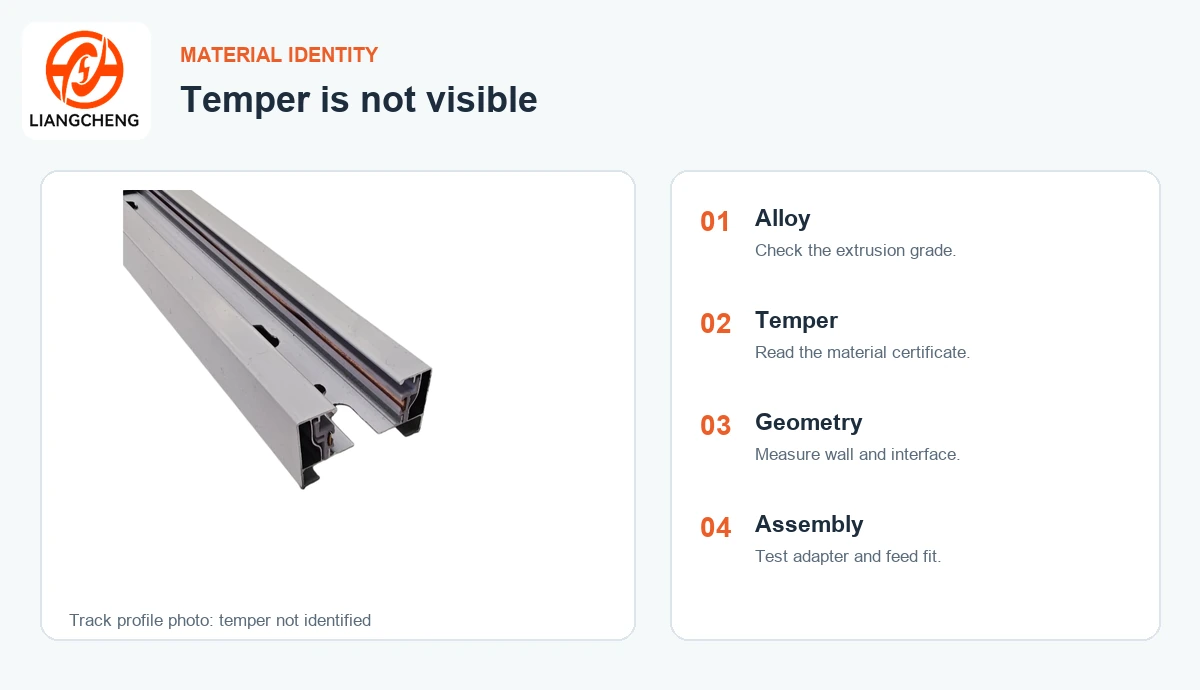
The distinction matters because the temper is a processing and property specification, not a visible feature. A rail can have the same color and apparent cross-section in T5 and T6. A photograph, a surface scratch test, or a supplier’s verbal statement cannot verify the temper. The purchase order should identify the alloy, temper, governing material standard, extrusion drawing, and evidence required from the production lot.
For a common lighting-profile example, buyers often discuss 6063-T5 and 6063-T6. Alloy 6063 is associated with extrudable architectural profiles and a good finishing response, while the T5 or T6 suffix controls specified mechanical properties after processing. Liangcheng’s 6063 aluminum material guide introduces the alloy choice; this article focuses on choosing and verifying its temper for a complete track rail.
How does T5 processing differ from T6 processing?
T5 starts from an elevated-temperature forming operation, such as extrusion, and relies on controlled cooling followed by artificial aging. The exact route and resulting properties depend on the alloy, extrusion section, cooling practice, and applicable standard. The label does not mean that the rail was merely left at room temperature after the press.
T6 includes solution heat treatment followed by artificial aging. Solution treatment and cooling create a different metallurgical starting state for the aging step. The buyer does not need to prescribe a furnace recipe unless the project specification requires one, but the supplier must be able to demonstrate that the delivered lot meets the specified temper and mechanical properties.
A post-extrusion process route can affect manufacturing cost, lead time, distortion control, and inspection needs. Those effects vary by extrusion shape and plant capability; T6 should not be assumed to have one universal premium or delivery penalty. A buyer should ask for the finished part price and inspection plan for the exact rail profile, rather than applying a generic temper surcharge.
| Question | T5 | T6 |
|---|---|---|
| How is the temper reached? | Cooling from elevated-temperature shaping, then artificial aging | Solution heat treatment, then artificial aging |
| What does the designation establish? | Processing condition and applicable property limits for a named alloy and product | Processing condition and applicable property limits for a named alloy and product |
| What must a buyer still verify? | Wall, straightness, finish, conductor and adapter system | Wall, straightness, finish, conductor and adapter system |
| Can a photo identify it? | No | No |
Does 6063-T6 have a measurable strength advantage over 6063-T5?
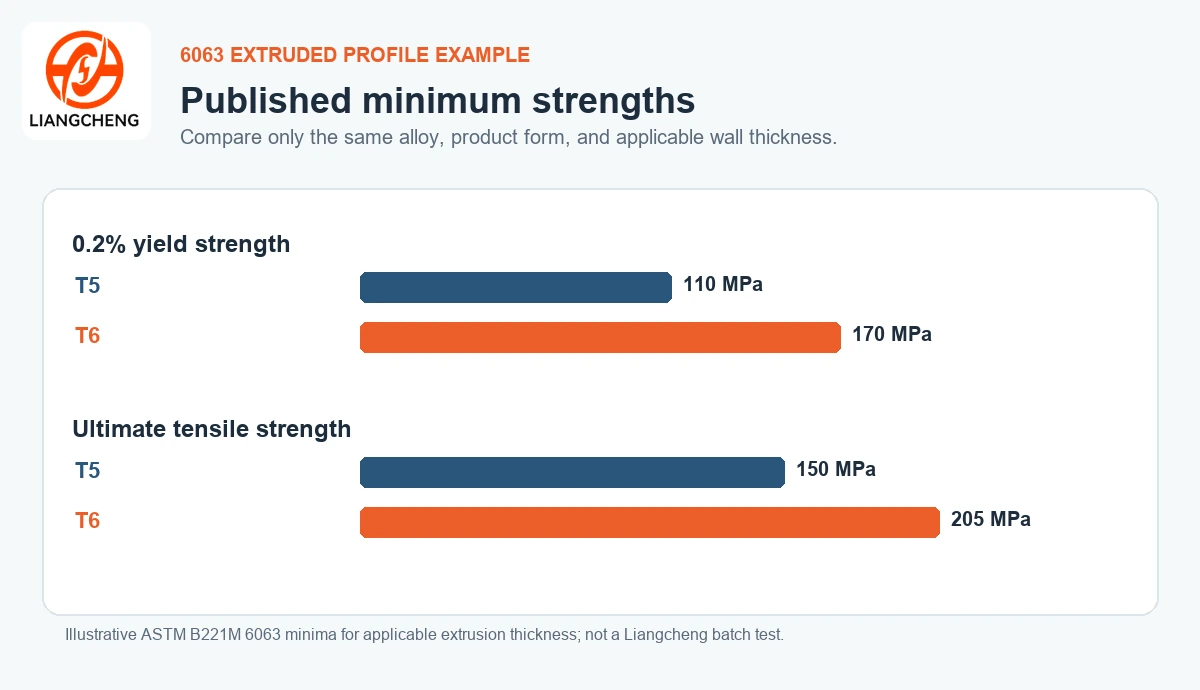
For the same 6063 extruded product form and applicable wall-thickness range, published minimum strength requirements for T6 exceed those for T5. An illustrative ASTM B221M table gives 6063-T5 minimum 0.2% yield strength of 110 MPa and ultimate tensile strength of 150 MPa for the specified thinner extrusion range. The corresponding 6063-T6 minimum values are 170 MPa and 205 MPa. Different thickness ranges or standards may have different limits, so the actual purchase specification must state which row applies.
The numerical comparison is a material-property example, not evidence that every T6 rail is 55% stronger in service or that every T5 rail performs at its minimum. Actual test values can exceed published minima, and rails fail or deform through the combined effects of section geometry, loading, joining, support, and installation. A buyer should use tensile values to verify material conformance, then evaluate the assembled rail under the project’s relevant loading conditions.
T6 can offer useful additional resistance to permanent deformation when the same profile and load case are compared. That advantage may matter for a demanding rail design, but it is not a substitute for a verified mounting plan. If the profile wall is too thin, the span too long, or a connector poorly supported, a stronger temper alone cannot guarantee acceptable installed performance.
Does T6 prevent long track rails from sagging?
Visible sag in a track rail depends strongly on profile geometry, rail length, support spacing, luminaire positions, and the stiffness of joints and mountings. T5-to-T6 strength limits help address permanent yielding, but a higher yield rating does not automatically solve ordinary elastic deflection. A project should verify straightness and allowable deflection for the actual rail configuration and installed loads.
A long surface-mounted run can often be improved by a better support schedule or a stiffer cross-section. A suspended run also needs its suspension points and join locations coordinated with the rail load. A recessed run may rely on a prepared ceiling support system, so the surrounding construction can dominate alignment. The buyer should request the manufacturer’s load and fixing guidance rather than infer safe spacing from alloy temper.
Transport can introduce curvature before installation. Protective packaging, straight handling, and documented acceptance limits matter for both T5 and T6 rails. Liangcheng’s long track rail packaging guide explains why shipping protection belongs in the quality plan for extended lengths.
Does temper determine wall thickness or common rail size?
Temper and profile dimensions are separate specifications. A 6063-T5 extrusion and a 6063-T6 extrusion could share a nominal external width, but the drawing must still define wall thickness, internal contact channel, mounting features, and permitted tolerances. A buyer should never treat the temper suffix as a promise of a thicker wall or greater section weight.
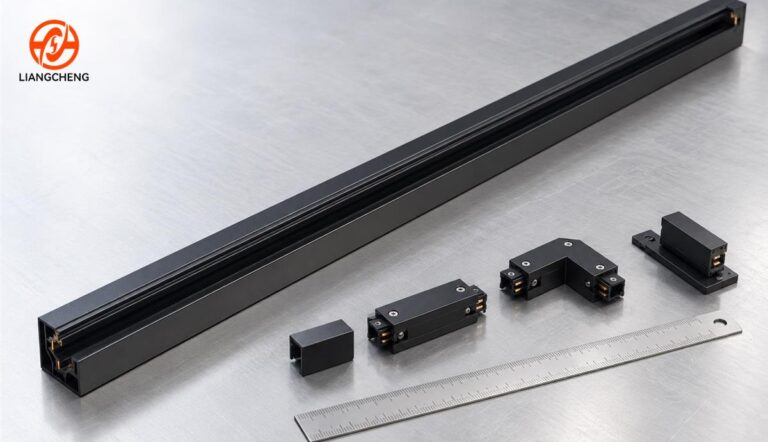
Track rail dimensions vary by electrical platform, profile family, and installation method. Two-wire, three-wire, four-wire, and six-wire systems can use different conductor arrangements and adapters; recessed and suspended profiles may require different outer geometry. Common order lengths depend on the supplier’s offering and shipping plan. Liangcheng’s H-type track rail dimensions guide shows the kinds of external and internal measurements that should accompany a quotation.
A drawing should identify which dimensions are critical to system fit. The adapter interface, conductive strip position, insulator retention, feed engagement, joint alignment, and mounting slot may require tighter control than a decorative surface. T6 cannot compensate for a contact channel that is outside tolerance, and T5 does not imply poor dimensional accuracy when extrusion and inspection are controlled.
Is T5 easier to cut, drill, or form on site?
Machining and fabrication behavior may differ between tempers, but the direction and size of any practical advantage depend on the alloy, tool, section, and manufacturing method. A buyer should not assume that a T5 rail can be bent or cut freely, or that a T6 rail cannot be processed. The approved supplier instructions determine whether field cutting, drilling, or forming is allowed for the specific system.
Field cutting can expose new metal, change the length of insulating parts or conductor strips, and alter the required end-cap and feed arrangement. A clean cut does not prove that the electrical system remains safe or compatible. A project should specify factory-cut lengths when accurate repetition is important, then define how any unavoidable site adjustment will be inspected and protected.
Recessed installations are particularly sensitive to uncontrolled field modification because a cut rail must align with a prepared ceiling opening. Suspended rails need correctly placed suspension interfaces, and surface rails need fasteners positioned to suit the substrate. Temper selection should follow the mechanical design rather than stand in for a complete installation drawing.
Does T5 or T6 change corrosion resistance and surface finish?
T5 and T6 do not, by themselves, specify an anodized coating, powder-coat thickness, color consistency, or corrosion performance for the finished rail. Alloy chemistry, surface preparation, coating process, environment, and handling are separate variables. A seller who promises a superior finish solely because a profile is T6 is leaving out the actual finish specification.
A project buyer should approve a finish sample and define the inspection method for visible faces. A brushed or anodized silver profile can reveal extrusion lines differently from a white or black coated rail. The assembled sample should include connectors and end caps because mismatched color or sheen at accessories can be more obvious than small variations along a straight length.
Protective packaging is part of finish control. Contact between long aluminum sections can cause rubbing or scratches during transport even when the temper meets specification. A site receiving inspection should separate a material-property defect from a coating, handling, or packaging defect so the correct corrective action is taken.
Does aluminum temper affect wiring or electrical compatibility?
The aluminum rail body supports the track system, but its temper does not identify the number of live conductors, circuit arrangement, copper strip material, insulation design, protective earth interface, or electrical rating. Those features belong to the complete rail, feed, connector, adapter, and luminaire system. A buyer should not describe a T6 rail as electrically safer than a T5 rail without product-level evidence.
Wiring should be checked against the exact system’s marked terminals, approved power feeds, applicable local requirements, and qualified installation instructions. The rail’s mechanical strength does not remove the need to verify polarity, earth continuity where required, circuit selection, and secure contacts. A two-wire versus four-wire decision is an electrical and control choice, not a temper choice.
Adapter compatibility needs physical and electrical validation. A track head may enter the channel but fail to lock, contact the intended conductor, or maintain the correct circuit selection. Liangcheng’s adapter compatibility checklist gives buyers a practical way to test the assembled interface.
Which track lighting applications might justify T6?
T6 may merit evaluation when a design requires higher verified material strength within the same alloy and profile family. Examples can include a rail with demanding fixture loads, long sections, or tight limits on permanent deformation. The project engineer still has to check support conditions, connectors, and the full assembly before approving the change.
A standard indoor retail rail may already meet its design requirements in the specified T5 condition. In that situation, ordering T6 without a defined performance target may add process and approval work without improving the customer’s visible result. The decision should be tied to a measurable requirement such as material-property minimum, allowable permanent set, or the supplier’s approved load schedule.
For a recessed rail, the ceiling opening and profile geometry may matter more than an increased material-strength figure. For a suspended rail, anchor and suspension-kit design are often the first questions. For a surface rail, fixing spacing and substrate may control performance. These are engineering priorities, not claims that one temper is universally best for an installation method.
How should a buyer compare T5 and T6 quotations fairly?
A fair quotation holds the alloy, profile drawing, wall thickness, finish, order length, electrical platform, accessories, and inspection plan constant while changing the requested temper. Comparing 6063-T5 from one profile with a different 6061-T6 extrusion confuses alloy and geometry with temper. The buyer should ask suppliers to disclose any drawing or tooling changes needed for the requested temper.
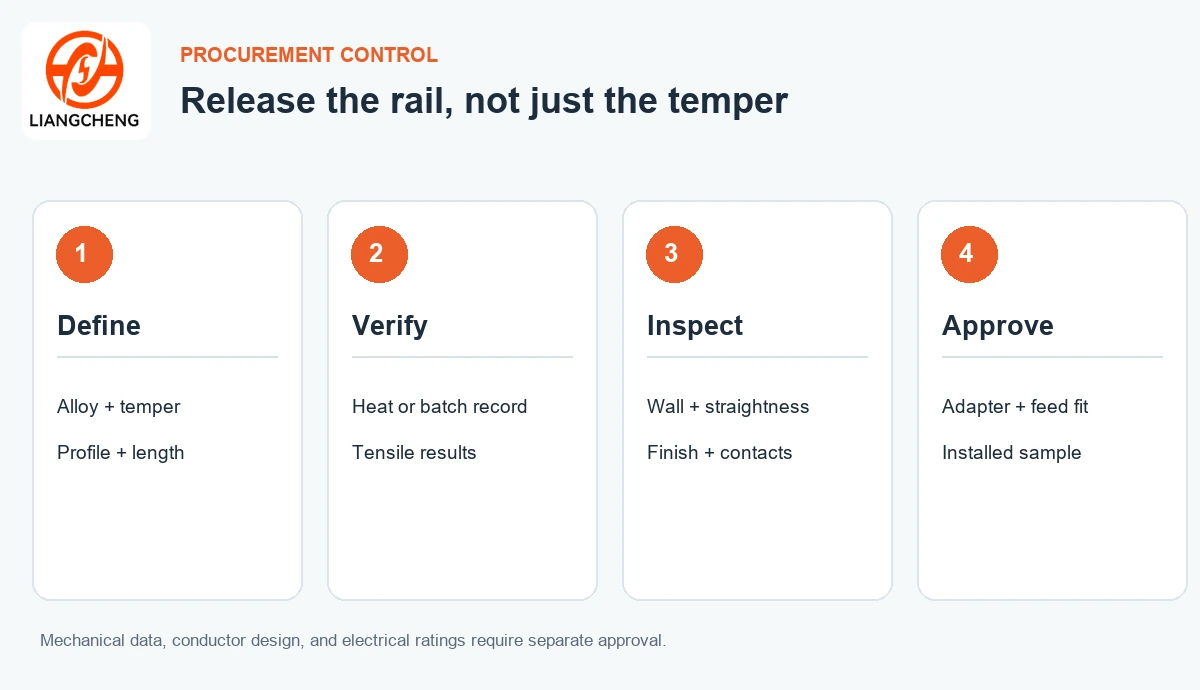
The purchase specification should name the material standard and applicable thickness range. It should also require a heat or batch identifier and a certificate or test report that links delivered extrusions to the declared alloy and temper. A generic certificate for unrelated stock cannot establish the condition of the delivered rail.
Price comparisons should include yield loss, straightening or finishing requirements, sample approval, delivery timing, and the cost of rejects. A lower unit price is not attractive if a rail arrives bowed, scratched, or incompatible with the selected adapter. Liangcheng’s track rail quality inspection guide covers the wider system checks that material certification alone cannot replace.
What should incoming inspection test on finished rails?
Incoming inspection should begin with identification. The receiving team should match the carton, rail marking or trace record, purchase order, drawing revision, alloy, temper, finish, and length. The material certificate should identify the applicable lot and relevant mechanical results. If the paperwork cannot be linked to the delivered goods, the temper claim is not adequately verified.
Dimensional inspection should measure the agreed critical features, including outer profile, wall at specified locations, adapter channel, conductive strip location, and mounting interface. Straightness should be checked over the specified length using a consistent method. The sample plan should cover production variation, not only one visually attractive rail from the top of the shipment.
Functional inspection should use the intended track head adapter, power feed, joiner, and end cap. The installer or qualified test team should verify locking, movement, electrical continuity, and rating-related requirements as applicable. Temper compliance and system compatibility are separate approval gates; passing one does not establish the other.
What information belongs in a T5 or T6 track rail RFQ?
A useful RFQ states the application and installation method, drawing or target cross-section, 6063 or other alloy designation, T5 or T6 requirement, finish, color, order lengths, quantity, packaging, electrical platform, compatible adapters, and accessory schedule. It should explain why a particular temper is requested so the supplier can propose a verified alternative if the design goal can be met more efficiently.
The RFQ should define acceptance evidence: material certificate, mechanical-property results, dimensional inspection report, finish sample, assembly compatibility check, and packaging photos or specification. State whether the material data must be from each heat, batch, or agreed sampling plan. A “T6 preferred” note without acceptance criteria is too vague for a controlled B2B order.
Installation information also belongs in the RFQ. Surface-mounted projects need fixing and span assumptions; recessed projects need ceiling opening and edge detail; suspended projects need load and suspension conditions. Liangcheng’s track rail RFQ information checklist helps turn those facts into a quotation package.
How should buyers evaluate a sample before mass production?
A preproduction sample should use the intended alloy, temper, extrusion die, finish, conductor assembly, and packaging method. Record measured straightness and critical dimensions before and after finishing, then fit the specified adapters and connectors. For long suspended or high-load runs, test the representative mounting span and fixture load rather than a short loose offcut. Retain the approved sample and inspection results as a reference for production lots. This sequence makes any later change to temper, die, or finishing process visible before it reaches a project site.
What are the most common T5 versus T6 buying mistakes?
The first mistake is comparing different alloys or different cross-sections as if the temper were the only variable. A stronger-looking rail may owe its performance to a thicker wall or shorter support span. Ask for the same drawing and the same test basis before attributing a difference to T5 or T6.
The second mistake is treating a published minimum as a certified result for a particular shipment. Published values define a reference requirement for a specified standard and size range. The delivered lot needs traceable evidence if the temper is a contractual requirement.
The third mistake is expecting the temper to solve finish, conductor, or adapter problems. T6 does not guarantee better anodizing, correct copper contacts, or an approved fixture fit. Those questions need their own drawings, samples, and tests.
The fourth mistake is selecting T6 because it sounds more “premium” while ignoring project load and installation. A rail that passes the actual load and system checks in T5 can be a rational purchase. A demanding rail may need T6, a different wall thickness, more support, or a different profile; the correct answer comes from verified performance.
Foire aux questions
Is 6063-T6 always better than 6063-T5 for track rails?
No. 6063-T6 has higher published minimum strength in comparable extrusion ranges, but the best rail depends on the complete profile, mounting, finish, electrical platform, accessories, and price. A buyer should specify a performance requirement before choosing the temper.
Can an inspector identify T5 or T6 by color or hardness feel?
No. Appearance is not a reliable temper test, and a casual scratch or handling check is not a substitute for a traceable material certificate and appropriate mechanical-property evidence.
Does T6 allow a longer unsupported span?
Not automatically. A span decision requires the rail section, fixture loads, connector behavior, support method, and allowable deflection or permanent set. Higher material strength alone does not establish the span.
Does changing from T5 to T6 change the track light adapter?
Temper alone should not change the adapter geometry, but a new production route or profile revision can affect critical dimensions. The buyer should verify the actual rail and adapter together after any material or process change.
Can the same supplier deliver both tempers?
Availability depends on the alloy, profile, extrusion and heat-treatment capability, order quantity, and specification. Ask the supplier to confirm the exact alloy-temper-drawing combination and the evidence supplied with each batch.
Which temper should a B2B buyer specify?
Specify T5 when the approved profile and installed system meet the project’s load, dimensional, finish, and compatibility requirements in that condition. Specify T6 when the design has a documented need for its higher material-property limits and the supplier can validate the complete rail after processing. In both cases, demand a traceable material record and an assembled-system approval. Temper is one controlled input to a reliable track lighting rail, not the final verdict on product quality.
Discuss wholesale or custom rail requirements with Liangcheng Lighting
Liangcheng Lighting supplies track lighting rails for commercial projects, distributors, and wholesale buyers, with customization options for the specified system. Share your drawing, target alloy and temper, installation method, rail lengths, finish, adapter, and order quantity so the team can review the complete requirement. Contact Liangcheng Lighting to request a project quotation or discuss a custom track rail program.
Besoin de solutions d'éclairage sur rail personnalisées ?
Contactez Liangcheng Lighting pour des solutions professionnelles de rails d'éclairage en aluminium en tant que fabricant d'équipement d'origine (OEM) ou fabricant d'équipement d'origine (ODM) et pour un support d'éclairage professionnel.
Connexe