








Estimated reading time: 14 minutes.
A recessed track rail should be purchased as a ceiling-integrated lighting system, not as an isolated aluminum profile. The correct buying decision combines the rail platform, ceiling section, mounting method, electrical architecture, compatible adapters and fixtures, connectors, feed components, finishing detail, maintenance access, and installation sequence. A rail that looks correct in a catalog can still create gaps, cracked plaster, inaccessible wiring, or incompatible fixtures when those interfaces are not approved before the ceiling is closed.
This guide is written for lighting distributors, contractors, architects, project buyers, and private-label brands sourcing recessed track lighting rails in bulk. It focuses on the information required to compare quotations, approve samples, coordinate construction, and receive consistent production rather than repeating a general explanation of track lighting.
What Is a Recessed Track Rail?
A recessed track rail is an aluminum lighting track installed partly or fully inside a ceiling or wall so the visible profile is reduced. The rail carries electrical conductors and provides the mechanical interface for compatible track light adapters or lighting modules. The ceiling construction hides the outer rail body while leaving the operating channel accessible for fixtures.
The word “recessed” describes the mounting relationship with the building surface; it does not identify one universal electrical standard. Recessed rails may belong to conventional mains-voltage track families, multi-circuit systems, or low-voltage magnetic platforms. A buyer must specify both the mounting construction and the electrical ecosystem because similar-looking recessed profiles may not accept the same adapters, conductors, feeds, or accessories.
What Is the Difference Between Recessed, Trimless, and Surface-Mounted Track?
A recessed rail with trim sits inside the ceiling opening but retains a visible flange that covers the cut edge. A trimless recessed rail uses plaster wings or another finishing interface so the ceiling finish meets the inner track opening without a visible border. A surface-mounted rail attaches below the finished ceiling and leaves the complete profile visible.
| Mounting method | Visual result | Construction timing | Installation tolerance | Best project condition |
|---|---|---|---|---|
| Surface-mounted | Complete rail remains visible | Can often be installed after the ceiling is finished | Alignment still matters, but no plaster interface is required | Retrofits, concrete ceilings, fast store upgrades, exposed interiors |
| Recessed with trim | Rail body is concealed; a narrow flange frames the opening | Opening and support should be prepared before final installation | The flange can hide a limited cut-edge variation | Suspended ceilings where a defined border is acceptable |
| Trimless recessed | Track opening appears integrated into the ceiling plane | Must be coordinated before final plastering and painting | Highest demand for straightness, level, joint support, and finishing quality | New construction and premium architectural interiors |

Trimless is not automatically the best choice. A finished concrete ceiling, a rapid retrofit, or a project with uncertain ceiling coordination may make surface mounting more practical. A recessed rail earns its visual advantage only when the project can control the ceiling opening, support, alignment, joint treatment, and future maintenance access.
Which Projects Benefit Most From Recessed Track Rail?
Recessed track rail is strongest where the ceiling plane is part of the architectural concept and lighting positions may change after opening. Fashion retail, galleries, showrooms, hotels, restaurants, offices, and high-end residential projects often benefit because the rail recedes visually while adjustable fixtures continue to support changing displays or room layouts.
A recessed system is less suitable when the ceiling is already complete, the void contains unresolved structural or mechanical conflicts, or maintenance components cannot remain accessible. A project that cannot finalize the track path before ceiling closure should compare a surface-mounted alternative rather than forcing a trimless detail into an unsuitable construction stage.
What Must a Buyer Decide Before Requesting a Quotation?
A useful quotation begins with a confirmed project condition. The buyer should provide the reflected ceiling plan, ceiling material and build-up, available void depth, structural support concept, rail path, feed locations, circuit or control requirements, intended fixtures, finish, quantities, packaging limits, destination market, and installation schedule. These inputs allow suppliers to quote comparable systems instead of interpreting an incomplete request differently.
The rail path should identify every straight length, corner, branch, crossing, wall-to-ceiling transition, termination, and power entry. The fixture schedule should identify adapter family, quantity, weight, wattage, circuit assignment, beam purpose, and control requirement. A rail layout without a fixture and electrical schedule cannot prove that the system is complete.
Which Recessed Track Platform Should You Choose?
The platform should be selected by the required fixture ecosystem and control function before the mounting profile is finalized. A simple single-circuit system may suit a small fixed layout. A multi-circuit system can divide fixtures into separately controlled groups on one rail. A magnetic low-voltage system may support compact interchangeable modules but also requires matched drivers, contacts, voltage, and control components.
Wire count, circuit count, and product naming are not reliable substitutes for a wiring diagram. Buyers should request the conductor arrangement, rated input, protective-earth method where applicable, circuit allocation, adapter contact positions, and exact compatible part numbers. The guides to 2-wire track rail, 3-wire track rail, and 4-wire track rail explain those electrical platform decisions in more detail.
Which Profile Dimensions Must Be Confirmed?
A recessed-track drawing must show the complete cross-section, not only the visible slot width. The approval dimensions should include overall rail width and height, internal channel geometry, visible opening, flange or plaster-wing width, conductor position, insulation position, mounting holes, adapter engagement surfaces, ceiling cutout, finished ceiling datum, and required space above or beside the profile.
Ceiling depth cannot be selected from a generic online rule. The actual requirement depends on the quoted profile, mounting bracket, electrical feed, connector envelope, cable bend, ceiling frame, board thickness, finishing layers, and service-access method. The supplier drawing and project ceiling section must be reviewed together before the purchase order is released.
Length also needs a system-level definition. Nominal rail length, cut tolerance, end preparation, connector allowance, end-cap allowance, and installed layout length are different values. Use the track lighting rail dimensions guide to build a measurement schedule that avoids cumulative layout errors.
How Do Ceiling Material and Structure Affect the Rail Choice?
Gypsum-board ceilings can accept purpose-designed trim or plaster-wing profiles when the framing and backing support the installed load. Modular ceiling systems require a detail that transfers weight to approved structural members rather than relying on a decorative tile. Concrete ceilings usually require a planned recess, secondary ceiling, or surface-mounted solution because late channel cutting can be impractical or unacceptable.
The rail must not depend on joint compound for structural support. Long profiles, connectors, fixtures, and installation handling create loads that should be transferred through specified brackets, backing, screws, or structural frames. The project engineer or qualified contractor must approve fixings for the actual substrate and local requirements.
What Drawings Should Be Approved Before Production?
A purchase-ready recessed rail package should contain at least five coordinated drawings. The reflected ceiling plan controls location and geometry. The cross-section controls the ceiling interface and visible datum. The fixing detail controls brackets, backing, and fasteners. The wiring or single-line diagram controls feeds, circuits, drivers, and controls. The accessory schedule controls the part number and orientation of every joiner, corner, feed, and end component.
- Reflected ceiling plan: track centerlines, segment lengths, corners, branches, feed points, driver or junction locations, and fixture zones.
- Ceiling section: rail cross-section, board thickness, cutout, finished surface, void, framing, and maintenance clearance.
- Fixing detail: bracket type, backing, fastener type, support spacing, joint reinforcement, and load path.
- Electrical diagram: input rating, circuits, protection, conductor allocation, drivers, dimming or control buses, and feed direction.
- Accessory schedule: straight joiners, conductive joiners, L/T/X parts, flexible connectors, live ends, end caps, covers, and adapter families.
Each drawing should carry a revision identifier and approval status. A written change-control rule should require review when profile geometry, connector tooling, conductor material, insulation, finish, or compatible adapter design changes after sample approval.
Why Must Installation Be Planned Before Ceiling Closure?
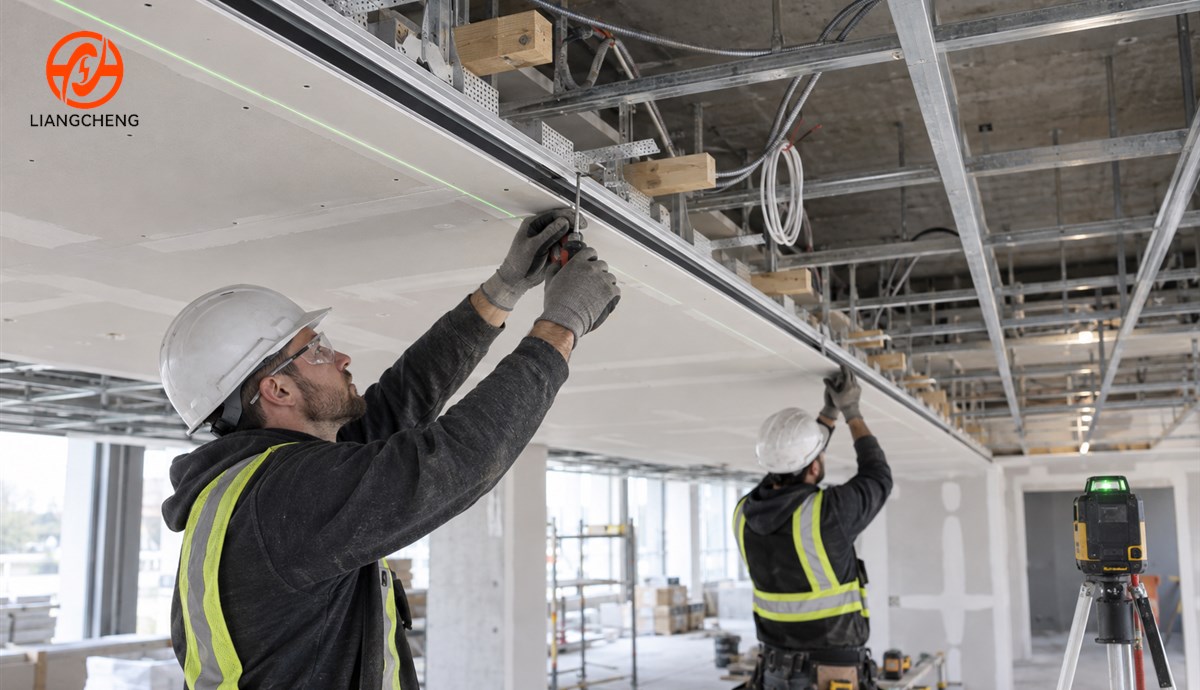
Trimless rail becomes part of the ceiling construction, so its most important decisions occur before the finished surface exists. Track location must be checked against joists, suspension channels, ducts, pipes, sprinklers, detectors, access panels, and other services. Feeds and control wiring must reach the correct entry points, while drivers and junctions must remain accessible under local rules and manufacturer instructions.
A practical coordination gate occurs before board closure: verify the latest approved layout, measure the delivered profile, inspect supports, confirm cable routes, confirm access, and dry-fit critical connectors. A second gate occurs before plaster finishing: verify straightness, joint alignment, finished-face position, protective masking, and absence of debris inside the channel.
What Belongs in a Complete Recessed Track Rail BOM?
A complete bill of materials prevents a low rail price from hiding missing system costs. The BOM should list rails by length and finish; mechanical and electrical joiners; directional corners; feeds; end caps; mounting brackets; screws or project-specific hardware; adapter types; fixture quantities; blanking covers where required; drivers or power components; control interfaces; spare parts; installation tools; and packaging units.
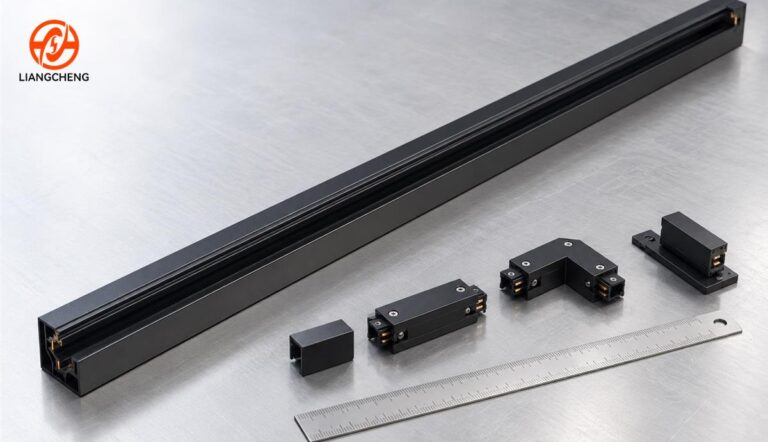
Mechanical and electrical continuity may require separate pieces. A straight connector can align two profiles without carrying power unless it includes the correct conductive element. Directional components may also have left/right or polarity orientation. The track lighting rail accessories guide explains how to turn a layout into a complete accessory schedule.
How Should Adapter and Fixture Compatibility Be Verified?
Compatibility must be proven by geometry, contacts, locking, electrical rating, and physical testing. A fixture that enters the channel but does not seat fully can create unstable contact or an unsafe mechanical condition. A matching brand name, voltage label, or wire count does not prove fit across product families.
Ask the supplier to identify the approved adapter family for the exact recessed rail SKU. Compare the adapter body width, keying, contact number and position, earth contact where applicable, locking travel, insertion force, retention, and current rating. Test every planned spotlight, pendant, wall-washer, or linear fixture type on a representative rail sample before bulk approval.
Which Material and Finish Details Matter?
Aluminum alloy is commonly used because it supports consistent extrusion, manageable weight, corrosion resistance, and durable surface finishing. The purchase specification should identify the agreed material grade or equivalent performance requirement, profile mass or critical wall dimensions, conductor material and cross-section, insulating components, finish process, color reference, gloss range if important, and acceptable surface defects.
Visual inspection should cover color consistency, gloss, scratches, dents, extrusion lines, coating coverage, sharp edges, and contamination inside the channel. Functional inspection should cover conductor retention, insulation seating, profile straightness, connector engagement, adapter movement, and continuity. A cosmetic sample alone cannot approve the electrical and mechanical system.
How Should Long Rails and Joints Be Controlled?
Long recessed rails make small deviations visible because the ceiling creates a straight reference plane. Bow, twist, inconsistent joint gaps, or misaligned visible slots can remain noticeable after fixtures are installed. Drawings should define datum surfaces and inspection methods so the supplier and buyer measure straightness and cross-section consistently.
Joints need both alignment and support. A connector should not be expected to correct two unsupported or distorted rail ends. The ceiling detail should provide backing or brackets near the joint, and the sample mock-up should demonstrate how the profile, connector, conductor path, and finish meet without a step.
What Should a Pre-Production Mock-Up Include?
A useful mock-up reproduces the highest-risk ceiling interface rather than displaying a loose rail on a table. Build a representative section using the intended board thickness, framing, brackets, rail, straight joint, corner if used, feed, end treatment, adapter, and at least one heavy or mechanically demanding fixture. Apply the planned joint treatment and finish so stakeholders can judge the final slot and surrounding ceiling.
The mock-up should verify installation sequence, cutout, level, joint appearance, feed access, fixture insertion, adapter movement, electrical operation, dimming or control behavior, surface temperature under the approved load, and maintenance procedure. Record measurements, photos, settings, part numbers, and corrective actions. The track rail sample approval process provides a structured path from drawing review to pilot run.
How Should Recessed Track Rail Quality Be Inspected?
Quality inspection should connect each production lot to the approved drawing and reference sample. Incoming checks can verify identity, quantity, length, cross-section, visible opening, finish, straightness, conductor and insulator position, accessory fit, adapter engagement, continuity, markings, packaging, and documentation. Sampling level and acceptance rules should be agreed before shipment.
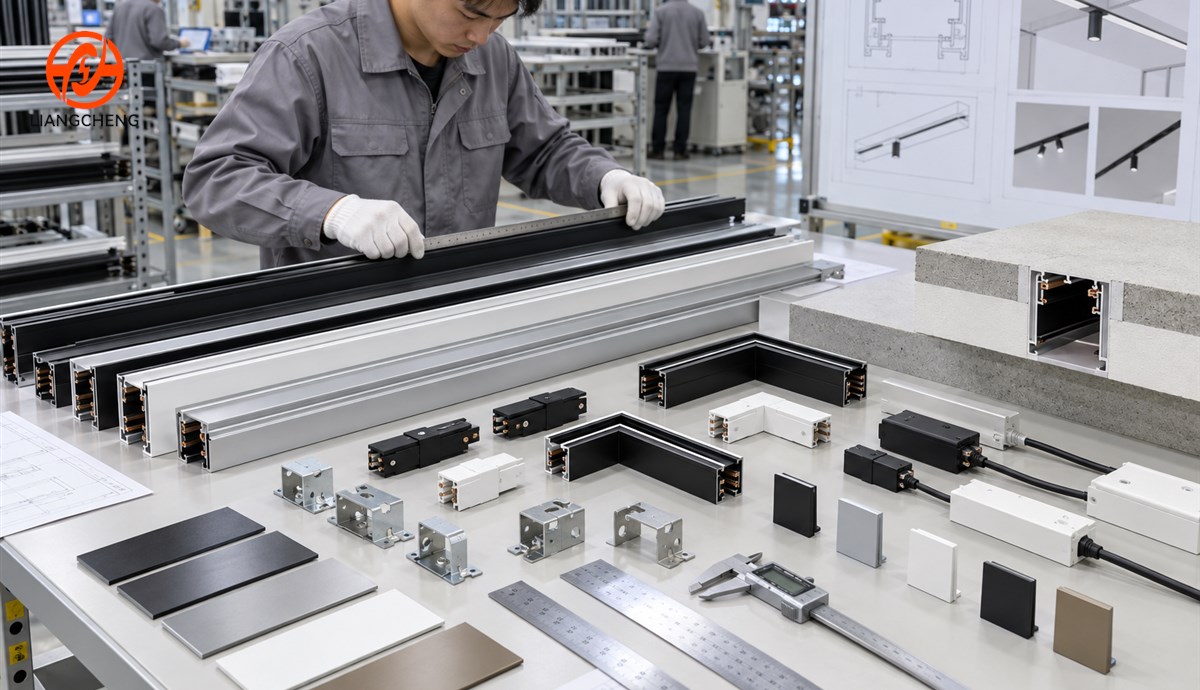
A rail that passes dimensional inspection can still fail as a system if accessories or adapters come from an unverified revision. Inspect representative assemblies, not only individual parts. The guide to judging track rail quality before buying explains how to request evidence and convert claims into inspection points.
How Should Recessed Track Rails Be Packaged?
Packaging must control bending, twist, surface abrasion, conductor contamination, crushed ends, and accessory loss. Long rails should be restrained as straight bundles with surface protection between profiles, reinforced end zones, moisture protection appropriate to the route, and cartons or crates designed for the handling method. Accessories should be separated, counted, labeled, and linked to the project BOM.
Packaging approval should use the real shipping length and quantity because a short sample carton does not represent a long export bundle. Confirm maximum package length, gross weight, lifting points, pallet or crate construction, container loading plan, and unloading constraints. Review the detailed guide to packaging long track rails when developing the shipment specification.
What Determines the Total Cost of a Recessed Track System?
The rail unit price is only one part of installed cost. A fair comparison includes aluminum profile, conductors, insulation, surface finish, special tooling, cut lengths, connectors, feeds, brackets, fixtures or adapters, drivers, controls, spare parts, packaging, inspection, freight, import costs, ceiling framing, cutting, plastering, painting, commissioning, and future access.
Trimless rail may carry additional installation and coordination cost because the ceiling finish depends on precise positioning. A cheaper profile can become the more expensive option if it lacks correct accessories, arrives bent, requires site modification, or delays the ceiling trade. Use the wholesale track rail pricing guide to normalize quotations before comparing totals.
Which Mistakes Cause the Most Expensive Rework?
- Ordering by visible width only: the hidden profile, flange, bracket, and connector envelope may not fit the ceiling.
- Treating all recessed rails as compatible: adapters and accessories can differ even when the slot looks similar.
- Approving the rail after ceiling closure: feeds, supports, cutouts, and access can no longer be changed economically.
- Using plaster as structure: joint compound finishes an interface but does not replace proper backing and mechanical fixation.
- Comparing incomplete quotations: missing connectors, brackets, feeds, drivers, or packaging distort the price comparison.
- Skipping the installed mock-up: a loose sample cannot reveal ceiling alignment, joint cracking, or maintenance constraints.
- Allowing uncontrolled revisions: a small profile or adapter change can invalidate an approved system.
- Ignoring packaging engineering: long profiles can arrive cosmetically damaged or permanently bent before installation begins.
What Should Be Included in a Recessed Track Rail RFQ?
A strong RFQ should state the project and destination, electrical platform, mounting type, rail cross-section or required interface, lengths, layout, finish, fixture and adapter family, circuits and controls, feeds, complete accessories, ceiling build-up, drawings, sample quantity, testing, inspection, packaging, order volume, delivery schedule, documentation, warranty requirement, spare parts, and change-notification rule.
Ask suppliers to list assumptions and exclusions rather than filling gaps silently. Require an itemized BOM, drawing revision, unit basis, tooling charges, sample lead time, production lead time, packaging method, and quotation validity. The reusable checklist in what information to include in a track rail RFQ can be adapted for recessed projects.
How Should Installation Tolerances Be Assigned?
Installation tolerances should identify which party controls each interface. The rail supplier controls the manufactured profile and accessory dimensions. The ceiling contractor controls the opening, support, level, and finished surface. The electrical contractor controls cable routing, feeds, protection, and connection quality. The lighting contractor or commissioning team controls adapter seating, fixture aiming, circuit assignment, and functional tests. A single general tolerance note cannot replace these separate responsibilities.
The project team should agree how straightness, level, joint steps, slot width, finished-face position, and corner alignment will be measured. The selected method should use defined datums and tools so a factory measurement can be compared with a site measurement. Visual approval should occur under normal viewing conditions as well as close inspection because a technically small deviation may become obvious along a long illuminated ceiling line.
Allowances also need boundaries. A visible flange can cover a limited opening variation, but it cannot compensate for an unsupported rail or an incorrect ceiling datum. Joint compound can smooth the transition around a trimless wing, but it should not be used to force a twisted profile into alignment. When actual site conditions exceed the approved range, the team should stop, record the deviation, and agree a corrective detail before finishing conceals the problem.
What Documentation Should Be Delivered at Handover?
A complete handover package should include as-built track layouts, feed and circuit locations, driver or junction access points, fixture and adapter schedules, approved product data, installation instructions, test records, finish references, spare-parts lists, warranty information, and maintenance guidance. The document set should identify the exact product revision so future replacements are compared with the installed system rather than a similar catalog image.
Facilities teams should know how to isolate power, remove and reinstall compatible fixtures, clean the rail channel, inspect contacts, reach drivers or junctions, and order replacement components. Good handover documentation protects the project value because a recessed system remains maintainable without exploratory ceiling work or guesswork about compatibility.
Final Recessed Track Rail Buying Checklist
- Confirm that no existing ceiling condition blocks recessed installation.
- Choose recessed-with-trim or trimless based on the required finish and construction stage.
- Approve the electrical platform, circuit structure, adapter family, and fixture ecosystem.
- Coordinate the rail cross-section with the ceiling section, supports, wiring, and maintenance access.
- Freeze the reflected ceiling plan, feeds, corners, branches, and accessory schedule.
- Request an itemized complete-system BOM instead of a rail-only quotation.
- Build and approve a representative installed mock-up before bulk production.
- Define dimensions, finish, straightness, compatibility, electrical, and packaging acceptance criteria.
- Protect the approved design with revision control and supplier change notification.
- Inspect representative assembled systems and long-rail packaging before shipment.
Source Custom Recessed Track Rails From Liangcheng Lighting
Liangcheng Lighting manufactures recessed aluminum track rails and complete track lighting system components for lighting brands, distributors, contractors, and commercial projects. Available services include wholesale supply, configurable dimensions, finishes, accessories, and OEM/ODM support based on project requirements.
Send your ceiling section, reflected ceiling plan, electrical platform, track lengths, finish, fixture schedule, accessory requirements, annual or project quantity, destination market, and packaging expectations. Liangcheng Lighting can review the information and prepare a quotation or sample plan for approval before bulk production. Explore the recessed track rail range or contact Liangcheng Lighting for a B2B recessed track rail quotation.
Benötigen Sie individuelle Schienensystemlösungen?
Kontaktieren Sie Liangcheng Lighting für OEM/ODM Aluminium-Schienenlösungen und professionelle Beleuchtungsunterstützung.
Bezogen