







Estimated reading time: 13 minutes
A 2-wire track rail normally provides two conductive paths for a basic power arrangement, while a 3-wire track rail provides a third conductive path that may serve protective earth or another documented system function. The essential difference is not simply that one rail contains one more contact. It is how the manufacturer assigns those conductors, how the rail is grounded, which adapters fit, and which electrical standard the complete system follows. A 3-wire rail does not automatically provide three independently controlled lighting circuits.
For a B2B buyer, the correct choice depends on the approved wiring diagram, local electrical requirements, fixture adapter, rail profile, voltage and current ratings, installation method, and required control behavior. Never order track rail by wire count alone. Specify the rail, feeds, connectors, adapters, and luminaires as one coordinated product family.
What is the quickest comparison between 2-wire and 3-wire track rail?
| Comparison point | 2-wire track rail | 3-wire track rail |
|---|---|---|
| Typical conductor arrangement | Two documented conductive paths, often line and neutral in a simple single-circuit system | Three documented conductive paths, commonly line, neutral, and protective earth in some product families |
| Grounding | May depend on system design, insulation class, or a separate documented method | Often includes a dedicated earthing path, but this must be verified from the model documentation |
| Circuit control | Usually one shared switched group | Often still one shared switched group; three wires do not mean three circuits |
| Adapter | Must match the two-wire rail profile and contact positions | Must match the three-wire rail profile, contacts, orientation, and grounding feature |
| Typical priority | Simplicity, compact construction, and straightforward switching | Documented grounding and compatibility within a defined line-voltage family |
| Procurement risk | Assuming every two-contact adapter is interchangeable | Confusing 3-wire with 3-circuit or assuming any three-contact adapter will fit |
The table describes common arrangements, not a universal wiring law. Track terminology varies by country and supplier. The exact terminal schedule and product drawing always take priority. For a broader overview of naming conventions, see the guide to 2-wire, 3-wire, and 4-wire track rail systems.
What does wire mean in a track lighting rail?
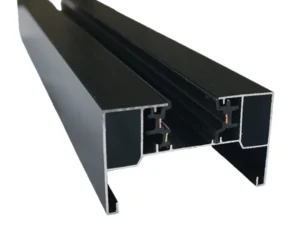
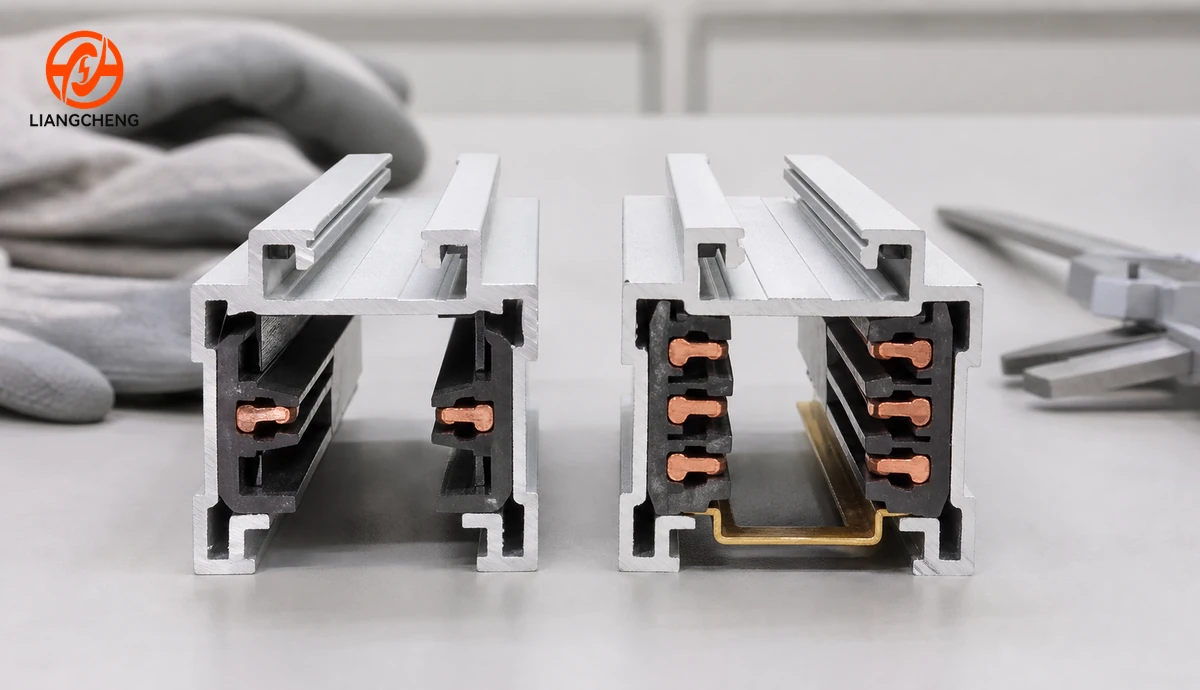
In a track rail, a wire-count label usually refers to conductive paths or contacts built into insulated carriers inside the aluminum profile. These paths deliver electrical power or perform another documented function when a matching adapter locks into the rail. The aluminum body provides mechanical support and may participate in protective bonding only when the system is designed, listed, and installed for that purpose.
Catalog language can be inconsistent. Some suppliers use the terms wire, line, phase, circuit, and channel as if they were interchangeable. They are not. A conductor is a physical conductive path. A circuit is a complete electrical path protected and controlled according to the design. Protective earth is a safety path. A control channel may carry a switching or communication function. Buyers should ask what every contact does instead of relying on the number in the product name.
This distinction prevents a common purchasing error: treating 3-wire rail as 3-circuit rail. A three-circuit system is designed so compatible adapters can select among several independently controlled live groups, normally with the required shared neutral and protective arrangement. Its conductor count, adapter and rail geometry are product-family specific. The existing comparison of 2-wire and 3-circuit track rail explains that separate control decision in more detail.
How does a 2-wire track rail work?
A typical 2-wire track rail uses two insulated conductive paths. In a common single-circuit mains arrangement, one path is line and the other is neutral. Every compatible track head connected to that rail run receives power from the same controlled supply, so the fixtures normally switch or dim together when the approved control equipment supports dimming.
The simple arrangement can reduce component complexity. It is often suitable for small retail displays, compact showrooms, residential accent lighting, kiosks, corridors, or other spaces where all fixtures on a run should respond as one group. A two-wire system can also be useful when the project team values a narrow profile and a straightforward bill of materials.
However, a simple arrangement is not universal. Two-wire rails can differ in channel width, profile height, contact spacing, polarity, locking tabs, end-feed orientation, rated voltage, rated current, mounting details, and compatible accessories. A track head may appear to slide into a rail but fail to make secure contact or correct mechanical engagement. For existing installations, identify the exact family before purchasing replacement parts.
Grounding needs particular attention. Some two-wire product families may be intended for equipment with a defined insulation strategy, while other systems use a separate bonding feature or construction method. The project electrician must follow the product documentation and local code. A buyer should never assume that the aluminum profile automatically supplies protective earth.
How does a 3-wire track rail work?
A typical 3-wire rail has three conductive paths. In many line-voltage product families, they are assigned to line, neutral, and protective earth. A compatible adapter engages the power contacts and the documented grounding contact when it is inserted and locked correctly. This arrangement can provide a clearly defined earthing path for compatible Class I luminaires and metal-bodied components.
Other three-wire arrangements are possible, which is why the model drawing remains essential. The third path could have a different function in a specialized product family. Regional naming also changes. In some markets, a common H-style single-circuit track is described as three-wire because it includes line, neutral, and ground. That description says nothing about three separately switchable groups.
A 3-wire system may be selected for commercial interiors, shops, galleries, hospitality spaces, offices, and other projects where the specified luminaires and local requirements call for a documented protective-earth connection. It can still operate as a single circuit: all heads on the rail respond together unless the complete control architecture provides another arrangement.
Compatibility is not established by wire count. The practical guide to track lights compatible with 3-wire rails shows why profile geometry, contact location, grounding, orientation, voltage, and locking method must all agree.
Is 3-wire rail safer than 2-wire rail?
Neither label is inherently safer. Safety comes from selecting a product appropriate for the application and installing the complete system according to its ratings, instructions, certification scope, local electrical code, and project design. A correctly specified two-wire system can be suitable for its intended equipment and environment. A three-wire rail with an earth path can be appropriate where protective grounding is required. The wrong adapter, incomplete bonding, excessive load, loose feed, damaged insulation, or incorrect installation can make either system unsafe.
Buyers should request evidence that relates to the actual model being ordered, not a generic certificate carrying only a company name. Useful documents include product drawings, rated voltage and current, insulation and grounding description, material specification, test information, applicable conformity documents, installation instructions, and traceable model references. An electrician or qualified designer should confirm code compliance for the destination market.
Protective devices and conductor sizing are project decisions. The rail rating is not permission to load a circuit to its theoretical maximum without considering fixture inrush current, driver power factor, dimming equipment, voltage drop, ambient temperature, connector limits, diversity, and the protective device. The lowest-rated component in the complete path can determine the allowable load.
Do 2-wire and 3-wire rails provide different lighting control?
Usually, both are used as single-circuit systems in the comparison addressed here. All compatible fixtures on a rail run receive the same switched supply. Either system may support dimming only when the power supply, drivers, dimmer or control device, and track components are compatible with the selected method.
If a project needs several groups of fixtures on the same physical rail to respond independently, wire count alone is the wrong selection shortcut. The designer should define the required scenes first, then choose a documented multi-circuit or control system. The distinction between physical conductors and controlled groups is covered in the project-level guide to single-circuit and multi-circuit track lighting.
For example, a small boutique may want every spotlight on one rail to switch together at opening and closing. A simple single-circuit rail is likely enough. A larger store may need window lighting, wall displays, and central merchandise to operate on different schedules. That requirement points toward several controlled groups, not merely toward a rail with one additional conductor.
Why are adapters and accessories not interchangeable?
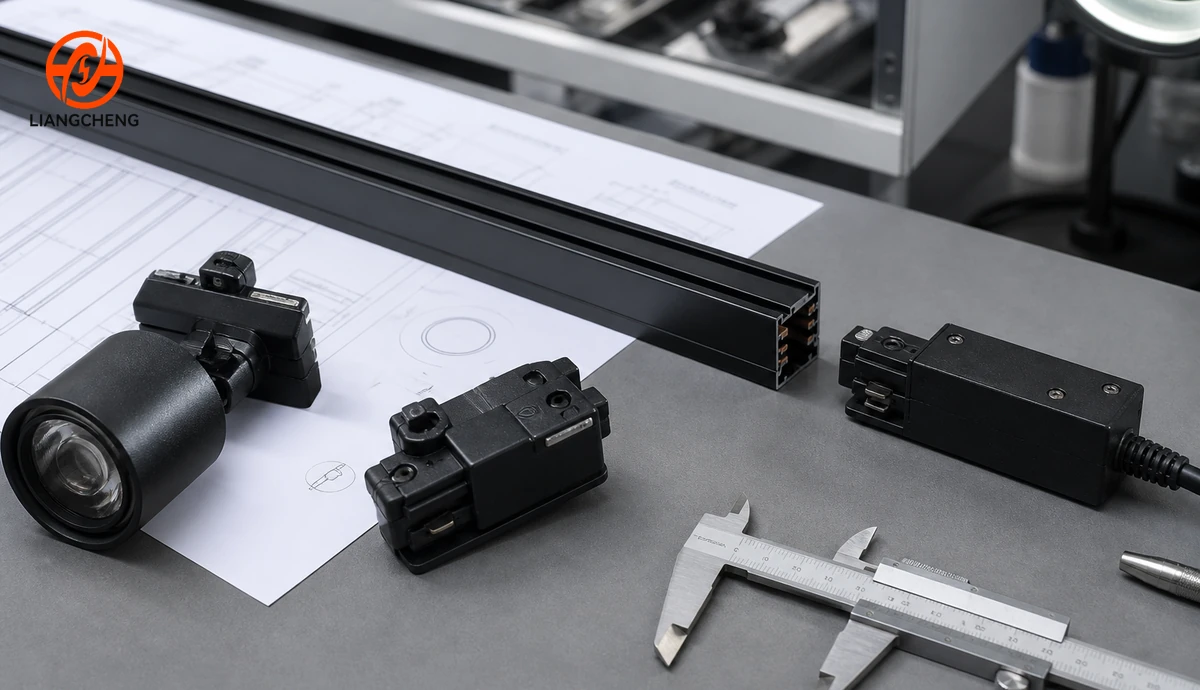
Track lighting is an interface system. The adapter must fit mechanically, align with the conductive paths, establish the correct polarity and grounding contacts, lock securely, and remain within the electrical and mechanical ratings. Small differences in a rail opening or contact position can prevent reliable engagement even when two products look nearly identical.
Compatibility covers more than track heads. A complete project can require live-end feeds, straight joiners, flexible joiners, L-, T-, or X-connectors, end caps, suspension kits, recessed trim, mounting clips, adapters, spotlights, pendants, and control accessories. Mixing product families can create gaps, reversed polarity, missing earth continuity, loose mechanical joints, or accessories that cannot complete the intended layout.
North American-style H, J, and L families demonstrate this issue clearly. They perform a similar function but use different contacts and keying. The H-Type, J-Type, and L-Type compatibility guide provides identification criteria for those installations. A wire-count label should never override an exact system-family match.
Which system is easier to install?
A basic 2-wire system often has fewer connection functions to coordinate, so its component selection and commissioning can be straightforward. A 3-wire rail may require explicit verification of earth continuity in addition to line and neutral connections. In practice, installation time depends more on the layout, mounting method, connector count, ceiling condition, feed location, access, alignment tolerance, and quality of the supplied components than on one additional conductor.
Surface-mounted straight runs are generally simpler than recessed, suspended, or multi-directional layouts. Corners and branches require approved connectors and careful orientation. Long runs need accurate measurement and allowance for feeds, joiners, end caps, thermal movement where applicable, and installation clearance. The track lighting rail dimensions guide explains which measurements should appear on drawings and purchase orders.
Before energizing, the installer should verify mechanical fastening, conductor isolation, polarity, earth continuity where required, connector engagement, fixture locking, circuit loading, and correct operation. Testing must follow local requirements and the instructions supplied by the manufacturer. Track components should not be cut, drilled, or modified in a way that damages insulation or falls outside the approved installation method.
How should a buyer choose between 2-wire and 3-wire rail?
Start with the project rather than the catalog. Identify the destination country, supply voltage, mounting method, fixture type, grounding requirement, control behavior, layout, load, finish, and certification expectations. Then request a complete system proposal that answers each requirement.
- Define the electrical architecture. State the supply, frequency, protective arrangement, number of controlled groups, dimming method, and applicable code.
- Confirm conductor functions. Obtain a terminal schedule or wiring diagram for the exact rail model. Do not accept the labels 2-wire or 3-wire as the complete answer.
- Match the interface. Compare cross-section drawings, channel dimensions, contact positions, polarity, grounding features, locking geometry, and adapter orientation.
- Specify the entire bill of materials. Include every feed, connector, end cap, mounting part, adapter, and luminaire required by the layout.
- Check ratings and evidence. Confirm voltage, current, load assumptions, material details, finish, installation instructions, testing, and destination-market documents.
- Approve a project sample. Assemble a representative rail run with the actual accessories and fixtures before releasing mass production.
The general guide to choosing the right track rail for a lighting project provides a broader decision framework covering architecture, controls, dimensions, installation and lifecycle planning.
What are the best applications for each rail?
Typical applications for 2-wire track rail
- Compact retail areas where every spotlight follows one switch or dimming group
- Residential or hospitality accent lighting using a documented compatible system
- Kiosks, small galleries, corridors, and display walls with a simple layout
- Projects prioritizing a straightforward bill of materials and compact profile
- Replacement work where the installed two-wire family has been positively identified
Typical applications for 3-wire track rail
- Line-voltage commercial systems that document line, neutral, and protective earth
- Projects using compatible grounded metal-bodied luminaires
- Retail, gallery, office, showroom, and hospitality interiors built around a defined three-wire family
- Replacement or expansion of an existing compatible H-style or other documented system
- Projects where the specification requires a dedicated protective-earth path within the coordinated rail system
These are selection patterns, not automatic approvals. The electrical designer and installer for the project remain responsible for confirming the exact product and local requirements. More wires do not improve beam quality, color rendering, glare control, energy efficiency, or visual comfort. Those results depend on luminaire optics, LED and driver quality, layout, aiming, surfaces, controls, and commissioning.
What should a wholesale specification include?
A wholesale inquiry should be detailed enough for the manufacturer to quote the same system the buyer intends to install. A short request for black 3-wire track in two-meter lengths leaves too many variables open. A useful request for quotation includes:
- Rail series and wire or conductor arrangement
- Function of each conductor and required grounding method
- Rated voltage, frequency, current, and project load assumptions
- External profile dimensions, channel geometry, and requested lengths
- Surface-mounted, recessed, or suspended installation
- Aluminum material, copper conductor specification, insulation, and finish color
- Compatible adapter and track-light models
- Feeds, joiners, corners, end caps, suspension parts, and quantities
- Packaging, labeling, barcodes, carton marks, and pallet requirements
- Destination market, required documentation, sample quantity, and forecast volume
For custom programs, the buyer should also define appearance tolerances, color reference, cut-length tolerance, hole or mounting details, packaging drop protection, inspection method, approved sample status, and change-control process. Customizing only the extrusion while ignoring the adapter and connector family can produce a rail that looks correct but cannot function as a complete system. The Liangcheng Lighting overview of custom LED track rail solutions explains how size, finish, accessories, samples, and production control fit together.

How should samples and production be inspected?
Approve a representative system rather than a loose rail sample. The sample should include the intended rail length, live-end feed, at least one straight or corner connector when used, end cap, mounting part, matching adapter, and selected luminaire. Assemble and operate the kit under controlled conditions using the documented supply and installation method.
Inspection should cover dimensions, straightness, twist, surface finish, color consistency, copper contact position, insulation condition, connector fit, feed engagement, adapter insertion and removal force, fixture locking, polarity, grounding continuity where applicable, and electrical operation. Packaging should prevent rails from bowing, scratching, crushing at the ends, or shifting in transit.
During mass production, retain the approved sample and drawing revision as comparison references. Use batch traceability for extrusion, finish, conductive components, assembly and packing. Any change to the profile, insulation, copper path, feed, adapter or accessory can affect compatibility and should require review. Final inspection should sample complete kits, not only individual aluminum extrusions.
Common purchasing mistakes to avoid
- Calling 3-wire a 3-circuit system. Confirm the number of independently controlled groups separately from conductor count.
- Buying rail and lights from unrelated families. Mechanical insertion does not prove electrical or grounding compatibility.
- Ignoring the destination market. Voltage, earthing, installation, documentation, and accepted system conventions vary.
- Quoting rail without accessories. Missing feeds or connectors can delay installation even when the extrusion arrives on time.
- Comparing price per meter only. Include copper specification, profile mass, finish, tolerances, accessories, packaging, inspection, freight risk, and replacement availability.
- Skipping a complete sample assembly. A cross-section drawing cannot reveal every tolerance and engagement issue.
- Assuming more conductors mean better lighting. Select control capacity only when the project will use it.
Frequently asked questions
Can a 2-wire track light fit a 3-wire rail?
Not automatically. It can be used only if the fixture adapter is explicitly compatible with that exact rail family and its electrical arrangement. Similar width or appearance is not enough. Verify the adapter contacts, keying, polarity, locking and required grounding.
Does 3-wire track rail mean three circuits?
No. A common 3-wire arrangement is line, neutral and protective earth within a single-circuit system. Three independently controlled circuits require a specifically designed multi-circuit rail, feed and selectable adapter arrangement.
Can 2-wire track lighting be dimmed?
Yes, when the track system, luminaires, LED drivers, dimmer or control device, circuit loading and installation are all compatible with the selected dimming method. Wire count alone does not determine dimming support.
Which rail is better for a retail store?
A small store with one lighting group may use a compatible 2-wire or 3-wire single-circuit system. A store needing several independently controlled scenes should evaluate a documented multi-circuit or control solution. Grounding, adapter availability and local requirements may determine the product family.
Can an existing 2-wire installation be upgraded to 3-wire by changing the feed?
No. The internal conductive paths, insulation, rail profile, feed, connectors, adapters and luminaires form a coordinated system. An upgrade normally requires evaluation and replacement of the affected components, followed by appropriate installation and testing.
What information should be sent for a replacement rail quotation?
Send clear photos of the rail opening, cross-section, internal contacts, end feed, adapter and markings; include measured width and height, installed voltage, fixture model, required length, finish, quantity and destination. Isolate power before inspecting installed electrical hardware.
Final recommendation
Choose a 2-wire track rail when the approved system provides the required safety arrangement and the project needs a simple single controlled group. Choose a 3-wire track rail when the specified product family, fixtures and local requirements call for its documented third conductor, commonly a protective-earth path. If the project needs several independently controlled lighting groups, specify circuit count separately and evaluate a purpose-built multi-circuit system.
Liangcheng Lighting provides wholesale and custom track lighting rail solutions for distributors, lighting brands, contractors and commercial projects. The team can coordinate rail profiles, conductor arrangements, lengths, finishes, feeds, connectors, adapters, track lights, packaging and project samples as one system. To prepare an accurate B2B proposal, send your destination market, wiring requirement, rail drawing or sample, accessory list, finish, quantity and expected application. Review more technical and sourcing information across the Liangcheng Lighting website, then contact the team with your project requirements for a wholesale or custom quotation.
Benötigen Sie individuelle Schienensystemlösungen?
Kontaktieren Sie Liangcheng Lighting für OEM/ODM Aluminium-Schienenlösungen und professionelle Beleuchtungsunterstützung.