







Read time: 14 minutes
The track lighting market is growing — and so is the complexity of what distributors are being asked to supply.
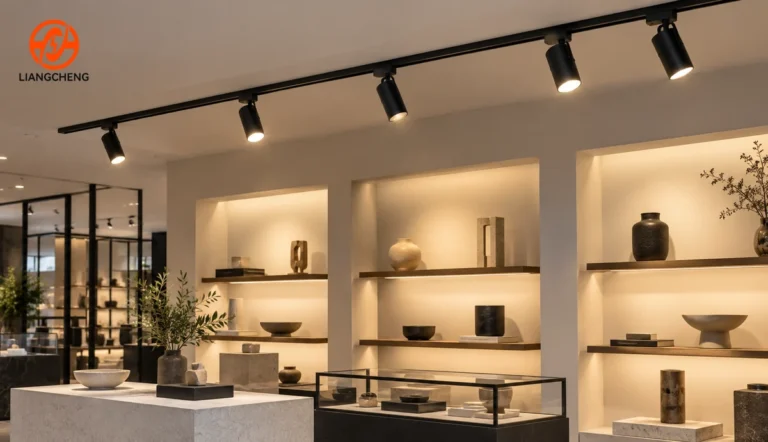
Ten years ago, a lighting distributor’s track rail inventory was straightforward: a few standard surface-mounted track profiles in black and white, compatible with a common range of spotlights. Today, the market demands magnetic track systems with tool-free fixture repositioning, multi-circuit rails serving independent lighting zones, recessed profiles with millimeter-precision ceiling integration, and OEM configurations with distributor branding.
The distributors who are building profitable, defensible product lines in this environment share a common approach: they source directly from aluminum track rail manufacturers who can supply the full range — standard and custom — with consistent quality, documented certifications, and the production capacity to scale. This guide covers everything you need to evaluate, specify, and source wholesale aluminum track rail effectively.
What Is Aluminum Track Rail and How Does It Work?
Understanding Aluminum Track Rail Systems
An aluminum track rail is a precision-extruded structural housing that serves three simultaneous functions in a lighting system: it provides mechanical support for lighting fixtures, delivers electrical power from a single feed point to multiple fixture positions along its length, and acts as a heat sink for any thermal load generated by the LED components within it.
The structural function requires adequate aluminum cross-section area and wall thickness to span between mounting points without visible deflection under the combined weight of the rail and its fixtures. The electrical function requires precisely engineered internal conductor channels — separated by insulating barriers — that carry current at the system voltage to standardized contact points compatible with the fixtures specified for the system. The thermal function requires the aluminum body to absorb heat from fixture components in contact with the rail and dissipate it into the surrounding air.
These three functions are why aluminum — specifically 6063-T5 alloy with its combination of extrudability, structural adequacy, and thermal conductivity of approximately 200 W/m·K — is the material standard for track rail manufacturing. Substituting inferior alloys, reducing wall thickness, or using recycled material compromises all three functions simultaneously.
Main Components of an Aluminum Track Rail System
A complete aluminum track rail system comprises the following components, each of which should be specified when placing a wholesale order:
Aluminum track profile — the extruded body that forms the structural and electrical backbone of the system. Available in surface mounted, recessed, suspended, and corner configurations. The cross-section determines circuit capacity, conductor count, and fixture compatibility.
Electrical conductors — copper conductors embedded within the aluminum profile’s internal channels. Conductor cross-section (specified in mm²) determines the maximum current-carrying capacity per circuit, which sets the maximum total fixture wattage per rail length.
Magnetic module system (for magnetic track) — a specialized set of permanent magnets and spring-loaded electrical contacts integrated into the fixture attachment mechanism, allowing fixtures to attach, detach, and reposition anywhere along the rail without tools or rewiring.
Diffuser or cover strip — for track rail systems where the conductor channel is exposed, a snap-in plastic cover strip protects conductors from dust and provides a clean finished appearance when sections of the rail are unloaded.
End caps — close the open ends of the rail, finishing the appearance and preventing contact with live conductors at rail terminations.
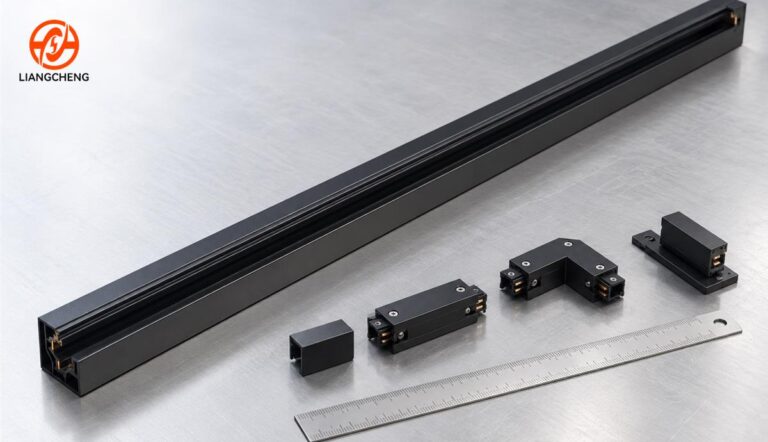
Connectors and joiners — L-shaped, T-shaped, and straight couplers join rail sections at corners and intersections, maintaining continuous electrical connectivity across the layout. Feed-in connectors attach the incoming mains power supply to the rail at any point along its length.
Mounting accessories — surface mounting clips, recessed installation brackets, ceiling suspension wire kits with adjustable cable grips, and wall mounting brackets for specific installation geometries.
When building a wholesale order, confirm which of these components are included in the supplier’s unit price and which must be ordered separately. Incomplete accessory supply is a common source of field installation problems.
Different Types of Aluminum Track Rail for Wholesale Buyers
Magnetic Aluminum Track Rail System
Magnetic track rail is the fastest-growing segment of the commercial track lighting market. The defining characteristic is the fixture attachment mechanism: rather than physically locking into the rail with a bayonet or push-and-twist connector, fixtures attach and detach magnetically, and can be slid to any position along the rail continuously without tools.
The electrical connection is made simultaneously with the magnetic attachment — spring-loaded contacts on the fixture engage with the conductors in the rail the moment the magnet holds the fixture in position. This means fixture repositioning requires only pulling the fixture away from the rail (breaking the magnetic connection), moving it, and pressing it back (remaking the connection). No tools, no circuit interruption, no rewiring.
This flexibility makes magnetic track the specification of choice for applications where lighting layouts change frequently: retail stores where display arrangements shift seasonally, gallery and museum spaces where exhibition configurations rotate, hotel lobbies and restaurants where layout adjustments respond to operational needs, and showrooms where presentation requirements evolve.
Voltage configurations: Magnetic track systems operate at either 48V DC (low voltage, safer for environments where people may contact the rail) or mains voltage (110–240V AC, depending on market). 48V systems require a constant voltage driver converting mains supply to 48V before the rail. Mains voltage magnetic systems connect directly to the building supply. Confirm voltage specification against your market requirements before ordering.
Wholesale specification checklist for magnetic track rail:
- Voltage: 48V DC or mains voltage (specify market)
- Track width: 20mm, 25mm, 26mm, or 35mm (determines compatible fixture range)
- Installation method: recessed, surface mounted, or suspended
- Circuit count: typically single-circuit for most magnetic systems
- Maximum load per meter: verify against planned fixture wattage
- Surface finish: silver anodized, matte black, or matte white
Traditional Multi-Circuit LED Track Rail System
Multi-circuit track rail systems — the established standard for commercial track lighting — carry multiple independent circuits within a single aluminum profile. The circuit configuration determines how many independently switched or dimmed zones the track can serve.
2-wire (1-circuit) track rail — the simplest configuration, carrying a single live and neutral conductor. Compatible with the widest range of track spotlight fittings. Cost-effective for applications where all fixtures on a track operate together without independent zone control.
3-circuit (4-wire) track rail — carries three independent live conductors plus a neutral. Any fixture connected to the rail can be assigned to one of three circuits, enabling three independently controlled zones from a single track run. Standard specification for retail applications requiring accent, ambient, and task lighting from a single overhead track.
4-circuit track rail — four independent live conductors plus neutral. Used in commercial applications requiring four independent zones, commonly in large retail floor plates, hospitality environments, or commercial offices with complex lighting control requirements.
6-circuit track rail — the highest-circuit-density configuration available in standard track systems. Six independent circuits plus neutral within a single profile cross-section. Specified for large commercial projects, entertainment venues, and specialist applications where maximum zone flexibility from a single overhead track is required.
For wholesale distributors, stocking the right circuit configuration for your primary market segments is the starting point. In most European and North American commercial markets, 1-circuit and 3-circuit represent the majority of volume; 4-circuit and 6-circuit serve specialist and large-project requirements.
Recessed Aluminum Track Rail
Recessed track rail installs within a pre-cut channel in the ceiling substrate, so the face of the track sits flush with the surrounding ceiling surface. Only the track face — and the fixtures attached to it — are visible from below. The aluminum profile body is completely concealed within the ceiling void.
This installation method requires more planning and site preparation than surface mounting — the ceiling must be prepared before finishing, or existing ceiling material must be cut and routed — but produces a fundamentally more refined result. The track does not protrude from the ceiling surface; the lighting appears integrated with the architecture rather than mounted onto it.
For wholesale distributors serving high-end residential, hospitality, and premium commercial markets, recessed track rail is an essential product line. Architects and interior designers specify recessed track as a standard approach in luxury environments. Distributors who cannot supply it lose these projects to competitors who can.
Wholesale note: Recessed track rail requires matching suspension brackets or retention clips specified for the ceiling construction type (plasterboard, concrete, timber, or T-grid ceiling). Confirm that these accessories are available from the same supplier and include them in wholesale orders to prevent field installation problems.
Surface Mounted Aluminum Track Rail
Surface mounted track rail attaches directly to the ceiling or wall surface using clips or screws driven through the mounting base of the aluminum profile. No ceiling modification is required. Installation is faster and less disruptive than recessed mounting, and the track can be removed and relocated without damaging the ceiling surface.
This is the dominant track rail installation method for retrofit projects — replacing existing lighting in occupied commercial spaces where ceiling disruption is impractical — and for applications where the track is a visible design element rather than an integrated architectural feature.
Surface mounted track in commercial matte black finish has developed strong aesthetic acceptance in contemporary retail, restaurant, and office environments where exposed industrial or minimal aesthetics are the design intent. The track itself is not hidden — it is part of the visual language.
For wholesale distributors, surface mounted track is the highest-volume segment and the correct starting point for building a track rail inventory. Standard lengths of 1m, 2m, and 3m in silver anodized, matte black, and white powder coat, with a full range of connectors and mounting accessories, covers the majority of commercial project requirements.
Suspended Aluminum Track Rail
Suspended track rail hangs from the ceiling via cable or rod suspension systems, positioning the track in open space below the ceiling surface rather than attached to it. Power is delivered via the suspension cables themselves (in systems designed for this purpose) or via a separate cable at the ceiling connection point.
Suspended track creates a distinctive lighting aesthetic — the track is visually present in the space, at a designed height below the ceiling, contributing to the architectural character of the environment as well as delivering light. This makes it the specification of choice for spaces with high ceilings where bringing lighting closer to the occupied zone is both functionally and aesthetically desirable: restaurants with high ceilings, hotel lobbies, retail flagships, and open-plan offices.
Suspended track systems require ceiling structural anchoring for the suspension points and pre-planned power routing to the suspension cable connection. For wholesale supply, include suspension hardware (cable length options, cable grips, ceiling anchors) in the product package rather than leaving installers to source these separately.
Why Aluminum Is the Best Material for Track Rail Systems
Excellent Heat Dissipation Performance
The conductors within a track rail system generate resistive heat under electrical load. Track-mounted fixtures with LED components in direct or thermal contact with the rail also transfer heat into the aluminum body. Without effective heat dissipation, accumulated thermal load degrades conductor insulation and LED component performance over time.
6063-T5 aluminum’s thermal conductivity of approximately 200 W/m·K enables the rail body to absorb this thermal load and dissipate it across its full surface area into the surrounding air. This passive cooling mechanism requires no moving parts and operates continuously throughout the system’s service life. For commercial track systems operating 10–16 hours per day, this thermal management function directly protects system longevity.
Lightweight but Strong Structure
Track rail must span between mounting points — typically 500mm to 1,500mm for surface mounted and recessed installations, up to 2,000mm+ for suspended systems — under the combined load of the aluminum body and all attached fixtures. At 2.70 g/cm³, 6063 aluminum provides the structural performance needed for these spans at approximately one-third the weight of steel. This weight advantage reduces ceiling mounting load requirements, simplifies installation logistics for long track runs, and reduces freight cost per linear meter for international shipping.
A 2-meter length of standard commercial surface mounted track rail in 6063 aluminum typically weighs 600–900g depending on cross-section. The same profile in steel would weigh 1,800–2,700g — creating meaningfully different installation and freight implications at commercial volumes.
Corrosion Resistance and Long Service Life
Commercial track lighting systems are expected to operate for 15–20 years with minimal maintenance. The aluminum body must maintain its structural integrity and surface appearance over this period across a range of installation environments — from the controlled interiors of offices and hotel rooms to the higher humidity of commercial kitchens, retail spaces with air conditioning condensation, and outdoor-covered areas.
6063 aluminum’s natural oxide layer provides inherent corrosion protection without surface treatment. Anodized aluminum track rail — with a surface oxide layer of 10–25 microns — provides enhanced protection that exceeds the service requirements of virtually all commercial indoor environments and most covered outdoor applications. For fully outdoor installations, specifying 25+ micron anodizing or powder coating with UV stabilizers ensures the expected service life.
Plastic track housing materials and thin galvanized steel alternatives degrade measurably within 5–7 years in commercial environments. Aluminum track rail at correct specification outlasts the building fit-out it is installed into.
Premium Surface Finishing Options
The surface finish of track rail is a visible aesthetic element in most commercial installations — particularly for surface mounted and suspended systems where the profile is a prominent ceiling element. The finishing options available on 6063 aluminum track rail serve both aesthetic and performance requirements:
Silver anodized — the natural aluminum finish, matte and uniform, suitable for contemporary and industrial design contexts. The standard specification for most commercial installations.
Matte black anodized or powder coated — the dominant specification in premium retail, hospitality, and residential contexts. Provides visual receding effect that reduces the visual prominence of the track itself, making fixtures the focus.
White powder coated — standard for retail and commercial environments with white ceiling systems, and for residential applications where the track integrates with white-painted surfaces.
Custom colors — RAL color matching available through powder coating for branded retail environments, hospitality projects with custom color palettes, and architectural specifications requiring color continuity with adjacent surfaces.
Key Specifications to Check Before Buying Wholesale Aluminum Track Rail
Aluminum Alloy Grade
Before confirming a wholesale order, request written confirmation that the track rail is produced from 6063-T5 aluminum alloy, along with a material certificate for the batch. This single specification drives thermal performance, surface quality, dimensional consistency, and anodizing uniformity across everything that follows.
Suppliers who cannot provide alloy documentation are either using recycled material, blended alloys, or are unaware of their own material specification — none of which are acceptable for a wholesale supply relationship.
Profile Dimensions and Circuit Specifications
Wholesale buyers should confirm the following dimensions for each SKU:
| Parameter | What to Confirm |
|---|---|
| Profile width | Outer width in mm; determines ceiling channel width for recessed |
| Profile height | Outer height in mm; determines visual profile depth in surface mounted |
| Wall thickness | Minimum 1.2mm for structural sections; verify, do not assume |
| Conductor cross-section | mm² per conductor; determines maximum current per circuit |
| Maximum current rating | Amps per circuit; determines maximum fixture wattage per circuit per run |
| Available lengths | Standard 1m / 2m / 3m; confirm custom cut length availability |
| Circuit count | 1-circuit (2-wire), 3-circuit, 4-circuit, 6-circuit, magnetic |
Track Compatibility and Fixture Matching
Track rail is only as useful as its compatibility with the fixtures your customers will use. Confirm:
- Which fixture ranges are compatible with the track’s conductor spacing and contact geometry
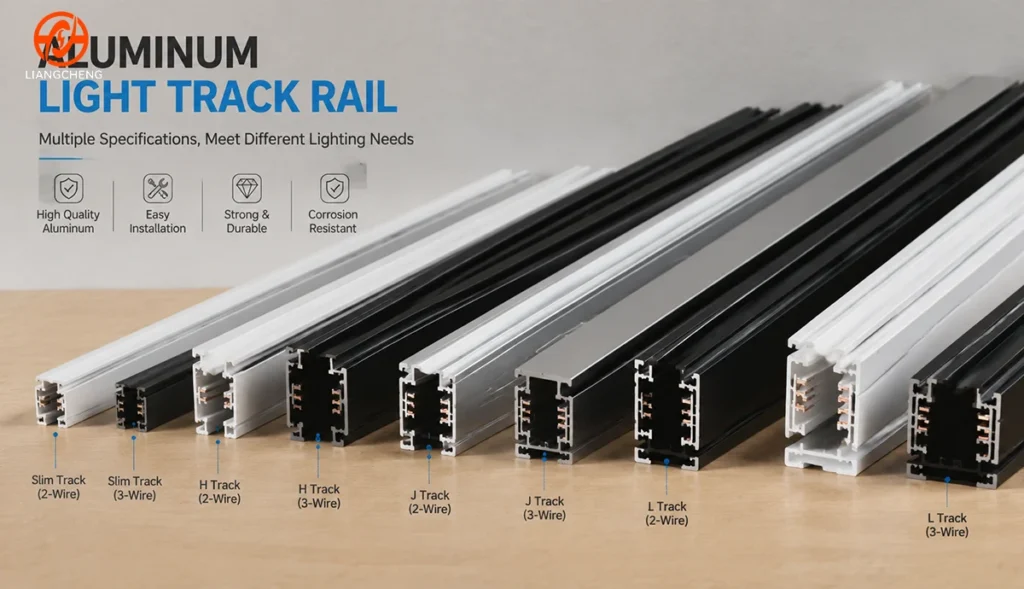
- Whether the track uses a proprietary connector system or a standard market geometry (e.g., standard H-type, J-type, or L-type)
- Maximum fixture load per circuit and per meter
- For magnetic track: magnet strength specification and whether fixture modules from multiple manufacturers are compatible
For wholesale distributors, selling incompatible track rail and fixtures is one of the most damaging quality events possible — it creates field problems, returns, and relationship damage with installers. Verify compatibility before stocking.
Load Capacity and Installation Method
Each track rail product should carry documented load specifications:
Maximum total wattage per circuit — determined by conductor cross-section and maximum current rating. Example: a 16A-rated circuit at 230V supports a maximum of 3,680W; practical loading should be derated to 80% of maximum for continuous operation, so 2,944W practical maximum.
Maximum span between mounting points — for surface mounted and recessed track, the maximum distance between mounting clips at which the rail remains straight under full load. For suspended track, the maximum distance between cable suspension points at full load without visible mid-span sag.
Maximum rail run length — for magnetic and multi-circuit systems, maximum total length from the feed-in point before voltage drop across the conductor run causes fixture performance variation. Longer runs may require power feed at multiple points.
How Lighting Distributors Should Evaluate Aluminum Track Rail Suppliers
Choose a Factory with Real Manufacturing Capability
The distinction between a genuine aluminum track rail manufacturer and a trading company reselling someone else’s product directly determines your pricing, quality control access, and OEM capability. Manufacturers own extrusion presses and surface treatment lines, employ engineering staff, and can modify production to your specifications. Trading companies purchase finished stock and have limited ability to influence product quality or customization.
Verification steps: request factory registration documents showing manufacturing as the registered business activity; ask for production line photos and video, specifically showing extrusion press equipment and anodizing lines; request a sample production schedule showing concurrent production of multiple customer orders.
Verify Product Quality Control Standards
Quality control for aluminum track rail encompasses four inspection stages, each of which a professional manufacturer should be able to document:
Incoming material inspection — alloy composition verification for aluminum billets before extrusion; conductor material inspection before assembly.
In-process dimensional control — profile cross-section measurement during extrusion runs, wall thickness spot-checks, conductor channel dimensional verification.
Surface quality inspection — anodizing color uniformity across the batch, coating thickness measurement, visual inspection for surface defects (scratches, oxidation marks, uneven color).
Final assembly and electrical inspection — conductor continuity testing, circuit isolation testing between conductors, accessory fit verification, packaging inspection.
For track rail systems carrying electrical current, ask specifically whether electrical testing (continuity and insulation resistance) is performed on 100% of output or on a sample basis.
Evaluate OEM and Customization Services for Your Brand
Lighting distributors building private label product lines — or serving contractors who need project-specific specifications — need OEM capability from their track rail supplier. The depth of this capability varies significantly between manufacturers.
Custom profile design — new extrusion die development for a proprietary cross-section. Provides product differentiation that prevents your customers from sourcing the same profile directly from the factory. Die development typically takes 7–15 days; confirm die ownership terms before authorizing tooling spend.
Custom length — cut-to-specification lengths for project orders or retail programs with defined module sizing. Standard factories produce 1m, 2m, and 3m lengths; OEM-capable manufacturers cut to any specification.
Logo branding — brand mark engraving, printing, or embossing on the track profile, end caps, or packaging. Important for distributor brands building recognition with installers and end users.
Custom packaging — branded retail boxes, custom carton markings, and private label documentation that protects your brand identity at every point in the distribution chain.
Custom color and finish — beyond standard silver, black, and white: custom RAL powder coat, special anodize colors, and dual-finish options (e.g., white face with black body).
Wholesale Aluminum Track Rail Pricing: What Determines Cost?
Main Factors Affecting Unit Price
Understanding price drivers helps wholesale buyers evaluate supplier quotes and identify when a suspiciously low price signals compromised specification rather than manufacturing efficiency.
Aluminum material cost — the primary variable cost in track rail production, tied to LME aluminum commodity pricing. Quotes significantly below the current aluminum spot price plus reasonable processing cost signal material quality compromise: recycled alloy blends, under-specified wall thickness, or undisclosed alloy substitution.
Profile cross-section complexity and material volume — larger, heavier cross-sections (more aluminum per meter) cost more than lighter profiles of the same length. Multi-circuit profiles with complex internal conductor channel geometries require more precision tooling and slower extrusion speeds than simple single-circuit profiles.
Circuit count and conductor specification — more circuits mean more conductors, more insulating barriers, and more assembly complexity. 6-circuit track rail costs more per meter than 1-circuit rail of the same cross-section for this reason.
Surface treatment — anodizing and powder coating add cost over mill finish. Custom colors add setup/preparation costs on top of standard treatment pricing.
Accessories included — end caps, connectors, mounting clips, and suspension hardware all have unit costs. A quote that includes a complete accessory set is not directly comparable to a quote for the track profile alone. Confirm exactly what is included.
Order quantity — volume price breaks are significant for aluminum track rail. The price difference between 200m, 1,000m, and container-load quantities (typically 5,000–15,000m depending on profile weight) can be 20–35% per meter. Always request pricing at multiple quantity tiers and calculate the cost-of-capital implications of ordering at higher quantity breakpoints.
How to Reduce Purchasing Costs Without Compromising Specification
Order at container load quantities. Filling a 20′ or 40′ container from a single supplier at a single time produces the lowest per-unit cost across product price, freight, and customs documentation. Consolidating multiple SKUs from one manufacturer into a single container is more efficient than multiple smaller shipments.
Standardize specifications across your product range. Working with a smaller number of standard cross-sections, surface finishes, and circuit configurations reduces tooling, setup, and inventory complexity — both for you and your supplier. Standardization also qualifies you for volume pricing on each SKU.
Work directly with manufacturers. Trading company margins of 10–20% on track rail represent significant cost that adds no quality or service value in established supply relationships. Direct factory relationships, particularly for repeat buyers at volume, access the manufacturer’s actual production economics.
Build longer-term supply agreements. Manufacturers offer better pricing, priority scheduling, and OEM flexibility to buyers who provide predictable annual volume. A 12-month purchasing agreement with defined quarterly volumes typically delivers 5–12% better pricing than spot purchasing of equivalent total quantity.
Applications of Wholesale Aluminum Track Rail
Retail Lighting
Retail is the largest single market for aluminum track rail globally. The combination of flexible fixture positioning, independent circuit zones, and the visual appeal of suspended or surface mounted track in contemporary retail environments drives continuous demand across clothing stores, jewelry shops, electronics retailers, and shopping mall common areas.
For wholesale distributors serving retail contractors, the key requirements are: broad compatibility between track rail and a wide range of spot and linear fixtures, reliable multi-circuit capability for accent/ambient zone separation, and consistent surface finish quality across batches (visible uniformity matters in retail where multiple tracks are installed in a single space).
Commercial Office Lighting
Open-plan office environments increasingly use track lighting as an alternative to traditional grid-based ceiling systems because track allows lighting layout to respond to furniture arrangement rather than being fixed at installation. Suspended track systems in particular have become standard in premium office fit-outs, where they contribute to the architectural character of the space while providing task-appropriate illumination.
Office track systems typically emphasize tunable white capability (adjustable from warm to cool color temperature), high CRI for accurate rendering of documents and screens, and dimming compatibility for circadian lighting programs. These requirements influence fixture specification more than track rail specification, but wholesale distributors should confirm that the track rail systems they stock are compatible with the dimming and control protocols their office market customers specify.
Hospitality Projects
Hotels, restaurants, and café environments specify track lighting for its combination of design flexibility and operational practicality. Track allows lighting teams to adjust fixture positions seasonally or in response to layout changes without structural modification. High-end hospitality specifications typically favor recessed or suspended track in premium surface finishes, with magnetic systems gaining traction in hotel rooms and restaurant spaces where frequent layout adjustment is most valued.
For wholesale distributors serving the hospitality market, quality consistency across batches is particularly important — hospitality operators return to the same specifications across multiple properties, and color or finish variation between batches creates visible quality problems in identical-looking spaces.
Residential Interior Lighting
Track lighting in premium residential environments has shifted from utilitarian to architectural. Homeowners and interior designers specify recessed track systems that integrate with the ceiling plane, magnetic track for kitchen and living areas where flexible spotlight positioning supports changing use patterns, and suspended linear track in dining and open-plan living spaces.
For wholesale distributors, residential track lighting is a growing segment that rewards stocking premium products: homeowners in this market prioritize appearance and design quality over cost, and premium-priced products with superior surface finishes and broader fixture compatibility justify the margin.
Exhibition and Display Lighting
Museums, galleries, and commercial showrooms require track systems that support precise beam control, easy fixture repositioning between exhibitions, and high color rendering for accurate artwork and merchandise presentation. This is the application environment where magnetic track systems have found their strongest early adoption — the tool-free repositioning capability directly addresses the operational needs of spaces that reconfigure regularly.
Exhibition and display lighting typically involves smaller total track footage than retail or office, but higher value per installation and higher specification requirements. Wholesale distributors serving this segment should ensure their magnetic track systems are compatible with specialist museum-grade spotlights with narrow beam angles and high CRI ratings.
Importing Aluminum Track Rail from China: What Buyers Need to Know
Advantages of Sourcing from Chinese Manufacturers
China’s aluminum track rail manufacturing industry offers structural advantages that other sourcing regions cannot match for international buyers:
Complete supply chain in a single location. The manufacturers, conductor suppliers, accessory factories, anodizing specialists, and packaging producers serving the LED track rail market are geographically clustered in Guangdong Province and surrounding regions. This proximity enables short component lead times, flexible OEM assembly, and consolidated shipment from a single point.
Production scale that supports consistency. Established Chinese track rail manufacturers producing at 100,000+ meters per month have the production volume that justifies automated quality control equipment, rigorous process management, and technical staff specialization. Scale that smaller manufacturers in other regions cannot justify.
Export documentation expertise. The major Chinese track rail manufacturers have shipped to Europe, North America, the Middle East, South America, and Australia as a matter of routine, and have practical experience with CE, RoHS, LVD, EMC, CB, and UL certification documentation for track lighting products — including current-carrying track systems where electrical certification is legally required.
Questions to Ask Chinese Suppliers Before Placing an Order
Use these questions to qualify suppliers before committing to a purchasing relationship:
- Are you a manufacturing factory or a trading company? Request business registration documentation.
- What is your monthly production capacity for track rail in linear meters?
- What is your minimum order quantity for standard products and for custom/OEM products?
- Can you provide material certificates confirming 6063-T5 alloy specification?
- What certifications do your track rail products hold? Request actual test reports, not certificate logos.
- What is your production lead time for a container-load order?
- Can you provide references from existing international distributors in our target market?
- What is your warranty policy and claims process for quality issues?
Shipping and Packaging Considerations
Aluminum track rail has specific logistics characteristics that affect packaging specification and container loading planning:
Profile length vs. container dimensions. Standard 2-meter track rail fits efficiently in 20′ and 40′ containers with standard carton lengths. 3-meter profiles require careful loading planning to avoid exceeding container interior dimensions; some 3m rail must be loaded diagonally or in open-top containers. Confirm length specification compatibility with your preferred container type before placing production orders at 3m lengths.
Protective packaging for surface quality. Every profile must be individually wrapped with protective film before bundling and carton packing. Profile-to-profile contact during freight causes surface scratching that makes products unsaleable, particularly for premium anodized finishes. Specify protective film as a packaging requirement in writing — not an assumption.
Container loading efficiency. A 20′ container typically carries 3,500–6,000 linear meters of standard surface mounted track rail depending on profile weight and carton size. Calculate container load capacity in advance to optimize order quantities for full container shipments.
Common Mistakes When Buying Wholesale Aluminum Track Rail
Choosing Suppliers Based Only on Price
The lowest quoted price for aluminum track rail almost always reflects one or more of the following: thinner aluminum walls than specified, recycled or blended alloy with lower thermal conductivity and anodizing quality, simplified conductor specification with lower current capacity than claimed, or omission of accessories that appear in competitor quotes. Evaluate total value — material specification, quality documentation, certification, and service — not unit price in isolation.
Ignoring System Compatibility
Track rail is a system product. A track profile that is incompatible with the fixture range your customers use, or that uses a proprietary connector geometry incompatible with the joiners and feed-ins your installers have in stock, creates field problems that damage your customer relationships. Confirm compatibility explicitly — with your fixture range, your connector requirements, and your market’s standard voltage and circuit conventions — before placing a wholesale order.
Not Testing Samples Before Bulk Orders
Factory samples and production batches are not always identical in quality. Before approving a bulk order, test samples against a written specification checklist covering wall thickness (measured, not estimated), surface finish quality against your color standard, dimensional accuracy against specification, accessory fit and function, and electrical continuity across the conductor run. Retain approved samples for comparison against production deliveries.
Buying Without Confirming After-Sales Support
After-sales support from a track rail supplier encompasses warranty terms, the process for handling quality claims on delivered batches, spare accessory availability for installer replenishment, and technical support for specification questions. Before placing the first wholesale order, understand these policies in writing. A supplier who cannot clearly explain their claims process before the first order will be impossible to work with when a real quality issue arises.
How to Choose the Right Aluminum Track Rail for Your Customers
For Retail Projects
Magnetic track systems are the preferred specification for retail environments where merchandise layout changes seasonally or frequently. The tool-free fixture repositioning capability is operationally significant for retail clients — it allows lighting teams to adjust accent positions without requiring an electrician. Specify 48V magnetic track for maximum fixture range availability, or mains-voltage magnetic track for markets where 48V constant voltage drivers add installation complexity.
3-circuit traditional track is the value-oriented alternative for retail projects where fixture layout flexibility is less critical. Three independent circuits from a single track run provide practical zone control for most retail lighting programs.
For Commercial Buildings
Multi-circuit track rail — 3-circuit or 4-circuit — serves the zone control requirements of commercial office environments. Specify suspended track systems for open-plan offices with high ceilings; surface mounted track for lower-ceiling commercial environments.
For large commercial projects, confirm maximum run length per circuit against the project’s fixture load specification, and identify whether multiple power feed points will be required.
For Luxury Interior Projects
Recessed track rail is the standard specification for luxury residential and premium commercial interiors where ceiling integration is a design requirement. Specify from manufacturers whose recessed profiles include plaster-in flange designs that allow joint compound to be applied flush to the diffuser face.
Suspended magnetic track is the growing premium specification for high-ceiling residential dining and living areas, hospitality environments, and premium retail — combining the architectural character of pendant lighting with the flexibility of magnetic fixture positioning.
Frequently Asked Questions
What aluminum alloy is used for track rails? 6063-T5 aluminum alloy is the industry standard for LED track rail manufacturing. Its combination of thermal conductivity (~200 W/m·K), excellent extrudability for complex multi-chamber cross-sections, and outstanding anodizing performance makes it the optimal material for the structural, electrical, and thermal requirements of track rail systems. Any track rail supplier who cannot specify and document the alloy they use should be disqualified from your approved supplier list.
What is the MOQ for wholesale aluminum track rail? Minimum order quantities vary by product type and supplier capability. For standard catalog products (surface mounted, common circuit configurations, standard finishes), MOQs of 200–500 linear meters are typical from established manufacturers. For custom OEM products requiring new die development or custom finishes, MOQs of 500–1,000 meters per SKU are typical to justify the tooling and setup investment. Container-load orders (typically 5,000–15,000 linear meters depending on profile weight) attract the most competitive pricing.
Can manufacturers customize aluminum track rail designs? Yes — OEM customization is available from established track rail manufacturers covering custom cross-sections (new die development), custom cut lengths, custom surface finishes (RAL powder coat, custom anodize colors), logo branding, custom accessory designs, and private label packaging. Confirm die ownership terms, engineering support availability, and OEM minimum quantities before engaging on a customization program.
How long does production take? Standard catalog products without customization: 10–20 days from order confirmation. Custom OEM products with new die development: 25–40 days total (7–15 days die development, 3–5 days sample approval, 15–20 days production). Surface finish variations (custom colors) add 5–7 days for setup. Sea freight transit time to destination adds 14–40 days depending on destination. Plan procurement schedules accordingly.
What is the difference between magnetic track rail and traditional track lighting? Traditional track lighting uses mechanical locking connectors — push-and-twist or bayonet — to fix fixtures at positions along the track. Repositioning requires physically unlocking the fixture, moving it, and re-locking. Magnetic track uses permanent magnet attraction to hold fixtures at any continuous position along the track, with simultaneous electrical connection made via spring contacts. Repositioning requires no tools and takes seconds. The tradeoff is that magnetic track systems typically have fewer compatible fixture options than established traditional track systems, and generally carry higher unit costs.
Can aluminum track rail be used for outdoor applications? Yes, with appropriate specification. Outdoor applications require track rail with IP65 or IP67-rated sealing to protect electrical conductors and contacts from moisture ingress. Standard indoor track rail without moisture sealing is not suitable for outdoor use. For outdoor-covered applications (canopies, covered terraces), specifying 25+ micron anodizing or outdoor powder coating on the aluminum body ensures the surface finish maintains appearance over the expected outdoor service life. Confirm that the fixtures specified for the track are also outdoor-rated.
Conclusion: Building a Reliable Aluminum Track Rail Supply Chain
Successful wholesale purchasing of aluminum track rail comes down to decisions made before the first order is placed: choosing the right material specification, understanding the full range of product types and circuit configurations your market requires, selecting suppliers with real manufacturing capability and documented quality systems, and calculating total landed cost rather than optimizing for ex-works unit price.
The distributors who build profitable, defensible track lighting product lines operate from the same foundation: a manufacturing partner with the production capability to deliver consistent quality, the OEM flexibility to support differentiated product programs, and the export experience to ensure reliable international supply. That foundation requires the upfront evaluation work this guide describes.
Jiangmen Liangcheng Lighting: A Dedicated Track Rail System Manufacturer for Wholesale Buyers
For lighting distributors who have worked through the criteria in this guide, Jiangmen Liangcheng Lighting Co., Ltd. represents a manufacturing partner worth evaluating seriously.
Liangcheng is a specialist: they manufacture LED track lighting systems exclusively, not as a product line within a broader aluminum extrusion business. Their 6,000+ m² factory in Jiangmen, Guangdong, produces the complete range of track lighting system configurations relevant to wholesale distribution programs — 2-wire, 3-circuit, 4-circuit, 6-circuit, and magnetic track systems — along with a full range of compatible accessories. With over 10 years of experience in LED track rail manufacturing and more than 1,000 product models, their technical depth in track systems is considerably greater than factories that produce track rail alongside other aluminum product lines.
Quality infrastructure wholesale buyers require. All Liangcheng products undergo 100% pre-shipment inspection by their dedicated quality control team, operating under ISO and TÜV GS quality management standards. Their international certification portfolio covers CE, LVD, EMC, RoHS, and CB — the documentation package required for European markets and accepted through mutual recognition across more than 50 countries via the CB scheme.
OEM capability for distributors building branded product lines. Liangcheng’s in-house R&D team holds patented technologies across their track system range and provides OEM/ODM customization services covering custom configurations, surface treatments, branding, and packaging. For distributors developing private label track programs, this engineering capability is the foundation of a differentiated product line.
Project support as a standard service. Liangcheng provides free complete track lighting solution design based on customer project specifications — a service that helps distributor customers win and specify commercial projects rather than simply selling stock. This design support extends the value of the wholesale relationship beyond product supply.
Their export reach — South America, Russia, Poland, North America, Europe, and additional global markets — reflects the logistics and documentation experience that wholesale buyers need from a manufacturing partner.
Contact Liangcheng Lighting (lclights.com) with your track rail specifications, circuit requirements, and volume targets to receive a complete product and pricing proposal.
Need Custom Track Lighting Solutions?
Contact Liangcheng Lighting for OEM/ODM aluminum track rail solutions and professional lighting support.
Related