






Read time: 12 minutes
Most buyers choose an LED aluminum profile the same way they choose a display cabinet: by how it looks and what it costs. Wall thickness rarely enters the decision until a project fails — when LED strips dim prematurely, surfaces yellow, or profiles warp after months of continuous operation.
The wall thickness of an LED aluminum profile is not a construction detail. It is the primary variable controlling how much heat the profile can absorb and dissipate from the LED strip inside it. Get this right, and your LED system delivers its rated lifespan. Get it wrong, and LED junction temperatures rise, lumen output drops, and the failure timeline accelerates from 50,000 hours to something much shorter.
This guide explains the physics, provides specific thickness recommendations by LED power density, covers the additional factors that work with thickness, and gives you the specification framework to match the right profile to any application.
What Is LED Aluminum Profile Wall Thickness?
Defining Wall Thickness vs. Overall Profile Size
Wall thickness and overall profile size are two distinct measurements that buyers frequently conflate. Understanding the difference is essential for correct specification.
Overall profile size describes the external dimensions of the extruded aluminum housing — width × height in millimeters. A profile specified as 17×8mm has an outer width of 17mm and an outer height of 8mm. This dimension determines how the profile fits in a ceiling channel, how visible it is on a surface, and whether it accepts a particular LED strip width.
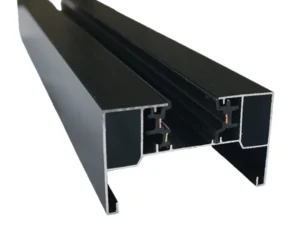
Wall thickness describes the actual aluminum material thickness at any cross-section of the profile — the measurement from the outer surface of the aluminum to the inner cavity surface. A profile may have an outer dimension of 20×10mm but a wall thickness of only 0.8mm, meaning most of the apparent size is empty cavity rather than thermally active aluminum mass.
The thermal performance of an LED aluminum profile is determined by wall thickness and total cross-section area — the amount of aluminum present to absorb and conduct heat — not by overall external size. A slim profile with 1.5mm walls can outperform a larger profile with 0.8mm walls on heat dissipation, despite appearing smaller from the outside.
This is the most common specification error in LED profile purchasing: selecting based on overall dimensions while ignoring the wall thickness that actually determines thermal performance.
Common Wall Thickness Ranges and What They Mean
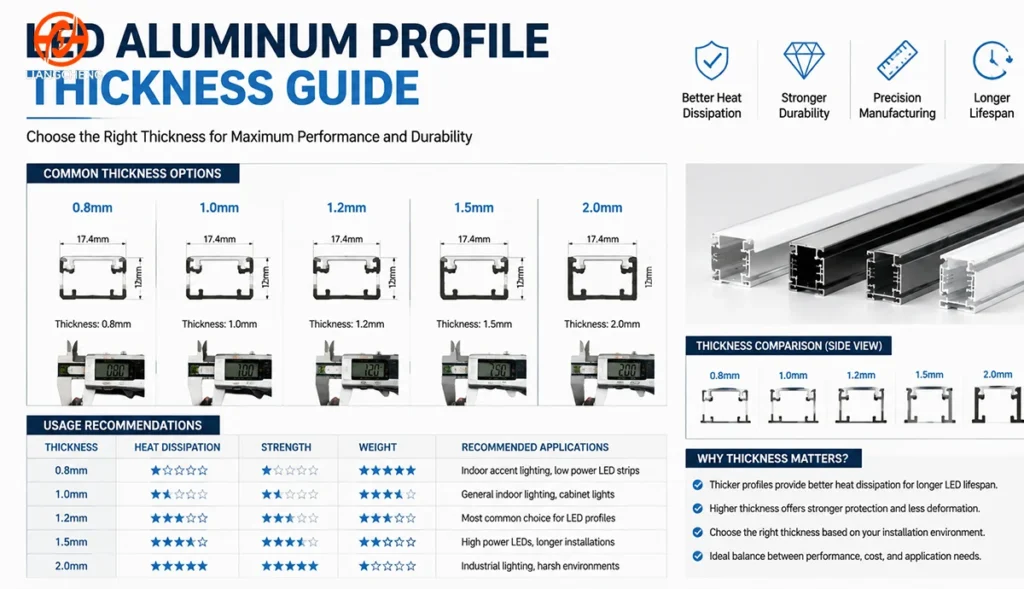
LED aluminum profiles are commercially available across a range of wall thicknesses, each representing a different balance between cost, weight, and thermal capability:
Thin profiles: 0.8–1.0mm wall thickness The lightest and least expensive category. Adequate for very low-power LED applications where heat generation is minimal. Limited thermal mass means these profiles reach equilibrium temperature quickly and have limited capacity to buffer transient heat loads. The thinner walls also reduce structural rigidity, making longer spans more prone to visible flex.
Standard profiles: 1.2–1.8mm wall thickness The working range for the majority of residential and commercial LED lighting applications. Sufficient thermal mass for LED strips up to approximately 15W/m in normal indoor conditions. The structural rigidity is adequate for typical installation spans without additional support.
Heavy-duty profiles: 2.0mm+ wall thickness Specified for high-power LED applications, outdoor installations, continuous-operation commercial lighting, and any environment where ambient temperatures are elevated. The additional aluminum mass provides meaningfully better heat dissipation and structural stiffness for spans carrying significant fixture loads.
The Physics of How Wall Thickness Affects Heat Dissipation
How an LED Aluminum Profile Functions as a Heat Sink
Every LED chip converts a portion of its electrical input to light and the remainder to heat. This heat is generated at the LED junction — the semiconductor interface where photon emission occurs. Junction temperature is the temperature at this specific point, and it is the single most influential variable in LED performance and lifespan.
Heat flows from the LED junction through the circuit board (PCB) substrate, into the aluminum base of the profile below the strip, and then through the aluminum body to the outer surfaces where it dissipates into the surrounding air. This flow follows the path of least thermal resistance.
The aluminum profile performs two distinct thermal roles simultaneously:
Conduction — moving heat away from the LED junction through solid aluminum, along the path from the LED contact surface to the extremities of the profile cross-section. This is governed by aluminum’s thermal conductivity (~200 W/m·K for 6063-T5) and the cross-sectional area through which heat flows.
Convection — dissipating heat from the aluminum surface into the surrounding air. This is governed by the total exposed surface area of the profile and the air movement conditions at the installation location.
Wall thickness affects both mechanisms: thicker walls provide more cross-sectional area for conductive heat flow and more thermal mass to absorb transient heat loads, and they contribute to the total surface area available for convective dissipation.
The Relationship Between Thickness and Thermal Performance: Quantified
The relationship between wall thickness and thermal performance is not linear — it varies with LED power density, ambient temperature, and installation environment. However, the general pattern is consistent and predictable:
At low power densities (under 5W/m), the heat generated per meter of LED strip is modest. Even profiles with 0.8mm walls can maintain LED junction temperatures within acceptable limits in ambient indoor temperatures of 20–25°C. The thermal demand does not exceed the profile’s capacity at this power level.
At medium power densities (10–15W/m), the thermal demand increases significantly. A 0.8mm wall profile will reach a higher equilibrium temperature than a 1.2mm wall profile under the same load — typically 10–20°C higher in controlled testing conditions. This difference in profile surface temperature corresponds to a similar or greater difference in LED junction temperature, with corresponding effects on lumen output and lifespan.
At high power densities (20W/m and above), thin-wall profiles are inadequate for maintaining acceptable LED junction temperatures in most installation environments. The thermal mass and cross-sectional area of 2.0mm+ profiles are necessary to prevent junction temperature from exceeding the LED manufacturer’s rated maximum. At these power levels, profile geometry — the total aluminum mass per meter and the surface area exposed to air — becomes the critical specification parameter.
What Happens When Wall Thickness Is Insufficient
An LED strip operating in a thermally inadequate profile experiences progressively elevated junction temperature. The consequences follow a predictable sequence:
Immediate lumen reduction — LED output at elevated temperature is lower than at rated temperature. A strip rated at 1,000 lm/m at 25°C junction temperature may produce only 850–900 lm/m at 55°C junction temperature, even in a brand-new installation.
Accelerated lumen depreciation — the rate at which LED lumen output declines over time (L70 lifespan is defined as the point where output falls to 70% of initial) is exponentially sensitive to junction temperature. An LED rated for L70 at 50,000 hours at 75°C junction temperature may reach L70 at only 20,000–25,000 hours if junction temperature runs consistently at 90–95°C due to thermal undersupply.
Color shift — phosphor-converted white LEDs experience color temperature drift at elevated junction temperatures, with warm-white LEDs typically shifting slightly toward the blue-green range as phosphor conversion efficiency changes with temperature.
Premature LED failure — in severe cases of thermal inadequacy, junction temperatures approach the absolute maximum rating of the LED chip, causing electrical degradation of the semiconductor junctions and early failure of individual LEDs. This manifests as dark spots along what should be a continuous light line.
Thickness Selection Guide by LED Power Density
The primary input for selecting LED aluminum profile wall thickness is the power density of the LED strip specified for the installation, expressed in watts per meter (W/m). The following recommendations assume standard 6063-T5 aluminum alloy profiles, indoor ambient temperature of 20–25°C, and surface mounted or recessed installation with adequate air circulation.
Low-Power LED Strips: 4W–9.6W/m
Recommended wall thickness: 0.8–1.0mm
At power densities below 10W/m, heat generation per meter is modest — typically producing equilibrium temperatures 10–20°C above ambient on the profile surface. Thin-wall profiles in 6063-T5 maintain LED junction temperatures within acceptable limits for standard residential and decorative applications.
Thin profiles are particularly appropriate for applications where the profile itself is a visible design element requiring a slim aesthetic: miniature cabinet lighting, furniture edges, step risers, toe-kick details, and shelf lighting where the profile dimensions must fit within tight spatial constraints.
Suitable applications: Under-cabinet lighting in kitchens, wardrobe interior accent lighting, display shelf lighting, staircase step lighting, bookcase lighting, decorative cove accents in residential spaces.
Not suitable for: Continuous operation above 10 hours/day, elevated ambient temperatures above 30°C, or installation in enclosed cavities without air circulation.
Medium-Power LED Strips: 12W–20W/m
Recommended wall thickness: 1.2–1.8mm
Medium power density is the working range for most residential and commercial LED lighting applications — office general illumination, hotel corridor and room lighting, retail accent lighting, and high-quality residential ceiling lighting. LED strips in this power range generate heat that a thin-wall profile cannot adequately manage over extended operation.
Standard-thickness profiles in 6063-T5 provide sufficient thermal mass to keep profile surface temperatures 15–30°C above ambient under normal operating conditions, which translates to LED junction temperatures within rated limits for most LED strip types. The structural stiffness of 1.2–1.8mm walls also supports larger installation spans without visible deflection.
For commercial applications where lighting systems operate 12+ hours per day, specify toward the upper end of this range (1.5–1.8mm). The additional thermal capacity reduces equilibrium temperature and extends LED lifespan meaningfully over a 5–10 year installation.
Suitable applications: Office ceiling lighting, hotel room and corridor accent lighting, retail general illumination, restaurant ambient lighting, quality residential ceiling and cove lighting, commercial display lighting.
High-Power LED Strips: 20W–30W+/m
Recommended wall thickness: 2.0mm+
High-power LED strips above 20W/m generate heat loads that standard-thickness profiles cannot manage without allowing junction temperatures to exceed acceptable limits. This power density range includes high-output commercial strips designed for retail accent lighting, museum and gallery illumination, architectural façade lighting, and industrial applications requiring high lumen output from a single linear source.
At 25W/m, a 1m length of LED strip generates 25 watts of heat — comparable to a small space heater element concentrated in a linear housing. Managing this requires substantial aluminum mass, large profile cross-section area, and in some applications, additional thermal design features such as extended fins or wing geometries that increase convective surface area beyond the basic channel profile.
For installations above 25W/m or in environments with elevated ambient temperatures (outdoor summer conditions, kitchens with heat exposure, industrial facilities), consider profiles with fin or wing geometries in addition to 2.0mm+ base wall thickness. The additional surface area these designs provide significantly improves convective heat dissipation.
Suitable applications: Retail high-bay accent lighting, museum and gallery specification lighting, architectural feature lighting, industrial work area lighting, outdoor covered area floodlighting, long-run linear systems where high lumen output per meter is required.
Profile Thickness Comparison Table
| Profile Category | Wall Thickness | Suitable LED Power | Heat Dissipation | Structural Rigidity | Typical Applications |
|---|---|---|---|---|---|
| Slim / Thin | 0.8–1.0mm | Up to 9.6W/m | Basic | Light | Cabinet, decorative, furniture |
| Standard | 1.2–1.5mm | 10–15W/m | Good | Adequate | Residential, standard commercial |
| Commercial | 1.5–1.8mm | 15–20W/m | Very good | Strong | Offices, hotels, retail |
| Heavy-duty | 2.0mm+ | 20W/m+ | Excellent | Maximum | High-power, outdoor, industrial |
Other Factors That Work With Wall Thickness
Wall thickness is the primary variable in LED profile thermal performance, but it operates in combination with four additional factors. Specifying the correct wall thickness while ignoring these factors can still produce inadequate thermal results.
Aluminum Alloy Selection
The alloy specification of the aluminum determines its thermal conductivity — how efficiently heat moves through the metal from the LED contact surface to the dissipating exterior. 6063-T5 aluminum at approximately 200 W/m·K is the industry standard for LED profile manufacturing and provides the thermal performance that thickness-based specifications assume.
Profiles manufactured from recycled aluminum blends, lower-grade alloys, or alloys with significant iron contamination may have thermal conductivities of 150–175 W/m·K — 12–25% lower than 6063-T5. This reduction in conductivity partially offsets any gains from increased wall thickness. A 1.5mm profile in 6063-T5 may outperform a 2.0mm profile in recycled blended alloy on actual thermal performance, despite the apparent advantage of the thicker specification.
This is why requesting alloy documentation (material certificate confirming 6063-T5 specification) is essential when evaluating LED profile suppliers, particularly for profiles positioned at the lower end of the price range.
Profile Cross-Section Shape and Geometry
The shape of the aluminum cross-section affects thermal performance independently of wall thickness through two mechanisms: total aluminum mass per meter (which determines thermal storage capacity) and exposed surface area (which determines convective dissipation rate).
Flat base profiles — the most common cross-section for surface mounted and recessed profiles — maximize the contact area between the LED strip’s PCB and the aluminum base, which is the most thermally critical interface. Heat flows efficiently from the LED contact surface into the base section.
Deep channel profiles — taller cross-sections with more aluminum material between the LED contact surface and the mounting surface — provide more thermal mass and a longer conductive path for heat distribution.
Fin and wing geometries — profiles with extended fin features projecting above or beside the main body significantly increase convective surface area. At equivalent wall thickness, a finned profile can dissipate heat 20–40% more effectively than a flat-base profile of similar material weight by exposing substantially more aluminum surface to air movement.
For high-power applications above 20W/m, comparing profiles with equivalent wall thickness but different cross-section geometries can identify solutions that manage thermal loads without resorting to the heaviest wall specifications.
Installation Environment: Indoor vs. Outdoor
The installation environment — particularly ambient temperature and air circulation — directly affects how effectively a given profile specification manages heat.
Indoor standard environments (ambient 20–25°C, normal air circulation): The recommendations in the previous section apply directly. Air circulation around the profile surface is generally adequate for natural convective cooling.
Indoor high-temperature environments (commercial kitchens, industrial facilities, ambient 30–40°C): At elevated ambient temperatures, the temperature differential between the profile surface and the surrounding air is reduced, which reduces convective heat dissipation. Increase specified wall thickness by one category above what the strip power density alone would suggest.
Outdoor covered applications (covered terraces, canopies, pergolas — ambient 15–35°C seasonal range): Outdoor ambient temperatures in summer can reduce the convective cooling effectiveness significantly. For covered outdoor applications, specify profiles rated for the next power category above the installed strip density.
Outdoor exposed applications (building façades, landscape, fully exposed): Direct solar radiation can elevate profile surface temperature by 20–30°C beyond ambient air temperature on south-facing or horizontal surfaces. For fully exposed outdoor applications, add 2.0mm minimum wall thickness, specify outdoor-grade anodizing (25+ microns) or powder coating for surface protection, and design the installation with air gaps behind the profile where possible to promote rear-surface convective cooling.
Enclosed or recessed installation in non-conductive substrates: Profiles installed in routed channels in MDF, wood, or plasterboard substrates lose the convective cooling of the profile’s outer surfaces to air circulation. Heat can only dissipate through the rear substrate contact and the diffuser face. For recessed installations in wood or MDF, increase wall thickness by 0.2–0.5mm above the standard recommendation for the LED power density.
Surface Treatment and Its Effect on Thermal Performance
The surface treatment of an LED aluminum profile has a modest but measurable effect on thermal performance through its influence on the emissivity of the profile surface — the efficiency with which the surface emits thermal radiation.
An anodized aluminum surface has a thermal emissivity of approximately 0.77–0.85 (depending on anodizing type and thickness), compared to bare mill-finish aluminum at approximately 0.05–0.10. This means an anodized profile radiates heat approximately 8–15 times more effectively than bare aluminum.
In practical terms, this difference is most significant in enclosed or poorly ventilated installations where convective cooling is limited and radiation becomes a proportionally more important heat transfer mechanism. In well-ventilated installations, convection dominates and the surface emissivity difference has minimal practical effect.
Matte black anodized or powder-coated surfaces have slightly higher emissivity than silver anodized, providing marginally better radiative cooling — but the difference is small enough that it does not affect the thickness specification decision in most practical cases.
Thickness Requirements by Application
Cabinet and Furniture Lighting
Cabinet and furniture lighting applications almost always use low-power LED strips — typically in the 4–9.6W/m range — where the emphasis is on even light distribution and compact profile dimensions rather than heat management. Thin profiles at 0.8–1.0mm wall thickness are appropriate.
The constraint in cabinet lighting is usually spatial: the profile must fit within a narrow shelf gap, behind a door reveal, or into a furniture edge detail with minimal visual intrusion. This application environment also rarely involves continuous 24-hour operation, which reduces the cumulative thermal stress on the profile and LED strip.
Ceiling and Recessed Lighting
Recessed ceiling profiles are specified across a wide range of LED power densities — from decorative cove lighting at 7–10W/m to high-quality architectural ceiling lighting at 15–20W/m. The enclosed installation geometry of recessed profiles (surrounded by ceiling substrate material on three sides) reduces convective cooling access compared to surface-mounted profiles.
For recessed ceiling lighting in wood or plasterboard substrates, increase the wall thickness specification by one step above what the LED power density alone would indicate. A 12W/m strip that would be adequately managed by a 1.2mm profile in surface-mounted configuration should be specified with a 1.5mm profile when recessed into a plasterboard ceiling with limited rear air circulation.
Commercial Linear Lighting
Commercial linear lighting systems — suspended office lighting, retail ceiling systems, hospitality overhead lighting — operate for extended daily hours and require reliable performance over 10–15 year installation lifespans. The combination of extended operation and moderate-to-high power density (15–25W/m for commercial linear) places sustained thermal demands on the profile system.
Specify commercial linear profiles at 1.5–2.0mm wall thickness as a minimum, with suspended or surface-mounted geometries that maximize air circulation around the profile body. For commercial projects specifying strips above 20W/m, evaluate finned or winged profile geometries as an alternative to simply increasing flat-base wall thickness.
Outdoor LED Lighting
Outdoor LED lighting applications present the most demanding combination of conditions for profile thermal management: elevated ambient temperatures in summer, potential direct solar heat gain on exposed surfaces, and surface treatment requirements for weather durability.
For outdoor covered applications (pergolas, canopies, covered terraces), specify 1.5mm minimum wall thickness for standard strips up to 15W/m, and 2.0mm for higher-power outdoor strips.
For fully exposed outdoor applications — building façades, landscape uplighting, pathway lighting, exterior architectural features — specify 2.0–2.5mm wall thickness minimum, with outdoor-grade surface treatment. For coastal environments with salt spray exposure, specify 25+ micron anodizing or outdoor powder coating and confirm that all cut ends and machined surfaces are sealed to prevent moisture ingress to bare aluminum.
How Thickness Affects LED Profile Quality and Cost
Why Thicker Profiles Cost More
The cost of an LED aluminum profile increases with wall thickness for straightforward reasons: more aluminum material per meter means higher material input cost; the greater cross-sectional area of thicker-walled profiles requires higher press force during extrusion, reducing production speed; and heavier profiles carry higher per-unit freight cost.
Typical approximate cost relationships between wall thickness categories for equivalent cross-section geometry and surface finish: a 1.5mm wall profile costs approximately 15–25% more per meter than a 1.0mm wall profile; a 2.0mm profile costs approximately 30–50% more than a 1.0mm profile. These relationships vary with aluminum commodity prices and exchange rates.
Why Choosing the Cheapest Profile Increases Total Project Cost
The true cost of specifying an undersized wall thickness becomes visible over the installation lifespan, not at the point of purchase. The failure costs — LED strip replacement, installation labor for replacement, potential ceiling or substrate repair in recessed applications, and customer relationship damage — consistently exceed the material savings from choosing a thinner, less expensive profile.
A commercial project where a lighting system requires LED strip replacement after 18,000 hours rather than the rated 50,000+ hours incurs three strip replacement cycles over the 10-year installation lifespan versus zero replacements for a correctly specified system. At commercial LED strip pricing and installation labor rates, this cost comparison makes even significant per-meter profile cost differences economically irrelevant.
Finding the Right Balance
The correct approach to wall thickness specification is to match the specification to the application requirements — no more, no less. Over-specifying wall thickness for very low-power decorative applications wastes material cost with no performance benefit. Under-specifying for high-power commercial applications creates the failure costs described above.
The framework is straightforward: identify the LED strip power density, adjust upward for any environmental factors (elevated ambient temperature, enclosed installation, outdoor exposure), and select the wall thickness category that covers the combined thermal demand with a reasonable margin. The margin matters — actual strip wattage at end-of-reel, ambient temperature variability, and density of fixture population all create variability around the theoretical specification.
How Lighting Distributors Should Evaluate Profile Suppliers on Thickness
Verify Aluminum Material Specification First
Before evaluating wall thickness, confirm the aluminum alloy. A supplier who cannot provide material certificates confirming 6063-T5 alloy specification introduces an unknown variable into the thermal performance equation. Recycled or blended alloys with lower thermal conductivity mean the published wall thickness does not correspond to the thermal performance that 6063-T5 specifications imply.
Request material certificates as a standard part of your supplier qualification process — not as a special request for specific orders.
Measure Wall Thickness on Samples Before Bulk Orders
Published wall thickness specifications and actual production wall thickness are not always identical, particularly from suppliers competing on price. Before placing bulk orders, measure wall thickness on received samples using calipers or an ultrasonic thickness gauge. Measure at multiple points along the profile length — wall thickness variation along the extrusion direction indicates inconsistent production control.
For critical commercial applications, specify wall thickness with a tolerance in the purchase order (e.g., “1.5mm minimum wall thickness, tolerance ±0.1mm”) rather than accepting the supplier’s nominal specification without verification.
Evaluate Customization Capability for Application-Specific Profiles
Applications with specific thermal requirements that standard catalog profiles do not address — very high power density commercial systems, specialized outdoor configurations, or branded OEM products requiring non-standard cross-sections — require a manufacturer with genuine OEM capability: an in-house engineering team, die development infrastructure, and the production controls to deliver consistent wall thickness on custom cross-sections at commercial volumes.
Common Mistakes When Selecting LED Aluminum Profile Thickness
Choosing Based on Appearance Alone
A profile that looks substantial may have thin walls with a larger overall outer dimension creating the impression of mass. A profile that appears slim may have proportionally thick walls relative to its outer dimension. Visual assessment of profiles cannot determine wall thickness — specification and measurement are the only reliable methods.
Ignoring LED Strip Wattage Requirements
The profile’s thermal specification must match the LED strip’s power density at the installation. Selecting a profile based on a generic “standard indoor application” description while installing a 20W/m high-density strip creates a predictable failure scenario regardless of how well the profile is made within its own specification.
Using Indoor Profiles Outdoors
Indoor profile specifications do not account for the additional thermal and environmental demands of outdoor installation. The consequences range from surface finish degradation (anodizing or coating failure from UV and weather exposure) to structural deformation from summer ambient temperatures approaching the profile’s operating limit, to moisture ingress through inadequately sealed cut ends or connector points.
Ignoring Long-Term Operating Hours
A profile that performs adequately at initial installation in a low-ambient-temperature testing environment may perform inadequately when operated 14 hours per day in a commercial space with summer indoor temperatures reaching 30–35°C. Specify for the worst-case operating conditions the installation will actually experience, not for ideal laboratory conditions.
Frequently Asked Questions
What thickness should an LED aluminum profile be? Wall thickness should match the power density of the LED strip: 0.8–1.0mm for strips up to 9.6W/m, 1.2–1.8mm for 10–20W/m strips, and 2.0mm+ for strips above 20W/m or outdoor applications. Adjust upward for elevated ambient temperatures, enclosed installation environments, or extended daily operation hours.
Is a thicker LED aluminum profile always better? Not always. Thicker profiles provide better heat dissipation for high-power applications, but specifying 2.0mm+ walls for a low-power decorative cabinet installation adds material cost with no thermal benefit. The correct specification matches wall thickness to the actual thermal demand of the LED strip and installation environment — not the maximum available.
How does aluminum thickness affect LED lifespan? LED lifespan is governed by junction temperature. Insufficient wall thickness allows junction temperature to run higher than rated, which accelerates lumen depreciation and shortens the LED’s effective service life. An LED rated for 50,000 hours at a junction temperature of 75°C may reach 70% lumen maintenance at only 20,000–25,000 hours if junction temperature consistently runs at 90–95°C due to inadequate thermal management.
What aluminum alloy is best for LED profiles? 6063-T5 aluminum is the industry standard. Its thermal conductivity of approximately 200 W/m·K, excellent extrudability for thin-wall complex cross-sections, and outstanding anodizing performance make it optimal for LED profile applications. Request material certification confirming 6063-T5 specification when evaluating suppliers — especially at lower price points where recycled alloy substitution is a known risk.
Can thin LED profiles be used for high-power LED strips? No. Thin profiles (0.8–1.0mm) do not provide sufficient thermal mass or surface area to manage the heat generated by LED strips above 10W/m. Using a thin profile with a high-power strip will result in elevated junction temperatures, accelerated lumen depreciation, and shortened LED service life. Match profile wall thickness to LED power density using the selection framework in this guide.
What is the standard thickness of LED aluminum profiles? There is no single universal standard — the appropriate thickness depends on the application. In commercial practice, 1.2–1.5mm wall thickness is the most common specification for general residential and light commercial LED strip applications (10–15W/m). For high-performance commercial and specialty applications, 1.5–2.0mm+ specifications are standard.
Conclusion: Thickness Is the Variable That Protects Your LED Investment
The wall thickness of an LED aluminum profile is not a minor manufacturing detail — it is the thermal specification that determines how well the profile performs its primary function as a heat sink, and consequently how long the LED system delivers its rated performance.
The selection framework is straightforward: match wall thickness to LED strip power density, adjust for installation environment and operating conditions, verify alloy specification to ensure the thermal conductivity assumption is valid, and confirm actual thickness on samples before bulk orders. Applied consistently, this framework eliminates the most common source of LED system premature failure in commercial and residential projects.
For wholesale buyers and lighting distributors, the thermal specification competence to match profile to application is a meaningful point of differentiation with specifiers, contractors, and end users who experience lighting system failures from under-specified profiles. Recommending the correctly specified profile from the start is the foundation of lighting distribution relationships that last.
Liangcheng Lighting: Premium Aluminum Material Across the Full Track System Range
At Jiangmen Liangcheng Lighting Co., Ltd., the specification decision described throughout this guide — matching aluminum material quality and wall thickness to the thermal demands of the application — is built into every product in their LED track lighting system range.
With over 10 years of experience manufacturing LED track rail systems and more than 1,000 product models covering 2-wire, 3-circuit, 4-circuit, 6-circuit, and magnetic track configurations, Liangcheng’s production is built around the understanding that track rail quality is determined by what’s inside the profile, not just its external appearance. Their commitment to premium-grade aluminum materials and reliable electrical components — stated explicitly as a company principle — reflects exactly the material specification standard this guide describes.
The combination of ISO and TÜV GS quality management standards with 100% pre-shipment inspection by a dedicated QC team means the aluminum specifications Liangcheng publishes correspond to what is actually shipped. For lighting distributors who have encountered the gap between specified and delivered wall thickness with other suppliers, this documented quality management infrastructure is a meaningful assurance.
Liangcheng’s CE, LVD, EMC, RoHS, and CB certified products serve shopping malls, office buildings, museums, hotels, conference rooms, and exhibition halls across South America, Russia, Poland, North America, Europe, and beyond — commercial environments where thermal performance directly determines whether a lighting installation delivers its rated service life.
For distributors building product lines where thermal specification is part of the value proposition to their customers, Liangcheng Lighting (lclights.com) provides the manufacturing foundation to deliver on that promise.
Need Custom Track Lighting Solutions?
Contact Liangcheng Lighting for OEM/ODM aluminum track rail solutions and professional lighting support.
Related