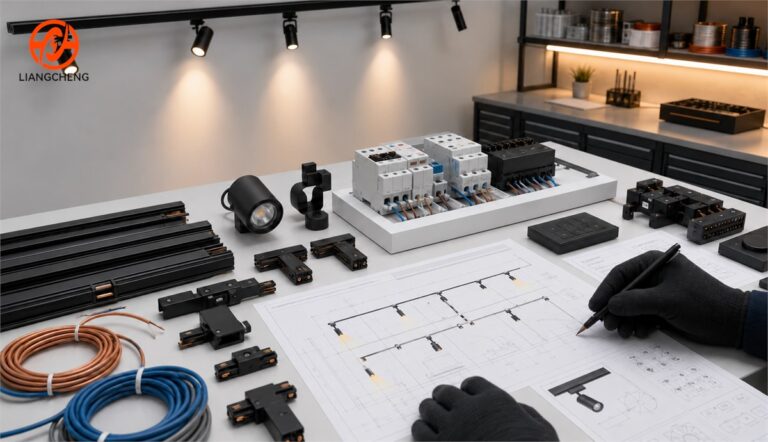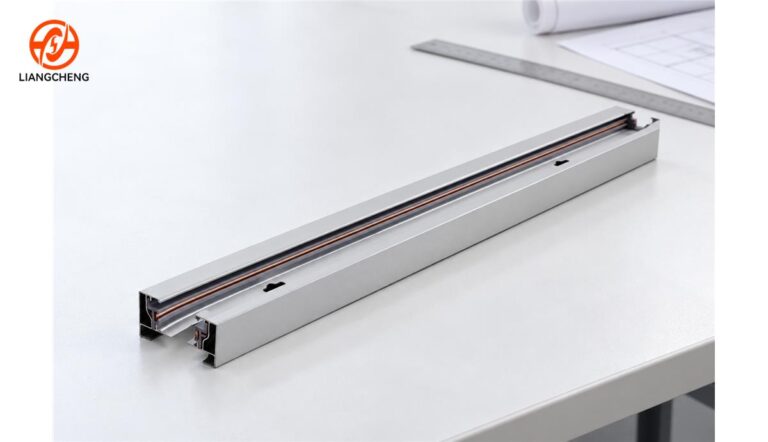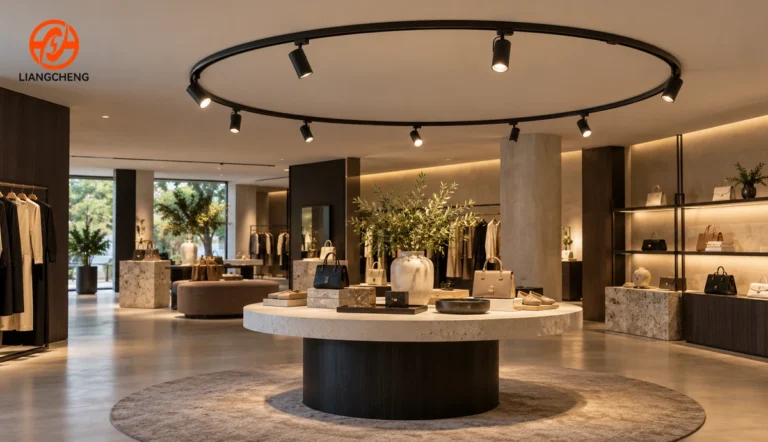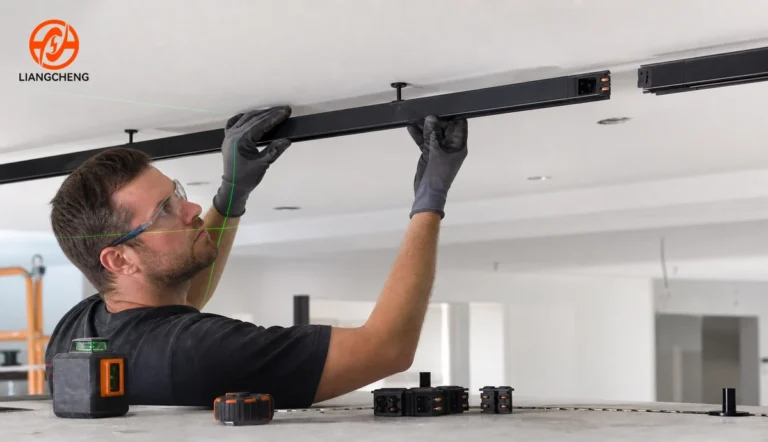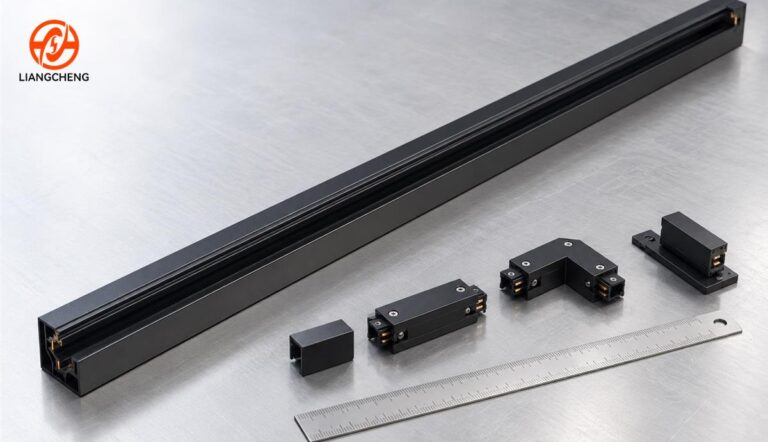







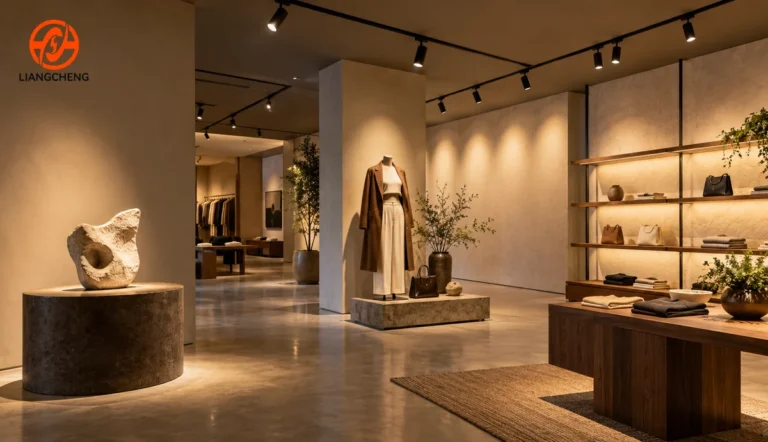

Track lighting for jewelry stores works best as an adjustable accent layer above windows, wall displays, consultation counters, and changing feature zones; it should not be expected to replace concealed lighting inside glass showcases. A dependable jewelry lighting plan combines comfortable ambient light, high-color-quality case lighting, focused track accents, controlled reflections, and a documented rail system that installers and store teams can maintain. For most projects, CRI 90 is a screening minimum, CRI 95+ is a sensible target for color-critical jewelry displays, and a physical mock-up remains more reliable than any single metric.
Jewelry store track lighting specification at a glance
| Decision | Practical starting point | Why it matters |
|---|---|---|
| Lighting layers | Ambient + in-case + track accent + task lighting | Each layer solves a different visibility problem. |
| Color rendering | CRI 90 minimum for general sales lighting; evaluate CRI 95+ for jewelry accents | Small differences in metals, stones, enamel, and skin tones are commercially important. |
| Additional color data | Request R9 and a complete TM-30 report where available | Two sources with similar CRI can render saturated colors differently. |
| Color temperature | About 3000K for warm metals; 3500K鈥?000K for mixed or cool-toned collections | CCT changes atmosphere and the apparent warmth of merchandise. |
| Beam angles | Roughly 10掳鈥?5掳 for small hero accents; 20掳鈥?0掳 for cases and feature groups; wider optics for walls | Beam angle must match target size and mounting distance. |
| Contrast | Start near 3:1 to 5:1 for regular displays and test stronger contrast for hero pieces | Relative brightness guides attention more effectively than uniform high illuminance. |
| Track architecture | Single circuit for simple stable layouts; multi-circuit or controlled systems for separately operated zones | Windows, sales floor, consultation, and cleaning modes may need different operation. |
| Approval method | Photometric calculation + representative merchandise mock-up + final aiming | Glass, velvet, polished metal, and faceted stones create effects that a catalog cannot predict. |
These values are starting points rather than universal rules. Ceiling height, daylight, showcase geometry, merchandise, local requirements, and luminaire photometry can change the final specification.
Why is track lighting useful in a jewelry store?
Track lighting is useful because jewelry displays change more often than the ceiling. Adjustable heads can follow a seasonal collection, bridal promotion, watch launch, or hero display. A compatible spotlight can also be added or replaced without rebuilding the ceiling layout.
Track lighting is most effective when the project defines targets before drawing rail lines. A rail route should serve real objects鈥攚indow displays, wall niches, freestanding cases, consultation tables, signs, and feature plinths鈥攔ather than form an arbitrary ceiling grid. The existing Liangcheng guide to track lighting design for retail stores explains the broader target-led method; jewelry stores add stricter requirements for color, sparkle, close inspection, and glass reflections.
Track lighting also has limits. A ceiling spotlight cannot evenly reveal small rings on several shelves inside a deep glass case, and a narrow beam may create a reflection that hides the product. The system succeeds only when optical design, case lighting, rail architecture, controls, and commissioning are coordinated.

How should a jewelry store layer ambient, accent, case, and task lighting?
A jewelry store needs at least four coordinated layers because no single fixture can provide atmosphere, sparkle, accurate inspection, and operational visibility at the same time. The ambient layer supports circulation and facial comfort. The in-case layer reveals small products at close range. The accent layer creates hierarchy and sparkle. The task layer supports consultation, packaging, security checks, and repair work.
Ambient lighting should remain comfortable and subordinate
Ambient lighting should make the room readable without competing with the merchandise. Uniformly high brightness reduces contrast, so indirect light, controlled downlights, or broad track distributions should establish a restrained base below brighter product targets.
Track accent lighting should create controlled emphasis
Track accents identify the pieces and surfaces that deserve attention. Narrow beams can create highlights on diamonds or polished metal, medium beams can cover necklace busts, and wall-wash optics can reveal branded displays. The BRE retail lighting guide notes that adjustable track arrangements support changing merchandise and strong contrast, provided glare is controlled.
Display-case lighting should perform the close-range work
Integrated linear LEDs, miniature spotlights, or concealed shelf lighting should reveal merchandise inside a case. Close placement produces more even coverage; diffusers reduce diode images, side lighting fills shadows, and concealed sources stay outside the customer’s direct view.
Task lighting should support people as well as products
Consultation tables need clear product and facial light without glare in the countertop. Packaging, checkout, and repair areas need separate task criteria because staff work is not the same visual task as customer-facing display lighting.
What CRI is appropriate for jewelry store lighting?
CRI 90 is a reasonable minimum screening value for most customer-facing jewelry store lighting, while CRI 95+ is a stronger target for cases, consultation counters, and color-critical accents. Higher CRI generally improves fidelity, but CRI alone cannot describe every relevant color shift. The U.S. Department of Energy LED guidance explains that CRI 90 or higher indicates excellent fidelity while also noting that CRI is weak at predicting saturated red performance; R9 and IES TM-30 metrics provide additional information.
R9 matters because red response affects rubies, garnets, rose gold, skin tones, and warm display materials. A project should request the actual R9 value instead of assuming that a CRI 95 product automatically has strong saturated-red rendering. However, R9 should not become the only supplemental test, because sapphires, emeralds, turquoise, pearls, and mixed-metal products involve other hue regions.
TM-30 gives specifiers a broader description through color fidelity, gamut, and hue-specific information. The Illuminating Engineering Society color committee identifies ANSI/IES TM-30 as its method for evaluating color rendition. For important retail programs, buyers should request a complete TM-30 report or spectral power distribution, compare candidate sources, and approve them with representative merchandise.
Which color temperature works for diamonds, gold, gemstones, and watches?
No single color temperature is ideal for every jewelry category. Warm white light around 2700K鈥?000K usually supports yellow gold, rose gold, amber, and intimate luxury interiors. Neutral white around 3500K often works well for mixed collections. Neutral-to-cool white around 4000K can reinforce the crisp appearance of diamonds, platinum, silver, white gold, and contemporary watch displays.
| Merchandise | Useful CCT range to mock up | Primary evaluation question |
|---|---|---|
| Yellow and rose gold | 2700K鈥?200K | Does the metal remain rich without making white stones look yellow? |
| Diamonds and white metals | 3500K鈥?000K | Does the display look crisp without becoming cold or blue? |
| Colored gemstones | 3000K鈥?000K | Which spectrum preserves the actual hue and saturation across the collection? |
| Pearls and skin-adjacent products | 3000K鈥?500K | Are subtle surface colors and skin tones natural at consultation distance? |
| Mixed jewelry and watches | About 3500K as a neutral starting point | Can one base source serve the assortment, with selective accents for special zones? |
CCT describes the appearance of the light, not its color-rendering ability. A 4000K source can have poor color fidelity, while a 3000K source can render colors extremely well. CCT choices should therefore be evaluated together with CRI, R9, TM-30 data, finishes, brand atmosphere, and physical merchandise.
How should track lighting interact with glass display cases?
Track lighting should illuminate the merchandise or display composition without producing a dominant image of the light source in the glass. A track positioned directly over the center of a horizontal case often creates steep angles, top shadows, or reflected hotspots. An offset rail position can provide a more useful aiming path, but the correct offset depends on case height, glass angle, customer position, ceiling height, and the luminaire beam.
Reflection control starts with sightlines. The designer should mark common customer eye positions, staff positions, entrance views, and seated consultation views. Aiming should then be checked from those positions with the glass closed. A solution that looks good while a case is open can fail immediately when the reflected ceiling and lamps appear on the front pane.
Overhead track accents and in-case lighting perform different jobs. In-case linear lighting provides even detail and reduces shadows between shelves. Track lighting creates highlights, connects the case to the room, illuminates vertical graphics, and supports feature pieces above or outside the case. Using both layers at moderate levels is usually more controllable than attempting to achieve all brightness from one intense source.
Display materials change the result: dark velvet raises contrast, white interiors reveal hotspots, and mirrors multiply source images. Before fabrication, coordinate lighting channels, cable routes, driver access, ventilation, locks, sensors, and service clearances.
How do beam angle, distance, and aiming determine the accent?
Beam angle cannot be selected without mounting distance because a beam spreads as it travels. As a first geometric estimate, beam diameter equals twice the distance to the target multiplied by the tangent of half the beam angle. The calculation estimates nominal spread; it does not replace a photometric file because real beams have field angles, intensity gradients, tilt distortion, and spill light.
| Nominal beam angle | Approximate diameter at 2.0 m | Approximate diameter at 2.5 m | Typical jewelry-store use |
|---|---|---|---|
| 10掳 | 0.35 m | 0.44 m | Small hero piece or concentrated sparkle |
| 15掳 | 0.53 m | 0.66 m | Bust, plinth, or compact feature group |
| 24掳 | 0.85 m | 1.06 m | Display case section or consultation feature |
| 36掳 | 1.30 m | 1.62 m | Broad display group or vertical feature |
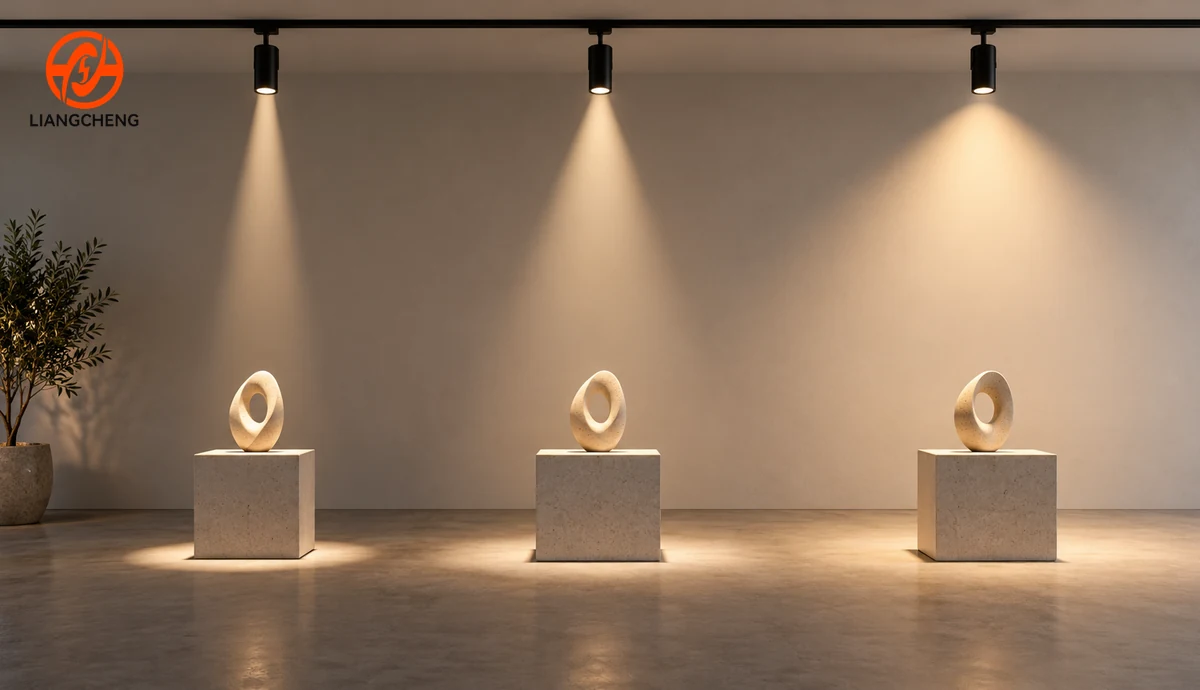
A narrow beam can create attractive flashes but may leave neighboring products dark or create a reflected source. A wider beam is more forgiving but may reduce contrast, so interchangeable optics are preferable to one beam angle throughout the store.
Rail position should allow useful aiming without placing bright apertures directly in customer sightlines. High ceilings may justify suspended rails that bring fixtures closer to targets. Low ceilings may need compact heads, deeper shielding, or recessed rail to reduce visual clutter. Every layout should be tested against actual fixture photometry and representative viewing positions.
Which track wiring and control strategy fits a jewelry store?
A small jewelry boutique with a stable layout may use a single-circuit track where all heads on a run switch or dim together. A larger showroom often benefits from multi-circuit track because window lighting, wall displays, central cases, consultation zones, and cleaning light can operate as separate groups. Multi-circuit capability creates zoning, but it does not automatically provide individual luminaire addressing or a particular dimming protocol.
Terms such as 2-wire, 3-wire, 4-wire, single-circuit, and three-circuit are not used identically in every market or product family. Wire count, protective earthing, circuit count, polarity, adapter interface, and control method are separate facts. The single-circuit versus multi-circuit track lighting guide explains the functional choice, while the final purchase specification must reference the selected supplier’s wiring diagram and component codes.

Branch-circuit wiring, protection, load calculations, earthing, installation, and inspection must be completed by qualified professionals under local requirements. IEC 60570 defines a scope for certain electrical supply track systems for luminaires, but a standard reference alone does not establish that a specific rail, accessory, adapter, and luminaire combination is compliant. Buyers should request traceable documents for the actual models and intended destination.
Surface-mounted, recessed, or suspended track: which installation fits?
| Mounting method | Advantages | Limitations | Good fit |
|---|---|---|---|
| Surface-mounted | Simple ceiling interface, visible service access, easy layout changes | Rail remains visually prominent | Retrofits, boutiques, exposed or straightforward ceilings |
| Recessed | Cleaner ceiling line and reduced visual weight | Requires coordinated cutout, ceiling build-up, access, and finishing | Premium stores with early ceiling coordination |
| Suspended | Brings fixtures closer to products and works below high ceilings | Needs structural coordination, suspension alignment, and cable planning | High-volume spaces, tall malls, open ceilings |
| Curved or custom route | Can follow circular counters, architectural features, or customer paths | Radius, connector, adapter travel, and production tolerances require approval | Round consultation islands and signature display zones |
The surface, recessed, and suspended track rail comparison provides a broader installation decision framework. Jewelry projects should add reflection sightlines and security-case coordination to that framework.
Are track rails, adapters, and luminaires universally compatible?
Track rails, adapters, and luminaires are not universally compatible. Similar external dimensions or the same wire-count label do not prove mechanical fit, conductor alignment, protective-earth engagement, locking strength, circuit selection, ratings, or control behavior. A jewelry project should approve the rail, feeds, connectors, adapters, and luminaires as a documented system.
Replacement and expansion projects need positive identification of the installed system. Buyers should record labels, rail cross sections, conductor positions, feed arrangement, adapters, polarity marks, dimensions, and available drawings. The Liangcheng track light adapter compatibility checklist turns those observations into a controlled approval process.
A physical fit test is necessary but not sufficient. The test should cover insertion, locking, retention, contact mapping, circuit selection, grounding where applicable, fixture mass and orientation, representative production variation, and the complete assembled luminaire. A golden sample should be retained with the approved drawing and revision so later deliveries can be compared with the same baseline.
What are the advantages and disadvantages of track lighting in jewelry stores?
| Aspect | Advantage | Disadvantage or risk |
|---|---|---|
| Flexibility | Heads can follow new collections and changed layouts. | Flexibility is wasted if staff are not trained to re-aim correctly. |
| Visual hierarchy | Controlled accents direct attention to high-value products. | Excessive contrast can cause discomfort or hide supporting merchandise. |
| System expansion | Compatible heads and accessories can be added along the rail. | Unplanned additions can exceed documented limits or introduce mismatched parts. |
| Controls | Multi-circuit systems can separate windows, cases, and operating modes. | More circuits add cost and complexity when the operating plan is unclear. |
| Maintenance | Accessible fixtures are easier to replace than concealed fixed fittings. | Adapter or driver availability can become a long-term risk. |
| Appearance | Black, white, recessed, suspended, and custom-finish rails support different interiors. | Large heads or dense rail layouts can compete visually with a luxury interior. |
| Display cases | Track accents connect cases to the room and create sparkle. | Ceiling light alone rarely provides even, glare-free in-case illumination. |
Which track lighting strategy fits each jewelry retail scenario?
Small independent boutique
A small boutique can begin with one coordinated rail family, a limited selection of beam angles, and simple grouped control. The priority is not maximum circuit count; it is accurate rail placement, good color quality, shielded heads, concealed case lighting, and a complete accessory kit. Spare adapters and one or two replacement heads reduce downtime.
Luxury flagship or large showroom
A flagship needs separate control of windows, wall displays, central cases, consultation rooms, feature art, and cleaning light. Multi-circuit or addressable control can be valuable, but the project should document scene ownership and staff operation. Recessed or custom-finish rail may reduce visual weight, while narrow, medium, and wall-wash optics create multiple levels of hierarchy.
Mall kiosk or island counter
A kiosk often has limited overhead control and highly reflective cases viewed from several directions. The design should prioritize concealed in-case lighting and evaluate whether the available ceiling or canopy can place accent sources outside common reflection angles. Compact rail heads, low-voltage case systems, driver access, security hardware, and mall installation restrictions must be coordinated early.
Multi-store rollout
A multi-store program should standardize approved rail and adapter families, fixture codes, optics, CCT and color data, finish references, scene schedules, aiming photographs, replacement parts, and inspection records. Standardization should preserve local layout flexibility without allowing uncontrolled substitutions. Each branch still needs a commissioning pass because ceiling heights, daylight, merchandise, and case geometry differ.
What specifications should a B2B buyer include in an RFQ?
A jewelry store track-lighting RFQ should describe the application and complete system rather than request only a price per meter. The track rail RFQ checklist provides a reusable purchasing structure. For a jewelry project, the following information is especially important:
- Project definition: country, store type, room and ceiling dimensions, reflected ceiling plan, display-case layout, target opening date, and whether the order is a prototype or rollout.
- Rail architecture: system family, circuit arrangement, conductor functions, mounting method, finished lengths, feed locations, connector orientations, finish, and quantity by SKU.
- Compatibility: rail, adapter, luminaire, feed, connector, dimmer, driver, and control references, supported by drawings and samples.
- Lighting performance: luminaire output, beam angle or photometric file, CCT, CRI, R9, TM-30 report where available, color consistency, dimming range, flicker information, glare-control accessories, and aiming range.
- Mechanical requirements: luminaire mass, adapter retention, rail support method, suspension details, connector limits, ceiling interface, and any custom radius.
- Case coordination: integrated lighting channels, diffusers, cable paths, driver location, ventilation, locks, sensors, doors, shelf positions, and service access.
- Documents: destination-market documentation, model coverage, installation information, drawings, inspection plan, traceability, and change-control requirements.
- Commercial scope: opening quantity, price breaks, MOQ by finish or length, samples, tooling, packaging, spares, delivery terms, lead-time basis, warranty handling, and declared exclusions.
The track lighting rail accessories guide helps buyers build the bill of materials. Missing feeds, joiners, end caps, directional connectors, suspension parts, or adapters can delay an installation even when every straight rail arrives on time.
How should buyers mock up, commission, and accept the system?
A representative mock-up should include the real rail, feed, adapter, luminaire, optic, dimming equipment, glass, display finish, and jewelry samples. It should be reviewed from customer and staff positions under both daytime and evening conditions. The team should compare color, sparkle, shadow, beam edges, reflections, facial appearance, dimming, flicker, and temperature near sensitive merchandise.
Commissioning should occur after cases, glass, signage, furniture, and merchandise are in their final positions. Every adjustable head should be aimed at a documented target. Control scenes should be set, labels checked, glare reviewed from walking paths, and approved views photographed. A track system installed but not aimed is unfinished work.
Acceptance should also verify product identity, quantities, rail straightness, finish, connector orientation, adapter operation, accessory completeness, circuit mapping, control behavior, documents, spares, and packaging condition. The final record should list component codes and revisions so maintenance teams can order compatible replacements.
Common jewelry store lighting mistakes
- Using ceiling track lights as the only case lighting. Small products on multiple shelves need concealed close-range light.
- Choosing the highest CCT to make diamonds look whiter. Excessively cool light can make the store clinical and misrepresent warm metals.
- Approving a fixture from CRI alone. R9, TM-30 data, color consistency, dimming behavior, and merchandise samples reveal differences that CRI can hide.
- Centering rail over a glass case without a reflection study. The result may show the customer a bright lamp image instead of the jewelry.
- Using one beam angle everywhere. A ring, necklace bust, wall case, and storefront graphic require different coverage.
- Confusing wire count with circuit or control capability. System terminology must be confirmed against actual diagrams and component codes.
- Mixing unverified rails and adapters. Similar appearance does not prove electrical or mechanical compatibility.
- Skipping final aiming. Flexible hardware produces value only after every head has a deliberate target.
- Ignoring replacement strategy. Store teams need approved spare heads, adapters, optics, and driver information.
Часто задаваемые вопросы
Is CRI 90 sufficient for a jewelry store?
CRI 90 can be sufficient for general circulation and non-critical areas, but cases and consultation displays usually justify evaluating CRI 95+ sources. The final decision should also consider R9, TM-30 data, color consistency, dimming, and a merchandise mock-up.
Should diamonds use 4000K or 5000K?
Many diamond and white-metal displays perform well around 3500K鈥?000K. A 5000K source can appear crisp but may also look clinical and can conflict with gold, skin tones, and a warm interior. The correct choice depends on the merchandise mix and should be approved in the actual case.
Can track lighting illuminate jewelry through the display glass?
Track lighting can add sparkle and emphasis through glass, but it rarely provides even detail across an entire deep case. Concealed in-case lighting should handle close-range visibility, while track accents support hierarchy and feature pieces.
Does a multi-circuit track automatically provide dimming?
No. Multi-circuit track provides independently supplied groups when designed accordingly, while dimming requires compatible luminaires, drivers, controls, wiring, and commissioning. Circuit count and dimming protocol are separate specifications.
Can a track spotlight from one supplier fit another supplier’s rail?
Compatibility should never be assumed from appearance or wire count. The adapter must match the rail mechanically and electrically, and the complete combination should be supported by drawings, ratings, samples, and system approval.
Source custom track lighting rail for jewelry projects
Liangcheng Lighting supplies wholesale and custom aluminum track lighting rail for distributors, lighting brands, contractors, and commercial project buyers. Available project discussions can cover rail family, surface or recessed profiles, finished lengths, black, white or custom finishes, circuit requirements, connectors, adapters, private-label packaging, sample approval, and repeat-order consistency.
For a more useful quotation, send your destination market, reflected ceiling plan, rail route, mounting method, required lengths, finish, circuit and control concept, compatible spotlight or adapter information, accessory list, opening quantity, and sample requirements. Visit the Liangcheng Lighting track lighting rail website or contact Liangcheng Lighting to discuss a jewelry store track rail project, wholesale program, or custom specification.
Нужны индивидуальные решения для трекового освещения?
Свяжитесь с Liangcheng Lighting для получения решений OEM/ODM по алюминиевым трековым системам и профессиональной светотехнической поддержке.
Относительный