





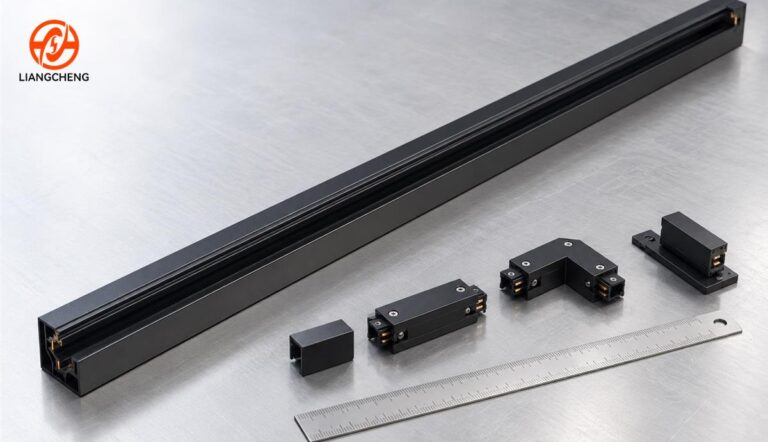

Quick answer: “SAA approval” is the name many in the trade still use for an Australian certificate of conformity for electrical equipment. For track lighting, the importer needs to know which part of the system the rules capture: the supply track, the track luminaire, or a separate LED driver. Under the Electrical Equipment Safety System (EESS), every in-scope item needs the Regulatory Compliance Mark (RCM) and a registered Australian responsible supplier. Only higher-risk items, such as independent LED drivers, need a certificate of conformity and their own database registration. The importer, not the overseas factory, is legally responsible for compliance.
Who this guide is for: Australian distributors, wholesalers, lighting brands and project contractors who import track rails, track spotlights and drivers. It explains how the rules apply to each component, which standards they cite, what to ask a factory for, and how to avoid paying for a certificate that does not cover what you ship. It does not replace advice from an Australian certifier or electrical safety regulator.
What does “SAA approval” mean in Australia today?
“SAA approval” is an old trade name for third-party electrical safety certification in Australia. It comes from the former Standards Association of Australia, which once ran the certification work. Today, recognised certification bodies issue certificates of conformity under the EESS against the relevant Australian or joint Australian/New Zealand standards. Importers, factories and tender documents still say “SAA approved” when they mean “holds a valid Australian certificate of conformity”. So the useful question is never “Is it SAA approved?” but “Which certificate covers which model, against which standard, issued by whom, and is it still valid?”
A certificate of conformity is not the same thing as the RCM. The certificate is evidence that a certifier assessed a defined product against a standard. The RCM is the single compliance mark that a registered Australian responsible supplier applies to show that the product meets both electrical safety and electromagnetic compatibility (EMC) obligations. A product can need the RCM without needing a certificate. A certificate alone does not give anyone permission to sell.
Who is legally responsible when track lighting is imported into Australia?
Under the EESS, the responsible supplier is the Australian manufacturer or importer that places the equipment on the Australian market. An overseas factory cannot be the responsible supplier. The importer must register as a responsible supplier on the national database. That registration is tied to an Australian business entity and renewed periodically. The factory supplies test reports, drawings and component information. The importer owns the legal obligation, the database records and the RCM use.
This allocation of responsibility changes how an importer should negotiate. A factory saying “our products are SAA approved” only helps if the certificate can be legally used for the importer’s own registration. Certificates are commonly issued in the name of a specific applicant. Some certifiers allow a certificate to be transferred or a supplier to be added, and others require a new application. Before placing an order, an importer should confirm with the certifier whether an existing certificate can support its own registration, or whether a fresh certificate in its own name is needed.
How does the EESS risk level system apply to track lighting components?
The EESS covers low-voltage electrical equipment rated above 50 V AC and below 1000 V AC that is designed or marketed for household, personal or similar use. Equipment is still in scope if it is also marketed for commercial use. Each in-scope item is assigned one of three risk levels, and the obligations rise with the level. Track lighting is not one product but a system. A track rail, a mains-voltage track spotlight, and an external LED driver can each land on a different level.
| EESS level | Core obligations | Typical track lighting items |
|---|---|---|
| Level 3 (high risk) | Meet the standard, RCM marking, valid Australian or New Zealand certificate of conformity, product registration on the national database linked to the responsible supplier | Independent LED drivers and other separate power supplies that feed luminaires at extra-low voltage, for example the power supply of a 48 V magnetic track system |
| Level 2 (medium risk) | Meet the standard, RCM marking, database registration, compliance folder available within 10 days of a request | Household-type recessed LED luminaires rated above 50 V and up to 250 V; simple portable luminaires |
| Level 1 (low risk) | Meet the standard, RCM marking, documentary evidence of compliance in English, link to a registered responsible supplier | Mains-voltage supply track and fixed track luminaires not named in the higher-level definitions |
In the published EESS definitions, fixed track luminaires and the supply track are not named as Level 2 or Level 3 equipment, so they are generally treated as Level 1. Level 1 is not exempt. The product must still comply with its standard and carry the RCM. The responsible supplier must keep English-language evidence, usually a test report, for five years after the item was last imported. Risk-level lists are revised from time to time. Importers should confirm the classification of each specific model with their certifier before launch.
Does the certificate cover the rail, the spotlight, or the whole system?
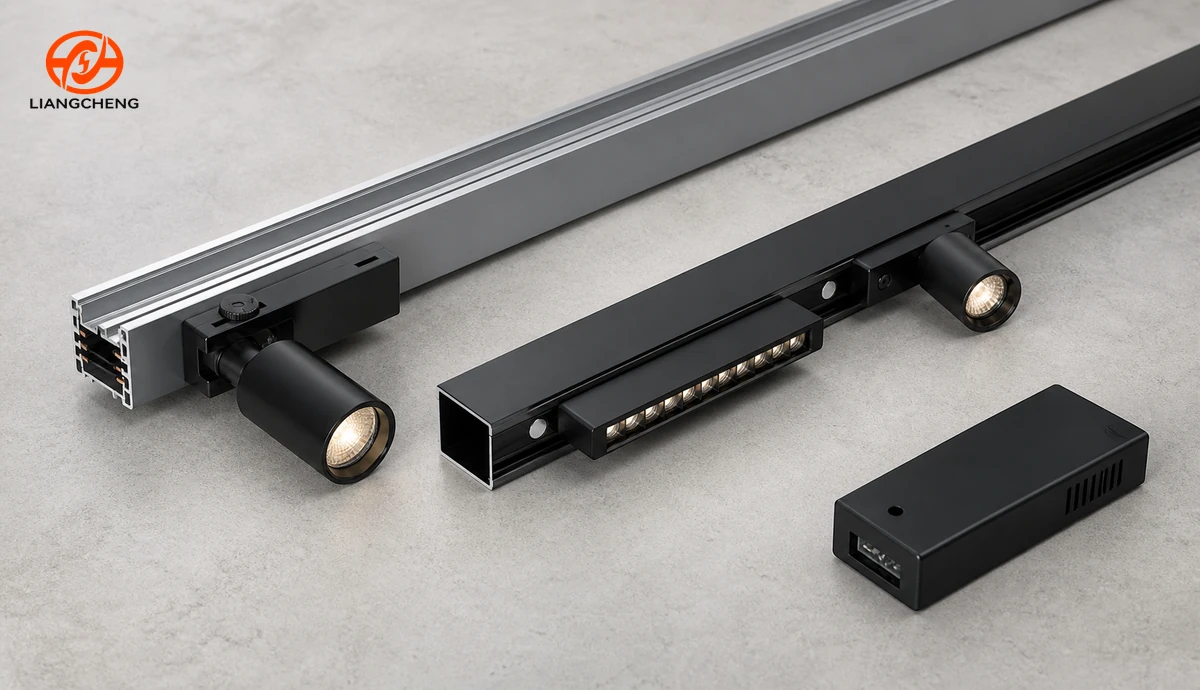
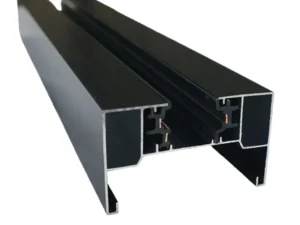
A certificate or test report covers only the models and configurations it lists. A track rail report assessed against the track systems standard covers the rail profile, conductors, end feeds, connectors and adapters named in the report. A track luminaire report covers the spotlight, its adapter interface and any built-in driver. The rail report does not automatically cover a spotlight from another factory, and a spotlight report does not prove that a rail is safe.
Because of this split, an importer should build a compliance map before ordering. List every SKU in the system, including straight rails, corner and T connectors, flexible joiners, live-end feeds, dead ends, suspension kits, track adapters, spotlights and drivers. Next to each SKU, note the standard that applies, the document that covers it and the EESS level. Gaps appear quickly. A common one is an accessory bought from a second supplier after the main system was tested. If the rails and adapters come from different sources, read the track light adapter compatibility checklist before relying on any single report.
Which Australian standards apply to track rails, track luminaires and drivers?
Australian standards for lighting are mostly adoptions of IEC standards with national modifications, so a well-documented IEC test report is a strong starting point. The standards most often cited for track lighting are listed below. Importers should confirm the current edition and amendments with the certifier, because certificates and test reports are tied to specific editions.
- AS 60570 (track systems): Electrical supply track systems for luminaires. The 2024 edition adopts IEC 60570 with Australian modifications. It covers track systems for ordinary indoor use mounted on, recessed into, or suspended from walls and ceilings. It explicitly does not cover operational or performance compatibility between different track systems.
- AS/NZS 60598.1 (general luminaire requirements): The general safety requirements for luminaires, including construction, earthing, wiring, creepage and clearance distances, and temperature limits.
- AS/NZS 60598.2.1 (fixed general-purpose luminaires): The particular part usually applied to mains-voltage track spotlights and linear track luminaires.
- AS/NZS 61347 series (lamp control gear): Part 1 plus Part 2.13 for electronic LED drivers. This is the standard behind most Level 3 driver certificates.
- AS/NZS CISPR 15 (EMC for lighting equipment): Radio disturbance limits for lighting products. Driver design and wiring layout decide most results.
- AS/NZS 3000 (Wiring Rules): An installation standard rather than a product standard. It governs how a licensed electrician connects the track feed to the building supply.
How is the RCM different from an SAA certificate?
The RCM is a marking obligation, while a certificate of conformity is one type of evidence. Australia uses the RCM as a single mark covering both the EESS electrical safety requirements and the Australian Communications and Media Authority (ACMA) EMC requirements. Only a registered responsible supplier may apply it to a product. The mark must be legible and durable. The EESS guidance commonly cites a minimum height of 3 mm. A factory can print the RCM on labels or packaging only under the Australian importer’s registration and instruction.
| Question | Certificate of conformity (“SAA approval”) | RCM |
|---|---|---|
| What is it? | A document from a recognised certifier confirming a model meets a standard | A compliance mark applied to the product and/or packaging |
| Who holds or applies it? | Issued to an applicant; must support the responsible supplier’s registration | Applied only by or for a registered Australian responsible supplier |
| Is it always required? | Required for Level 3 items; not required for Level 1 or Level 2 | Required for all in-scope equipment at every level |
| Does it cover EMC? | No, it is an electrical safety document | Yes, it also signals the supplier’s EMC compliance under ACMA arrangements |
What wiring and voltage details matter for Australian track systems?
Australia supplies 230 V at 50 Hz, and mains track systems are normally Class I equipment that relies on a reliable protective earth path. The earth design is one of the first things a certifier and electrician will check. That includes how the earth is carried through the aluminium profile or a dedicated conductor, how joints and connectors keep earth continuity, and how the adapter makes the earth connection before the live contacts. A rail that performs well in a mechanical sample but has a weak earth path at a joiner is a compliance risk, not just a quality issue.
The common track formats behave differently from a compliance point of view:
- Single-circuit track (often called 3-wire): Live, neutral and earth. It is the simplest to document and suits shops, cafés and homes with one switched group. The 3-wire track rail guide explains the conductor layout.
- Three-circuit track (often called 4-wire): Three live conductors, a shared neutral and earth. It allows zones to be switched separately on one rail. That means more contact positions to assess and a heavier dependence on correct adapter phase selection. See the 4-wire track rail buying guide for typical layouts.
- Extra-low-voltage magnetic track: The rail usually carries 24 V or 48 V DC from an external driver. The rail itself is outside the EESS voltage range, but the mains-connected driver is typically Level 3 and needs its own certificate and registration.
- Two-wire track: Common in some export markets. For Australian mains use, the earthing arrangement must be checked carefully before choosing this format.
Do track lights sold only for commercial projects still need compliance?
Commercial-only marketing can take a product outside the EESS registration scheme, but it does not take the product outside electrical safety law. The EESS captures equipment designed or marketed for household, personal or similar use, even if it is also marketed for commercial use. A track system sold exclusively into shops, galleries and offices may fall outside the national registration requirements. However, state and territory electrical safety laws still require that electrical equipment is safe. ACMA EMC requirements apply regardless of the end user.
In practice, most Australian commercial projects demand the same evidence anyway. Builders, electrical contractors, consultants and asset owners regularly ask for certificates, test reports and RCM-marked product as a condition of approval. Distributors also rarely control where a product ends up after sale. A rail sold to a contractor may finish in a home renovation. For these reasons, most importers treat commercial track ranges as in scope and document them fully rather than rely on a narrow interpretation.
Which project types ask most often for Australian certification evidence?
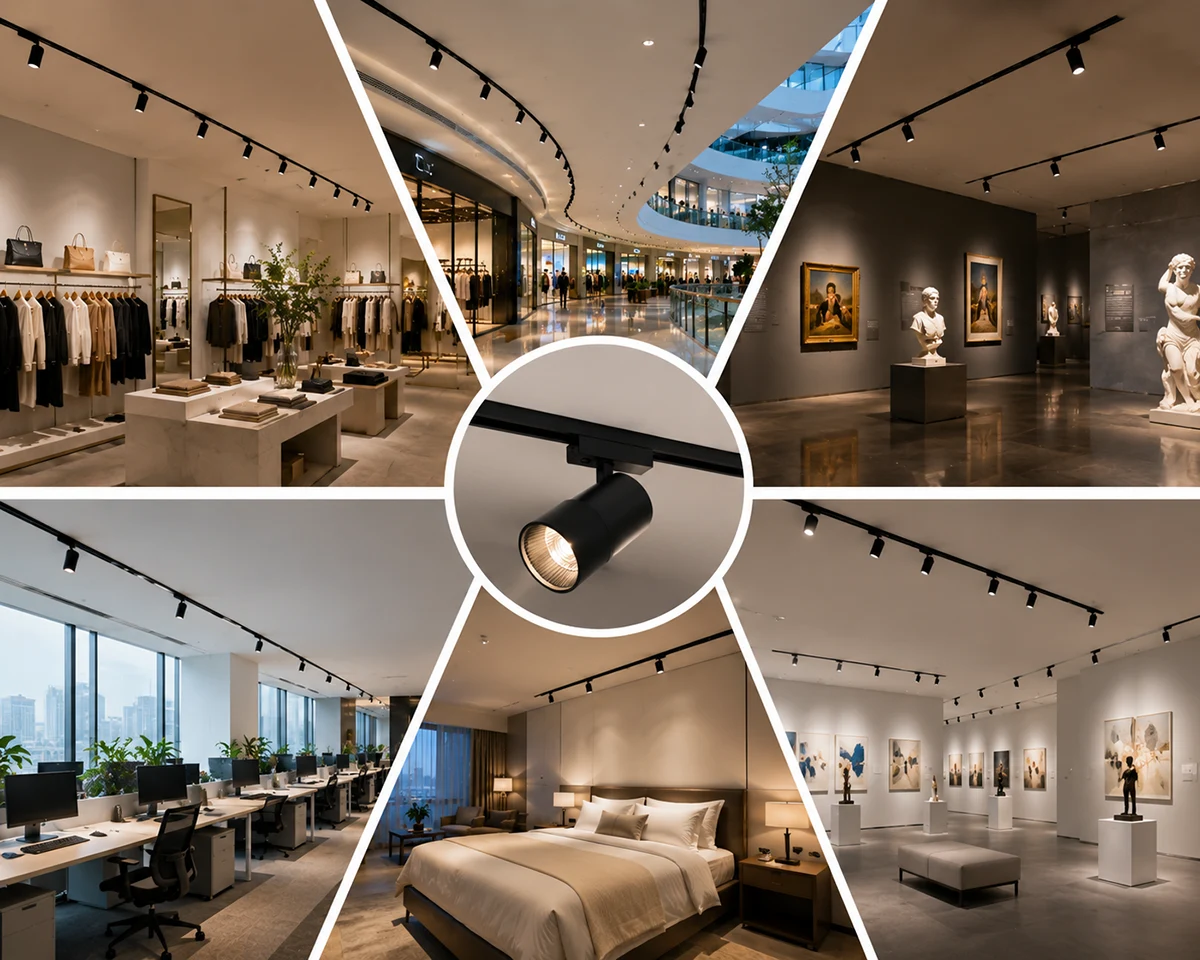
Certification requests tend to follow the project’s approval chain rather than its lighting design. These project types generate the most documentation requests for track lighting in Australia:
- Retail fit-outs and shopping centres: Centre management and fit-out contractors often require compliance documents before installation is signed off. Fit-outs repeat across many stores, so a single documentation pack can support a whole rollout.
- Galleries, museums and showrooms: Track is reconfigured often. Adapters and heads are moved by non-electricians, so specifiers focus on earth continuity and safe adapter engagement.
- Hospitality and serviced apartments: These sit close to “household or similar use”, so documentation is usually expected to meet the full EESS standard.
- Offices and education buildings: Consultants specify a performance outcome and ask the contractor to prove compliance for every substituted product.
- Residential renovations: Clearly within EESS scope, with licensed electricians usually reluctant to install unmarked products.
For a broader view of how commercial buyers evaluate rail systems beyond certification, see commercial track lighting rail systems: what buyers need to know.
Can an existing CB test report shorten the Australian approval process?
A current IECEE CB test report is usually the fastest foundation for an Australian certificate, but it is rarely enough on its own. The CB Scheme lets a test report issued by one participating laboratory be used by certifiers in other member countries. Australian certifiers generally require the report to include Australian national differences, or a supplementary assessment covering them. When those differences are missing, the certifier may request extra testing, typically on earthing, markings, cord and terminal requirements, or temperature limits.
A CB report also needs to match the product exactly. Check that the model numbers, rated voltage and frequency, rail profile, conductor cross-section, driver make and model, and insulation materials in the report match the goods on the order. A report for a similar-looking product from the same factory does not cover a different profile or a driver substitution. When comparing options, ask the factory for the report itself, not a summary certificate, and confirm it carries the correct standard editions.
Which documents should an importer request from a track lighting factory?
A complete document request at the RFQ stage prevents most certification delays. Before confirming a purchase order for the Australian market, ask the factory for the following:
- Full test reports: AS 60570 or IEC 60570 for the track system and AS/NZS 60598 or IEC 60598 for the luminaires, ideally CB reports with Australian national differences.
- EMC test report: CISPR 15 or AS/NZS CISPR 15 for luminaires and drivers, identifying the tested driver.
- Driver documentation: The make, model and existing Australian certificate number for any independent driver, so its registration status can be checked.
- Critical component list: Conductors, insulators, adapter contacts, terminal blocks, cables and plastics with their ratings and sources.
- Drawings: Rail cross-section, conductor positions, earth path and accessory interfaces.
- Label artwork: Ratings, model reference, supplier identification and space for the RCM.
- Installation instructions: Instructions in English that match the tested configuration, including maximum load per circuit and mounting methods.
- Change-control commitment: A written agreement that the factory will not change critical components without notice.
A disciplined RFQ also improves price comparisons. Quotes that include a defined document pack are easier to compare than quotes with “certificate available” in a footnote. Factors that shape wholesale pricing, including documentation, are covered in what determines wholesale track rail pricing.
What are the most common compliance mistakes when importing track lighting?
Most compliance failures in imported track lighting come from mismatches between the certified product and the shipped product, not from fundamentally unsafe designs. These are the mistakes that come up most often:
- Driver substitution: The factory changes the LED driver to a cheaper or more available model after testing. Both the safety assessment and the EMC result can be invalidated, and for a Level 3 driver the registration no longer matches the product.
- Mixed-source systems: Rails from one factory, adapters from another and heads from a third, with no evidence that they were assessed together. AS 60570 does not cover compatibility between different track systems, so the importer carries that risk.
- Certificate in someone else’s name: Relying on a certificate issued to another importer without confirming with the certifier that it can support your own registration.
- Expired or superseded documents: Certificates have validity periods, and standards are revised. A certificate that was valid at the sample stage may lapse before a repeat order ships.
- Marking errors: A missing RCM, missing ratings, or labels that do not match the model numbers on the certificate.
- Profile changes: A thinner wall, different conductor gauge or new insulator material introduced to cut cost. A tested design is a fixed design.
An on-site check of document control is the most reliable way to catch these issues early. The steps are outlined in how to audit a track rail factory before placing a bulk order.
What does a typical approval pathway look like for an importer?
A structured pathway keeps certification in step with sampling and production rather than delaying them. A practical sequence for a new Australian track lighting range is:
- Define the range: Fix the SKU list, rail format, voltage, mounting options and accessories that will be sold.
- Classify each item: Identify the applicable standard and EESS level for the rail, luminaires and any separate drivers, and confirm the classification with a certifier.
- Collect factory evidence: Obtain test reports, the component list and drawings, and identify gaps against Australian national differences.
- Register as responsible supplier: Set up the importer’s registration on the national database if this is not already done.
- Certify and register where required: Obtain certificates for Level 3 items and register Level 2 and Level 3 items. Assemble Level 1 evidence files.
- Approve marking: Sign off label and packaging artwork with the RCM and correct ratings.
- Freeze the design: Lock the approved sample, components and drawings as the production reference.
- Inspect before shipment: Compare production goods against the frozen reference, including driver models and labels.
Timing depends heavily on the starting evidence. With a complete CB report that includes Australian differences, a certifier may only need a document review. Without it, local testing adds weeks. Build the certification lead time into the launch plan rather than starting it after the first container is booked.
What are the trade-offs between certifying a full system and certifying components separately?
Certifying a matched system from one source gives the strongest evidence, while certifying components separately gives more sourcing flexibility. The choice affects cost, speed and risk.
| Approach | Advantages | Disadvantages | Best suited to |
|---|---|---|---|
| Matched system from one manufacturer | One document set; compatibility evidence; simpler change control; easier for project approvals | Depends on one supplier; less freedom to mix head styles | Distributors building a private-label range and project contractors who need clean submittals |
| Rail and heads certified separately | Flexible sourcing; can add heads from other ranges | Compatibility not proven by any standard; more documents to track; higher field risk | Experienced importers with in-house technical staff |
| Extra-low-voltage system with certified driver | The driver carries most of the regulatory burden; rail sits outside EESS voltage range | The driver needs a certificate and registration; low-voltage limits on run length and load | Residential and boutique projects favouring minimal magnetic profiles |
Which specifications should be fixed before certification starts?
Certification is tied to the exact specification, so commercial choices should be finalised before testing begins. The specifications that most often trigger re-assessment when changed later are:
- Rail format and profile: Single-circuit or three-circuit, surface, recessed or suspended mounting, and the exact extrusion drawing. The common H type track rail dimensions are a useful reference for Australian-style adapters.
- Classificações elétricas: Rated voltage (220–240 V for Australian mains), rated current per circuit (often 16 A in the track standard’s range) and maximum luminaire load.
- Conductors and insulators: Copper cross-section, insulator material and its flammability rating.
- Driver selection: Integral or external, and the exact make and model.
- Finish and lengths: Colours and cut lengths (commonly 1 m, 2 m and 3 m). These rarely affect safety, but they must appear correctly on labels and in the model list.
For buyers comparing rail options at this stage, the lighting track rail buying guide summarises the main specification decisions.
Does New Zealand accept the same documentation?
Australia and New Zealand share many joint AS/NZS standards and use the RCM, but each country has its own electrical safety regulations. New Zealand rules are set under its own electrical safety regulations, with separate requirements for declared and medium-risk articles. A test report to a joint AS/NZS standard is often usable in both markets. However, an importer supplying New Zealand should confirm the local supplier obligations rather than assume Australian registration covers them.
Perguntas frequentes
Is SAA approval mandatory for all track lighting in Australia?
No. A certificate of conformity is mandatory only for Level 3 in-scope equipment, such as independent LED drivers. Mains-voltage track rails and fixed track luminaires are generally Level 1, which requires RCM marking, a registered responsible supplier and documented evidence of compliance, but not a certificate.
Can a Chinese factory hold the RCM registration for an Australian importer?
No. The responsible supplier must be an Australian manufacturer or importer. A factory can provide test reports and print the RCM on labels at the importer’s instruction, but the legal obligations stay with the Australian business.
Does a CE marking or CB report count as Australian approval?
No. CE marking has no legal standing in Australia. A CB test report is useful technical evidence that an Australian certifier can review, especially when it includes Australian national differences, but it is not an Australian certificate or registration by itself.
Do 48 V magnetic track systems avoid Australian requirements?
Only partly. The extra-low-voltage rail falls outside the EESS voltage range, but the mains-connected driver that powers it is generally Level 3 equipment that needs a certificate and registration. EMC requirements also apply to the system.
How can an importer check whether a driver is registered?
Search the public EESS registration database using the brand, model or certificate number from the driver label and documentation. Confirm that the registered model matches the label exactly and that the registration is current.
How can Liangcheng Lighting support an Australian track rail program?
Liangcheng Lighting manufactures wholesale and customised track lighting rails for distributors, brands and project buyers. The range includes 3-wire single-circuit track rails, 4-wire three-circuit track rails, trilhos embutidos, sistemas de trilhos magnéticos and matching acessórios de iluminação de trilho. The factory runs its own aluminium extrusion, CNC machining and assembly lines. That makes it practical to freeze a profile, conductor specification and accessory set for a certified Australian range and keep it unchanged across repeat orders.
For Australian importers, the team can supply available test reports, drawings, component lists and label artwork for the quoted configuration, so your certifier can review them against Australian requirements. It can also support OEM branding, custom lengths and finishes, and pre-shipment inspection against an approved sample. Every certification claim should be checked against the exact model being quoted and the current supporting documents.
Planning a track lighting range for Australia? Contatar Liangcheng Lighting or email sales@lclights.com with your SKU list, rail format, mounting method, expected volumes and the documents your certifier has requested. We will propose a matched configuration, share the available documentation, and quote wholesale and OEM pricing for sampling and bulk production.
Precisa de Soluções Personalizadas de Iluminação de Trilhos?
Entre em contato com a Liangcheng Lighting para soluções de trilhos de alumínio OEM/ODM e suporte profissional de iluminação.
Relacionado