







Estimated reading time: 13 minutes
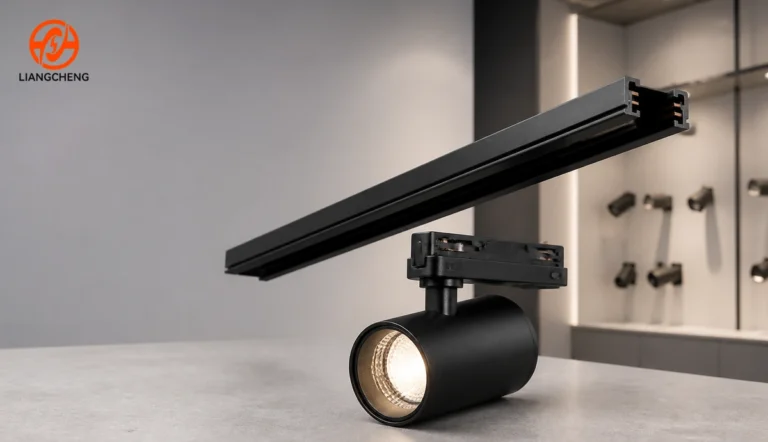
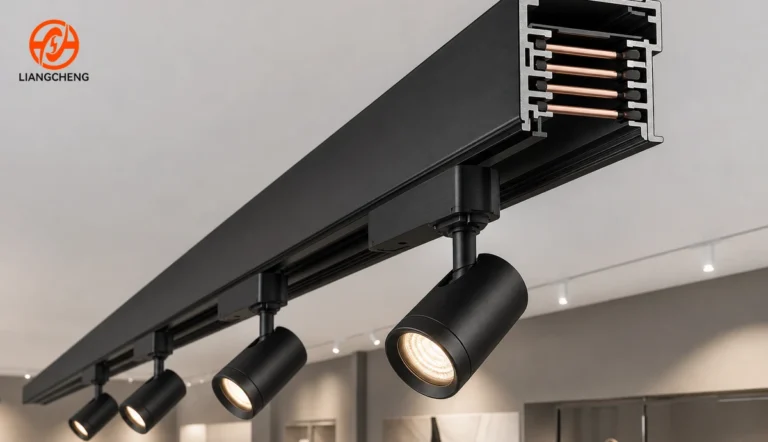
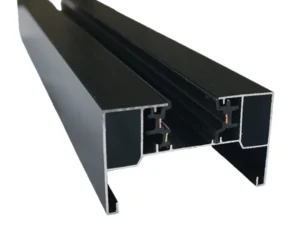
The main difference between ordinary track lights and magnetic track lights is the system architecture. Ordinary track lighting generally uses mechanically locked adapters on a conventional powered rail, often distributing line voltage directly to track heads with individual drivers. Magnetic track lighting usually uses a slim low-voltage rail, commonly 24V or 48V DC, with a remote power supply and fixtures retained by magnets plus a mechanical safety lock. This difference affects fixture size, installation, available light modules, output capacity, controls, maintenance, appearance, compatibility, and total project cost.
Neither system is universally better. Ordinary track lights are often the practical choice for robust commercial accent lighting, high-output spotlights, familiar installation, and cost-sensitive projects. Magnetic track lights are often preferred when a project needs a minimalist ceiling, mixed linear and spot modules, frequent layout changes, and close architectural integration. The correct decision depends on the lighting task, ceiling construction, electrical design, control requirements, maintenance strategy, and long-term component availability.
What do ordinary track lights and magnetic track lights have in common?
Both systems use a powered rail to support multiple luminaires and deliver electricity along a continuous path. Designers can place fixtures at useful positions, aim light toward products or surfaces, and adjust the arrangement more easily than with fixed ceiling points. Both can support retail, gallery, hospitality, showroom, office, and residential applications when the system is correctly specified.
The shared principle is explained in the guide to how an LED lighting track works: the track is both an electrical distribution component and a mechanical mounting structure. The rail, conductors, adapters, connectors, feeds, luminaires, drivers, and controls must function as one coordinated system.
The similarities can make the products look interchangeable in photographs, but they are not. Rail dimensions, conductor positions, adapter shapes, voltage, polarity, locking methods, control signals, and load limits differ. A fixture should never be installed on a rail merely because its adapter appears to fit.
How does the electrical architecture differ?
Ordinary track lighting is commonly designed around a line-voltage rail. Depending on the market and product family, the track may carry 110-120V or 220-240V AC, and commercial systems may support one or more switched circuits. Each integrated LED track head normally contains its own driver or electrical conversion components.
Magnetic track lighting is commonly based on low-voltage DC distribution. A remote or track-mounted power supply converts the building supply to the required DC voltage before feeding the rail. Many architectural systems use 48V DC, although other voltages exist. The fixtures must match the rail voltage and polarity as well as the physical adapter.
This distinction changes system planning. A conventional line-voltage track may not need one central low-voltage power supply for the run, but each luminaire still includes driver electronics. A magnetic system needs a correctly sized and accessible power supply, suitable cable distances, spare capacity, ventilation where required, and voltage-drop checks. The electrical designer must consider total wattage, power factor, inrush current, control equipment, protective devices, and local regulations for either system.
How are fixtures attached to each rail?
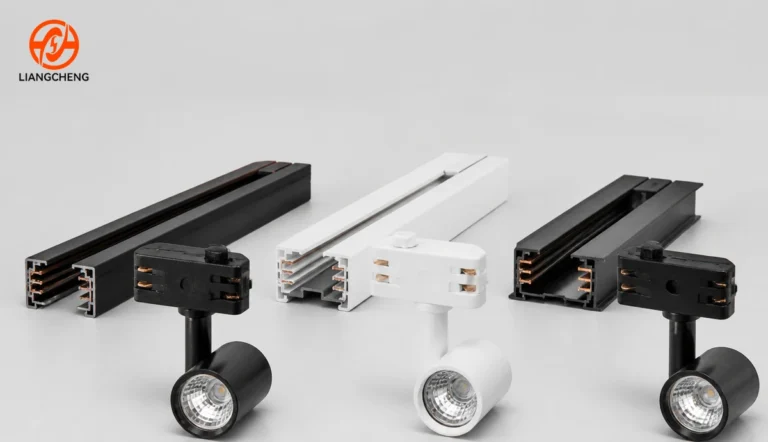
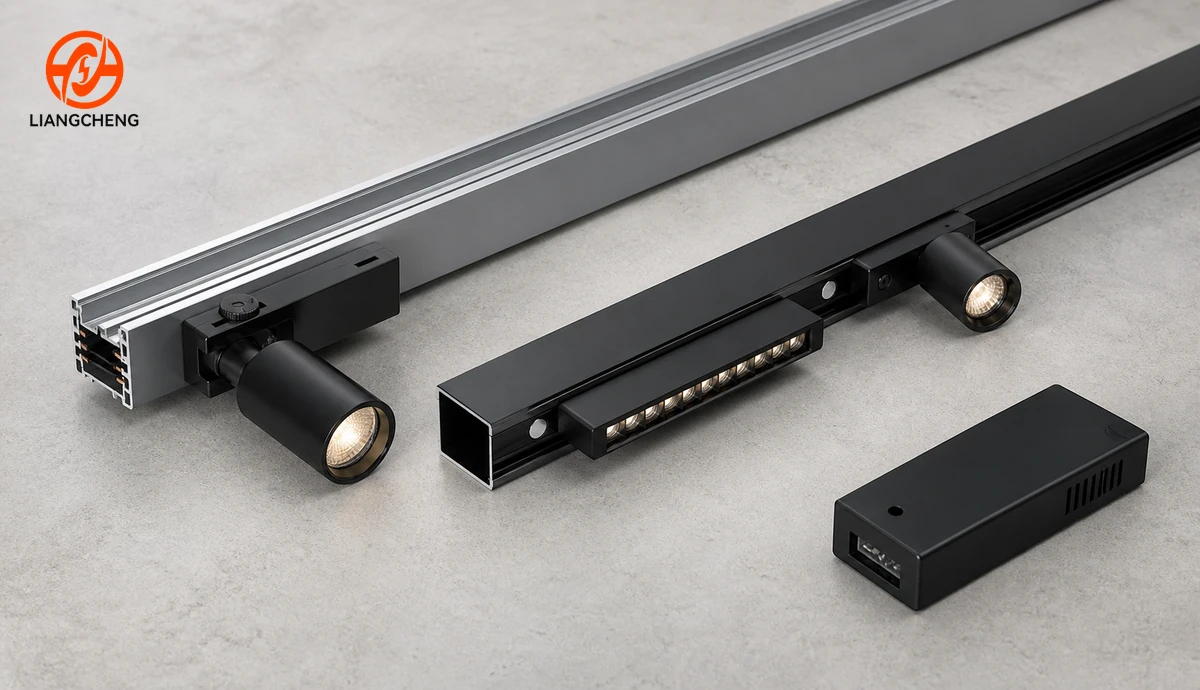
An ordinary track head typically uses a mechanical adapter inserted into the rail and rotated or locked into position. The adapter makes contact with the required conductors and provides structural retention. Multi-circuit adapters may include a selector that assigns the luminaire to an available circuit.
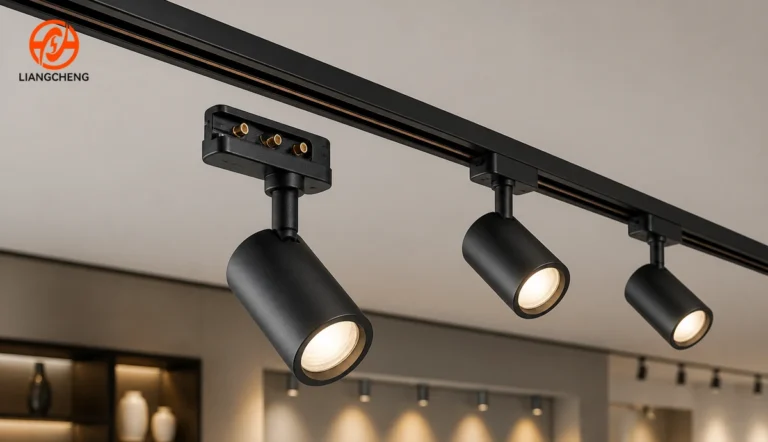
A magnetic track module uses magnetic force to guide and retain the fixture in the channel, but a properly engineered system should also use a mechanical latch or safety feature. Electrical contacts connect to the low-voltage conductors when the module is seated. This arrangement can make it faster to insert, remove, or move compatible modules.
The word “magnetic” should not imply that any magnetic lamp can be placed on any magnetic rail. Retention dimensions, contact position, voltage, polarity, communication conductors, locking features, and maximum loads are system-specific. The supplier should provide compatibility documentation for every rail, connector, power feed, driver, and module.
Which system offers more flexibility after installation?
Both systems are adjustable, but magnetic track generally provides a broader modular experience. Ordinary track heads can be moved and re-aimed along a compatible rail, which is already highly flexible compared with fixed downlights. Magnetic systems add compact linear bars, grille modules, wall washers, pendants, and spotlights that can often be combined within one slim channel.
This modularity helps spaces that change frequently. A boutique can replace a linear ambient module with accent spots, a gallery can move focused heads for a new exhibition, and a hospitality space can revise a visual sequence without changing the entire ceiling. The benefit is strongest when the original track layout, power capacity, and control strategy anticipate future configurations.

Fast physical changes do not remove the need for safe working procedures. Power should be isolated as required by the manufacturer and local rules. A qualified person should verify that the revised fixture load remains within the power supply, rail, feed, connector, and control limits.
How do the fixture shapes and optical options compare?
Ordinary track lighting is strongly associated with adjustable cylindrical spotlights. These fixtures can provide concentrated accent light, medium or wide beams, wall-washing distributions, and relatively high output. The larger body can accommodate a driver, heat sink, reflector, lens, shielding, and optical accessories.
Magnetic track lighting supports spot modules, but its key visual advantage is the ability to combine different fixture forms in one narrow system. Common options include recessed linear lights, continuous-looking luminous bars, multiple-cell grille modules, adjustable spotlights, pendant modules, and wall-wash elements. This range makes it easier to build ambient, vertical, accent, and decorative layers with a consistent architectural language.
Compact size does not guarantee better optical performance. Designers should compare photometric files, peak intensity, beam distribution, cutoff, source brightness, glare control, color quality, thermal behavior, and maintained output. A larger traditional spotlight may outperform a compact module when the project requires a narrow high-intensity beam from a high ceiling.
Which system creates a cleaner ceiling appearance?
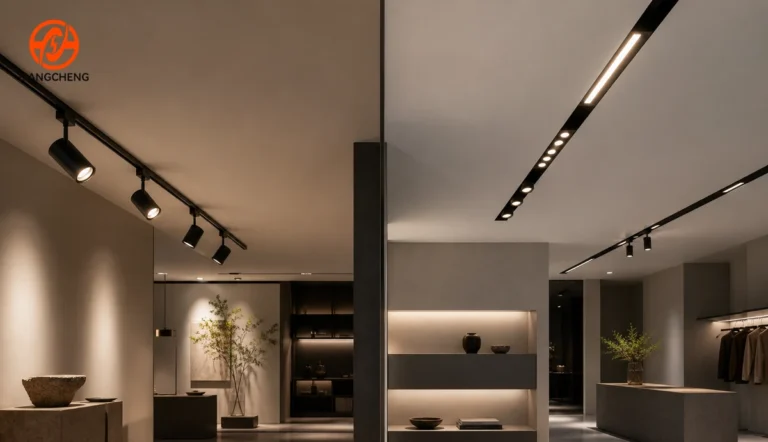
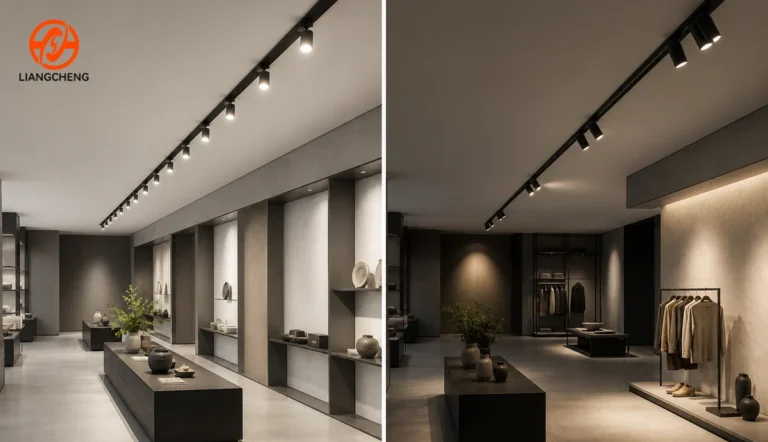
Magnetic track usually creates a slimmer, more integrated appearance. Recessed or trimless rails can read as narrow architectural lines, while flush linear modules reduce the visual size of individual fixtures. This approach suits minimalist interiors where the ceiling grid is part of the design concept.
Ordinary track is generally more visible because the rail profile, adapter, and spotlight body project below the ceiling. That visibility is not always a disadvantage. In retail stores, studios, galleries, and industrial interiors, exposed track can feel purposeful and provides clear access for aiming and maintenance.
Surface-mounted magnetic track is also visible, and recessed magnetic track requires more coordination with the ceiling system. A clean result depends on straight installation, accurate joints, consistent finishes, aligned connectors, and careful integration with sprinklers, diffusers, detectors, signs, and ceiling panels.
How do installation requirements differ?
Ordinary surface-mounted track is often simpler for renovations because the rail can be fixed to an existing ceiling and connected to a suitable supply point. Installers are familiar with common line-voltage systems, and the driver is typically inside each LED head. Recessed and suspended versions require additional details but retain the same general system logic.
Magnetic track requires a low-voltage power strategy. The power supply may be concealed above an accessible ceiling, placed in a serviceable enclosure, or integrated into a compatible feed component. Designers must allow for access, heat management, cable routing, voltage drop, and replacement. A concealed driver that cannot be reached without damaging the ceiling creates a future maintenance problem.
Trimless magnetic rails may need to be coordinated before plasterboard finishing. The installer must support the rail correctly, keep it straight, protect the channel during wet work, and complete clean edges. This can increase labor and coordination compared with a simple surface track, even if magnetic modules are faster to fit afterward.
For either system, installation must follow the manufacturer’s instructions and local electrical and building requirements. Structural support should be based on rail, connector, luminaire, and accessory loads. Long runs and suspended layouts need particular attention to alignment and support spacing.
Which system supports higher output and larger commercial spaces?
Ordinary commercial track lighting often has an advantage when a project needs multiple high-wattage spotlights, long runs, high ceilings, or strong accent intensity. Line-voltage distribution and larger luminaire bodies can suit retail, exhibition, warehouse, and showroom tasks where output and optical punch are more important than a minimal fixture profile.
Magnetic systems can deliver effective commercial lighting, especially through multiple modules and carefully designed layers. However, the total connected wattage is limited by the power supply, feed, rail, connectors, cable, and allowable voltage drop. A long run may require additional feeds or power supplies rather than simply adding modules indefinitely.
Do not compare systems only by luminaire wattage. Compare delivered illuminance on the target, beam quality, vertical light, glare, efficiency, spacing, mounting height, dimming, and maintained output. A lighting calculation and physical mock-up are more reliable than selecting a system from product photographs.
How do circuit zoning and controls compare?
Ordinary commercial track can offer multi-circuit control within one rail. A three-circuit arrangement may allow different groups of spotlights to be switched or dimmed separately, depending on the adapters and control system. The site’s explanation of 2-wire and 3-circuit track rail describes why conductor and circuit choices matter.
Magnetic track control varies widely. Basic systems may place all modules on one low-voltage output, while advanced systems may support dimming or addressable control through compatible drivers, control conductors, wireless components, or digital protocols. Individual control should never be assumed from the word “magnetic.” It must be confirmed for the exact power supply, rail, module, and control architecture.
Controls affect the complete bill of materials. A dimming method must be compatible with the driver and expected load range. Addressable systems require commissioning and documentation. Designers should define scenes, zones, interfaces, default states, and maintenance access before ordering hardware.
What are the key differences at a glance?
| Comparison point | Ordinary track lights | Magnetic track lights |
|---|---|---|
| Typical rail power | Often line-voltage AC | Often 24V or 48V DC |
| Power conversion | Usually inside each LED track head | Usually one or more separate power supplies |
| Fixture retention | Mechanical adapter and lock | Magnetic positioning plus mechanical safety retention |
| Common fixture forms | Adjustable spotlights and wall washers | Linear, grille, spot, pendant, and wall-wash modules |
| Visual profile | More visible rail, adapter, and spotlight body | Slim channel with integrated modular appearance |
| Output potential | Often suited to higher-output commercial spotlights | Depends strongly on module and power-supply capacity |
| Renovation simplicity | Surface track can be straightforward | Needs low-voltage driver planning; trimless work adds coordination |
| Reconfiguration | Movable heads within compatible track | Fast module changes and broader module mix |
| Initial cost | Often lower for basic systems | Often higher due to rail, modules, driver, and detailing |
| Compatibility | System-specific despite familiar formats | Highly system-specific; matching is essential |
Which system is easier to maintain?
Ordinary track lighting is familiar to many facility teams. A failed integrated head can usually be removed from the rail and replaced with a compatible unit. If the driver is inside the head, driver failure is addressed by servicing or replacing that fixture rather than locating a shared remote supply.
Magnetic modules are physically convenient to remove and exchange, but the system introduces shared components. If a remote power supply fails, every module connected to that output may stop working. The power supply must therefore be accessible, correctly ventilated, properly loaded, and available as a replacement part.
Both approaches need a spare-parts plan. Retain product codes for rails, feeds, connectors, adapters, drivers, optics, modules, end caps, and finishes. Before a large project, confirm how long compatible components will remain available and whether later products can be mixed with the installed generation.
How do purchase price and lifecycle cost compare?
An ordinary track system often has a lower initial cost when the project needs a straightforward surface rail and standard spotlights. It may also reduce ceiling coordination and use widely understood installation methods. This makes it attractive for budget-controlled stores, workshops, temporary installations, and renovations.
A magnetic system often has a higher initial system cost because the project needs matched rails, connectors, low-voltage power supplies, multiple module types, and sometimes recessed or trimless ceiling work. The premium may be justified where design integration, fast reconfiguration, and mixed light layers create operational or architectural value.
Lifecycle cost includes more than hardware. Compare installation labor, ceiling preparation, commissioning, aiming, access to drivers, energy use, downtime, spare parts, layout changes, warranty, and the cost of replacing incompatible components. A system that is inexpensive at purchase can become costly if its fixtures or adapters are unavailable during a later renovation.
Where does each system work best?
Ordinary track lights are often suitable for:
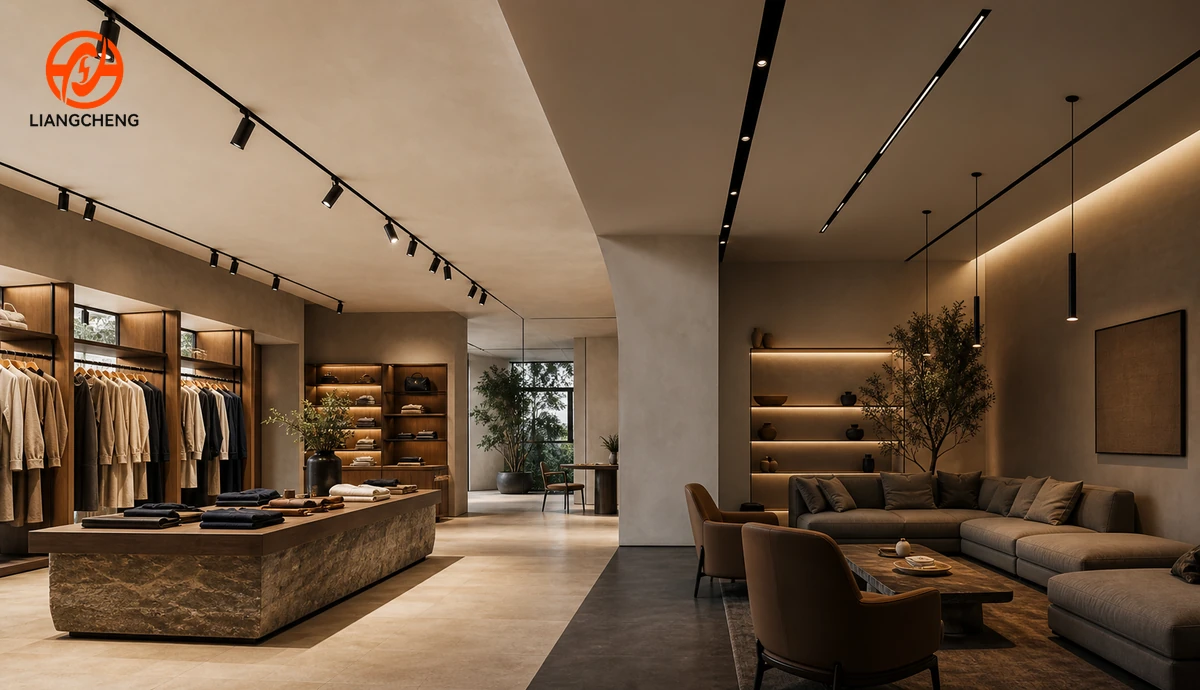
- Retail stores that need strong, adjustable merchandise accents
- Showrooms and exhibitions with high ceilings or large targets
- Workshops, studios, and practical commercial interiors
- Renovations using surface-mounted rail
- Projects where initial budget and familiar maintenance are priorities
Magnetic track lights are often suitable for:
- Premium boutiques and showrooms with minimalist ceilings
- Hospitality interiors needing linear, accent, and decorative modules
- Galleries and flexible spaces with frequent lighting changes
- Modern offices, reception areas, and presentation zones
- Projects where the track is part of the architectural composition
The article on using LED track rails in commercial lighting design explains how adjustable infrastructure supports visual hierarchy, zoning, and future layout changes. Those principles apply to both ordinary and magnetic systems.
What should buyers check before choosing a system?
- Define the lighting task. Record mounting height, target size, required illuminance, beam spread, color quality, glare limits, and visual priorities.
- Confirm the electrical system. Identify voltage, circuits, power supplies, cable routes, loads, controls, protection, and local compliance requirements.
- Confirm complete compatibility. Match rail, adapters, connectors, feeds, drivers, modules, controls, and accessories using written supplier documentation.
- Review the ceiling. Decide between surface, recessed, trimless, or suspended installation and provide structural support and service access.
- Compare photometric performance. Evaluate actual distributions and target results, not only watts, lumens, or fixture appearance.
- Plan future changes. Reserve reasonable load capacity and identify likely display, furniture, or partition layouts.
- Review maintenance. Make drivers and connection points accessible and confirm spare-part availability.
- Approve samples. Check finish, adapter fit, connection security, dimming, flicker, noise, color consistency, glare, and aiming before bulk procurement.
Buyers comparing conventional rail configurations can review the guide to 2-wire, 3-wire, and 4-wire LED track rail types. For project-specific colors, dimensions, connectors, and packaging, the overview of custom LED track rail solutions provides additional sourcing context.
What common mistakes should be avoided?
Comparing only appearance: A slim magnetic system and a conventional track may produce very different output, glare, control, and maintenance results. The decision should begin with performance.
Assuming all rails are compatible: Similar profiles do not prove mechanical or electrical compatibility. Obtain written matching lists and samples.
Ignoring the magnetic power supply: An undersized, inaccessible, or poorly ventilated supply can limit the entire system. Include spare capacity and voltage-drop calculations.
Choosing one optic for every target: Narrow accents, broad displays, walls, tables, and circulation areas need different distributions. Use a controlled family of optics and modules.
Installing trimless rail too late: Recessed details must be coordinated with ceiling framing and finishing. Late decisions often produce poor alignment or costly rework.
Skipping commissioning: Adjustable systems still require final aiming, scene setting, load verification, documentation, and staff training.
Final verdict: ordinary or magnetic track lighting?
Choose ordinary track lighting when the project prioritizes robust high-output spotlights, familiar line-voltage distribution, straightforward surface installation, broad commercial use, and controlled initial cost. It remains a strong solution for retail, showrooms, galleries, workshops, and other spaces that need reliable adjustable accent light.
Choose magnetic track lighting when the project prioritizes a slim architectural appearance, mixed linear and spot modules, frequent reconfiguration, and an integrated lighting language. It is especially effective in premium retail, hospitality, reception, gallery, and contemporary multipurpose interiors.
The best system is the one designed as a complete package. Voltage, rail, feeds, power supplies, adapters, luminaires, optics, controls, ceiling details, access, and future supply must all be coordinated. A well-planned ordinary track system is better than a poorly engineered magnetic one, and a well-designed magnetic system can deliver flexibility that a basic conventional layout cannot match.
Frequently asked questions
Are magnetic track lights safer than ordinary track lights?
Magnetic systems commonly distribute low-voltage DC in the rail, while ordinary systems often carry line voltage. This changes electrical risk at the track, but it does not make installation or live maintenance automatically safe. The power supply connects to mains electricity, and all work must follow product instructions and local rules.
Can magnetic lights be installed on an ordinary track?
No, not unless a manufacturer explicitly provides an approved compatible interface. The voltage, contacts, rail geometry, polarity, adapter, and retention method are different. Improvised adapters can create electrical, mechanical, and warranty risks.
Do magnetic track lights use less electricity?
Not inherently. Energy use depends on luminaire efficacy, wattage, quantity, control, operating hours, and lighting design. Low-voltage distribution does not by itself guarantee lower consumption than an efficient ordinary LED track system.
Can ordinary track lights be moved?
Yes. Compatible ordinary track heads can usually be removed, repositioned, and re-aimed along the rail. Magnetic systems may make module changes faster and offer more fixture forms, but adjustability is a benefit of both types.
Is magnetic track lighting suitable for commercial projects?
Yes, when the system provides the required output, optical control, driver capacity, controls, certification, warranty, and service access. High ceilings or demanding accent tasks may still favor larger conventional spotlights.
Which system is better for recessed installation?
Both can be recessed, but magnetic track often provides a slimmer integrated result and more flush modules. Recessed or trimless work requires early ceiling coordination, precise installation, and access to the low-voltage power supply.
Precisa de Soluções Personalizadas de Iluminação de Trilhos?
Entre em contato com a Liangcheng Lighting para soluções de trilhos de alumínio OEM/ODM e suporte profissional de iluminação.
Relacionado