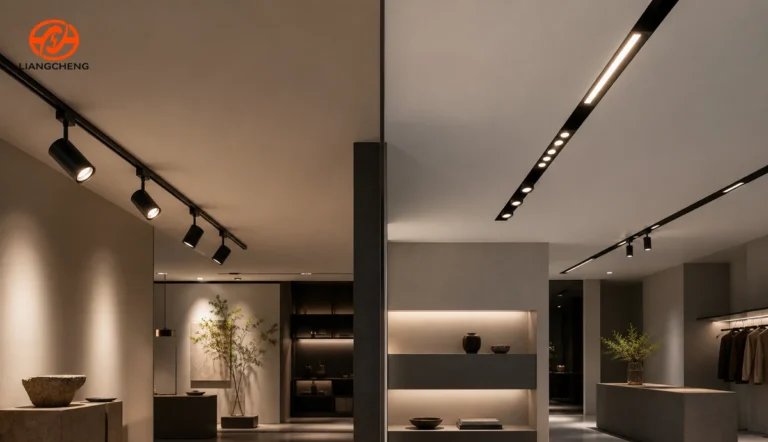







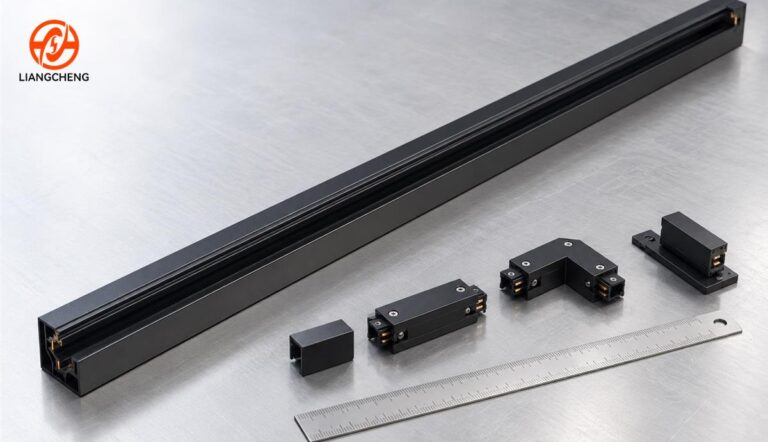

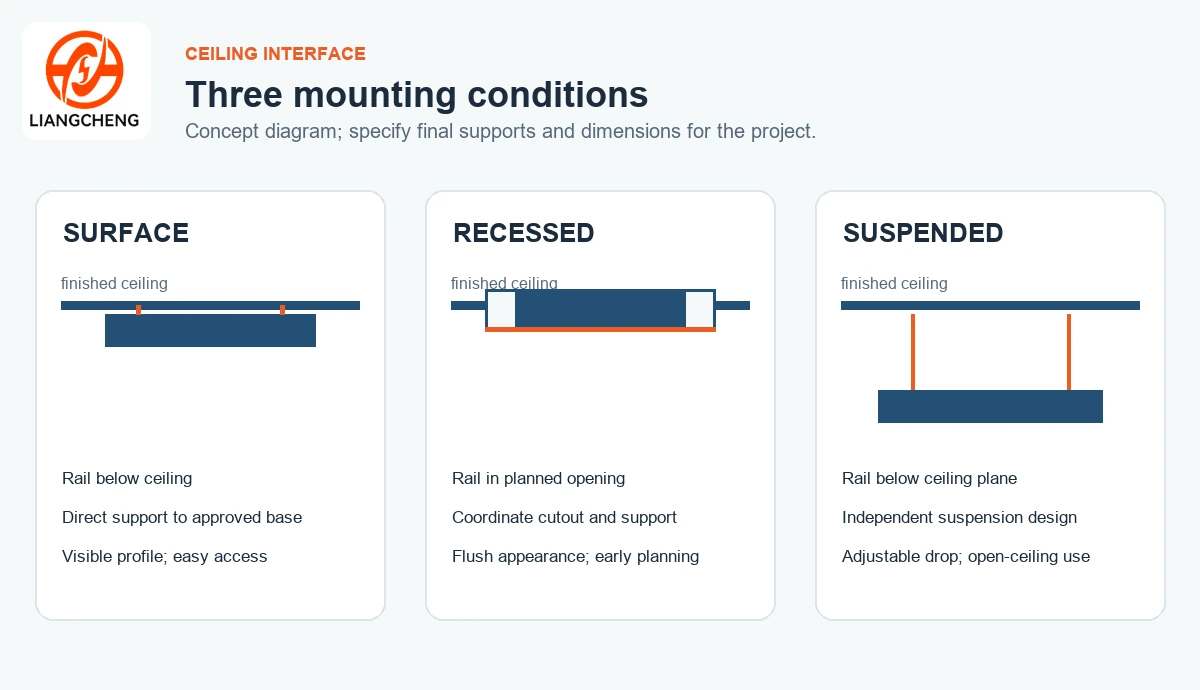
Surface-mounted, recessed, and suspended track rail installations solve different ceiling problems. Surface mounting fixes a compatible rail below a finished plane and is usually easiest to access. Recessed mounting integrates a specified profile into a planned ceiling opening for a quieter visual line. Suspended mounting hangs an approved rail system below the structure when a lower lighting plane or exposed ceiling is needed. The mounting choice changes support, feed routing, coordination, and maintenance, but it does not by itself determine the rail’s electrical circuit type.
Reading time: 13 minutes. This installation comparison is written for lighting designers, electrical contractors, project buyers, wholesalers, and distributors who need to agree on a buildable track lighting system before ordering rails and accessories.
What is the practical difference between the three installation methods?
A surface-mounted track rail remains visible below the ceiling. The rail is fixed to a suitable substrate or support system using the mounting method approved for that rail. A surface installation generally allows later access to fixings, power feeds, and connectors, although accessibility still depends on the surrounding architectural detail.
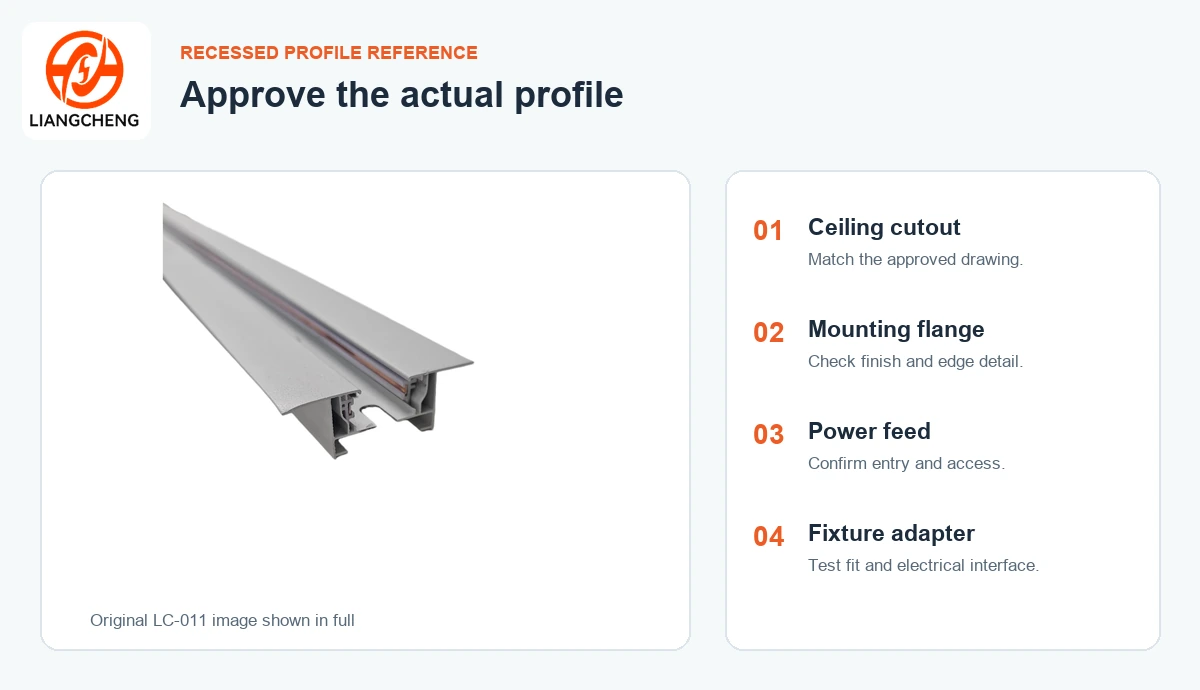
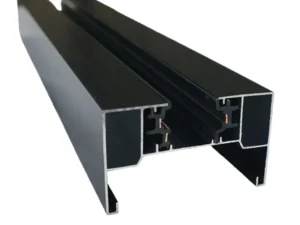
A recessed track rail sits partly within a prepared ceiling opening. The visible edge may have a trim or another manufacturer-specific finish. Recessed installation requires agreement on the opening, ceiling build-up, structural support, feed location, and final finish before the ceiling is closed. The product photo in this guide shows Liangcheng Lighting’s LC-011 recessed two-wire rail as a profile reference; the installation drawing must still be approved for the project.
A suspended track rail is supported below the ceiling or structural soffit by a compatible suspension assembly. The rail can bring luminaires closer to merchandise or work surfaces and can create a deliberate linear feature. Suspension introduces additional questions about anchor points, load path, drop length, level, movement, feed cable management, and service access.
| Fator de decisão | Surface-mounted | Recessed | Suspended |
|---|---|---|---|
| Visible result | Rail body below ceiling | Rail integrated into ceiling opening | Rail below the ceiling plane |
| Ceiling preparation | Approved fixing base and feed | Coordinated opening, support, and finish | Approved anchors, drops, and feed route |
| Typical advantage | Accessible and adaptable | Architectural continuity | Adjustable lighting plane |
| Typical constraint | Profile remains visible | Late changes can disturb ceiling work | Structure and leveling need review |
| Best early question | What supports the rail? | Who owns the ceiling opening? | Where does the load go? |
Which installation method fits the ceiling and project stage?
A finished solid ceiling often favors surface mounting if the project permits a visible rail and a suitable fixing base can be confirmed. A surface rail may avoid cutting a large opening, but the electrical feed still needs a compliant and serviceable route. A decorative finish, insulation layer, or weak ceiling board is not automatically a suitable structural fixing point.
A new suspended ceiling can accommodate a recessed rail when the opening and support are designed before board installation. The ceiling contractor and lighting supplier should agree on cutout width, straightness, depth, flange treatment, joint positions, and tolerance. Recessed rail specified after ceiling completion can require avoidable repair, repainting, or a different mounting approach.
An exposed slab, high ceiling, or open-plan retail space may favor a suspended rail where a lower mounting height improves the lighting task. The suspension system must be designed around the total rail and luminaire load and the condition of the overhead structure. A suspended rail should not be assumed interchangeable with a surface-only or recessed-only extrusion.
A decision should be made at the room level when one building contains several ceiling conditions. A showroom might use recessed rail in a finished customer area, surface rail in a service zone, and suspended rail in a high-volume display area. Keeping the electrical platform and adapter family consistent across those areas may simplify purchasing, but each mounting variant still needs its own approved mechanical accessories.
How does each method affect the electrical feed and wiring plan?
All three installation methods need a defined electrical entry point, compatible power feed, conductor arrangement, isolation strategy, and access for inspection. The location of the feed changes with the mounting method: a surface rail may receive power at a visible end or junction detail, a recessed rail may require a planned connection space above the ceiling, and a suspended rail needs a managed route from the building supply to the hanging rail.
Mounting format does not tell a buyer whether the system is two-wire, three-wire, four-wire, or another platform. Those labels describe product-specific conductor and control arrangements, not the way the extrusion attaches to a ceiling. Protective earthing, polarity, circuit selection, and rated voltage must be checked against the exact rail, feed, adapter, luminaire, and local electrical design. Liangcheng’s two-wire versus four-wire rail comparison explains why circuit choice should be made separately from mounting choice.
A qualified electrical professional should complete and test the supply connection under the applicable local code and the manufacturer’s instructions. The article does not provide a universal wire-by-wire connection sequence because terminal markings, earthing provisions, and control functions vary by product. An order should include the wiring diagram and the required rail, feed, connector, adapter, and luminaire combination.
A suspended track requires particular attention to the cable path. The suspension wires or rods are mechanical supports unless the approved product instructions explicitly assign another function. A supply cable needs its own specified routing, protection, strain relief, and connection method. The buyer should request a complete suspended-system drawing rather than assuming a surface feed can be reused without changes.
What should be checked before a surface-mounted rail is fixed?
A surface-mounted rail needs a verified load-bearing base, a straight setting-out line, and a fastening method compatible with the ceiling and rail. The project team should check slab, channel, or secondary framing location before installation. A board finish alone may not carry the weight of the rail, multiple track heads, and adjustment loads.
Surface-mounted track layout should account for the direction of the lighting heads and the available working clearance. A rail too close to a wall, soffit, sprinkler, air diffuser, or display frame can limit aiming or future fixture movement. The designer should dimension the rail centerline from fixed building references rather than from furniture expected to move.
Surface installations usually provide easier access for later rail replacement or layout changes than finished recessed installations. That benefit has limits: long continuous runs still need planned joints, feed positions, and a finish strategy. The track lighting rail accessories guide details feeds, connectors, end caps, and mounting hardware that belong in a complete system.
What must be agreed before a recessed rail is installed?
Recessed rail selection starts with the exact profile drawing, not a generic label such as “flush track.” A recessed-with-trim profile, a trimless detail, and an extrusion intended for another ceiling build-up can require different openings and finishing methods. The buyer should obtain the cross-section, outer dimensions, cutout guidance, support method, end detail, and feed clearance before the ceiling subcontractor cuts material.
The LC-011 two-wire recessed rail photo is a visual reference for the profile’s body and flanges. It is not a substitute for a dimensioned drawing or compatibility test. The photograph should be checked alongside the selected connectors, feeds, adapters, ceiling sample, and finished-lighting mock-up. Liangcheng’s recessed track rail buying guide covers deeper procurement and inspection questions; this article focuses on choosing and coordinating the installation route.
Recessed track installation also needs a decision about when to fit the rail relative to ceiling finishing. Some systems require the extrusion to be secured before final board finishing; others use a trimmed opening with later insertion. The correct sequence comes from the approved system drawing. Changing a profile after framing or board closure can affect straightness, edge quality, paint, and access to the power feed.
For a long recessed run, drawing review should cover visible joint lines and the route’s cumulative tolerance. Even small cutout or alignment errors can be noticeable when a continuous rail crosses multiple ceiling panels. The builder, electrical contractor, and supplier should assign responsibility for ceiling opening accuracy, rail support, final alignment, and damage protection.
What makes suspended installation structurally different?
A suspended rail transfers load through suspension kits into approved overhead anchors or framing. The structural engineer or qualified project team should check the substrate and anchor design, especially when several luminaires or long runs are carried by one assembly. A decorative ceiling tile or light-gauge finish is not a substitute for a designed load path.
Suspended rails need the drop height and spacing specified early. Drop length affects fixture-to-target distance, sightlines, glare, and the way the rail reads in the room. Unequal suspension lengths or poorly coordinated ceiling levels can make a straight rail appear crooked even when each individual component is within its own manufacturing tolerance.
A suspended lighting run also needs an agreed method for controlling swing, rotation, and cable visibility where the application requires it. The chosen rail and suspension accessories must be approved as a system. A distributor should confirm whether the order includes compatible suspension kits, ceiling plates, joining pieces, power entry parts, and instructions, rather than quoting the extrusion alone.
Can the same rail be mounted in all three ways?
Some track rail platforms offer several mounting options, but a shared electrical platform does not prove that one extrusion is suitable for every mounting method. A recessed profile may have flanges and a depth designed for a ceiling cutout; a suspended profile may need a dedicated suspension interface; a surface profile may use different fixing points. The mechanical drawing and manufacturer’s installation instructions decide what is permitted.
Electrical compatibility must also be checked independently of the profile’s mounting shape. A track light adapter can appear to fit but still have the wrong contact position, circuit behavior, locking action, or earth interface. A buyer should test the chosen rail, adapter, luminaire, feed, and connector as an assembly. Liangcheng’s track light adapter compatibility checklist offers a structured approval process.
Mixed mounting projects should use a controlled part-number schedule. The schedule can group rails by electrical family while separating surface brackets, recessed profiles, and suspension kits by installation condition. It should identify every transition point and show whether a joiner provides mechanical alignment, electrical continuity, or both.
Which specifications belong on the installation drawing?
A useful track rail installation drawing shows the rail path, ceiling type, elevation, fixing substrate, power feed, circuit grouping, fixture positions, and service access. The drawing should distinguish design intent from the supplier’s product dimensions. A line on a reflected ceiling plan is not enough to manufacture or install the rail without coordination.
The rail schedule should include profile code, finish, length, section quantity, conductor platform, rated electrical characteristics, connector family, mounting kit, and end treatment. For recessed work, add cutout and finished-edge information. For suspended work, add drop length, suspension points, anchor design responsibility, and feed-cable detail. For surface work, add the fixing base and fastener specification approved by the project team.
Track lengths should be checked against transport, handling, and ceiling access, not only the desired visual run. Multiple sections require join positions and an acceptable alignment method. A rail may be cut only when the manufacturer’s procedure permits it, and field cutting may change the end-cap, feed, or joiner count. The H-type track rail dimensions article shows why nominal profile size alone is insufficient for interface approval.
How do cost and installation risk compare?
Surface mounting often reduces ceiling preparation, which can be valuable in refurbishment, but its visible profile may demand a higher finish standard. Recessed mounting can create a cleaner ceiling line, but opening coordination and rework can dominate cost if the design changes late. Suspended mounting can avoid a continuous ceiling recess, but it adds suspension design, leveling, and cable-detail work.
Price should be compared at system level. A low rail-only quotation does not include feeds, connectors, end caps, suspension parts, trims, labor, ceiling repair, or testing. The buyer should request a complete bill of materials and identify which contractor owns each installation task. Liangcheng’s track rail RFQ checklist helps make supplier quotations comparable.
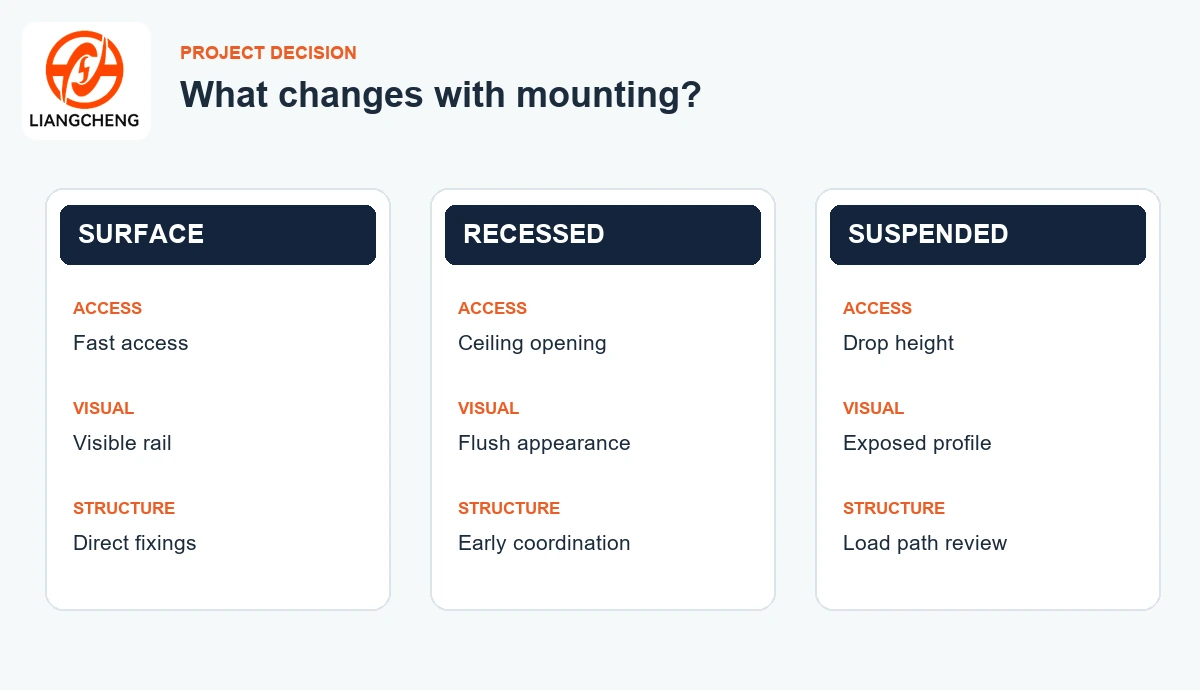
Risk also has a schedule cost. A surface rail can usually be repositioned more readily than a rail buried in a finished ceiling, although electrical and fixing work is still needed. A recessed rail needs its profile frozen before ceiling production. A suspended rail needs anchor and drop details approved before final installation. The correct method is the one the project can build and maintain reliably within its architectural goals.
Which method works best in common project applications?
Retail stores with frequently changed merchandise often benefit from accessible rails and movable track heads. Surface or suspended installation can support re-aiming and layout changes where the ceiling allows it. A premium display zone may still prefer recessed rail when the visual ceiling line matters more than frequent rail relocation. Rail positioning should follow changing display tasks and the intended aiming range.
Galleries and showrooms may prefer recessed rail when the ceiling should remain visually quiet, but exhibit flexibility still depends on adapter compatibility and the available lighting positions. High-ceiling commercial interiors may use suspension to bring the lighting plane toward exhibits or work areas. Surface mounting can be the practical option for an existing ceiling that cannot accept a recess.
Office and hospitality projects should consider maintenance access, ceiling services, glare, and visual order. A recessed rail can align with other architectural lines if the ceiling system is planned early. A suspended rail may create a clear design feature in open-ceiling spaces. The application should determine the method rather than the assumption that one format is inherently more “premium.”
What should a distributor or project buyer request before ordering?
A B2B inquiry should include a reflected ceiling plan, ceiling section, mounting condition for each run, rail length schedule, color and finish, electrical platform, local supply conditions, fixture and adapter samples, feed locations, and desired accessories. Suspended projects need drop height and structural information; recessed projects need the ceiling build-up and opening tolerance; surface projects need substrate and fixing details.
Ask for dimensioned drawings and a complete part list before approving a bulk order. The list should separate rail lengths, feeds, straight and corner connectors, end caps, mounting accessories, suspension kits, and spare parts where relevant. A physical sample or project mock-up is especially useful when a recessed rail meets a finished ceiling edge or when a long suspended run must appear visually straight.
Specify what approval evidence is required. Useful evidence includes sample fit checks, fixture movement and locking checks, continuity and electrical safety testing by the qualified installer, finish inspection, packaging review, and a documented response to design changes. The supplier should not be asked to guess a local code requirement that belongs to the project electrical designer.
How can a project mock-up prevent installation rework?
A representative track rail mock-up should reproduce the real ceiling condition rather than display a rail on a loose board. The sample should include the intended substrate or suspension detail, a short rail run, the selected feed and end treatment, at least one joint if the final layout uses joints, and the actual luminaire adapter. The team can then judge finish, alignment, access, and fixture movement before approving a production order.
A recessed mock-up is particularly useful for checking the edge between rail flange and ceiling finish. The installer can confirm whether the cutout and support method preserve a straight line after painting or panel installation. A suspended mock-up should show the intended drop, cable route, and leveling method, because those details are highly visible in an open space.
The mock-up approval should be documented with photographs, the approved profile and accessory codes, any accepted tolerances, and the name of the person responsible for design changes. A visual approval without part numbers can fail when bulk material differs from the sample. A controlled record lets the supplier, ceiling contractor, and electrical installer work from the same version of the design.
Perguntas frequentes
Is recessed track rail always flush with the ceiling?
Recessed track rail is integrated into an opening, but the final appearance depends on the specific profile and trim detail. Some rails show a visible flange while others require a more concealed edge treatment. The approved cross-section and ceiling sample define the finished result.
Can a surface-mounted rail be converted into a suspended rail?
A surface-mounted rail can be suspended only if the manufacturer approves that exact profile with a compatible suspension system. A generic cable kit does not establish mechanical suitability, electrical-feed suitability, or compliance with the project load design.
Does a two-wire rail require a recessed installation?
No. Wire count describes an electrical platform; recessed installation describes a mechanical ceiling interface. Available mounting variants depend on the manufacturer’s product family, so the rail profile and electrical arrangement must be checked separately.
Which method is easiest to change after installation?
Surface mounting is often the most accessible option for later rail relocation because it does not rely on a finished ceiling opening. The actual work still depends on feed location, ceiling repair, support capacity, and the need for a qualified electrical installer.
When should the supplier receive the ceiling drawing?
The supplier should receive the ceiling drawing before finalizing a recessed or suspended rail quotation. Recessed cutouts and suspended anchor and drop positions affect product and accessory selection; late drawings can cause a correct rail to become wrong for the installation.
How should the final mounting decision be made?
Choose surface mounting when the project prioritizes accessible installation and can accept a visible profile. Choose recessed mounting when architectural integration is important and the ceiling can be coordinated before closure. Choose suspended mounting when a lower lighting plane or deliberate exposed feature is needed and the overhead structure can support a properly designed system. In every case, confirm the exact rail, feed, connectors, adapter, luminaire, and installation instructions as one compatible package.
Discuss wholesale and custom track rail supply with Liangcheng Lighting
Liangcheng Lighting supports B2B track lighting rail procurement, wholesale supply, and project customization. Send the mounting method, ceiling details, rail layout, conductor platform, required finish, fixture adapter, and target quantity to help the team prepare a practical system quotation. Explore Liangcheng’s custom track rail options or contact Liangcheng Lighting to discuss a distributor range or commercial lighting project.
Precisa de Soluções Personalizadas de Iluminação de Trilhos?
Entre em contato com a Liangcheng Lighting para soluções de trilhos de alumínio OEM/ODM e suporte profissional de iluminação.
Relacionado