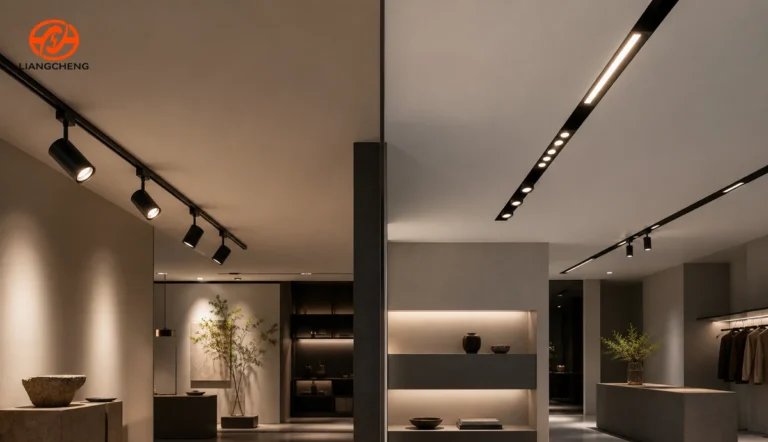







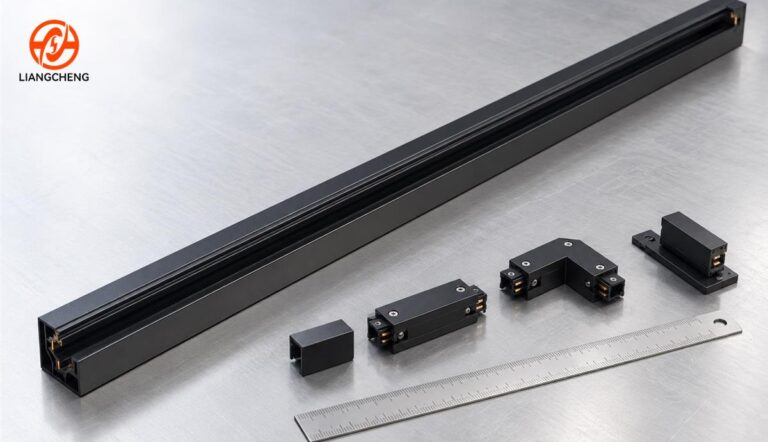

A conventional track rail and a magnetic track are different lighting infrastructures, even though both let luminaires move along a rail. Conventional systems commonly carry line-voltage AC through a keyed rail to mechanically locked track heads. Magnetic systems commonly distribute low-voltage DC from a separate power supply through a purpose-built rail to compatible magnetic modules with a defined retention method. The rail profile, wiring, feeds, connectors, mounting details, load limits, and replacement strategy must be selected as one system. Neither rail accepts the other system’s fixtures simply because their widths look similar.
This guide compares the rails and complete installation packages that a project buyer, contractor, distributor, or OEM brand must specify. Liangcheng already has an article on the Diferenças entre trilhos de luz comuns e magnéticos, which concentrates on luminaires and lighting effects. Here the focus is the fixed rail infrastructure, electrical chain, site coordination, sample approval, and repeat supply.
Estimated reading time: 13 minutes.
What is the difference between a track rail and a magnetic track?
In this comparison, “track rail” means a conventional powered aluminum rail designed for a mechanical track-light adapter. Depending on the family, the rail may serve a simple single circuit or several independently controlled circuits. “Magnetic track” means a separate rail family that positions compatible light modules magnetically and normally uses an additional mechanical safety feature specified by the manufacturer. The magnetic system often includes a remote or integrated low-voltage power supply. These descriptions are common patterns, not universal electrical specifications.
The words describe a system interface rather than an appearance. A recessed conventional rail may be visually discreet, and a surface-mounted magnetic rail may be highly visible. Both require correct mechanical support, electrical protection, feeds, connectors, compatible luminaires, and a maintenance plan. The difference that matters to procurement is what power reaches the rail and how the selected module makes a safe, repeatable connection.
Liangcheng Lighting’s aluminum track rail range includes conventional configurations and discusses magnetic systems and custom work. A buyer should request the exact rail and accessory model for the chosen architecture. A general family label does not provide a cross-section, voltage rating, or approval for a specific project.
How does power reach each rail?
A conventional line-voltage track normally receives AC from a protected building circuit through a compatible live-end or other approved feed. Conductors inside the rail distribute that supply to track-head adapters. A single-circuit rail may have live and neutral plus a defined protective-earth arrangement; multi-circuit rails use additional paths for separately switched groups. The precise terminal map and earthing method belong to the product drawing and installation instructions, not to an assumed wire-count nickname.
A common low-voltage magnetic system places a power supply between the building AC circuit and the rail. The supply converts AC to the specified DC output, often 24V or 48V in architectural products, and a matching DC feed connects to the magnetic track. Polarity, output voltage, current capacity, cable length, connector rating, and control method must agree across the power supply, rail, and modules. Some products use other architectures; the actual equipment schedule must govern the design.
The low-voltage stage does not remove mains wiring from the project. The magnetic system still needs a safe AC connection to its power supply, suitable ventilation and access, and protection under the applicable rules. A conventional track may avoid a shared remote supply, but LED heads still need their own driver or conversion electronics. Qualified electrical professionals should design and verify either connection path.
| Rail-level decision | Conventional track rail | Magnetic track |
|---|---|---|
| Common distribution | Line-voltage AC on an approved rail family | Specified low-voltage DC after a power supply |
| Fixture connection | Keyed mechanical adapter and electrical contacts | System-specific magnetic positioning, contacts, and retention |
| Conversão de energia | Usually within each LED head | Usually at a shared supply, sometimes with module electronics |
| Control structure | One or more rail circuits, depending on model | Power-supply and module-control architecture, depending on model |
| Ceiling coordination | Rail, feed, mounting, and adapter clearance | Rail, feed, power-supply access, and possible recessed housing |
| Replacement boundary | Matching rail, head adapter, feed, and connectors | Matching rail, module, power supply, feed, and controls |
The table compares typical architectures, not every product sold under either name. Approval must use the proposed model’s current ratings, wiring diagram, dimensions, and compatibility statement. If a quotation cannot identify those documents, the buyer cannot reliably price or install the system.
Why does the supplied LJ-201 rail matter in this comparison?
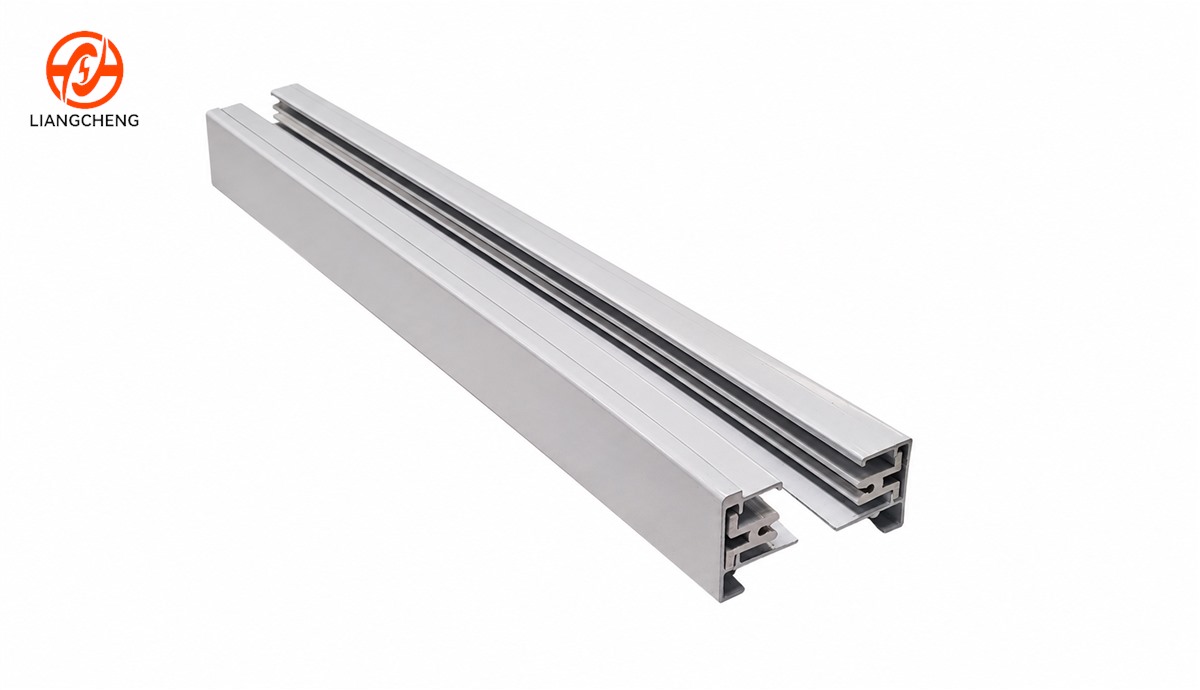
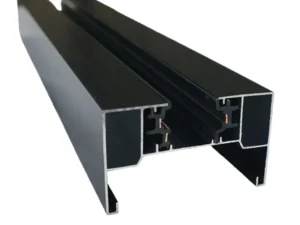
The image below is based on the specified Liangcheng LJ-201 two-wire rail photograph. Its visible channel, extrusion, and contact region illustrate a conventional mechanical-adapter rail. The far end has been visually completed for the editorial composition, so the image is an illustration rather than a dimensioned product drawing. It should not be read as a magnetic rail or as evidence that a magnetic module will fit this two-wire profile.
A two-wire rail can be an efficient choice when one lighting group and a compatible family of track heads meet the project brief. It does not automatically provide independent control zones, and its safety construction must be evaluated from the actual product documentation. A buyer considering a magnetic alternative should compare the whole power and accessory package, not only the apparent width of the LJ-201 extrusion. Liangcheng’s 2-wire versus 3-circuit guide
Which profile dimensions must be specified?
For both architectures, start with external width and depth, usable channel opening, stock and cut length, straightness, wall features, mounting points, finish, and connector engagement. A conventional rail additionally needs the adapter key, contact positions, insertion and locking envelope, conductor insulation, and protective-earth interface where applicable. A magnetic rail needs its module contact map, retention geometry, polarity features, module insertion clearance, and power-feed interface. Similar outside dimensions do not make those internal features equivalent.
Surface mounting calls for clear ceiling support points, fixing spacing, feed clearance, and the final projection below the ceiling. Recessed or trimless work adds cutout width, ceiling-void depth, housing or flange geometry, plaster edge, board thickness, and access for electrical equipment. Suspended rails need cable or rod spacing, canopy position, alignment, and tested loading. The track rail dimensions guide
Liangcheng’s general rail catalog lists standard metric lengths from 0.5 m to 3 m for its broader range. That does not prove availability for every magnetic or conventional profile. An RFQ should identify the exact rail series, length, cut tolerance, finish, packaging length, and whether site cutting is permitted. Feed bodies, joiners, end caps, and corner connectors can change installed run length, so the ceiling plan should dimension the assembled route rather than just sum nominal rail pieces.
How do the installation workflows differ?
A straightforward surface-mounted conventional run can be planned around a protected AC circuit, a rail feed, suitable structural fixings, matched joiners, end caps, and adapter heads. The electrical design must still check voltage, current, circuit grouping, earthing, luminaire load, support spacing, and local requirements. Familiarity may reduce site coordination for simple retrofits, but a rail swap into an existing ceiling is safe only after the interface and ratings are identified.
A low-voltage magnetic run introduces a power-supply location and a DC wiring path before the rail. The designer must reserve space for an accessible supply, verify that its output matches the modules, and check total connected load, cable distance, voltage drop, feed count, controls, and service access. Recessed magnetic profiles may add ceiling-void and finishing work. A clean visible slot can therefore require more hidden coordination than a surface-mounted conventional rail.
Neither method guarantees easier installation in every project. A new ceiling can accommodate a planned magnetic recess and driver access; an occupied store with a short surface run may favor conventional rail work. A surface magnetic rail can be easier than a complex recessed conventional detail. Compare the actual ceiling, power point, maintenance access, and installation sequence rather than treating “magnetic” or “traditional” as a labor estimate.

What changes in circuit control and connected load?
Conventional rails may offer one or multiple separately switched circuits, depending on the series. A three-circuit commercial system can place several fixture groups on one physical rail when the feed, adapters, and electrical design support circuit selection. A simple two-wire run normally operates as one group. Buyers should not confuse the number of visible conductors with the number of usable control zones or assume a dimmer works with every LED head.
Magnetic rails usually distribute a specified DC supply, while dimming and grouping depend on the power supply, controller, module electronics, and control protocol. Two magnetic modules on one rail may not be independently controllable merely because they can be removed separately. Ask for the exact control diagram, addressing or zoning method, dimming range, driver compatibility, and commissioning responsibility before promising a flexible control scheme to a client.
Connected load is a system limit, not a marketing number printed on the rail alone. For a simple illustration, 240 W at 48 V represents 5 A before losses and design allowance. That arithmetic does not establish a safe run, because the power supply, feed, conductor, connector, cable, thermal conditions, and voltage drop may impose lower limits. Conventional rails also have electrical and structural limits. A qualified designer should calculate the complete circuit and verify the proposed fixture schedule.
Can fixtures or accessories be shared between the systems?
Conventional track heads and magnetic modules are generally not interchangeable. They use different rail openings, contacts, retention methods, supply voltages, polarity arrangements, and sometimes control protocols. An adapter that can be pushed into a similar-looking slot is not proof of electrical or mechanical compatibility. Never modify an adapter or bypass a lock to make a cross-family fit.
Compatibility must be checked within each system as well. Conventional H, J, L, two-wire, and multi-circuit families can use distinct keys and contacts. Magnetic rails from different series may vary in channel width, contact spacing, magnet position, retention details, voltage, and module electronics. A distributor should list approved rail, feed, connector, module, power supply, and control codes as a family, and should maintain revision information when products change.
For a retrofit, photograph and measure the installed rail end, product marking, feed, connector, and working luminaire interface. Request a matching sample and written compatibility statement before ordering a replacement batch. The track light adapter compatibility checklist
Which rail is better for different project applications?
A conventional rail often suits a retail store or showroom that needs powerful adjustable spotlights, one or more well-defined switching groups, and accessible surface installation. Its larger heads can house substantial optics and thermal components. The rail is a practical infrastructure when the client values robust accent lighting and a straightforward replacement strategy more than a minimal ceiling line.
A magnetic track often suits a reception, gallery, boutique, hospitality space, or contemporary interior where the rail must integrate with architecture and accept a mix of linear, spot, grille, or pendant modules. Its modularity is valuable when display layouts change, provided the original power supply and control capacity anticipate future configurations. A slim appearance is not evidence that the system can carry any desired wattage or that every future module will remain compatible.
Mixed-use projects may need both architectures in different zones. A high-ceiling sales floor can use conventional high-output accents while a nearby display wall uses a recessed magnetic line for compact modules. The two systems should be designed as separate electrical and mechanical families with clear drawings, labels, spare parts, and maintenance instructions. Sharing a visual finish does not justify sharing feeds or adapters.
The appropriate choice follows the lighting task and ceiling constraint. A fixture-level comparison can help with optics and visual effects, while this rail-level decision determines what must be built, powered, and maintained. A mock-up with real fixture output and the proposed ceiling detail can reveal problems that neither a product photo nor a unit price exposes.
What are the advantages and trade-offs of each rail architecture?
A conventional rail’s strengths can include established mechanical-adapter workflows, accessible surface mounting, high-output track-head options, and familiar circuit planning. Its limits can include a more visible adapter and head, fewer compact module formats in some families, and separate head-level electronics. The actual cost and flexibility depend on the specified rail family, luminaire range, finish, and control plan.
A magnetic rail’s strengths can include a clean recessed line, compact module mix, and convenient reconfiguration within an approved system. Its trade-offs can include a separate power supply, added ceiling coordination, stronger dependence on one compatible module family, and a need to plan driver access and DC distribution carefully. Magnetic retention does not remove the need for a certified structural and electrical connection.
Neither option is inherently more energy efficient. Energy use depends on luminaire efficacy, optics, output target, number of modules, driver efficiency, dimming, and operating hours. Neither option is automatically cheaper over its life. Compare the same lighting performance and include rails, fixtures, feeds, connectors, power supplies, ceiling work, installation, spare inventory, and future replacement availability.
What belongs in a complete quotation and bill of materials?
A conventional-rail quotation should itemize rail lengths and finishes, live-end or center feeds, straight and directional connectors, end caps, mounting or suspension parts, adapter types, compatible track heads, controls where needed, packaging, and spares. A magnetic quotation needs the rail and installation housing as applicable, AC-to-DC supplies, DC feeds, electrical joiners, module types, controls, driver-access detail, mounting parts, end caps, and spare modules or supplies. A rail-only price cannot be compared fairly with a complete installed-system price.
Every line item should reference the approved series and revision. Specify whether connectors pass power, provide only mechanical alignment, or carry a control signal. Mark polarity, left/right orientation, branch direction, and mounting condition on the reflected-ceiling plan. A replacement-stock list is particularly important for magnetic systems whose modules and supplies may change generation over time.
Liangcheng’s track rail RFQ checklist
How should a distributor or project buyer approve samples?
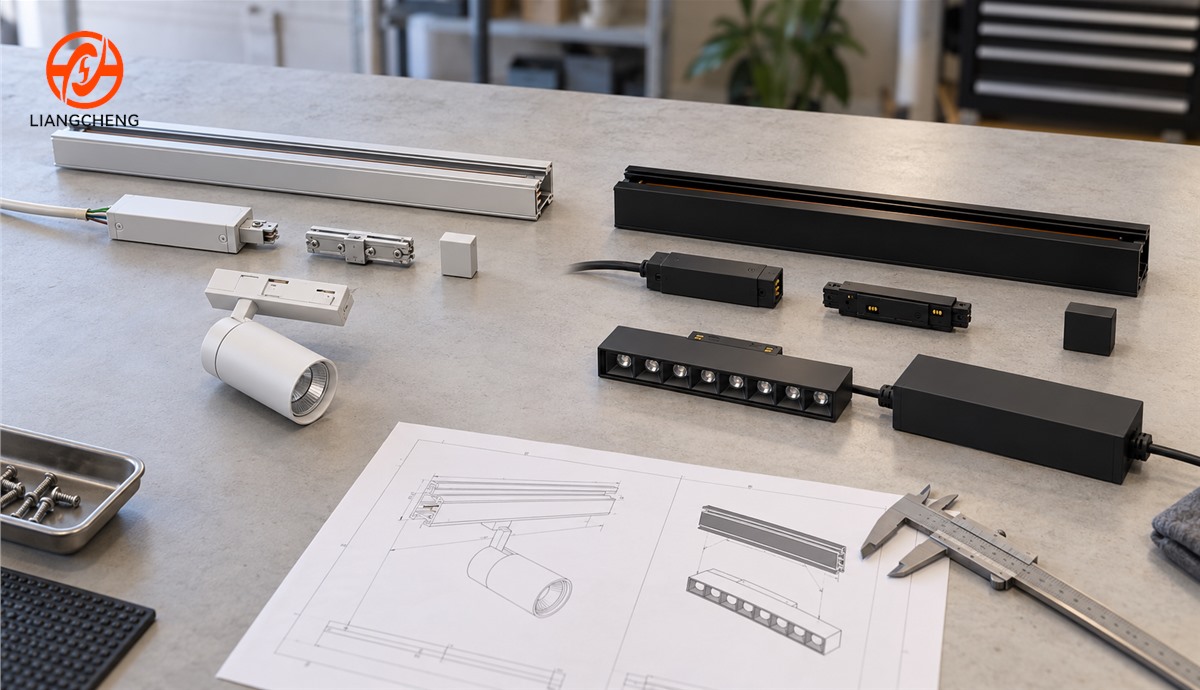
Begin with a written project brief and controlled drawings for the two candidate systems. Compare the required lighting output, ceiling format, wiring path, control zones, service access, and delivered cost. Then request a representative kit rather than one short rail alone. The kit should include the actual feed, a straight and directional connector, an end cap, a mounting part, and at least one intended luminaire or module. Magnetic candidates also need the specified power supply and control parts.
Inspect rail length and section dimensions, straightness, finish, contact location, insulation, connector engagement, module or adapter insertion, retention, and removal. Test assembled corners and end conditions rather than only a straight piece. Qualified personnel should verify electrical and control behavior under the supplier’s instructions. Record pass, fail, and unresolved items against a drawing revision, then keep a marked approval sample for the pilot order.
A pilot run should check normal cartons, transport protection, installation sequence, and consistent fit across more than one rail and accessory lot. Long aluminum profiles can arrive bent or scratched despite passing factory inspection, so packaging is part of the approval. Reorder documents should fix the part codes, revisions, critical dimensions, finish reference, and change-notification process. That level of control makes a B2B rail program repeatable rather than merely attractive in a showroom mock-up.
Perguntas frequentes
Is a magnetic track still a track rail?
Yes. A magnetic track is a powered rail and mounting system, but its interface and electrical architecture differ from conventional mechanical-adapter track. The word “magnetic” describes one aspect of module placement and retention, not permission to use the rail without matched contacts, a suitable power supply, and approved mounting.
Can I replace a conventional two-wire rail with a magnetic rail using the same wiring?
Not without a new system design. A common magnetic setup needs a matching low-voltage power supply and DC feed, while a conventional rail commonly receives AC through its own feed. The ceiling wiring, driver location, controls, rail profile, fixtures, and approvals must be reviewed by qualified professionals before a conversion.
Does a 48V magnetic rail need fewer feeds than a line-voltage track?
Not necessarily. Feed count depends on connected load, conductor resistance, allowed voltage drop, rail length, connector rating, and power-supply placement. Lower distribution voltage can mean higher current for the same power. The project designer should calculate and test the actual run instead of assuming one feed serves any length.
Are magnetic modules always easier to maintain?
Individual magnetic modules may be convenient to remove, but a shared failed supply can affect several modules. Maintenance also depends on access to the driver, availability of matching replacement modules, rail revision, controls, and documented isolation procedures. A conventional head may be easier to replace in one project and harder in another.
Which system is better for a recessed ceiling?
A magnetic system can create a narrow integrated appearance with flush modules, but conventional recessed track is also available. The better choice depends on cutout and cavity dimensions, ceiling construction, power-supply access, desired fixture forms, installation tolerance, and maintenance. Approve a section mock-up before ordering a large quantity.
Discuss wholesale track rail and magnetic-system requirements with Liangcheng
Liangcheng Lighting supplies aluminum track rail solutions for lighting projects, wholesalers, distributors, and OEM brands. To compare a conventional rail with a magnetic alternative, send the project layout, mounting detail, target voltage and control plan, fixture schedule, desired lengths and finish, destination market, expected order volume, and packaging needs. Liangcheng can then identify the relevant rail and accessory range and discuss drawings, sample kits, customization, and a quotation tied to the intended system.
For a repeatable B2B purchase, request the current model drawings, matched feeds and connectors, a documented sample approval plan, and separate pricing for each complete system. Review Liangcheng’s track rail offerings and contact the team to discuss wholesale supply, custom lengths or finishes, OEM packaging, and project-specific rail requirements.
Precisa de Soluções Personalizadas de Iluminação de Trilhos?
Entre em contato com a Liangcheng Lighting para soluções de trilhos de alumínio OEM/ODM e suporte profissional de iluminação.
Relacionado