








Tempo estimado de leitura: 13 minutos
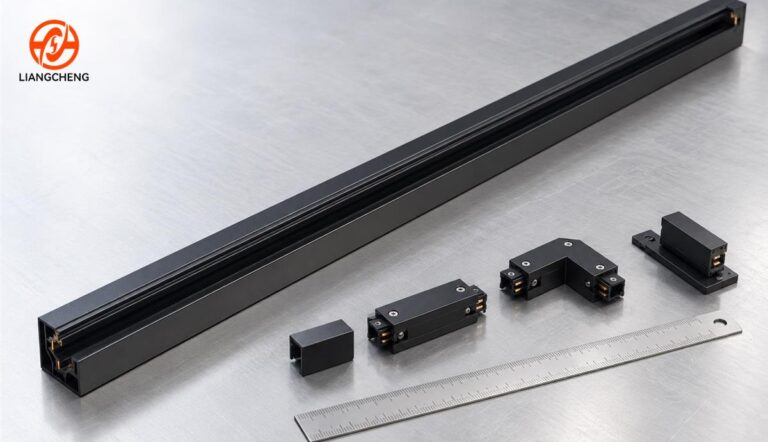
A 6-wire track rail should be purchased as a documented power-and-control system rather than as a rail with two extra copper strips. A purchase-ready specification identifies every conductor function, the protective-earth method, control protocol, rail profile, adapter, luminaire driver, feeds, connectors, electrical ratings, mounting method, commissioning scope, quality criteria, packaging, and change-control requirements. The strongest offer is the one that can be verified from drawing approval through programmed operation and repeat supply.
This 6-wire track rail ultimate buying guide is designed for distributors, importers, lighting brands, project suppliers, contractors, and technical purchasing teams. It focuses on the commercial and engineering evidence needed before a bulk order. Readers who need the basic construction and operating principle can begin with what a 6-wire track rail is and how it works.
What does the 6-wire label tell a buyer?
The 6-wire label tells a buyer that six conductive paths are present in the identified rail, but the label does not prove what those paths do. A common control-enabled configuration uses four conductors for three selectable power circuits and a shared neutral, plus two conductors for a control signal. Protective earth may use an additional contact or the metal housing according to the system design. Other product families can allocate the six paths differently.
A quotation should therefore include a terminal schedule that names all six conductors and separately identifies earth. The schedule should state which paths carry mains power, which paths carry a control signal, whether signal polarity matters, and which adapter contacts connect to each path. A seller description such as 6-wire, smart track, dimming track, or three-phase track is not a substitute for that diagram.
| Identity question | Provas a solicitar | Risk prevented |
|---|---|---|
| What does each conductor carry? | Numbered terminal and cross-section diagram | Wrong power or signal connection |
| How is protective earth provided? | Earth-contact drawing and continuity requirement | Unverified grounding path |
| Which control method is supported? | Protocol statement and compatible driver list | Rail and luminaire control mismatch |
| Which components belong to the system? | Approved compatibility matrix | Mixing visually similar but incompatible parts |
When does a project need a 6-wire rail?
A project needs a 6-wire rail when the required control functions cannot be delivered reliably by a simpler rail and fixture arrangement. Common reasons include individual luminaire addressing, digital dimming, scene recall, re-grouping without physical rewiring, status reporting, or combining selectable power circuits with a dedicated control pair. Galleries, retail chains, hospitality spaces, showrooms, and flexible commercial interiors can benefit when lighting layouts and scenes change frequently.
A 6-wire rail is unnecessary when every fixture can operate as one group or when three switched groups already satisfy the project. Extra conductors do not create useful intelligence unless matching adapters, drivers, control devices, software, and commissioning work are included. A buyer should define the required user actions first, such as dimming one artwork separately or recalling an evening scene, then select the least complex architecture that performs those tasks.
How does 6-wire rail compare with standard multi-circuit rail?
A standard multi-circuit rail usually provides several selectable power groups, while a control-enabled 6-wire rail commonly adds a two-conductor signal path. Circuit selection determines which power group supplies a fixture. Digital or analog control conductors can carry commands that change output without moving the fixture to another power group. These are separate functions and should be documented separately.
| Ponto de decisão | Standard multi-circuit rail | Control-enabled 6-wire rail |
|---|---|---|
| Basic grouping | Fixtures assigned to available power circuits | Power-circuit assignment may remain available |
| Individual addressing | Usually not provided by the rail alone | Possible when the approved control ecosystem supports it |
| Required adapter | Matching power-circuit adapter | Matching adapter with correct signal contacts and driver interface |
| Comissionamento | Circuit assignment and switching checks | Power checks plus addressing, grouping, scenes, and records |
| Failure analysis | Power, contacts, protection, or fixture | Power path, signal path, addressing, configuration, or fixture |
O 4-wire track rail buying guide covers multi-circuit procurement without assuming an added control pair. A buyer should move to six conductors only when the project requirements and component ecosystem justify the additional control layer.
What should the six-conductor cross-section reveal?
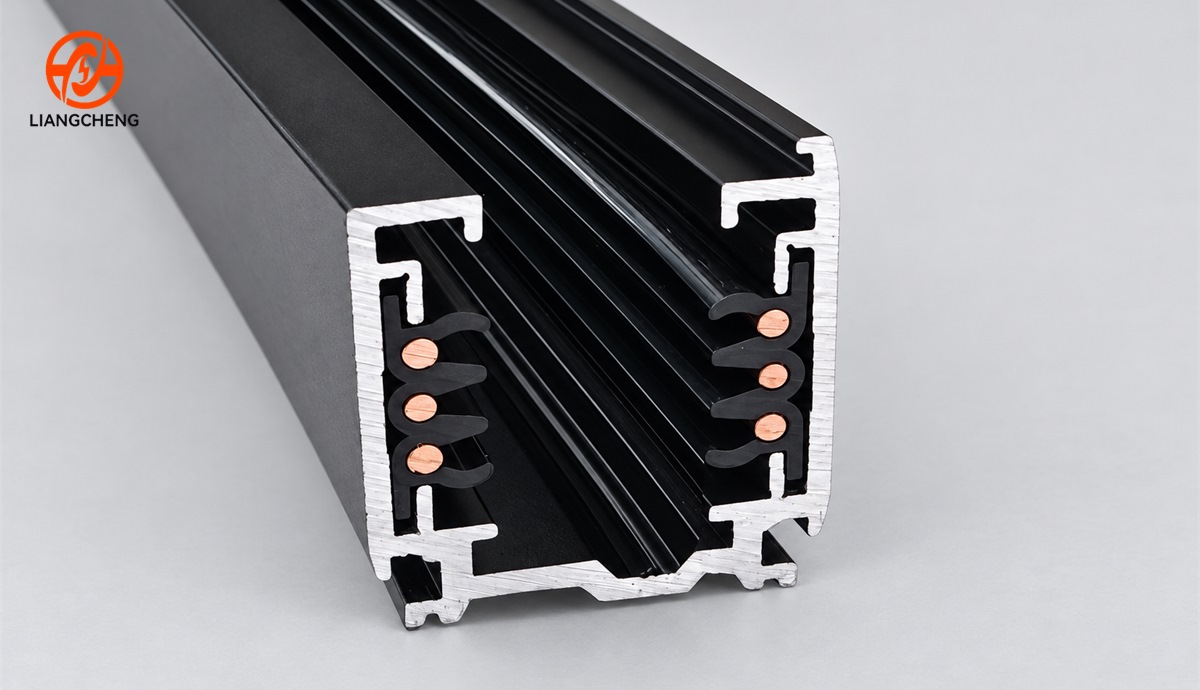
The rail cross-section should show six copper conductors retained in insulated carriers with adequate separation and a defined relationship to the adapter channel. A drawing should identify conductor position, critical spacing, insulation geometry, polarity or orientation features, adapter insertion envelope, housing dimensions, and earth contact. The physical rail should match the controlled drawing within the agreed tolerances.
A production sample should be examined for loose conductors, cracked or distorted insulation, conductive debris, damaged cut ends, coating inside contact areas, and inconsistent contact height. A conductor count alone cannot demonstrate performance. Contact pressure, alignment, surface condition, insulation retention, and adapter travel determine whether power and control connections remain stable after repeated insertion and normal use.
Why must the control protocol be named in the RFQ?
The control protocol determines the signal source, bus power or controller, driver type, addressing method, polarity rules, cable treatment, device limits, commissioning tools, and fault-diagnosis process. A rail described only as dimmable may support a digital bus, a polarity-sensitive analog signal, a pulse input, or a manufacturer-specific method. Those options are not interchangeable merely because each uses two conductors.
A purchase order should state the protocol and required functions in plain language. The requirements may include individual addressing, group control, scene recall, tunable-white operation, emergency integration, monitoring, or a simple shared dimming signal. The buyer should also define who supplies the controller, who programs the devices, who provides the final address schedule, and how future replacement fixtures will be commissioned.
Which components must be approved as one control ecosystem?
A complete 6-wire system includes the rail, live-end or center feed, power and signal terminals, straight and directional connectors, end caps, mounting or suspension hardware, fixture adapters, LED drivers, luminaires, control power supply or gateway when required, user interfaces, and commissioning tools. The components should be listed by controlled part number rather than by generic description.
The adapter is the most concentrated compatibility risk because it must lock mechanically, retain the luminaire, connect to the correct power conductor, engage earth, and connect the control pair without bridging adjacent contacts. A successful physical insertion does not prove electrical mapping or control compatibility. Use the track adapter compatibility checklist to approve the rail and adapter as one interface.
How should the power and signal paths be documented?
The project drawing should separate power distribution from signal distribution even when both travel through one extrusion. The power schedule should state the supply arrangement, circuit grouping, protective devices, fixture loads, driver inrush, switching behavior, and earth continuity. The signal schedule should state the controller, bus supply, conductor pair, topology, permitted polarity, device count, addressing plan, and test points.
Separating the schedules makes troubleshooting more precise. A fixture that remains dark may have lost mains power, while a fixture that turns on but ignores commands may have a signal, driver, addressing, or configuration fault. A commissioning team should be able to test each layer independently before evaluating complete scenes.
How should rail orientation and handed connectors be planned?
Six-wire rails normally include an asymmetric ridge, earth feature, or key that fixes the relationship between conductors and accessories. That orientation must remain consistent through every rail section and connector. Reversing one section can map an adapter to different power or signal positions even when the mechanical joint appears acceptable.
Ceiling plans should show the orientation reference, feed direction, and exact connector code at every straight joint, corner, T branch, and cross. Left and right feeds or inner and outer T connectors should not be replaced with one generic line item. The track lighting rail accessories guide explains how feeds, couplers, junctions, end caps, and mounting parts become a complete bill of materials.
What electrical information should buyers verify?
Electrical ratings must come from the exact rail, connector, adapter, luminaire, driver, controller, and project supply design. Buyers should verify nominal voltage, rated current, conductor loading, shared-neutral limitations where relevant, protective-device selection, earth arrangement, ambient conditions, fixture input power, power factor, and driver inrush. A current rating printed beside the rail does not define a safe number of LED fixtures.
The control conductors should be assessed separately from the mains conductors. Buyers should verify insulation classification, permitted signal type, bus power requirements, maximum devices or addresses, allowed topology, and test method for the specified protocol. Qualified electrical and controls personnel should approve the installation design for the destination market; the article does not replace product instructions or local requirements.
Which mechanical specifications belong in the order?
A mechanical specification should define section length, external width and height, internal profile geometry, mounting interface, recessed cutout when applicable, straightness, twist, critical wall features, conductor position, finish, color tolerance, cut-end condition, connector insertion allowance, fixture load limits, and support spacing. Each value should reference a drawing revision or agreed inspection method.
Six-wire rails may look almost identical to four-conductor versions from below, so external appearance cannot identify the system. A renovation or extension project should use a measured cross-section, terminal map, adapter sample, and known system code. The track rail dimensions guide provides a systematic method for recording an existing profile.
What documents should accompany a 6-wire quotation?
A strong quotation includes the rail drawing, terminal schedule, protocol declaration, electrical ratings, compatible adapter and driver list, accessory schedule, mounting options, finish data, installation instructions, sample plan, quality requirements, packaging proposal, delivery terms, and stated exclusions. Compliance or test documents should identify the exact product and market scope rather than a different rail family.
The RFQ should ask suppliers to state deviations in a separate table. Hidden assumptions are especially costly in a control system because one omitted feed, incompatible driver, or unsupported function can prevent commissioning. The track rail RFQ checklist helps buyers normalize technical and commercial responses.
How should a six-wire system sample be approved?
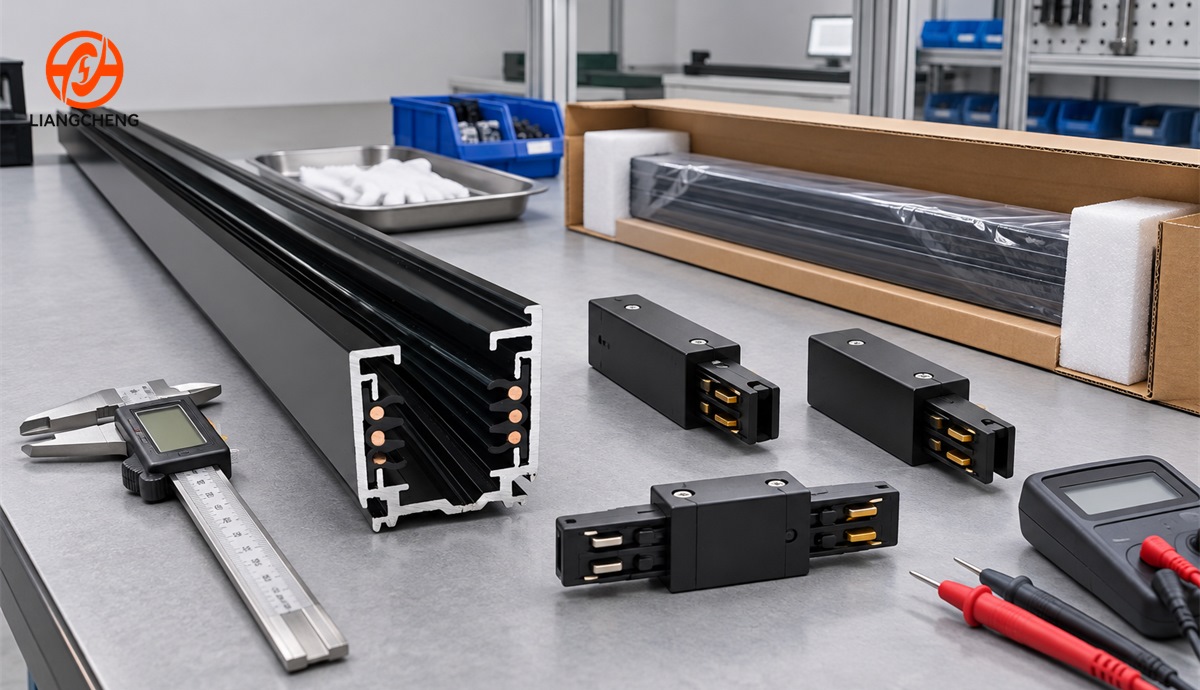
Sample approval should begin with documents and progress to an operating mini-system. A useful sample set includes rail sections, left and right feeds, representative straight and directional connectors, end caps, adapters, luminaires with the proposed drivers, and the intended control equipment. The sample should reproduce every important interface rather than demonstrate one lamp on one short rail.
The evaluation should verify dimensions, conductor mapping, earth continuity, insulation, circuit selection, signal continuity, adapter locking, fixture retention, addressing, grouping, dimming behavior, scene recall when required, power-cycle recovery, and compatibility across the specified components. A pilot quantity should then test normal production, full-length straightness, packaging, labeling, installation handling, and repeat commissioning. The sample approval guide describes how drawings, reference samples, corrective actions, and pilot release should connect.
What should a commissioning plan deliver?
A commissioning plan should identify who energizes the rail, who configures control devices, who assigns addresses, who builds groups and scenes, and who signs the results. The deliverables should include the final device list, address schedule, group and scene map, controller configuration backup, firmware or software versions when relevant, test results, unresolved issues, and instructions for adding replacement luminaires.
Commissioning should test both normal and abnormal conditions. Each power circuit should operate independently. Each addressed fixture should respond to its assigned commands. The team should confirm dimming range, scene recall, power-loss recovery, response after a fixture is moved, and behavior when a signal connection is interrupted. A visually successful demonstration is incomplete if the configuration cannot be reproduced after maintenance.

What should production and pre-shipment inspection cover?
Production inspection should check aluminum profile dimensions, rail straightness, conductor position, insulation retention, coating condition, cut quality, mounting features, and accessory fit against the approved reference. Electrical checks should cover conductor continuity, separation between unintended paths, earth continuity where applicable, signal-pair continuity, terminal mapping, and representative adapter contact.
Pre-shipment inspection should verify quantities by SKU, handed accessories, adapters, controller-related parts, labels, documents, package contents, rail finish, length, straightness, and shipping protection. Batch records should link finished goods to production and inspection data. The guide on judging track rail quality explains why product, system, and supply quality must be reviewed together.
How should long six-wire rails be packaged?
Long rails should be protected against bending, twist, scratches, impact, moisture, conductor damage, and movement inside the carton. Individual sleeves, surface separators, rigid end protection, controlled bundle weight, internal supports, and reinforced outer packaging reduce common transit damage. Accessories and metal connectors should be packed separately so they cannot strike the coated rail.
The package design should also protect traceability. Carton labels should identify model, length, finish, quantity, production batch, and purchase order. Control-capable feeds and adapters should not be mixed with similar standard parts. The guide to packaging long track rails explains how to validate a pack for actual rail length and logistics handling.
How should buyers compare prices for six-wire systems?
A valid price comparison should use the delivered cost of a commissionable system. The calculation should include rail, feeds, directional connectors, couplers, end caps, mounting hardware, adapters, compatible drivers, control equipment, programming, documentation, samples, tests, packaging, freight, duties, expected damage, replacement parts, and technical support. Rail price per meter is only one input.
A cheaper offer can create a higher project cost when commissioning is excluded, compatible drivers are limited, connectors are missing, or replacement fixtures cannot be addressed with the installed tools. Buyers should compare the same functional scope and warranty boundary. The wholesale track rail pricing guide provides a broader method for normalizing quotations.
How should distributors manage six-wire inventory?
A distributor should separate control-enabled rails and accessories from visually similar standard systems. SKU names should include the system family, conductor configuration, mounting type, finish, length, handed orientation, and control capability. Warehouse photographs should show connector keying and contact patterns, while sales documents should state that same wire count does not prove interoperability.
The launch range should include enough parts to build and commission a real layout: rail lengths, feeds, end caps, straight connectors, required corners and branches, mounting hardware, approved adapters, representative fixtures, control components, and service spares. Technical staff should keep drawings, terminal maps, compatibility lists, master samples, and configuration files with clear revision control.
Which warning signs should stop a bulk order?
- The supplier cannot identify the function of all six conductors.
- The quotation says DALI, smart, or dimmable without naming the exact supported protocol and driver requirements.
- The standard feed or adapter is offered for both four-wire and six-wire rail without verified contact mapping.
- Directional connectors have no left, right, inner, outer, or orientation definition.
- The sample demonstrates switching but not addressing, grouping, dimming, or configuration recovery.
- Electrical capacity is stated as a fixture count without driver inrush and supply information.
- Compliance documents do not identify the quoted model or destination scope.
- The supplier has no controlled process for profile, insulation, conductor, adapter, driver, or firmware changes.
What is the final 6-wire buying checklist?
- Define the user controls, scenes, reporting, and future reconfiguration that the project actually requires.
- Obtain the six-conductor terminal map and the separate protective-earth definition.
- Name the control protocol, controller, drivers, addressing method, and commissioning responsibility.
- Approve the rail, adapter, feeds, connectors, luminaires, drivers, and controls as one ecosystem.
- Document power circuits and the control bus in separate coordinated schedules.
- Fix rail orientation and every handed accessory on the layout drawing.
- Approve profile dimensions, finish, mounting, full-length tolerances, and load limits.
- Test a complete mini-system before authorizing a representative pilot.
- Define production inspection, commissioning records, packaging, traceability, and change control.
- Compare quotations by delivered, commissionable, repeatable system cost.
Frequently asked questions about 6-wire track rail
Does 6-wire always mean a digital lighting-control rail?
No. Six conductors often include a separate two-wire control pair, but the protocol and conductor allocation vary. The exact terminal diagram and compatibility documents must define the product.
Can standard multi-circuit fixtures work on a 6-wire rail?
Compatibility cannot be assumed. The rail profile may look similar, but control-capable systems can require different feeds, adapters, contact positions, drivers, and approvals. Use an explicitly approved combination.
Does a six-wire rail control every fixture individually?
Individual control is possible only when the complete system supports addressing and has been commissioned correctly. Six copper paths alone do not create individual control.
Can the two signal conductors be used for any dimming method?
No. Digital buses, analog control, and pulse inputs have different electrical and configuration requirements. Use only the signal method identified by the rail, adapter, driver, and controller documentation.
What must be retested after a component change?
A change to the rail profile, conductor position, insulation, feed, connector, adapter, driver, controller, or relevant software can affect compatibility. Retesting should match the changed risk and may include dimensions, contact mapping, continuity, control response, scenes, and recovery.
What information produces an accurate quotation?
Send the destination market, application, layout, mounting method, rail lengths, finish, terminal requirements, protocol, fixture and driver schedule, controls, accessories, quantities, sample tests, commissioning deliverables, packaging, and delivery terms.
Discuss a wholesale or customized six-wire rail system with Liangcheng Lighting
Liangcheng Lighting provides wholesale and customized track lighting rail services for B2B buyers. An effective inquiry should include the destination market, conductor-function requirement, control method, layout, mounting style, rail lengths, finish, fixture and adapter information, accessory schedule, expected quantity, commissioning scope, and packaging needs.
Visit lclights.com to discuss six-wire track rail samples, compatible components, customized specifications, private-label requirements, packaging, and bulk supply. A complete technical file and operating sample will create a stronger purchasing decision than comparing rail prices or conductor counts alone.
Precisa de Soluções Personalizadas de Iluminação de Trilhos?
Entre em contato com a Liangcheng Lighting para soluções de trilhos de alumínio OEM/ODM e suporte profissional de iluminação.
Relacionado