







Tempo estimado de leitura: 13 minutos
Wholesale track rail pricing is determined by the approved rail construction, electrical components, finish, manufacturing quantity, accessory scope, customization, quality requirements, and delivery conditions. A lower price per meter does not necessarily mean a lower cost for the same usable lighting system. Buyers need to compare equivalent specifications and quantities before deciding whether a quotation offers better value.
For distributors, lighting brands, and project contractors, the most useful pricing question is not simply how much a rail costs. The useful question is what the quoted amount includes, what remains payable, and how many compliant, usable units the purchase will deliver. This guide provides a cost comparison framework rather than a current price list or a quotation from Liangcheng Lighting.
What should buyers compare before comparing track rail prices?
A valid track rail price comparison starts with a common product definition. Two black rails of equal length can contain different conductor arrangements, insulating components, mounting features, or adapter interfaces. Comparing the headline prices without those details can make a product substitution look like a genuine manufacturing saving.
A common quotation baseline should identify the drawing revision, exact rail model, electrical configuration, finish, ordered lengths, quantities, and included accessories. The baseline should also state the delivery destination and commercial scope. Missing information should remain visibly unresolved rather than being treated as a free inclusion. The track rail RFQ information checklist explains how to collect the underlying specification.
| Comparison field | Question to resolve | Why the answer changes cost |
|---|---|---|
| Price unit | Per meter, piece, carton, or complete kit? | Different denominators can disguise a higher equivalent price. |
| Product scope | Bare housing or assembled electrical rail? | Conductors and insulation may be excluded. |
| Order mix | How many pieces of each length and finish? | Separate production batches can require separate setup. |
| Accessory scope | Which feeds, connectors, and mounting parts are included? | Rail-only pricing does not represent an installed system. |
| Nonrecurring charges | Are tooling, samples, and artwork charged separately? | First-order costs can differ from repeat-order costs. |
| Delivery basis | Which packing and transport charges are included? | Collection prices and delivered prices cover different services. |
How do aluminum profile design and material content affect price?
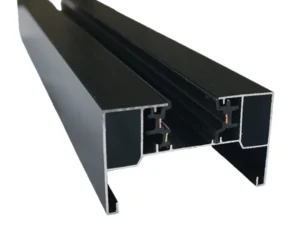
Aluminum profile geometry affects track rail cost through material consumption and manufacturing difficulty. A larger cross-section can require more metal per meter, while narrow channels or complex features can make extrusion control more demanding. Material weight is therefore a useful comparison field, but weight alone does not establish structural suitability or overall product quality.
A heavier track rail is not automatically the better purchase. The relevant requirement is whether the approved design supports the intended installation and maintains the required dimensions. Removing metal from a noncritical feature may be a legitimate engineering change; reducing a functional wall without review can change stiffness, fit, or mounting behavior. Any proposed material reduction should return to technical approval before price acceptance.
Raw material costs and processing costs should be considered separately. Even when metal input costs decline, machining, finishing, assembly, packaging, and overhead do not necessarily decline by the same percentage. Buyers should ask whether a revised quotation reflects a material adjustment, a design change, or a commercial concession, because those explanations have different implications for repeat orders.
Why do conductors and electrical configuration change the quotation?
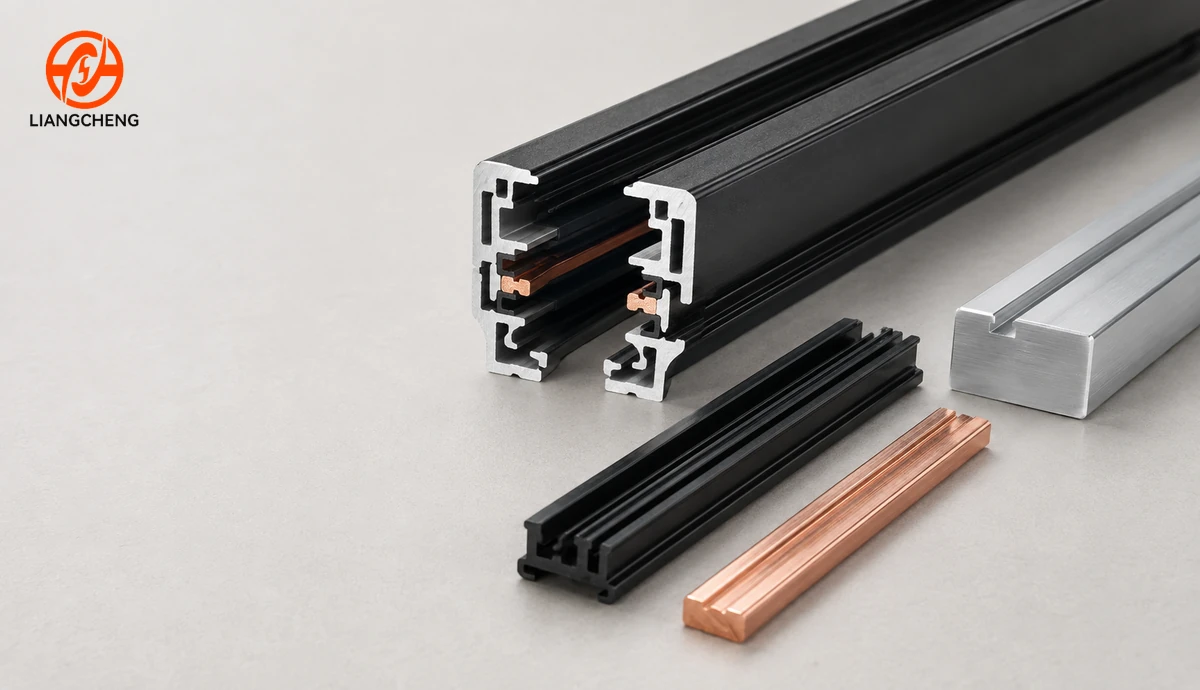
Electrical components contribute to wholesale track rail pricing through conductor material, cross-section, number and placement of conductive paths, insulation design, and assembly requirements. An assembled rail is not equivalent to an empty aluminum channel. Buyers should confirm the actual bill of materials rather than infer electrical content from an exterior photograph.
Track system names do not provide enough information to normalize electrical specifications. Wire count, circuit terminology, protective connections, control functions, and operating requirements must be confirmed for the exact model. A quotation should identify the intended rail and adapter combination; a generic compatibility statement cannot establish that two differently priced systems are interchangeable.
Compatibility affects commercial cost because rails, adapters, feeds, and connectors need to function together. A less expensive rail that requires replacing stocked adapters may increase the total conversion cost for a distributor. Use the adapter compatibility checklist for B2B buyers to separate verified matching components from assumptions before evaluating a price reduction.
How much do finish, color, and appearance requirements matter?
Track rail finish requirements affect cost through preparation, coating or anodizing operations, masking, handling, and rejection criteria. Standard production finishes may be easier to schedule than a special color with a tightly controlled appearance. The premium depends on the process and batch conditions, so a universal percentage surcharge would be misleading.
Color descriptions should be paired with an agreed reference and inspection conditions. A simple request for black does not define gloss, texture, permitted variation, or the appearance of exposed ends. Clear acceptance criteria reduce the chance that an inexpensive quotation covers a different visual standard from the one expected by the buyer.
Cosmetic requirements should distinguish visible installation surfaces from concealed areas. Requiring identical cosmetic treatment everywhere can add cost without improving the finished installation, while loose requirements on visible joints can create inconsistent sets. A practical specification preserves functional protection and the intended appearance while avoiding unnecessary inspection or finishing work on noncritical surfaces.
Why does quantity per SKU matter more than the total order alone?
Wholesale quantity affects price when a larger production batch spreads setup work across more output. However, an order of several thousand meters divided among many profiles, colors, and lengths is not equivalent to one continuous run of a single configuration. The relevant production quantity may be the quantity per stock keeping unit, finish batch, or manufacturing operation.
Minimum order quantities can apply at different levels. A supplier may distinguish an order minimum from a custom color minimum, packaging print minimum, or accessory minimum. Buyers should request those thresholds separately. Reaching an aggregate purchase value does not necessarily remove the setup cost of every low-volume item in the order.
A repeatable order mix can sometimes create savings more effectively than a larger but unpredictable purchase. Fewer low-volume variants may simplify planning and reduce changeovers, subject to actual factory conditions. Buyers should test alternative quantity combinations with the supplier rather than assume that doubling the order will produce a fixed discount.
How should tooling and customization charges be allocated?
Custom track rail pricing should separate nonrecurring development charges from recurring production charges. Tooling, engineering review, sample preparation, fixtures, and initial packaging artwork may be charged once, while printing, special assembly, and inspection can recur with each order. Combining every charge into a single unit price makes later quotations harder to interpret.
A simple tooling allocation is the agreed tooling charge divided by the relevant committed quantity. If a fictional tooling charge is 600 currency units and the first order contains 1,200 rail pieces, allocating the full charge to that order adds 0.50 currency units per piece. These numbers demonstrate arithmetic only; they are not actual tooling prices or supplier terms.
Forecast volume should not be confused with committed volume when evaluating tooling recovery. Spreading a charge across hoped-for future purchases can make an unproven product appear cheaper than the first order actually is. Record the upfront payment, first-order allocated cost, and repeat-order price separately, and confirm ownership, maintenance, storage, and reuse arrangements in writing.
Why can accessories reverse an apparent rail price advantage?
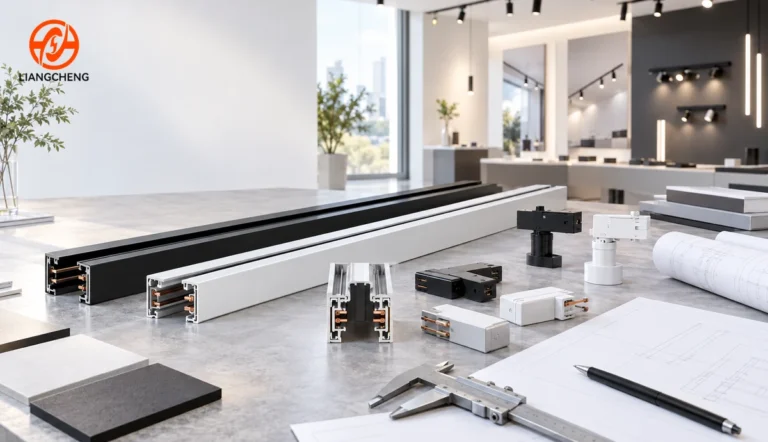
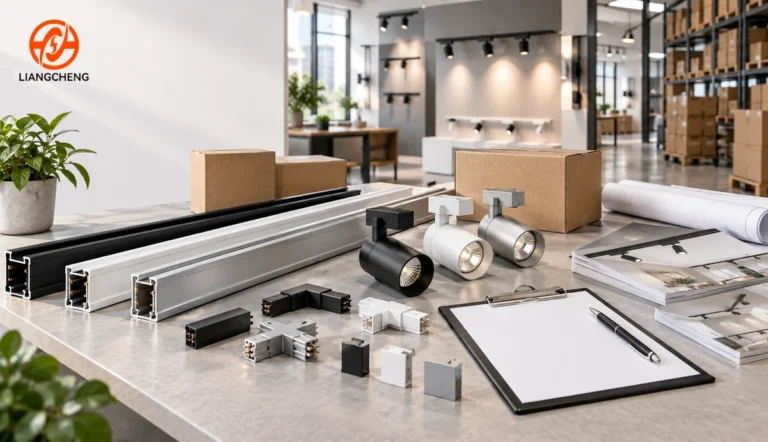
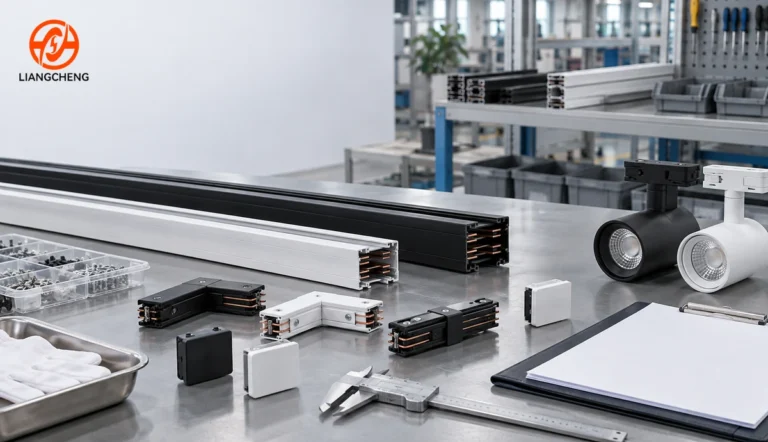
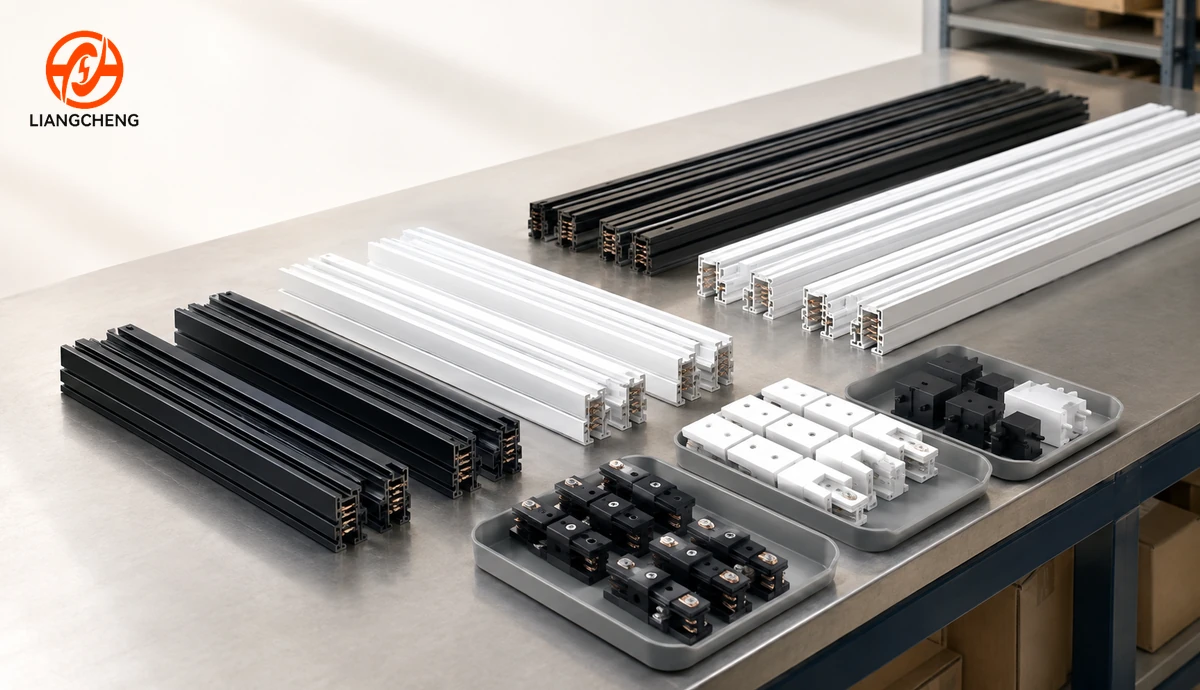
A track rail quotation becomes a system quotation only when the required accessories are counted. Power feeds, end caps, straight connectors, corners, suspension parts, and mounting hardware can change the order total. A rail supplier offering a lower rail price may still produce a higher complete-system price if essential parts are excluded or priced differently.
Accessory quantities should follow the actual installation or resale kit, not a uniform allowance per meter. A layout with many short branches can need more connectors and feeds than a long straight run with the same rail length. The complete track rail accessories guide helps identify the components that belong in the comparison.
Buyers should compare both a rail-only subtotal and a defined system subtotal. Keeping those two views exposes missing parts without hiding the underlying rail economics. Optional service spares should appear on separate lines, because a spare accessory is different from a component required to make the original kit complete.
How do inspection and documentation affect the total cost?
Quality requirements affect price when they change measurement work, sample preparation, traceability, reporting, or testing scope. Routine production checks and a buyer-specific inspection report are not necessarily the same deliverable. A quotation should state which evidence is included and which additional work requires a separate fee.
Required conformity evidence must relate to the exact product and destination requirements. A general website certification statement does not establish the coverage of every rail configuration or customized variant. Ask the supplier to identify applicable documents and unresolved review needs; qualified specialists should resolve technical compliance questions before the order is released.
Sample approval can add an upfront cost while helping identify specification differences before volume production. The commercial question is which characteristics the sample review establishes and whether later changes require renewed approval. The drawing-to-pilot sample approval process provides a separate framework for managing that evidence.
How do rail length, packaging, and freight change delivered cost?
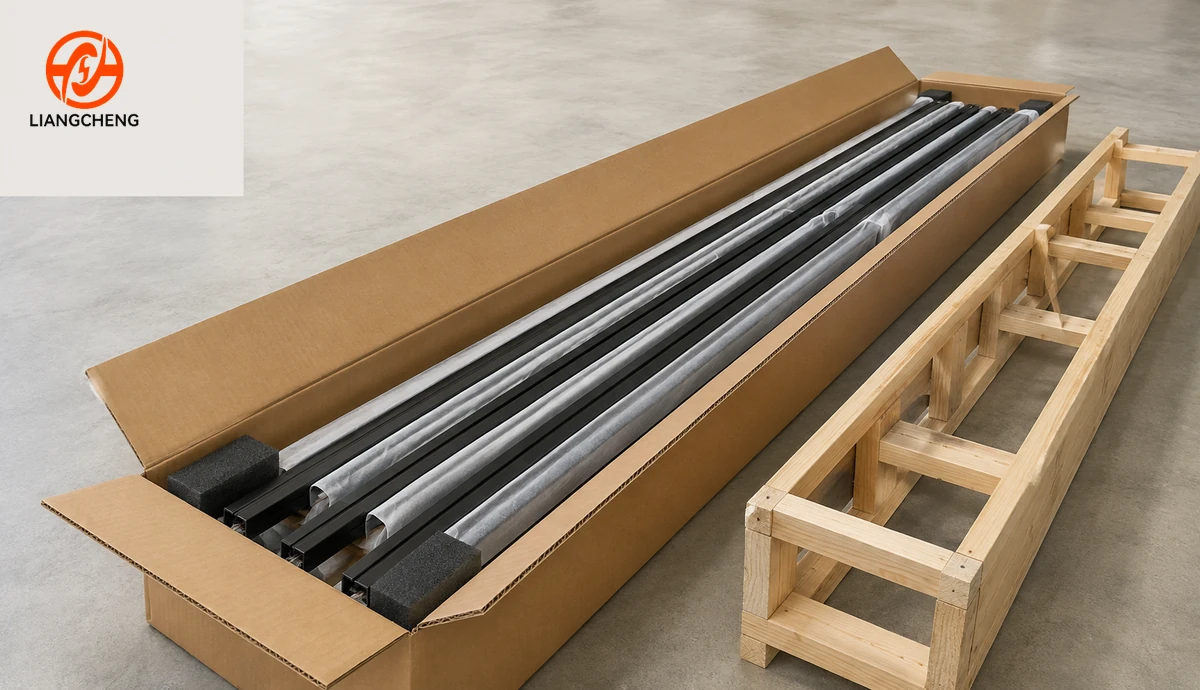
Long track rails can create transport and handling constraints that are not visible in a per-meter factory quotation. Carton length, packed volume, support method, destination access, and carrier acceptance can affect the shipping solution. Two orders with identical metal weight can therefore produce different transport quotations.
Shorter rails are not automatically cheaper at system level. Dividing a continuous run into more pieces can add connectors, assembly work, and joints, even if the shorter cartons are easier to transport. Buyers should compare the delivered bill of materials for the required layout rather than optimize carton dimensions in isolation.
Protective packaging should be priced against the shipment plan and agreed acceptance condition. Separators, end protection, rigid support, and handling arrangements serve different purposes, and no single packaging photograph proves transit performance. The guide to protecting long track rails from bending and scratches explains the packaging decisions behind this cost category.
How can buyers normalize two wholesale quotations?
Quote normalization means converting different offers to the same product scope, quantity, currency, and delivery point. First calculate the rail-only amount, then add required accessories, separately charged packaging, applicable setup charges, and the transport costs needed to reach the chosen comparison point. Keep uncertain amounts marked as estimates rather than presenting an incomplete total as final.
The following example uses fictional currency units, abbreviated CU, for 1,000 identical two-meter rail pieces. Both offers are assumed to meet the same approved specification and include the same required accessory quantities. The example is not a market benchmark, a live freight rate, or a Liangcheng Lighting quotation.
| Cost item | Offer A | Offer B |
|---|---|---|
| Rail unit price | 4.00 CU per meter | 8.40 CU per two-meter piece |
| Rail subtotal for 2,000 meters | 8,000 CU | 8,400 CU |
| Required accessories | 900 CU | 700 CU |
| Specified packaging | 400 CU | Included |
| First-order setup | 300 CU | Included |
| Transport to comparison point | 1,200 CU | 1,100 CU |
| Comparison subtotal | 10,800 CU | 10,200 CU |
| Subtotal per ordered rail piece | 10.80 CU | 10.20 CU |
Offer A has the lower rail-only price, but Offer B has the lower comparison subtotal by 600 CU. The difference comes from the combined accessory, packaging, setup, and transport scope. The calculation does not prove that Offer B is technically superior; technical equivalence is an explicit assumption that still requires independent verification.
The comparison subtotal is not automatically a fully landed cost. Depending on the agreed delivery point, destination handling, taxes, duties, insurance, or other charges may remain outside the table. Obtain applicable amounts from the responsible service providers and compare both offers on the same basis without double-counting charges already included.
How should buyers account for usable quantity and uncertainty?
Cost per accepted usable unit is a retrospective measure calculated from the relevant actual purchase costs divided by accepted usable output. Ordered quantity and usable quantity can differ when parts are damaged, incorrect, or unavailable for the intended system. A forecast comparison should use clearly labeled scenarios rather than assign an unsupported defect rate to a supplier.
A sensitivity check shows which unknown could change the decision. In the fictional comparison, Offer B leads by 600 CU; an additional verified cost above that amount could eliminate the advantage if Offer A remains unchanged. This approach directs follow-up toward consequential omissions instead of treating every small price difference as equally important.
Which commercial terms can change a repeat-order price?
Quotation validity matters because a manufacturing offer is tied to stated timing and assumptions. Material inputs, exchange rates, capacity, and delivery arrangements can change between quotation and order confirmation. Ask whether the price is fixed for the stated validity period and which events trigger a revised offer; do not assume an old quotation remains available indefinitely.
A repeat-order price should be compared against the same technical revision and commercial scope as the original. Lower quantities, a new color, revised packaging, additional reports, or a faster schedule can change the workload. A price-change explanation should distinguish those scope changes from changes in the cost of producing an otherwise identical order.
How can buyers reduce cost without weakening the specification?
Cost reduction should begin with unnecessary variety and duplicated work rather than unapproved component changes. Consolidating compatible order lines, reusing approved packaging artwork, planning standard lengths where suitable, and providing stable release schedules may simplify production. Each proposal should be quoted explicitly so the buyer can see whether the operational change creates a real saving.
Negotiation should preserve the approved functional requirements while making commercial trade-offs visible. Ask for separate alternatives showing the price effect of quantity, finish, packaging, and delivery schedule. Reject undocumented substitutions as a pricing shortcut: a cheaper offer with a changed specification is a new technical proposal, not a like-for-like discount.
What should a buyer record when approving the final price?
A price approval record should preserve the assumptions that made the offer acceptable, not just the negotiated total. Record the quotation number, revision, date, currency, exact product configuration, ordered quantities, included services, excluded charges, and validity period. A purchasing colleague should be able to reconstruct the comparison without searching through informal messages or relying on the memory of the original negotiator.
Every unresolved price item should have an owner and a resolution deadline. For example, the supplier can confirm whether printed cartons are included, while the appointed logistics provider can confirm transport scope to the selected destination. An estimated amount should stay distinguishable from a confirmed amount until evidence arrives. Replacing an unknown with zero makes a spreadsheet appear complete while leaving the commercial exposure unchanged.
Alternative offers should carry their own revision labels when they change the specification. A different finish, shorter length, simplified pack, or reduced accessory quantity may provide a valid lower-cost option, but the option should not silently replace the approved baseline. Compare the saving with the operational consequence, obtain the relevant technical acceptance, and retain both versions so the purchase order identifies exactly which proposal was selected.
After delivery, actual costs can improve the next quotation review. Reconcile the invoiced product amount, separately paid logistics charges, accepted quantities, and any documented credits or replacement costs. Keep unrelated expenses outside the calculation and avoid charging the same item twice. The resulting order history helps distinguish an exceptional first-order expense from a recurring cost that belongs in the next purchasing decision.
A useful final approval statement identifies the selected offer and explains why it meets the common scope. The statement should also list remaining conditions, such as approved samples or a confirmed shipping quotation. This short decision record makes later price changes easier to evaluate because the original commercial and technical assumptions remain visible.
What pricing questions do wholesale buyers ask most often?
Is a price per meter better than a price per piece?
Neither pricing unit is inherently better. Per-meter pricing simplifies material-length comparison, while per-piece pricing can better reflect cutting, end preparation, and individual packaging. Convert both to the exact ordered lengths, then confirm whether fixed piece-level operations are included before comparing totals.
Can annual volume secure the same price as one large order?
Annual volume does not automatically provide the economics of a single production batch. Smaller releases can require repeated setup, storage, or handling. A supplier may offer a framework arrangement, but the price depends on committed quantities, release conditions, and responsibilities rather than a forecast alone.
Should buyers select the lowest complete-system quotation?
The lowest complete-system quotation is meaningful only after technical acceptance and commercial verification. Compare delivery feasibility, documented scope, service arrangements, and unresolved assumptions alongside the total. Price ranking should follow equivalence checks, because a complete list of incompatible components still cannot deliver the required lighting system.
Ready to obtain a comparable wholesale quote from Liangcheng Lighting?
Liangcheng Lighting offers standard track rail systems and matching accessories for wholesale buyers, lighting brands, distributors, and project contractors. Available customization areas include lengths, colors, finishes, branding, and packaging. Review the custom track rail options to define the product scope before requesting a commercial comparison.
For a useful B2B quotation, send the required rail model or drawing, quantities by length and finish, accessory list, packaging requirements, destination, and target schedule. Request separate recurring product costs and any first-order charges. Contact Liangcheng Lighting for a wholesale or custom track rail quotation based on your actual specification, and compare the complete deliverable rather than the headline rail price alone.
Precisa de Soluções Personalizadas de Iluminação de Trilhos?
Entre em contato com a Liangcheng Lighting para soluções de trilhos de alumínio OEM/ODM e suporte profissional de iluminação.