








Szacowany czas czytania: 13 minut
A distributor should launch a new track lighting system only after the product platform, compatible components, sales claims, stock rules, order workflow, installation support, and post-sale response are all controlled. The launch is ready when a customer can select, order, receive, install, expand, and reorder the same system without relying on undocumented assumptions.
This distributor launch checklist focuses on market execution after a track lighting system has been selected. It complements technical sourcing and private-label development guidance, but it does not replace product qualification, local regulatory review, or competent installation planning. Each launch gate below identifies a question, the evidence needed to answer it, and the consequence of releasing the range too early.
What should a distributor freeze before announcing the system?
A distributor should freeze the commercial launch baseline before publishing catalogs or accepting orders. The baseline includes the rail family, electrical configuration, approved luminaires and adapters, mounting methods, finishes, lengths, accessories, packaging, and product identifiers. Marketing should not begin while engineering and purchasing are still changing the definition of the sellable system.
A frozen launch baseline does not prohibit future product extensions. It separates approved launch items from candidates that remain under review. This distinction protects customers from receiving a combination that appeared in promotional material but was never qualified, and it prevents sales teams from treating an engineering sample as normal stock.
Every controlled item should point to a revision or approval record. The private-label track lighting rail product-line guide explains how to structure a broader range; this checklist begins at the later moment when a distributor must decide what is genuinely ready to sell.
Which launch gates should be visible to every department?
A cross-functional launch gate gives product, purchasing, sales, marketing, warehouse, and support teams one definition of readiness. A department may complete its own task while the total launch remains blocked. For example, printed cartons do not make the range ready if the compatible accessory list is incomplete.
| Brama | Minimum evidence | Owner | Release decision |
|---|---|---|---|
| System definition | Approved SKU list and controlled compatibility map | Product or engineering | No undefined combinations |
| Commercial model | Landed cost, channel price, margin, and quotation rules | Finance and sales | Economics reviewed by SKU |
| Supply readiness | Lead times, minimums, initial stock, and reorder policy | Purchasing | Supply promise is feasible |
| Fulfillment | Receiving, storage, picking, packing, and returns instructions | Operations | Correct kits can ship |
| Market enablement | Accurate product data, training, samples, and support scripts | Marketing and sales | Claims match approved evidence |
| Pilot release | Named accounts, monitored orders, issue ownership, review date | Launch leader | Scale only after learning |
The launch leader should keep one decision register with status, owner, dependency, due date, and supporting evidence for every gate. A green label without a linked record is only an opinion. A useful gate allows another employee to verify why the item was approved and what conditions still apply.
How should the launch SKU matrix be built?
The launch SKU matrix should contain only products that serve a defined customer job and can be supplied accurately. Separate rail length, finish, mounting format, electrical configuration, accessory type, and sellable pack quantity into structured fields. Long product names are poor substitutes for fields because similar names can conceal important differences.
Core SKUs should satisfy the most common launch scenarios, while extension SKUs should add a distinct application or layout capability. Project-only items should be quoted against confirmed requirements rather than placed into stock automatically. This role-based approach is more controlled than offering every possible combination from the first day.
Each SKU should have a unique identifier that remains stable across quotations, cartons, warehouse locations, invoices, and support records. If a finish or component change creates a technically different product, the distributor should determine whether a new identifier or revision is needed. Reusing one code for multiple uncontrolled versions makes complaints and reorders difficult to trace.
How should compatibility be converted into sellable rules?
A compatibility map should list every approved rail-to-adapter, rail-to-connector, and rail-to-mounting combination that the distributor intends to sell. Similar appearance, matching color, or successful insertion into one sample does not establish system compatibility. The approved map should reference the relevant product revisions and qualification evidence.
Sales rules should translate the compatibility map into clear choices. A quotation tool, product page, or sales worksheet should prevent an employee from combining an unapproved adapter with a rail. The track light adapter compatibility checklist provides the deeper technical questions that should be resolved before the combination becomes selectable.
Compatibility exceptions should be visible and bounded. If an accessory works only with a specific rail revision or mounting method, that condition belongs in the product data and quotation review. Hiding exceptions in internal email creates a predictable support problem because customers and new employees cannot discover the restriction when they need it.
What belongs in the launch bill of materials?
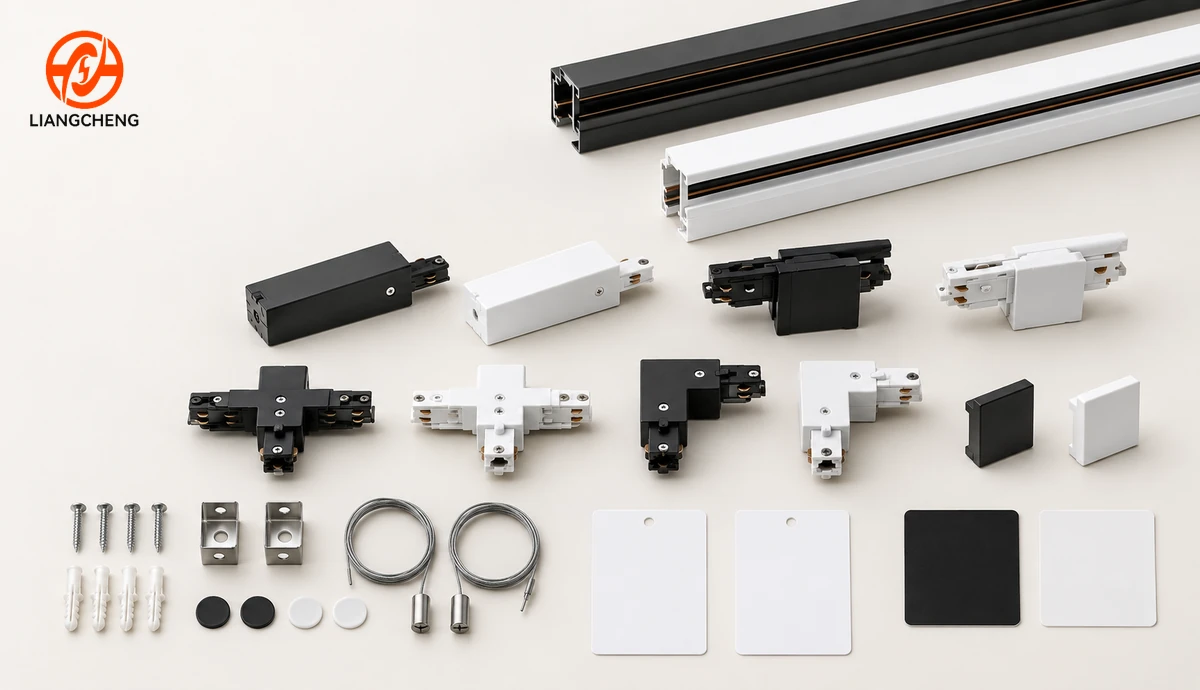
A launch bill of materials should convert each customer layout or starter kit into rails, feeds, connectors, end caps, mounting parts, and compatible luminaires or adapters. A rail-only quotation does not describe an installable system. The bill of materials should identify required items separately from optional extensions and recommended service spares.
Accessory quantities should follow the layout rather than a fixed allowance per meter. A network of short branches can require more connectors and feeds than a long straight run with the same total rail length. The track lighting rail accessories guide helps distributors translate system layouts into a complete accessory schedule.
Starter kits can simplify early sales only when their use case is narrow and explicit. A kit should list every included SKU and state which decisions remain project-specific. A convenient carton should not imply that the same mounting hardware or electrical configuration is appropriate for every ceiling and jurisdiction.
How should product data and sales claims be approved?
Product data should be drawn from the approved specification and verified supplier evidence. Dimensions, finishes, electrical information, mounting methods, compatible components, package contents, and limitations should match across the website, catalog, quotation, and carton. Conflicting information creates both customer risk and internal rework.
Sales claims should be specific enough to verify and narrow enough to defend. A statement about compatibility, load, service life, or certification should identify the exact model and conditions covered by evidence. A generic certificate logo or an unrelated test report should not be expanded into a claim about every customized configuration.
Translation review should check technical meaning, not grammar alone. Terms for wires, circuits, conductors, mounting, and protective connections can be confused across markets. The distributor should use approved terminology and ask a competent specialist to resolve requirements that affect safety or regulatory compliance.
What commercial information must be ready before launch?
The commercial model should calculate margin from the complete sellable scope, not only the rail purchase price. Include accessories, packaging, inbound transport, transaction or channel costs, warranty allowances based on relevant evidence, and variable fulfillment work where applicable. Keep assumptions separate from confirmed costs so the launch team can see where uncertainty remains.
A price list should define the unit, currency, validity, quantity level, tax treatment where applicable, and included delivery scope. A per-meter rail price and a per-piece kit price cannot be compared directly. The wholesale track rail pricing guide provides a structured method for normalizing different quotation scopes.
Discount authority should be established before sales begin. Define which employees can approve project pricing, what minimum contribution requirements apply, and which costs must be recalculated for unusual lengths or packaging. Uncontrolled launch discounts can create demand that looks successful while producing an unsustainable service burden.
How should initial inventory be divided?
Initial inventory should be divided into saleable stock, demonstration stock, replacement stock, and controlled trial stock. These categories serve different purposes and should not be freely exchanged without a record. A display sample may no longer be appropriate for shipment, while service stock must remain available for approved customer support.
Stock depth should reflect demand confidence and replenishment risk for each SKU. Core rails and frequently required accessories may justify broader coverage than low-frequency colors or complex connectors. A high total inventory value does not protect service levels if the mix contains excessive rails and too few components needed to complete customer orders.
Pack multiples, minimum order quantities, and useful lead time should be recorded per SKU. Useful lead time includes production, transport, receiving, and any release inspection required before stock becomes available. A supplier dispatch date is not the same as the date when the distributor can promise material to a customer.

What receiving and warehouse controls should be tested?
Receiving instructions should tell staff how to identify the shipment, check quantities, protect long rails, separate held material, and record visible damage. The first shipment is an opportunity to test whether product codes and packaging work in normal operations. Any confusion should be corrected before replenishment volume increases.
Warehouse locations should reduce mixing between visually similar rails, finishes, adapters, and accessories. Labels should remain readable after outer cartons are opened, and picked quantities should reconcile to the customer order. A photograph of an organized shelf does not prove accuracy; a supervised test order provides stronger evidence.
Packaging instructions should address rail length, surface protection, accessory segregation, and the intended delivery route. Review the long track rail packaging guide when setting the incoming and outbound standard. No packaging method can be assumed suitable for every carrier or destination without relevant evidence.
Which launch materials should sales teams receive?
Sales teams need a concise system overview, controlled SKU list, compatibility map, bill-of-material examples, quotation rules, lead times, limitations, and escalation contacts. Training should teach employees how to identify missing project information, not merely repeat product benefits. A useful salesperson knows when a request requires technical review.
Product samples should demonstrate the approved system rather than a collection of unrelated parts. Include representative rail cutaways, compatible adapters, essential connectors, mounting examples, finish references, and clear product identities. Samples should be updated or withdrawn when a revision changes, because an obsolete demonstration can create an incorrect customer expectation.
Training should include realistic scenarios and a recorded competence check. Ask each participant to build a bill of materials, identify an incompatible combination, explain a lead-time limitation, and route a technical question. Attendance proves presence; scenario performance provides better evidence that the employee can support a customer.
How should installation guidance be controlled?
Installation information should match the exact system, approved mounting method, and destination requirements. It should identify components, preparation limits, assembly sequence, checks, warnings, and the need for qualified installation where applicable. Generic instructions copied from another rail family can create false confidence even when the products look similar.
Distributors should not replace electrical designers, code specialists, or qualified installers with sales literature. The launch pack should state what product information is available and which project decisions remain the responsibility of competent parties. Clear boundaries improve support because technical questions reach the right person earlier.
Support staff should use the same controlled documents as sales and customers. When a recurring question reveals ambiguity, update the source instruction and revision record instead of adding another informal answer. One maintained source is easier to keep accurate than multiple email templates with slightly different guidance.
How should a pilot launch be designed?
A pilot launch should involve a limited number of suitable customers, a bounded SKU set, and explicit learning goals. Select accounts whose applications match the approved system and who can provide usable feedback. A large promotional release creates more exposure but does not necessarily produce clearer evidence.
Pilot metrics should cover order completeness, quotation time, picking errors, shipping damage, installation questions, returns, repeat inquiries, and realized contribution. Revenue alone cannot show whether the system is operationally ready. A high-value first order can conceal missing accessories or excessive support work that would become costly at scale.
Pilot problems should be linked to the responsible layer: specification, product, packaging, sales process, warehouse operation, installation information, or customer use. This classification prevents every issue from being described as a product defect and helps the launch team direct corrective action to the right owner.
Which launch assets need separate ownership and budgets?
Launch assets should have named owners because product stock, demonstration equipment, photography samples, printed materials, website data, training time, and replacement inventory follow different control and budget rules. Combining every cost under marketing can hide operational commitments, while charging every sample to inventory can overstate stock that remains available for sale.
A demonstration system should have a defined purpose, location, responsible employee, approved configuration, and review date. Products used for installation practice, photography, or customer handling may no longer be equivalent to unopened saleable stock. Keep their identities visible so warehouse staff do not ship a display rail simply because its exterior still looks acceptable.
Content assets should identify their product-data source and revision. A catalog image can remain visually useful after a specification changes, but the associated dimensions, compatibility statement, or package contents may become obsolete. Assign an owner to update the website, quotation templates, training files, and downloadable materials together when the approved system changes.
Launch budgets should separate one-time preparation from recurring order economics. Photography, sample boards, initial training, and artwork development may occur once, while packaging, pick-and-pack work, support, and replacement allowances can recur. This separation helps the distributor judge repeat-order contribution without pretending that the first launch required no investment.
The approved sample set should connect physical references with drawings and system records. The track rail sample approval process explains how to preserve those links. A distributor should define when launch samples need replacement, because damaged, outdated, or incomplete examples can teach customers and employees the wrong configuration.
What support and returns process must exist on day one?
A day-one support process should define contact channels, response ownership, information required from the customer, containment steps, and escalation criteria. Request order number, SKU, quantity, lot or carton identity where available, installation context, photographs, and a clear problem description. Collecting consistent evidence accelerates investigation.
Return authorization should distinguish commercial returns, transit damage, picking errors, compatibility mistakes, and suspected product nonconformity. These categories can require different containment and cost treatment. Returned electrical components should not automatically reenter saleable stock without an appropriate condition and identity review.
Replacement stock policy should define which critical components remain available and who may release them. Service recovery can protect a customer project, but an urgent replacement should not erase the original investigation. Keep replacement, credit, supplier recovery, and corrective-action records connected without counting the same cost twice.

What should the go-live decision record contain?
The go-live record should identify the approved SKU scope, supporting evidence, unresolved conditions, responsible approvers, release date, and next review trigger. A conditional approval should state the boundary precisely. For example, an approved standard finish does not automatically release an unreviewed custom color.
A launch blocker should remain noncompensable. Strong marketing materials or attractive pricing should not offset unresolved compatibility, product identity, safety, or required compliance evidence. The decision model should prevent a weighted score from turning a critical unknown into an acceptable average.
The final decision can be launch, limited pilot, hold, or cancel. A hold should identify the evidence required to proceed, while a cancellation should address remaining stock, samples, published content, and customer commitments. Clear outcomes prevent a paused candidate from continuing to sell informally.
How should 30-, 60-, and 90-day reviews differ?
The 30-day review should focus on execution signals: product-data questions, quotation delays, order completeness, picking errors, damage, and installation inquiries. Early review is designed to find process friction quickly, not to declare long-term market success from a small sample.
The 60-day review should examine repeat inquiries, conversion by customer type, accessory attachment, support time, returns, and inventory imbalance. Compare complete-system orders with rail-only inquiries to understand whether the channel understands the offer. Correct training and stock mix before scaling promotion.
The 90-day review should decide which SKUs remain core, move to project-only status, need revision, or exit. Use realized contribution, inventory age, service workload, and verified customer demand. A SKU should not remain in the range only because launch materials have already been printed.
Frequently asked questions about distributor launches
How many SKUs should a new track lighting system launch with?
No universal SKU count fits every distributor. Launch the smallest complete range that serves defined customer layouts, then add extensions when demand and operating evidence justify them. Completeness matters more than raw SKU count.
Should all compatible accessories be stocked from day one?
Not every approved accessory needs equal stock depth. Essential completion parts require dependable availability, while low-frequency layout accessories may use shallower stock or project ordering. The policy must match the customer promise and supplier lead time.
Can marketing start before the pilot order arrives?
Market preparation can begin, but public claims and delivery promises should remain controlled until product, packaging, data, and supply evidence are approved. Early lead collection is different from accepting orders for an undefined or unavailable system.
Ready to launch a track lighting system with Liangcheng Lighting?
Liangcheng Lighting supplies standard track rail systems and matching accessories for distributors, lighting brands, wholesalers, and project contractors. Available customization areas include rail lengths, colors, finishes, branding, packaging, and system accessories, subject to confirmation for the selected product and order.
To prepare a distributor launch, contact Liangcheng Lighting for wholesale or custom track lighting rail support. Share the target market, rail platform, proposed SKU list, compatibility needs, sample plan, packaging requirements, launch quantity, and destination. A precise brief helps both teams build a launch scope that customers can understand, install, expand, and reorder with confidence.
Potrzebują Państwo indywidualnych rozwiązań oświetlenia szynowego?
Skontaktuj się z Liangcheng Lighting w sprawie rozwiązań aluminiowych szyn kontaktowych OEM/ODM oraz profesjonalnego wsparcia oświetleniowego.