







Temps de lecture estimé : 14 minutes
Long track rails need a packaging system that performs two different jobs at the same time. The system must keep every finished surface separated from abrasive contact, and it must turn multiple slender rails into a rigid load that resists bending, twist, end impact, and handling pressure. Protective film alone cannot prevent bending. A strong carton alone cannot prevent scratches when profiles can rub inside it.
The most reliable approach uses several coordinated layers: clean individual protection, profile separators, reinforced ends, distributed internal supports, a rigid pallet or skid, controlled strapping, and secure container blocking. The design should be verified with the actual rail length, section, quantity, finish, accessories, route, and handling method. This guide explains how distributors, importers, project suppliers, and lighting brands can specify and inspect that system before a wholesale shipment leaves the factory. For the wider sourcing context, see the Guide de rails de voie ferrée en aluminium en gros.
Why are long track rails difficult to ship?
A track lighting rail is long compared with its cross-section. That geometry makes a rail efficient for installation but vulnerable during logistics. A worker can lift one end while the center remains unsupported. A forklift can place a narrow point load under a carton. A long bundle can bridge between widely separated pallet blocks. Stacked cargo can press on the center of a weak carton. Each event creates bending stress even when the aluminum itself meets the product specification.
Surface damage follows a different mechanism. Anodized or powder-coated rails can rub against adjacent profiles, loose accessories, staples, grit, or damaged packaging. Vibration during transport can turn a small contact point into a visible wear line. The aluminum versus steel track rail guide explains material differences, but either material still needs a packaging design matched to its finish and geometry.
Ends are especially vulnerable. A direct impact can deform a cut face, conductor channel, plastic insert, or mounting feature. Even a small distortion can make a joiner, feed, end cap, or adapter difficult to install. Packaging must therefore protect appearance, straightness, and system interfaces rather than only preventing the product from falling out of the carton.
What should a complete packaging system include?
| Packaging layer | Main purpose | Common failure if omitted |
|---|---|---|
| Individual sleeve or protective film | Separates the finish from dust and rubbing | Scuffs, gloss marks, color transfer, or adhesive residue |
| Profile separators | Prevents rail-to-rail contact and controls position | Vibration wear and local pressure marks |
| End pads or end blocks | Absorbs impact and protects cut faces and conductors | Crushed ends, displaced inserts, or bent channels |
| Internal supports | Limits movement and transfers load through the bundle | Mid-span sag, twist, and shifting |
| Reinforced carton or case | Contains the bundle and spreads external pressure | Puncture, collapse, and concentrated loading |
| Rigid pallet or skid | Provides a straight handling base and forklift access | Unsupported overhang and fork damage |
| Straps with edge protection | Holds the load together without cutting the carton | Loose cargo or excessive local compression |
| Blocking and bracing | Stops motion inside the vehicle or container | Sliding, racking, and impact against other cargo |
These layers must work as one load path. An internal block is useful only when it transfers force to a suitable carton wall or base. A strap is useful only when its force is distributed. A rigid pallet is useful only when the carton is supported along the required length and does not overhang a weak edge.
What information is needed before packaging is designed?
Start with the actual product rather than a generic long carton. Record the rail family, section drawing, material, wall thickness, length, mass per piece, finish, conductor arrangement, plastic inserts, cut-end condition, and any fitted component. The Guide des dimensions des rails d'éclairage sur rail shows why length and cross-section must be controlled together.
Next define the commercial unit. State pieces per inner bundle, bundles per carton, cartons per pallet, maximum gross mass, label structure, and whether the buyer needs retail, distributor, project-zone, or private-label packing. A project order may need separate cartons by floor or installation area. A distributor may prefer repeatable stock cartons that support warehouse picking.
Finally define the route. Packaging for a domestic full-truck movement can differ from a mixed international journey involving factory handling, container loading, sea vibration, port transfers, customs inspection, warehouse stacking, local delivery, and site handling. The design should reflect the actual number of transfers and the equipment likely to touch the load.
How should each rail be protected from scratches?
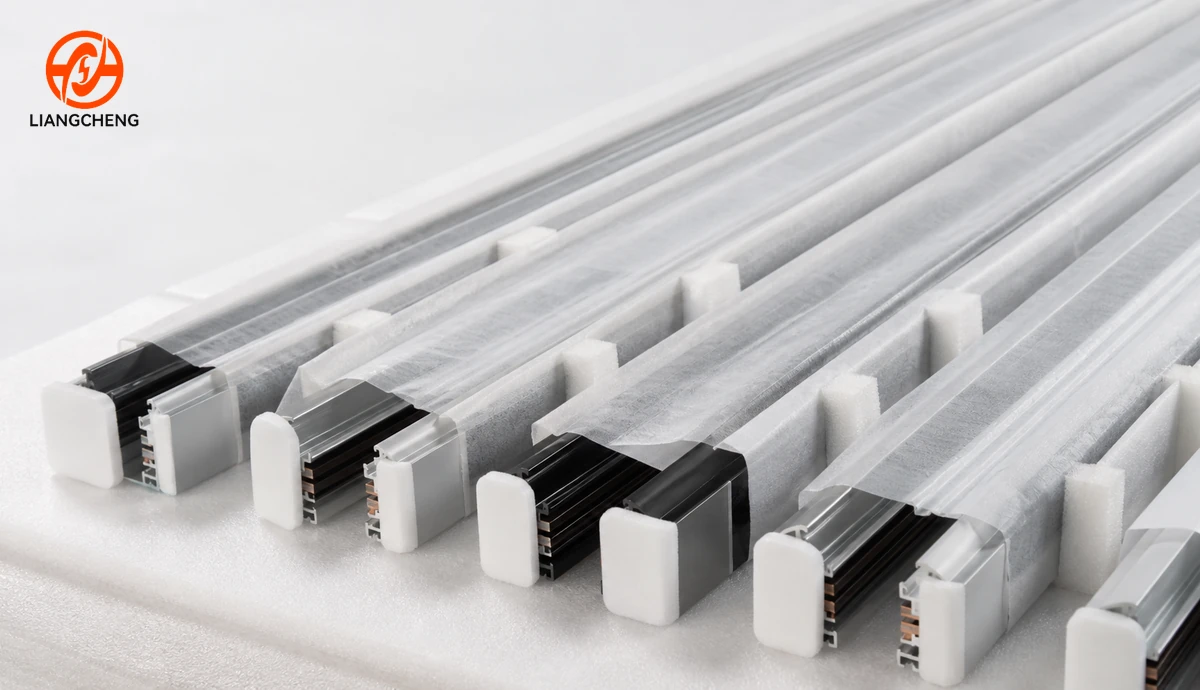
The first rule is to stop finished surfaces from touching. Each rail should have a clean individual barrier appropriate to the finish. Options include a non-abrasive sleeve, soft wrap, protective film, or a combination. The selected material must not shed particles, trap hard debris, stain the coating, or leave unacceptable adhesive residue after the expected storage and transport period.
Protective film should be applied to the surface it is designed to cover, without creases that create pressure ridges. A film intended for flat sheet may not remain secure around a narrow track profile. Test adhesion after temperature changes and storage. Too little adhesion allows the film to move and expose the finish. Excessive adhesion can make removal difficult or leave residue.
Separators are still needed after wrapping. Use soft, clean, dimensionally stable material at locations that prevent direct contact and keep profiles aligned. Separator material should not compress until metal parts meet. Its spacing should be based on rail stiffness, bundle mass, and the support pattern rather than on a fixed generic interval.
How should cut ends and conductor channels be protected?
Long rails often receive impact through the carton ends when a package is placed on the floor, pushed against a stop, or contacted by another load. A soft wrap around the rail body does not provide enough end protection. Use shaped pads, caps, or blocks that keep the rail end away from the outer carton and distribute impact across a broader area.
The protector should support a structurally suitable part of the profile without pressing directly on delicate conductors, plastic insulators, narrow flanges, or decorative edges. It should also keep adjacent rail ends from striking each other. Where rails have fitted end caps, confirm whether those components can carry transport loads or whether a separate sacrificial protector is required.
End reinforcement needs space for normal tolerance. A cavity that is too tight can force rails into the block and transmit shock directly to the product. A cavity that is too loose allows repeated impacts. The approved packaging sample should show the intended fit, material, thickness, and orientation.
How can a bundle resist bending?
Bending control begins by turning individual rails into a stable, straight bundle. Align the rails in a consistent orientation, fill planned voids, and use internal supports that maintain geometry without crushing the profile. When different sections or colors share one shipment, avoid mixing them inside one unsupported cavity unless the insert is specifically designed for the combination.
The bundle should be supported at enough points to prevent harmful sag under its own mass and expected external loads. Support locations should transfer force to the skid or structural base. A block placed under a thin carton panel can simply punch through the board. A support placed only at both ends can leave the center vulnerable. A random block pattern can introduce local bends instead of preventing them.
Rail orientation also matters. Some cross-sections are stiffer in one direction than another. The packaging engineer should compare the section geometry with expected vertical and lateral loads. The bundle may need restraint in both axes because a carton can be rotated during handling. The approved drawing should define orientation so workers do not improvise.
What makes a long carton structurally effective?
A long corrugated carton provides containment and surface protection, but its strength depends on board grade, flute direction, joint design, moisture condition, unsupported span, closures, and internal structure. Increasing board thickness alone does not guarantee that a long package remains straight. The carton must work with inserts and a rigid base.
Reinforce the ends, corners, and known handling zones. Prevent staples or sharp fasteners from entering the product cavity. If a carton has hand holes, verify that lifting through them does not bend the package or expose rails. Long packages often require team lifting or mechanical handling; the handling method should be indicated by the packaging design and operating procedure.
Wooden cases, composite panels, honeycomb structures, or reinforced skids may be appropriate for heavy, high-value, extra-long, or multi-transfer shipments. The correct choice depends on load and route. Avoid assuming that the most rigid material is automatically best. Added mass, customs requirements, moisture, disposal, warehouse equipment, and unpacking safety also affect the decision.
How should strapping be applied without deforming rails?
Straps keep the packaging system together, but excessive tension can crush the carton, compress inserts, mark finishes, or distort a slender profile. Too little tension allows the load to loosen as cushioning settles. The packaging process needs a defined strap material, width, location, tension range, tool, and inspection method.
Use corner boards or load spreaders under straps. Do not place a narrow strap directly above an unsupported rail feature. Align strap locations with internal blocks or structural pallet members where practical, so the force travels through the designed load path. Keep buckles and seals away from finished surfaces and handling contact zones.
Inspect the bundle after strapping. Check carton indentation, rail alignment, insert compression, and whether any profile can move. If the bundle becomes straighter only after very high strap force, the base or internal support system needs improvement. Straps should secure a stable package, not force an unstable package into shape.
How should a pallet or skid support long rails?
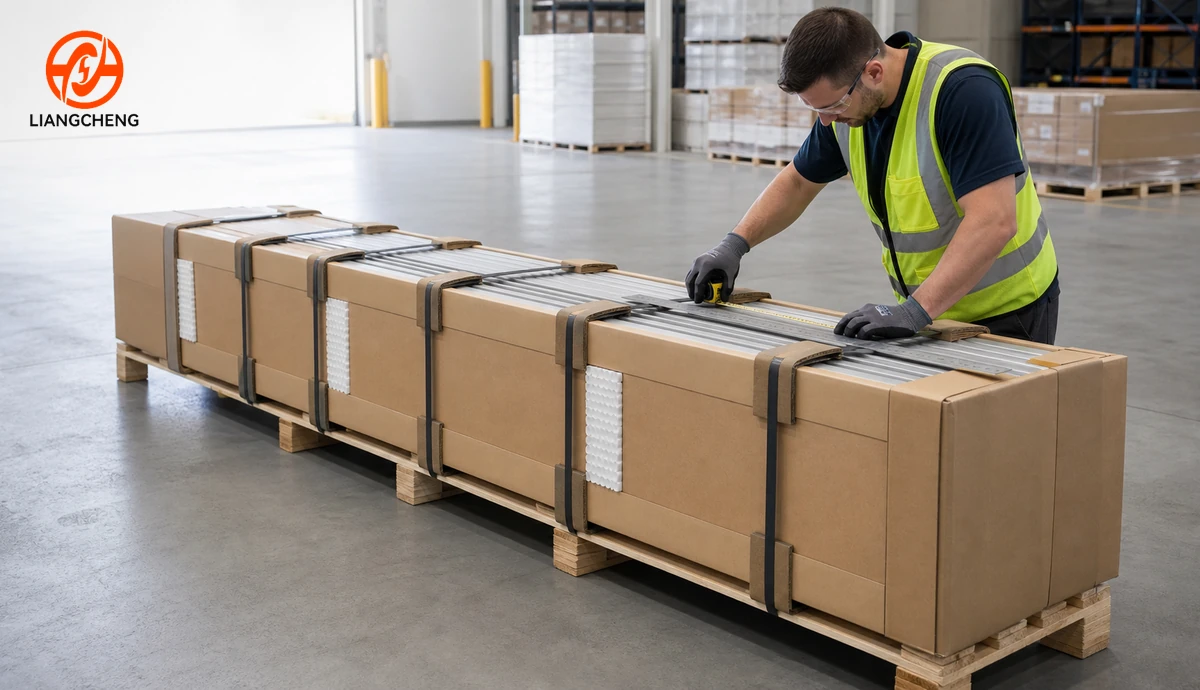
The skid should be straight, dry, undamaged, and long enough for the package design. Avoid unsupported carton overhang unless the packaging has been engineered for it. Deck boards and bearers should distribute weight and create clear forklift entry. Fork openings must match the handling equipment and keep forks away from the rail cavity.
Mark or physically define safe fork-entry zones where practical. A long closed carton can hide the product position, so an operator may insert forks into a weak side or lift with the tips under only part of the load. Protective base boards and fork guards can reduce that risk. The package should remain stable when lifted at the intended points.
Stacking requires a separate check. Upper loads should transfer through structural corners, posts, or aligned supports rather than through the middle of a rail bundle. Do not publish a stacking limit until the complete package has been evaluated with its actual gross mass and storage conditions.
How should long rail cartons be secured in a container?
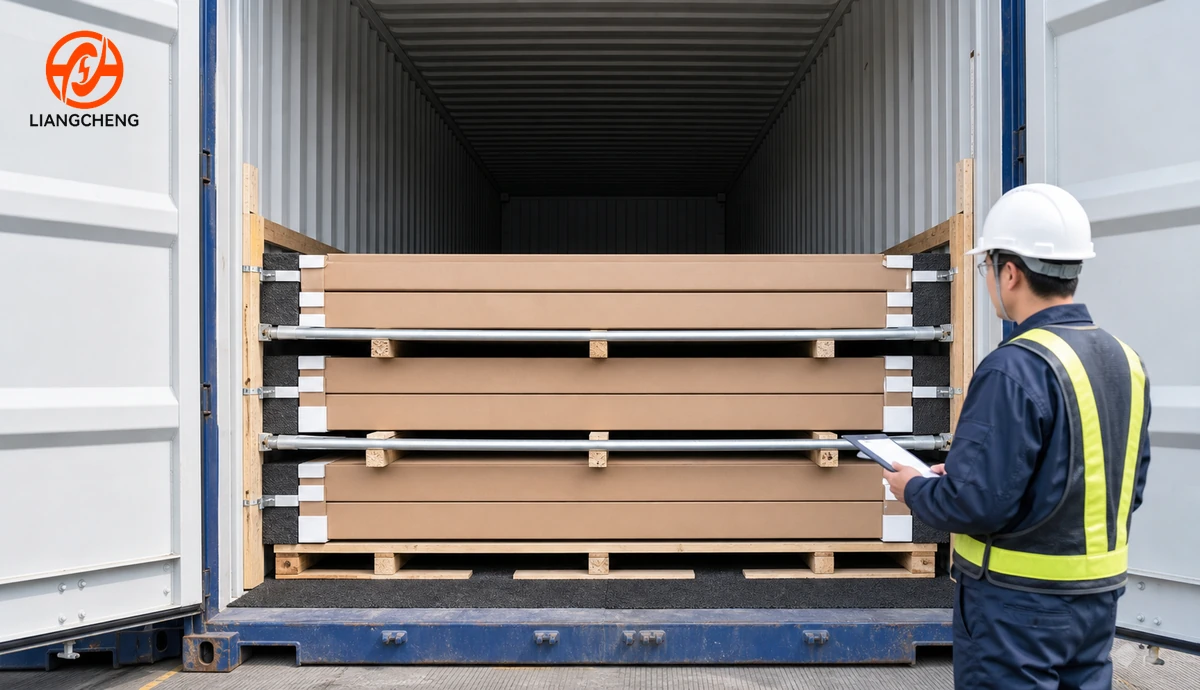
A well-designed carton can still fail if it slides inside a container. Long packages must be blocked against forward, rearward, and sideways motion according to the transport plan. Use suitable dunnage, anti-slip material, bracing, load bars, or tiedown arrangements selected by qualified logistics personnel. Fill harmful voids without creating a point load against the carton center.
Load packages straight and level on aligned supports. Do not create an accidental bridge between pallets of different height. Do not allow another cargo unit, loose timber, or metal edge to press against an unsupported section. Keep heavy cargo from loading directly onto long rail cartons unless the packaging and stack arrangement are designed for it.
Container condition matters. Inspect the floor, walls, roof, doors, protrusions, water entry, residue, and odor before loading. Photograph the empty container, placement sequence, blocking, final load, and seal. These records support traceability and help distinguish a product defect from transport damage.
How should moisture and storage exposure be managed?
Moisture can soften corrugated packaging, reduce stacking strength, affect labels, and create condensation on metal or electrical components. Packaging materials should be dry before use. Finished rails should enter the package clean and at a stable condition. Avoid sealing visibly wet or cold products in a way that traps condensation.
Barrier bags, desiccants, ventilation, or moisture indicators may be useful for particular routes, but they require a defined design. Desiccant placed in an open carton cannot control an unlimited volume of humid air. A sealed barrier without suitable preparation can trap existing moisture. Select the approach based on route, climate, storage duration, and product sensitivity.
Warehouses should keep long cartons off wet floors and away from uncontrolled outdoor exposure. Store them on the intended supports. Leaning a long package against a wall can create a permanent curve or a fall hazard even when transport packaging was adequate.
Should accessories be packed with the rails?
Feeds, joiners, end caps, adapters, screws, and directional connectors can be packed in the same shipment, but loose parts should never move inside the rail cavity. Use labeled inner cartons, trays, or bags secured in a defined compartment. Protect metal hardware from rubbing against rail surfaces or entering conductor channels.
Keep accessory identity, color, orientation, quantity, and rail family visible. The track rail accessories system guide explains how a coordinated bill of materials supports quotation, packing, and installation. A good package lets the receiving team verify accessories without unpacking and exposing every rail.
For project orders, pack by installation zone when requested. For distributor stock, use consistent part codes and carton quantities. Never hide a heavy accessory carton at the unsupported center of a long rail bundle. Its mass can create a local bend during vibration or lifting.
How can a packaging design be validated?
Begin with a documented packing trial using production rails, normal workers, actual materials, and the planned quantity. Measure rail straightness and inspect finish before packing. Record the arrangement, support locations, strap settings, gross mass, dimensions, and closure method. Unpack and reinspect after the trial.
A risk-based validation can include handling lifts, controlled impacts, vibration, compression, stacking, and climate exposure that represent the expected distribution environment. Long packages may need special fixtures and safe procedures. The test plan should define orientations, severity, pass criteria, rail measurements, surface inspection lighting, and the condition of packaging after each stage.
Do not declare success only because the carton remains closed. Inspect every critical product characteristic after testing: overall straightness, twist, cross-section, cut ends, conductors, inserts, finish, color, fitted parts, and accessory condition. Compare results with approved product specifications and a pre-test record.
What should pre-shipment packaging inspection cover?
Pre-shipment inspection should use a checklist tied to the approved packaging specification. Verify rail identity, length, finish, pieces per bundle, individual sleeves, separator placement, end blocks, carton construction, internal supports, pallet dimensions, strap locations, labels, gross mass, and loading plan. Photograph the first completed package before releasing the full packing run.
Sample finished bundles from different points in the packing run. Check that the carton is straight, closures are complete, straps are not cutting into the board, supports have not shifted, and no rail moves when the package is handled according to the method. The broader track rail importing guide places packaging inspection within the full sourcing process; this article focuses on the package itself.
Record any deviation and obtain disposition before loading. An extra layer of tape does not correct a missing internal support. Repacking is usually less expensive than accepting a known weakness and managing damaged inventory after arrival.
How should buyers inspect rails after delivery?
Inspect the load before moving it from the vehicle or container. Photograph shifted cargo, crushed corners, water marks, broken straps, punctures, and unsupported overhang. Preserve the relationship between damaged packaging and the affected carton. Opening everything immediately can destroy useful evidence.
Move cartons using the defined lifting points, then open selected packages carefully. Compare rail straightness, ends, finish, conductors, and quantities with the approved sample and specification. Record damage location along the rail and inside the carton. Repeated damage at the same support or strap position indicates a packaging design issue rather than random handling.
Keep packaging samples, labels, shipment records, and photos until the receiving decision is complete. A clear evidence set helps the supplier identify whether the cause was product handling, internal packing, pallet support, container securing, or destination handling.
What should a buyer put in the packaging specification?
- Rail family, cross-section, length, finish, and quantity per package.
- Required individual sleeve or film, including removal and residue expectations.
- Separator material, shape, placement, and minimum condition.
- End-protection design and clearance from delicate features.
- Bundle orientation, internal support layout, and void-control method.
- Carton or case construction, closures, reinforcement, and gross-mass limit.
- Pallet or skid size, fork-entry zones, overhang rule, and stacking rule.
- Strap type, locations, edge protectors, and controlled application method.
- Accessory segregation, labels, traceability, and project-zone requirements.
- Container loading, blocking, bracing, moisture, photo, and seal records.
- Validation method, inspection plan, acceptance criteria, and change control.
Packaging should be included when evaluating a custom product, not added after production. The custom track rail solutions guide explains how length, finish, branding, and packaging can be coordinated during OEM and ODM development. Buyers planning a commercial range can also use the commercial track rail buyer guide to connect packaging choices with the system and project application.
Foire aux questions
Is protective film enough to stop scratches?
No. Protective film covers a surface, but wrapped rails can still rub, trap debris, or receive pressure marks. Use clean separators and control movement inside the bundle.
Can long track rails be shipped without a pallet?
Some light or short packages may use another validated handling system, but long wholesale bundles usually benefit from a rigid skid or pallet. The base must match the package length, mass, route, and handling equipment.
How many supports should a long rail carton have?
There is no universal number. Support quantity and spacing depend on rail section stiffness, length, bundle mass, carton structure, stack load, and handling. Validate the actual configuration.
Should straps be as tight as possible?
No. Straps need enough tension to secure the load without crushing cartons, inserts, or rails. Use a controlled setting and place straps over structural supports with edge protectors.
What is the first sign of an inadequate package?
Warning signs include carton sag, unsupported overhang, loose movement, strap indentation, shifted end blocks, rail contact, crushed ends, punctures, and repeated marks at the same location.
Plan wholesale and custom track rail packaging with Liangcheng Lighting
Liangcheng Lighting supplies track lighting rail systems for wholesale, distributor, lighting-brand, OEM, ODM, and commercial project requirements. Buyers can discuss custom rail lengths, colors, surface finishes, compatible accessories, branding, carton markings, bundle quantities, and project-specific delivery formats.
For an efficient B2B quotation, send the target rail family, cross-section or drawing, length, finish, order quantity, destination, transport mode, warehouse limits, accessory list, label requirements, and any previous damage photos. The track rail selection guide can help organize the product requirements before packaging is finalized.
Contact Liangcheng Lighting through the website to develop a wholesale or custom track rail proposal with packaging matched to the product and route. An approved package sample and clear acceptance record can reduce bending, scratches, claims, repacking, and installation delays when long rails move from the factory to the final market.
Besoin de solutions d'éclairage sur rail personnalisées ?
Contactez Liangcheng Lighting pour des solutions professionnelles de rails d'éclairage en aluminium en tant que fabricant d'équipement d'origine (OEM) ou fabricant d'équipement d'origine (ODM) et pour un support d'éclairage professionnel.