







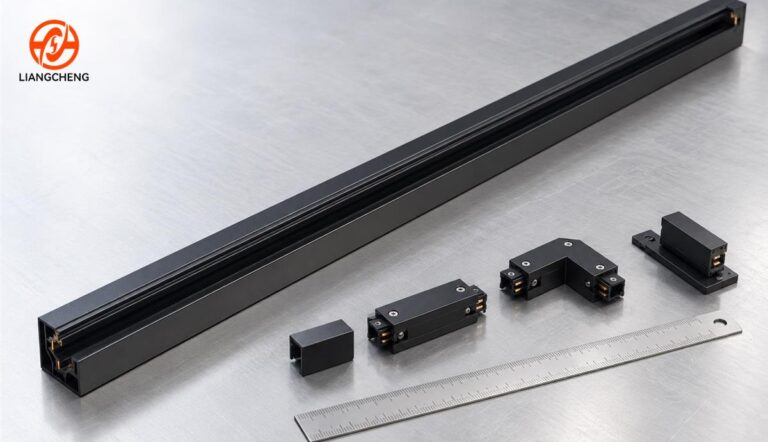

A 3-wire track rail should be purchased as a complete, documented lighting system rather than as an aluminum profile sold by the meter. A reliable order defines the conductor functions, rail cross-section, matching adapter, feed and connector family, mounting method, electrical ratings, finish, sample acceptance criteria, packaging, and change-control rules. The best buying decision is the system that fits the intended project and can be reproduced consistently, not simply the rail with the lowest unit price.
This 3-wire track rail ultimate buying guide is written for importers, distributors, lighting brands, contractors, and project buyers who need to convert a product inquiry into a controlled bulk order. The guide focuses on procurement decisions, approval evidence, and repeat-order reliability. Readers who first need a technical definition can start with the complete explanation of how a 3-wire track rail works.
What must a buyer confirm before requesting a quotation?
A buyer must first confirm that the requested product is a conventional 3-wire single-circuit track rail, not a three-circuit rail, a low-voltage magnetic rail, or a control track with additional signal conductors. In a common 3-wire arrangement, the conductive paths serve line, neutral, and protective earth, but the exact terminal schedule and grounding method for the selected product family must control the order.
The terms "3-wire," "3-circuit," and "3-phase track" are frequently confused in quotations. Three wires usually describe three conductive paths, while three circuits describe three independently selectable lighting groups and normally require a different conductor arrangement and adapter. A buyer who actually needs separate scenes should review single-circuit versus multi-circuit track lighting before selecting a rail.
A useful quotation request states the application, installation country, supply voltage and frequency, control method, mounting style, rail color, required lengths, layout shape, fixture family, estimated fixture quantity, expected load, target standards, packaging needs, and order volume. The quotation becomes more comparable when each supplier receives the same drawings, photographs, fixture data, and required evidence.
When is a 3-wire track rail the right system?
A conventional 3-wire track rail is a sensible choice when the project needs movable line-voltage track lights on one coordinated switching or dimming group and the system design includes a documented protective-earth path. Typical applications include small and medium retail stores, display walls, galleries with simple control, showrooms, hospitality spaces, offices, and residential areas where fixtures may be repositioned as layouts change.
A 3-wire rail is not the right default when a project needs several independently controlled groups on one physical rail, individually addressable luminaires, a very slim low-voltage magnetic appearance, or a proprietary control ecosystem. In those cases, a multi-circuit or control-based system may solve the actual requirement more directly. Adding wire count without defining the control task can increase cost while leaving the project need unresolved.
A 3-wire rail should also not be selected only because an existing track head appears to have three contacts. Similar contact counts do not prove that the profile, contact positions, polarity, grounding interface, insertion direction, mechanical keying, or lock geometry are compatible. Existing-system replacement requires end-profile photographs, dimensions, adapter photographs, markings, and preferably a physical sample.

Which specifications make two quotations comparable?
A quotation should separate the rail specification from the complete system schedule. The rail specification describes the extrusion, conductors, insulation, dimensions, finish, ratings, and mounting. The system schedule adds adapters, feeds, connectors, end caps, suspension or mounting parts, compatible luminaires, spares, and packaging. A low rail price can hide missing system components, so both documents are necessary.
| Specification area | What the buyer should request | Pourquoi c'est important |
|---|---|---|
| architecture électrique | Terminal schedule, conductor functions, polarity, grounding method, voltage, current, frequency, and control limits | Prevents confusion between wire count, circuit count, and control capability |
| Mechanical interface | Dimensioned cross-section, contact positions, keying, insertion direction, adapter model, and locking method | Determines whether fixtures and accessories fit and make reliable contact |
| Rail construction | Profile material, nominal dimensions, tolerances, conductor material and form, insulator material, and straightness criteria | Controls rigidity, contact consistency, installation, and repeat ordering |
| Terminer | Color reference, gloss or texture, coating process, sample standard, and acceptable variation | Prevents visible mismatch across rails, connectors, and repeat shipments |
| Mounting | Surface, recessed, or suspended method; fixing points; support spacing; ceiling constraints; and allowable loads | Connects the product to the actual ceiling and installation method |
| Accessoires | Feed orientation, straight joiners, L/T/X connectors, flexible connectors, end caps, covers, clips, suspension parts, and spares | Turns straight rail lengths into a complete working layout |
| Evidence | Applicable declarations, test reports, drawings, instructions, labels, traceability, and sample records | Allows technical review against the destination market and project |
| Commercial terms | MOQ, price basis, tooling, sample cost, lead time, carton data, loading plan, warranty process, and change notification | Reveals total delivered risk rather than unit price alone |
The three-wire label does not replace a drawing. A dimensioned cross-section should show the outer profile, opening, internal ribs, insulator positions, conductor locations, and critical interface dimensions. The buyer should mark which dimensions require production tolerances and which are reference dimensions. The Guide des dimensions des rails d'éclairage sur rail explains how lengths, cross-sections, cutouts, clearances, connectors, and tolerances should be measured.
How should adapter compatibility be approved?
Adapter compatibility must be approved as an electrical, mechanical, and functional interface. A successful insertion proves only that one sample entered one rail. Approval must also confirm that the adapter contacts land on the intended conductors, protective earth engages as designed, polarity is correct, the lock retains the fixture, the adapter can be removed without damage, and normal production variation does not create intermittent contact.
The safest procurement method treats the rail and adapter as a controlled pair. The purchase file should include rail and adapter model numbers, cross-section drawings, contact layouts, insertion orientation, lock operation, fixture load limits, ratings, approved samples, and written compatibility confirmation. The track light adapter compatibility checklist provides a focused approval method for B2B buyers.
A buyer who intends to use multiple fixture styles should approve every adapter variant, even when the fixture bodies share a similar appearance. Cylindrical spotlights, pendants, wall-wash lights, and linear luminaires may use different adapter housings or load conditions. The guide to track lights that can use 3-wire rails explains why fixture format and interface approval are separate decisions.

What belongs in a complete bill of materials?
A complete bill of materials starts with a scaled ceiling layout rather than a total number of rail meters. The drawing should show each straight run, feed position, joint, turn, branch, end, mounting point, luminaire position, ceiling condition, and access limitation. The rail schedule can then assign part numbers, lengths, quantities, finishes, and orientation to every position.
A basic straight run commonly needs rail sections, one compatible power feed, electrical joiners where sections continue, mechanical support where required, end caps, mounting hardware, adapters or fixtures, and installation instructions. A shaped layout may also require left- or right-oriented L connectors, T connectors, X connectors, flexible joiners, or separate feeds. Connector orientation must be checked against polarity and the actual plan.
Accessories should be purchased from the approved system family because a connector that looks similar can differ in conductor position, body width, keying, feed orientation, or current path. The complete track rail accessories guide explains how feeds, joiners, turns, branches, end caps, adapters, and mounting parts work together.
A spare-parts plan should reflect project risk rather than an arbitrary percentage. Long projects may need spare feeds, connectors, end caps, adapters, finish-matched rail, and packaging for site replacement. A distributor usually needs broader spare coverage because future customers may require one missing part long after the original shipment has sold.
How should the rail construction be evaluated?
The aluminum profile should be evaluated for dimensions, wall distribution, rigidity, straightness, cut quality, burr control, and finish consistency. Heavier construction can improve stiffness, but weight alone does not prove better interface control. A well-designed profile must keep the insulators and conductors in stable positions while remaining practical to cut, mount, connect, package, and install.
The conductor system should be evaluated for material, cross-section, placement, exposed contact surface, retention, and consistency along the full rail. A conductor that is locally misaligned can produce poor adapter contact even when its bulk material is acceptable. Buyers should therefore combine material documentation with dimensional inspection and repeated fit testing.
The insulating carriers should be checked for positioning, secure retention, surface condition, heat-related behavior, and resistance to damage during cutting and installation. The insulator is not merely a separator; it maintains the spacing that lets the adapter reach the correct conductor while preventing unwanted contact with the aluminum body.
The protective-earth arrangement deserves its own verification. The order should state how earth continuity is achieved through the rail, connectors, feeds, and fixture adapter, and how continuity is checked after assembly. Electrical design and installation must follow the applicable rules in the destination market and should be completed or reviewed by qualified professionals.
What should the finish specification include?
A finish specification should identify color, texture, gloss, coating process, approved reference sample, viewing conditions, and acceptable variation. Terms such as "black" or "white" are too broad for projects in which rails, feeds, joiners, end caps, and adapters are visible together. The same nominal color can look different when gloss or surface texture changes.
Finish inspection should compare parts under consistent lighting and at normal viewing distance, then examine close-range defects separately. Buyers should define how scratches, chips, exposed metal, dirt, color difference, hook marks, and cut-end appearance will be judged. Packaging must protect the finish standard that production achieves, or the inspection effort is wasted during transport.
Which evidence should be reviewed before sample approval?
The evidence package should include the current product drawing, terminal schedule, ratings, bill of materials, installation instructions, packaging specification, quality plan, and applicable compliance documents. The buyer should confirm that reports and declarations identify the relevant model or family, destination market, standard, issuer, date, and scope. A certificate name alone does not show that every ordered variation is covered.
Product markings and labels should match the approved technical and commercial files. Model names, ratings, batch or date identification, carton labels, color codes, lengths, quantities, and handling marks should remain consistent across product, inner package, master carton, packing list, and purchase order. Clear identification reduces warehouse errors and makes later complaint analysis possible.
A supplier audit can confirm whether drawings, incoming materials, conductor insertion, extrusion, cutting, finishing, assembly, testing, packing, nonconformance handling, and change control operate as one system. Buyers planning a large or repeat program can use the track rail factory audit guide to connect factory evidence with purchasing risk.
What should a sample approval plan prove?
A sample approval plan should prove identity, compatibility, assembly, appearance, electrical function, installation practicality, and packaging before the bulk order begins. The sample set should represent the actual rail finish, length or representative section, conductors, insulators, feed, connectors, end cap, mounting parts, adapter, and at least one intended fixture configuration.
The test matrix should include repeated insertion and removal, adapter lock engagement, contact stability, polarity, earth continuity, connector fit, feed orientation, rail joining, end-cap fit, mounting, straightness, finish comparison, and a trial package. If several colors, lengths, connector orientations, or adapters are being ordered, the matrix should state which variants need physical samples and which can be released by documented equivalence.
The approved sample should be linked to signed drawings, photographs, measured results, and a revision identifier. A loose sample without a dated specification can become ambiguous when the supplier or buyer later changes a detail. The track rail sample approval process explains how to move from drawing review through pilot production and final release.
How should bulk production be inspected?
Bulk inspection should verify that production matches the approved sample and current specification. Incoming or pre-shipment checks can cover model, quantity, length, cross-section, straightness, cut ends, conductor and insulator position, finish, accessory identity, connector fit, adapter operation, continuity, markings, packaging, and carton condition. The inspection plan should define sampling, tools, methods, limits, and disposition for failed lots.
Functional testing should use approved components rather than improvised substitutes. A rail that passes dimensional inspection can still fail if the actual adapter has unstable contact or the connector does not maintain the intended electrical path. Sample selection should cover different cartons, production times, and positions within the shipment rather than only easily accessible top pieces.
Inspectors should record measured results, defect photographs, carton numbers, lot identification, and the exact revision used for comparison. The guide to judging lighting track rail quality before buying helps buyers convert broad expectations into observable acceptance points.

How should long track rails be packaged?
Long rails require packaging that controls bending, twisting, end impact, abrasion, moisture exposure, and carton movement. Protective film can reduce surface abrasion, but it does not replace end protection, separators, sleeves, rigid support, suitable carton strength, and controlled bundle weight. Accessories should be packed and labeled so that small parts do not strike finished rail surfaces.
The packaging specification should define rail orientation, separators, end protection, bundle quantity, inner sleeve, carton dimensions, reinforcement, pallet or crate method, maximum weight, labels, and loading plan. A trial pack should be inspected before bulk packing, especially when custom lengths or mixed accessories change weight distribution. The guide to packaging long track rails against bending and scratches covers these controls in detail.
How should buyers compare the true wholesale cost?
The true cost of a 3-wire track rail order includes rail, required accessories, fixtures or adapters, samples, testing, custom finish, packaging, inland transport, freight, duties, inspection, installation waste, spares, and the cost of incompatible or damaged material. Comparing only price per meter favors incomplete quotations and hides the cost of making the system usable.
A useful comparison calculates cost per complete installed run or cost per store package. The buyer should normalize rail lengths, accessory counts, finish, packaging, Incoterms, currency, lead time, documentation, warranty process, and replacement support. The wholesale track rail pricing guide explains how material, construction, customization, order quantity, packaging, and commercial terms influence price.
Usable yield belongs in the cost model because bent rails, scratched finishes, missing connectors, or incompatible adapters create replacement freight and site delay. A slightly higher initial quotation can be economically stronger when the supplier delivers a complete, protected, traceable system with fewer installation surprises.
What should distributors require for repeat orders?
A distributor should create a controlled product master that includes approved drawings, photographs, samples, color references, part numbers, packaging, labels, carton quantities, test records, and revision history. Sales descriptions can be simplified for customers, but the internal master must preserve the technical details that make the product repeatable.
Change control should require notice before the supplier alters the extrusion, conductor, insulator, coating, finish, adapter source, connector geometry, production route, packaging, markings, or key tolerances. The buyer can then decide whether documentation review, a new sample, or a pilot order is necessary. Silent changes are especially risky because an interface may look unchanged while contact or fit shifts.
Private-label programs should connect brand packaging to the same technical revision system. Custom cartons and labels add value only when the product inside remains traceable to the approved configuration. Distributors developing a broader range can review how to build a private-label track lighting rail product line without creating uncontrolled SKU complexity.
What information belongs in the final RFQ?
The final RFQ should include the application, destination market, project or distribution purpose, rail model or required interface, conductor functions, supply conditions, control method, profile drawing, dimensions and tolerances, finish, lengths, quantities, mounting style, accessories, adapters, fixtures, evidence requirements, sample plan, inspection criteria, packaging, branding, delivery terms, and requested quotation validity.
The RFQ should also state which items are mandatory, which are supplier proposals, and which remain open for technical discussion. Clear priorities let the supplier identify conflicts early instead of silently substituting a familiar product. The track rail RFQ information guide provides a structured checklist for preparing a comparable request.
Final 3-wire track rail buying checklist
- Confirm that the project needs a conventional 3-wire single-circuit system.
- Document the function of every conductor and the protective-earth method.
- Approve one rail, adapter, feed, connector, and fixture family as a coordinated system.
- Use dimensioned drawings and controlled tolerances instead of names or photographs alone.
- Convert the ceiling layout into a complete bill of materials with connector orientation.
- Review applicable ratings, instructions, declarations, reports, labels, and traceability.
- Test representative samples for fit, lock, contact, continuity, finish, mounting, and packaging.
- Link the approved sample to a dated drawing and specification revision.
- Inspect bulk production against the approved reference and record lot evidence.
- Compare complete delivered cost and usable yield rather than rail price per meter.
- Require written change notification for every critical interface and material.
- Keep spare parts and repeat-order records appropriate to the project or distribution model.
Foire aux questions
Does 3-wire track rail mean three lighting circuits?
No. A conventional 3-wire track rail commonly supports one lighting circuit with three documented conductive paths, often line, neutral, and protective earth. A three-circuit system is a different architecture intended to provide three selectable lighting groups. The supplier's terminal schedule and system drawing must settle the definition.
Un projecteur sur rail à 3 fils peut-il s'adapter à n'importe quel rail à 3 fils ?
No. The same wire count does not guarantee matching profile geometry, contact positions, polarity, keying, grounding, insertion direction, ratings, or locking. Buyers should approve the exact rail and adapter pair using drawings, samples, and functional tests.
Is 3-wire track rail better than 2-wire track rail?
Neither wire count is universally better. A 3-wire system can provide a documented internal protective-earth path, while a 2-wire system may suit a different product design or installation context. The correct choice depends on the wiring arrangement, fixture class, applicable rules, project requirements, and complete system evidence. A direct 2-wire versus 3-wire track rail comparison helps buyers evaluate the difference.
Can 3-wire track rail be cut on site?
Many track rails can be cut when the manufacturer's instructions permit it, but the cut must not damage or short conductors, distort insulators, create burrs, or prevent the end cap and connector from fitting. The installer should follow the approved cutting, deburring, cleaning, reassembly, and test procedure for the exact system.
What is the safest way to match an existing rail?
The safest matching package includes power-isolated end-profile photographs, measured dimensions, contact locations, feed and connector photographs, adapter details, product markings, installation country, and a physical sample when possible. An electrician or qualified technician should isolate and inspect the existing system before measurements are taken.
What should a buyer send for a custom wholesale quotation?
A buyer should send the profile or compatibility requirement, conductor functions, lengths, finish, layout, mounting style, adapters, feeds, connectors, fixture information, destination market, required evidence, packaging, branding, quantity, and delivery terms. Better input produces a more accurate quotation and reduces revision cycles before sampling.
Build a controlled 3-wire track rail supply program
Liangcheng Lighting supplies wholesale and customized track lighting rail for distributors, lighting brands, contractors, and project buyers. The team can support profile and accessory coordination, custom lengths and finishes, sample development, private-label packaging, order planning, and repeat-supply documentation based on the agreed product scope.
Contact Liangcheng Lighting with your target market, conductor arrangement, rail drawing or existing sample, compatible fixture requirements, layout, finish, lengths, accessories, packaging, and expected volume. A complete technical request allows the factory to prepare a more useful sample plan and B2B quotation.
Besoin de solutions d'éclairage sur rail personnalisées ?
Contactez Liangcheng Lighting pour des solutions professionnelles de rails d'éclairage en aluminium en tant que fabricant d'équipement d'origine (OEM) ou fabricant d'équipement d'origine (ODM) et pour un support d'éclairage professionnel.
Connexe