







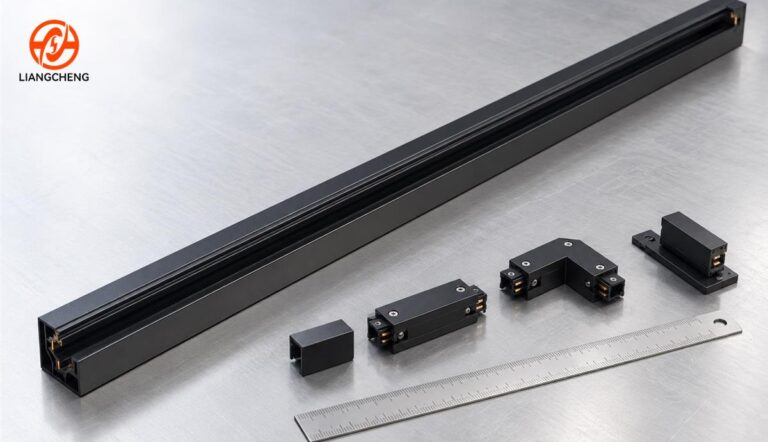

Two-circuit track lighting supports two independently assigned lighting groups on a coordinated rail system; three-circuit track lighting supports three. The extra group is useful when a project needs a third scene or wants to reassign fixtures later without adding another physical track run. Neither name guarantees a particular conductor count, adapter shape, current rating, dimming protocol, or cross-brand compatibility. Buyers should select a complete documented system, not an aluminum profile labeled only “2 circuit” or “3 circuit.”
Tiempo estimado de lectura: 14 minutos.
This guide is for lighting brands, distributors, contractors and project buyers comparing two-circuit with three-circuit systems. It focuses on the decision that occurs after a project has already established that one common lighting group is insufficient. The broader single-circuit versus multi-circuit guide covers that earlier choice; the discussion here turns two- and three-group requirements into a purchase-ready specification.
What does “circuit” mean in track lighting?
In this comparison, a circuit is an independently supplied or switched load path that a compatible track luminaire can be assigned to. Two-circuit track lets a project place one set of heads on group 1 and another on group 2 while both sets share a physical rail route. Three-circuit track adds a third selectable group. The group count describes control architecture, not the number of fixtures, the number of track pieces, the number of wall switches at a room entrance, or the number of copper strips visible in a photograph.
An individual track head normally belongs to one selected group at a time. A separate switch or approved control device can change the state of each group if the feed, wiring and luminaire drivers are designed accordingly. A three-circuit rail does not by itself create three useful scenes: a project that energizes only one path and assigns every head to it still operates as one group. Conversely, two groups can already serve many practical schemes, such as ambient lighting plus merchandise accents.
The term “three-phase track” is often used in market descriptions of three-circuit systems. That wording does not prove that a given installation uses a three-phase building supply. The actual supply arrangement, conductor schedule, protection and shared-neutral conditions must be established from the manufacturer’s data and the destination-market electrical design. A qualified electrical professional should approve the final wiring and installation.
What is the practical difference between two and three circuits?
| Buyer question | Two-circuit system | Three-circuit system |
|---|---|---|
| How many independent groups can the documented rail support? | Two | Three |
| Best fit for a stable plan? | Two lighting layers with little expected change | Three layers or a likely future third layer |
| Can heads be reassigned? | Only between two valid paths, if the adapter permits | Among three valid paths, if the adapter permits |
| Does the track alone guarantee dimming? | No; control gear and LED drivers must match | No; control gear and LED drivers must match |
| Are adapters automatically interchangeable? | No; verify family, geometry, contacts and ratings | No; verify family, geometry, contacts and ratings |
| Likely purchasing implication | May be a leaner matched bill of materials where two groups suffice | May justify more system complexity for a useful third group |
Neither choice is categorically better. A three-circuit track is wasted capacity if the third group never serves a design, operational or future-change requirement. A two-circuit track becomes restrictive if a retailer later wants storefront, sales floor and feature display lights operated independently along the same rail. The buying question is therefore the number of separately useful groups, not which number sounds more advanced.

How are two-circuit and three-circuit tracks wired?
A typical two-circuit track design provides two line paths, commonly described as L1 and L2, plus the return and protective-earthing arrangement specified for that system. A documented North American two-circuit product, for example, uses two hot conductors and one common neutral; its aluminum rail and protection details are defined in its own instructions. Other families may use separate neutrals or a different construction. The label “two circuit” does not establish which arrangement applies to a Liangcheng or third-party rail.
A common three-circuit mains-voltage design provides L1, L2 and L3 together with neutral, while the protective-earth function may be an additional conductor, a specified metal-rail path, or another documented construction. A four-strip count can therefore describe three line conductors and neutral in one family while another product lists the grounding feature separately. The drawing, marking and test record matter more than a shorthand such as “four wire.”
The power feed is the point where the building wiring enters the track system. A buyer should request a terminal schedule showing every conductor function, the intended supply and protective devices, and any restrictions on shared neutral or phase grouping. The schedule should also show how the feed, straight connector, corner connector and adapter preserve those functions through an entire run. A live rail-end photograph cannot replace that document.
A licensed or otherwise qualified installer should wire and commission the system under the applicable local requirements. This article is not an installation wiring diagram. In particular, buyers should not assume that bridging or leaving an unused line path is permitted merely because another brand’s product guide describes it. Those decisions depend on the exact rail and supply configuration.
Is two-circuit track the same as two-wire track?
No. “Two-wire” commonly counts two conductive paths in a rail and often denotes a single-circuit power arrangement; “two-circuit” describes two independently assignable lighting paths. The two terms are not interchangeable. A project team that sends a photograph of a two-wire rail while requesting two-circuit control risks receiving an incompatible quotation or a misleading sample. The 2-wire versus 3-wire comparison explains conductor terminology in more detail.
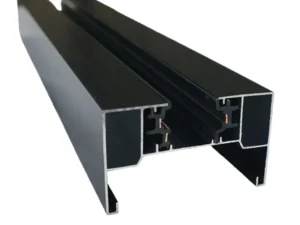
The specified LC-15B/6212E photo below is a Liangcheng two-wire rail reference. It is included to show why a rail profile photo must be identified accurately, not to represent a two-circuit system. The complete supplied photo frame is retained without additional cropping; the original photography is a close-up of one rail section.

Does a third circuit automatically provide better dimming?
No. Additional circuits supply more separately assignable power groups, but dimming depends on the installed control method and compatible luminaire drivers. Switching three groups on and off is different from smoothly dimming each group. A project may use separate phase-control equipment, an approved digital-control architecture, or another documented solution; the exact approach is not implied by the number of circuit paths.
For a two-circuit scheme, the schedule should identify which heads belong to each group and what each control actually does. For a three-circuit scheme, it should do the same for the third group. If the customer requests scene presets, occupancy response, color tuning or network control, the supplier must separately verify the controller, driver and interface. A standard three-circuit rail should not be described as carrying a data protocol unless its datasheet explicitly supports it.
Control compatibility should be tested on the actual assembly. A dimmer that operates one sample head acceptably may still produce flicker, incomplete shutoff or an unsuitable minimum level with a different driver or load mix. Document the control device model, fixture driver, circuit assignment and test conditions for both candidate systems.
How do track heads select circuit 1, 2 or 3?
In a compatible multi-circuit family, the luminaire adapter connects the head to a selected line path. Some adapters expose a selector; others require a defined contact configuration or product variant. The selection method and allowed positions come from the adapter documentation. A visible three-position selector is useful evidence of intended function, but it does not prove the adapter is mechanically or electrically compatible with every three-circuit track on the market.
The adapter’s geometry, keying, contact location, protective-earth engagement, lock, load rating and selector mapping must all match the rail. A head can appear to fit yet touch the wrong conductor or fail to lock securely. The track adapter compatibility checklist provides a separate approval process for this interface. For procurement, the adapter code and drawing revision should accompany every rail code.

Can two-circuit heads be used on a three-circuit rail?
Only when the manufacturer documents that exact adapter and rail pairing. A two-circuit head may lack the third contact position, use a different channel profile, or depend on another polarity and grounding scheme. Even within one broad market family, compatible appearance is not a test result. A change in molding or contact placement can change the outcome. Treat cross-use as a qualification question, not an assumed benefit of having more circuits available.
A replacement project should identify the installed rail before any new head is ordered. Collect an end-view photo, a working adapter sample, the feed and connector codes, circuit marks, dimensions and a record of the supply. If the rail is not identifiable, the safest commercial proposal may be a complete matched replacement system rather than a promise to fit an unknown track. Cross-compatibility claims need a drawing comparison and witnessed sample test.
What common specifications matter beyond circuit count?
The buyer should identify the rail’s physical profile, mounting type, nominal length and allowed cut-to-length practice. Surface, recessed and suspended installations do not share every clip, support or feed detail. Aluminum alloy, profile wall thickness, conductor material, insulation construction and finish affect manufacturing and installation, but their suitability must be evaluated against the approved system design rather than one isolated marketing adjective.
Electrical documentation should give the rated voltage, current or power limits, grounding arrangement and the conditions under which those ratings apply. A track advertised with several circuit ratings must not be treated as if all ratings can simply be added together: feeds, connectors, neutral, protective devices, cable routing and local design constraints can lower the permissible system load. The final circuit schedule should be checked by the project’s electrical professional.
Mechanical documentation should state permitted fixture loads, support spacing and mounting restrictions. A long rail with heavy pendants is not approved just because the same profile supports light spotlights in another installation. Dimensional drawings should define the rail opening, adapter engagement features and connector handing. Packaging should protect long straight lengths from bending, scraping and mixed-system accessories.
Which components must be bought as one system?
A purchase-ready track lighting system normally includes rail lengths, power feeds, end caps, straight and corner connectors, mounting hardware, compatible adapters, luminaires and any specified control gear. Depending on the layout, it may also need suspension sets, recessed trim, flexible connectors or separate circuit-identification labels. A low price per meter of rail has little value if the matching feed or corner piece is unavailable when installation begins.
For every component, identify the family and revision. Record connector handedness, orientation and whether it carries all intended circuit paths around the corner. A mechanical L connector that changes the rail direction is not automatically an electrical continuation of every circuit. If a system uses an isolated connector intentionally, that choice should appear on the drawing. The track rail accessories guide helps structure a complete bill of materials.
When is a two-circuit system the better choice?
Two circuits are usually sufficient when the same rail route must support exactly two meaningful lighting groups and the merchandising or architectural plan is stable. A compact boutique might separate general sales-floor heads from display accents. A small gallery could switch wall-wash fixtures separately from object spotlights. A restaurant could divide service lighting from feature lighting without needing a third independent layer on the same rail.
The practical advantage is a simpler group plan: two paths to document, assign, label and commission. Depending on the matched product family, this may also reduce component or control complexity. The limitation is that later three-way segmentation may require a new track family, another physical run, additional control work or a different layout. The buyer should include expansion probability in the comparison, not only opening-day needs.
A two-circuit system does not automatically cost less in every market. Availability, connector mix, required adapter design, shipping quantity and certification documentation can reverse a simple profile-price comparison. Request complete matched quotes for both options before stating a savings figure.
When is a three-circuit system worth the added complexity?
Three circuits are useful when a third independently controlled group performs a defined task. A fashion retailer may need window merchandise, general circulation and changing feature displays operated separately. A gallery may need artwork accents, wall wash and visitor circulation. A multipurpose showroom may use one group for a permanent product zone, one for seasonal staging and one for general presentation.
The third group also has option value where layouts change regularly. A circuit-selecting adapter can let an approved luminaire move from one group to another along a common rail route, provided the system is designed for that operation. The benefit is not infinite flexibility: head type, mechanical loading, beam distribution, available power and control equipment still constrain the result.
Three circuits may increase the number of terminal connections, selector settings and commissioning checks. If the project team cannot explain how circuit 3 will be used now or under a realistic future layout, a more complex rail may create cost without reader-visible value. A decision should name the intended third group in the lighting schedule.
How should a retail project compare the two options?
Consider a hypothetical store with 18 track spotlights, each rated 20 W at the fixture input. Total connected input would be 360 W before any project-specific allowances. Under a two-circuit plan, nine heads could serve general merchandise and nine could serve feature displays, with 180 W on each group. Under a three-circuit plan, six heads could serve each of three distinct groups, with 120 W assigned to each. The arithmetic illustrates grouping only; it does not establish a permissible circuit load or prove that any particular track supports the arrangement.
Now test the operational question. If the manager needs only “general” and “feature” switches, the two-circuit layout does the job. If the store must keep a window display lit while the rest of the sales floor is dimmed and a promotional wall is changed independently, the third group has a clear function. If the proposed third group merely duplicates an existing switch, it is not a justification on its own.
The worked plan should be turned into a reflected-ceiling layout and luminaire schedule. Mark every head’s circuit assignment and target display, then test all switching scenes before ordering. This catches a common error: a circuit plan that works on paper but places the wrong heads on the wrong visual target after the track turns a corner.
How do galleries, hospitality and offices differ?
A gallery often values the ability to change fixture positions and group artwork separately from wall wash. Two circuits can work for a stable collection with two display layers; three can support rotating exhibitions that require a third independent scene. The selection should follow exhibition programming and fixture load rather than an assumption that all galleries need the same rail.
A hospitality project may divide service, feature and evening ambience. Three circuits help when all three groups must share one rail route and the drivers can support the specified dimming plan. A small café with one accent layer and one task layer may not benefit from the third group. The required light quality, glare control and fixture styling remain separate from circuit count.
An office or showroom may change partitions or presentation zones. Multi-circuit track can simplify reassignment of compatible heads, but circuit groups do not replace a broader control design. If occupancy sensors, daylight response or addressable scenes are needed, the electrical and control designers must verify the whole architecture. A circuit count cannot stand in for a control schedule.
What should a B2B RFQ request from the supplier?
A useful two-versus-three-circuit RFQ starts with the project country, supply conditions, mounting method, rail route, circuit-group schedule and fixture types. It should request a dimensioned rail cross-section, conductor and protective-earth map, power-feed terminal schedule, rated limits, compatible adapter codes, circuit-selector method, connector drawings, finish references and packing plan. Quantities should distinguish rail lengths, feeds, corner types, end caps and spare parts.
The RFQ should state whether a buyer wants an existing approved system or a custom wholesale/private-label program. For a custom program, specify target profile, length, finish, labeling, carton protection, minimum order and change-notice expectations. Ask which drawings and samples will become the approved production reference. The lista de verificación para solicitar cotizaciones de rieles provides a fuller document set.
How should samples be approved before a bulk order?
Approve a complete small system, not a loose rail. The sample set should include rail, feed, every relevant connector, end cap, mounting component, adapter and representative luminaire. First check part identity, dimensions and finish. Then have qualified personnel perform safe de-energized fit, locking, continuity, isolation and protective-earth checks according to the approved test plan. Finally, commission each intended circuit path and control scene on the specified supply.
Record the adapter’s selected circuit, the illuminated heads, any contact or feed issue, and whether the result matches the lighting schedule. Repeat the test after the system turns through its real connector arrangement; a straight sample cannot reveal a corner-mapping error. Retain an approved sample and drawing revision so later wholesale deliveries can be compared against the same reference.
What is the final decision rule?
Choose a two-circuit track when two independently useful groups meet the project’s current and credible future needs, and a matched documented system passes the sample review. Choose a three-circuit track when a third group has a named operational purpose or a well-supported future use, and the associated wiring, adapters, controls and total system cost are accepted. Put a proposal on hold if the supplier cannot identify conductor functions, verify the adapter family or provide a testable complete system.
Preguntas frecuentes
Can three-circuit track be installed with only two groups active?
Sometimes, but only under the exact product instructions and approved electrical design. An unused path does not make every two-circuit adapter compatible with that three-circuit rail.
Does three-circuit track carry more load than two-circuit track?
Not automatically. Permissible load depends on the rated rail, feed, connectors, neutral arrangement, protective devices and installation. Compare documented system ratings rather than multiplying a label by the circuit count.
Can a two-wire rail provide two independently controlled circuits?
Not by definition. Two-wire describes a conductor count and commonly supports one basic power path. Confirm a system’s actual conductor map and control scheme instead of equating wires with circuits.
Discuss a matched wholesale track rail system with Liangcheng Lighting
Liangcheng Lighting supplies wholesale and customizable track lighting rail systems for B2B buyers. Send the team your layout, two- or three-group schedule, destination market, rail format, adapter and luminaire references, finish, quantities and packaging needs. Contactar a Liangcheng Lighting to discuss a matched rail-and-accessory proposal and request the drawings or samples needed for project approval.
¿Necesita soluciones de iluminación de riel personalizadas?
Contacte a Liangcheng Lighting para obtener soluciones profesionales de rieles de aluminio OEM/ODM y soporte de iluminación profesional.
Relacionado