



Read time: 13 minutes
The performance gap between a premium LED profile and a cheap one rarely shows up on first inspection. Both look like extruded aluminum. Both accept a diffuser cover. Both hold a strip. The difference becomes visible over 12 to 18 months of continuous operation — in the form of lumen degradation, surface yellowing, profile warping, or outright LED strip failure.
In most cases, that gap traces back to a single decision made at the manufacturing stage: the aluminum alloy specification.
6063-T5 aluminum has become the global standard for LED aluminum profile manufacturing for reasons that are grounded in material science, not marketing. This guide explains exactly what 6063 aluminum is, why its properties make it optimal for LED profiles, how it compares to the alternatives — 6061 aluminum, plastic, and steel — and what buyers should check to verify they are actually getting what they’re paying for.
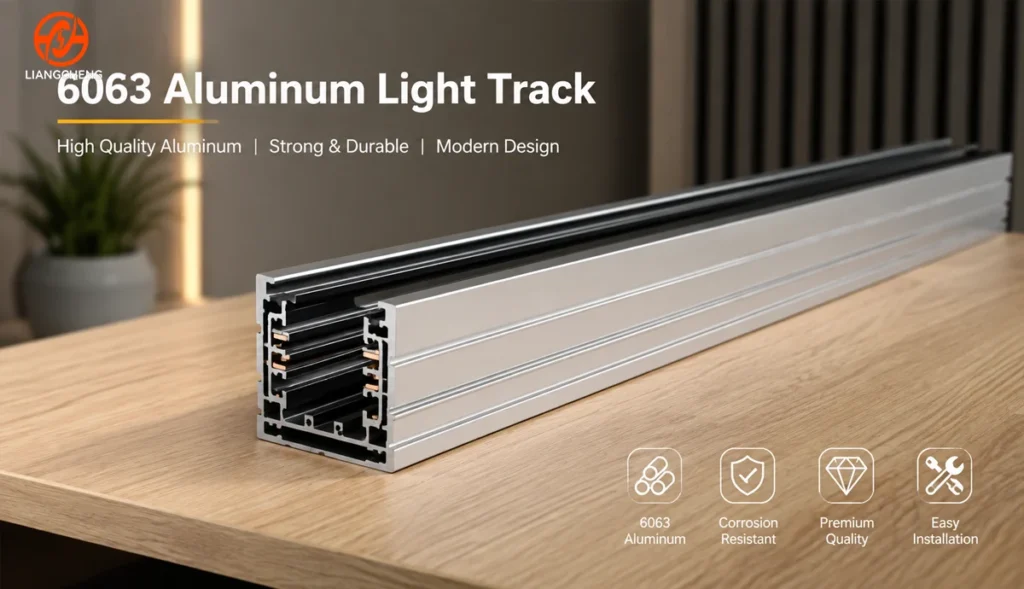
What Is 6063 Aluminum Alloy?
Understanding the 6063 Aluminum Grade
6063 is a medium-strength aluminum alloy belonging to the 6000 series — the Al-Mg-Si (aluminum-magnesium-silicon) family. Its chemical composition is precisely controlled within the following ranges:
| Element | Composition Range |
|---|---|
| Aluminum (Al) | Balance (~97.5%) |
| Magnesium (Mg) | 0.45–0.90% |
| Silicon (Si) | 0.20–0.60% |
| Iron (Fe) | ≤ 0.35% |
| Copper (Cu) | ≤ 0.10% |
| Manganese (Mn) | ≤ 0.10% |
| Zinc (Zn) | ≤ 0.10% |
| Other elements | ≤ 0.15% total |
The magnesium-silicon combination is what gives 6063 its defining characteristics: excellent extrudability, smooth surface quality, and outstanding anodizing performance. Within the aluminum alloy family, 6063 is frequently called the “architectural aluminum alloy” — a term that reflects its dominant use in applications where surface appearance and precise cross-section geometry matter as much as mechanical strength.
Common applications of 6063 aluminum outside of LED profiles include window and door frames, curtain wall systems, solar panel frames, irrigation tubing, and decorative architectural elements — applications where the alloy’s combination of dimensional precision, aesthetic surface quality, and corrosion resistance are the primary selection criteria.
Why 6063-T5 Is the Temper Used for LED Aluminum Profiles
The designation T5 identifies the temper — the post-extrusion processing condition of the alloy. Understanding what T5 means explains why it is the preferred temper for LED profile production.
After extrusion, aluminum profiles are in a relatively soft state at elevated temperature. The T5 process involves cooling the extruded profile directly from the extrusion temperature (typically by air quenching), then immediately applying artificial aging — heating the profile at a controlled lower temperature (around 175–200°C) for a defined period to precipitate Mg₂Si particles within the aluminum matrix. This precipitation hardening mechanism increases the alloy’s yield strength and hardness without requiring a separate solution heat treatment step.
The practical result for LED profile manufacturing is a profile that is:
- Sufficiently hard to resist deformation during handling, shipping, and installation
- Dimensionally stable — the artificial aging relieves internal stresses that would otherwise cause warping or distortion over time
- Ready for surface treatment immediately after extrusion — no separate heat treatment step required
- Produced efficiently in a continuous manufacturing flow
The alternative temper, T6, involves a full solution heat treatment cycle before aging and produces higher strength — but at the cost of slower production, higher energy consumption, and reduced dimensional stability on thin-walled sections, which makes it less practical for the complex, thin-wall cross-sections of LED profiles.
For the structural requirements of LED profile applications, T5 provides all the strength needed while optimizing for the surface quality, dimensional precision, and production efficiency that LED profile manufacturing demands.
Why Material Selection Directly Impacts LED Performance
The Relationship Between Aluminum Material and LED Lifespan
Every LED strip light generates heat during operation. This heat originates at the semiconductor junction inside each LED chip, where electrical energy converts to light. The junction temperature — the temperature at that conversion point — is the single most important variable governing LED performance over time.
The relationship between junction temperature and LED lifespan follows a well-documented pattern: a junction temperature rise of 10°C approximately halves the operating life of the LED. An LED rated for 50,000 hours at a junction temperature of 75°C may deliver only 25,000 hours if junction temperature rises to 85°C — and progressively fewer hours as temperature increases further.
The aluminum profile is the primary mechanism through which heat is removed from the LED junction. Heat flows from the LED chip, through the circuit board (PCB), into the aluminum channel below, and then dissipates from the aluminum body into the surrounding air. The thermal conductivity of the aluminum — how efficiently it moves heat — directly controls how much heat accumulates at the junction.
This is why material specification is not a secondary consideration in LED profile quality. The aluminum alloy choice determines heat management effectiveness, which determines LED performance, lumen maintenance, and service life.
What Happens When the Wrong Material Is Used
LED profiles made from substandard aluminum — recycled alloy blends, under-specified wall thickness, or alloys not suited to heat transfer — produce a predictable set of failure patterns:
Elevated LED junction temperature causes accelerated lumen depreciation: the light output drops measurably within the first 6,000–10,000 hours of operation, rather than maintaining consistent output over the rated lifespan.
Profile deformation from materials with insufficient mechanical stability — warping along the length, diffuser covers that won’t stay clipped, visible bowing that creates uneven light lines in installation.
Poor anodizing performance from recycled or blended alloys: uneven color, poor adhesion, and surface failures within one to two years of installation rather than the 10–15 year surface life expected from properly anodized 6063.
Increased total cost — the cheapest profiles require replacement most quickly. A project completed with $0.50/m profiles that need replacement after two years costs far more over ten years than one completed with $1.50/m premium profiles that last for ten.
Why 6063 Aluminum Is the Preferred Material for LED Profiles
Excellent Heat Dissipation Performance
Thermal conductivity — the rate at which a material transfers heat — is the most consequential physical property for LED profile material selection. 6063-T5 aluminum has a thermal conductivity of approximately 200 W/m·K. To appreciate what this means in practice, consider the comparison:
| مادة | Thermal Conductivity |
|---|---|
| 6063 Aluminum | ~200 W/m·K |
| 6061 Aluminum | ~167 W/m·K |
| صلب | ~50 W/m·K |
| Polycarbonate (PC) | ~0.2 W/m·K |
| PMMA (Acrylic) | ~0.18 W/m·K |
6063 aluminum conducts heat approximately 1,000 times more efficiently than plastic materials. This means the aluminum profile actively draws heat away from the LED strip’s circuit board and distributes it across the full profile body, where a large surface area dissipates it into surrounding air. Plastic materials, by contrast, act as thermal insulators — trapping heat at the LED junction rather than removing it.
Within the aluminum family, 6063 has notably higher thermal conductivity than 6061 (~200 vs ~167 W/m·K) — approximately 20% better heat transfer performance from the same profile cross-section. For high-power LED strip applications above 10W/m, this difference is meaningful.
Superior Extrusion Performance for Complex Profile Geometries
The design complexity achievable in a 6063 extrusion is directly linked to the alloy’s exceptional flow characteristics at extrusion temperature. Silicon and magnesium in the 6063 composition lower the alloy’s flow stress during extrusion, enabling:
Thin-wall sections — walls as thin as 0.6–0.8mm can be produced without defects in 6063, allowing profile designers to achieve the slim cross-sections demanded by modern LED profile aesthetics without sacrificing structural integrity.
Complex internal geometries — the multi-void cross-sections common in LED profiles (LED channel cavity, mounting groove, diffuser retention channel, and accessory clip recesses all in one extrusion) are achievable in 6063 at production speed. Less extrudable alloys require simplified cross-sections or slower production rates.
Tight dimensional tolerances — wall thickness variation of ±0.05–0.10mm and outer dimension tolerances of ±0.10–0.15mm are achievable on LED profiles in 6063, ensuring consistent diffuser fit and LED strip compatibility across production batches.
High surface quality — the smooth, seam-free surface that 6063 produces directly from the extrusion die requires minimal post-processing before anodizing, reducing production cost and improving surface uniformity.
Lightweight Yet Structurally Adequate
6063-T5 aluminum has a density of 2.70 g/cm³ — approximately one-third the density of steel. For LED profiles, this weight advantage translates into:
Easier handling during installation, particularly for long linear profiles (2m–3m lengths) that would be cumbersome in steel. Lower structural loading on ceiling and wall mounting substrates, which matters for recessed plasterboard and suspended pendant applications where substrate load capacity is a design constraint. Reduced freight cost per meter for international shipments, where weight is a significant cost variable.
Despite its low weight, 6063-T5 provides adequate mechanical strength for all standard LED profile applications. With yield strength in the range of 110–150 MPa, profiles in 6063-T5 resist bending under normal span conditions and maintain shape under installation forces.
Outstanding Corrosion Resistance
6063 aluminum forms a natural oxide layer (aluminum oxide, Al₂O₃) on its surface when exposed to air. This passive oxide layer is chemically stable, adherent, and self-repairing — it re-forms immediately if the surface is scratched, providing continuous corrosion protection.
In indoor lighting environments — the majority of LED profile applications — natural oxide protection provides long-term durability without additional treatment. When anodized, the oxide layer is thickened and hardened to a controlled depth (typically 10–25 microns), providing enhanced protection suitable for commercial, outdoor-covered, and coastal environments.
For track lighting system applications in demanding commercial environments — shopping malls, hotels, airports — the combination of 6063’s natural corrosion resistance and a professional anodized surface treatment produces systems that maintain appearance and structural integrity for 15+ years without maintenance.
Premium Surface Finish Quality
The surface quality that 6063 produces directly from extrusion — smooth, uniform, free of streaks or grain lines — is unmatched within the structural aluminum alloy family. This directly affects the quality and consistency of subsequent surface treatments:
Anodizing on 6063 produces an exceptionally even, consistent oxide layer. The uniformity of magnesium and silicon distribution in the 6063 matrix means the electrochemical anodizing reaction proceeds evenly across the surface, producing consistent color depth and coating thickness. This is critical for LED profile projects where multiple profiles are installed in a single continuous run and color uniformity is a visible quality indicator.
Powder coating on 6063 adheres reliably to the clean, smooth extruded surface, producing consistent coverage and color without the pinholing or adhesion problems that can affect rougher alloy surfaces.
6063 Aluminum vs 6061 Aluminum
6061 is the most common alternative aluminum alloy considered for LED profile applications. Understanding the difference clarifies why the choice favors 6063 for profile manufacturing.
Material Comparison
| عقار | 6063-T5 | 6061-T6 |
|---|---|---|
| قوة الشد | 145–195 ميجا باسكال | 260–310 MPa |
| Yield strength | 110–150 MPa | 240–275 MPa |
| الموصلية الحرارية | ~200 W/m·K | ~167 W/m·K |
| كثافة | ٢٫٧٠ جم/سم³ | ٢٫٧٠ جم/سم³ |
| Extrudability | ممتاز | متوسط |
| Thin-wall capability | Excellent (0.6mm+) | Limited (1.2mm+ practical minimum) |
| Surface finish quality | ممتاز | جيد |
| جودة الأنودة | Excellent — consistent, uniform color | Good — slight grain visibility on some sections |
| Machinability | جيد | ممتاز |
| تكلفة | أسفل | أعلى |
| Typical applications | LED profiles, window frames, architectural elements | Structural components, machine parts, aerospace |
Which Alloy Is Better for LED Profiles?
For LED aluminum profile applications, 6063 is the correct specification. The reasoning is straightforward:
6061’s mechanical advantages — higher tensile and yield strength — are not relevant to LED profile applications. LED profiles are not load-bearing structural elements. The strength levels of 6063-T5 are more than adequate for all installation methods and span conditions encountered in LED lighting. The additional strength of 6061 provides no functional benefit in this application.
6061’s disadvantages — reduced thermal conductivity (~20% lower than 6063), more limited extrudability restricting cross-section complexity and thin-wall production, and less uniform anodizing — are directly relevant to LED profile performance. A switch from 6063 to 6061 in LED profile manufacturing reduces heat management performance, constrains profile design options, and reduces surface finish consistency for no performance gain.
6061 is the correct material for structural components that carry significant mechanical load — machine frames, jigs and fixtures, structural brackets, aerospace components. LED profiles are not in this category. The common misconception that “higher strength means better material” leads buyers to over-specify mechanical properties while under-specifying thermal and surface properties — the opposite of what LED profile applications require.
6063 Aluminum vs Plastic
Plastic materials — primarily polycarbonate (PC) and PMMA (acrylic) — are used for LED profile diffuser covers, end caps, and occasionally for low-cost profile housings in budget lighting applications. Understanding how aluminum and plastic compare on the properties that matter for profile housing explains why aluminum cannot be replaced.
Thermal Conductivity: The Fundamental Difference
The thermal conductivity comparison is decisive. PC has a thermal conductivity of approximately 0.20 W/m·K; PMMA approximately 0.18 W/m·K. These values are roughly 1,000 times lower than 6063 aluminum at 200 W/m·K.
A plastic housing around an LED strip does not dissipate heat — it traps it. This is not a matter of degree; it is a fundamentally different thermal behavior. Plastic LED channels may be acceptable for very low-power LED strips (under 3W/m) where heat generation is minimal. For any application above this threshold, plastic housing directly elevates LED junction temperature, accelerating lumen depreciation and shortening service life.
Durability Comparison
| Factor | 6063 Aluminum | Polycarbonate / PMMA |
|---|---|---|
| UV resistance | Excellent — anodized surface stable | PC: moderate; PMMA: yellowing after prolonged UV exposure |
| Impact resistance | High — metal deformation absorbs impact | PC: good; PMMA: brittle, crack-prone |
| Fire performance | Non-combustible, melting point 660°C | Combustible; PC: self-extinguishing; PMMA: burns |
| Temperature range | Stable –40°C to 150°C+ | Deformation above 80–120°C (PC/PMMA respectively) |
| Long-term dimensional stability | ممتاز | Susceptible to thermal cycling expansion/contraction |
| Recyclability | Fully recyclable | Limited recycling infrastructure |
In commercial lighting applications — shopping malls, museums, hotels — fire performance is a specification requirement, not a preference. Aluminum profiles are non-combustible and present no fire risk. Combustible plastic housings fail fire safety requirements in these environments.
Which Offers Better Value Over the Full Product Life?
Plastic profiles cost less per meter at the point of purchase. Over a 5–10 year installation lifespan, aluminum profiles consistently provide better total value through reduced LED replacement costs (from managed junction temperature), no surface degradation from UV or thermal cycling, and maintenance-free appearance in visible installations.
6063 Aluminum vs Steel
Steel is occasionally considered as a structural material for LED profile or track rail system manufacturing. Aluminum’s advantages over steel in this application are clear across all relevant dimensions.
Weight: A Significant Installation Difference
6063 aluminum at 2.70 g/cm³ is approximately one-third the density of steel at 7.85 g/cm³. For a 2-meter LED profile, this difference is immediately apparent in handling and installation. For track rail systems that may span 10–20 meters across a commercial ceiling, the structural load on the ceiling substrate from aluminum is substantially lower than from steel — which directly affects the specification of fixing anchors and their spacing.
Corrosion Resistance: No Contest in Lighting Environments
Steel requires surface treatment — typically galvanizing or powder coating — to prevent corrosion in even standard indoor environments. Unprotected steel in commercial lighting applications would begin surface rust formation within months in typical humidity conditions.
Aluminum’s natural oxide layer provides inherent corrosion protection without any surface treatment. Anodized aluminum exceeds steel’s corrosion resistance in virtually all lighting environments, including coastal, high-humidity, and outdoor-covered applications, without ongoing maintenance.
Fabrication, Installation, and Appearance
Aluminum extrudes into complex, precision cross-sections that steel cannot match without significantly more complex and expensive fabrication. Cutting, drilling, and field modification of aluminum profiles uses standard woodworking and metalworking tools; steel requires more specialized cutting equipment and produces harder-to-manage swarf.
The natural surface quality of extruded 6063 aluminum — smooth, uniform, anodizable — produces the premium appearance that commercial lighting applications demand. Steel’s surface quality after equivalent fabrication is significantly lower, and steel cannot be anodized (only powder coated).
For LED track rail applications specifically, aluminum’s lower electrical resistivity compared to steel (2.82 vs 10–11 μΩ·cm) can be relevant in high-current circuit configurations, though in most commercial track systems the current-carrying conductors are copper regardless of the structural rail material.
Why LED Profile Manufacturers Prefer 6063-T5 Aluminum
Easier Extrusion of Complex Profile Designs
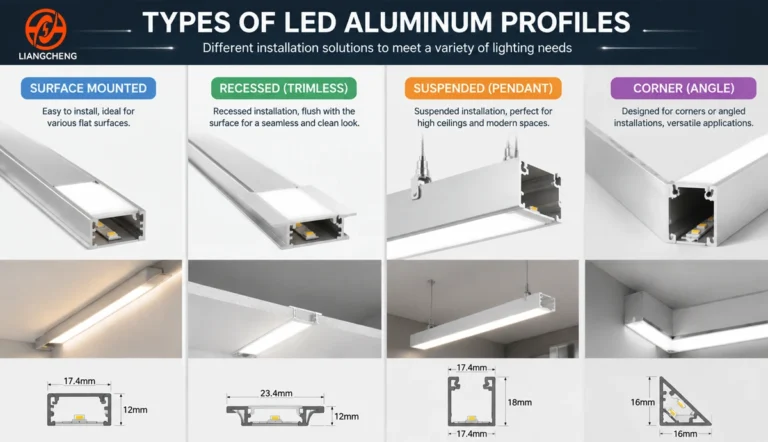
The full range of LED profile types — surface mounted, recessed, suspended, corner, and magnetic track systems — each require cross-section geometries that 6063’s extrusion characteristics enable and that other materials cannot match economically.
A magnetic track lighting profile, for example, incorporates multiple internal chambers (conductor channels, magnet mounting groove, structural walls, diffuser retention slots) in a single extrusion. A recessed profile with plaster-in flanges requires precise thin-wall sections over a wide face. A suspended linear profile with bidirectional emission requires symmetrical internal geometry with consistent wall thickness across the full width. All of these are producible in 6063 with standard extrusion tooling and production speeds that support commercial manufacturing economics.
Attempting the same geometries in 6061 would require slower production speeds, thicker minimum walls (increasing material cost and weight), and would produce inferior surface quality that increases post-processing cost.
Consistent Production Quality for High-Volume Manufacturing
For a factory producing LED profiles at commercial scale — hundreds of thousands of linear meters per year — 6063-T5 provides consistent production quality that reduces waste, rework, and variation between batches.
The alloy’s consistent flow characteristics mean dimensional variation from one extrusion run to the next is minimal. The reliable anodizing response means color batches can be reproduced consistently. The straightness achieved through proper stretching is reliably maintained. For buyers placing repeat orders requiring color and dimension consistency across multiple deliveries, 6063’s production consistency is a practical advantage that reduces quality disputes and replacement claims.
Surface Treatments Available for 6063 Aluminum Profiles
Anodizing
Anodizing is the most common surface treatment for 6063 LED profiles and the one that most fully leverages the alloy’s properties. The electrochemical process converts the aluminum surface into an integral aluminum oxide layer, thickening and hardening the natural oxide that 6063 already forms.
Standard anodizing thickness specifications:
- 10–15 microns — standard for indoor residential and commercial applications; provides excellent scratch resistance and color uniformity
- 15–25 microns — specified for heavy-use commercial environments, light industrial, or high-humidity interior applications
- 25+ microns — outdoor-rated applications, coastal environments, harsh industrial environments
Available anodize colors: silver (natural), matte black, bronze/champagne, and custom colors at minimum order quantities. The uniform surface quality of 6063 is what enables consistent anodized color across large production batches — an essential requirement for projects where multiple profiles are installed in a continuous visual run.
Powder Coating
Powder coating applies a thermosetting polymer finish electrostatically, then cures it at 180–200°C to produce a thick, durable surface layer. The advantage over anodizing is color range: any RAL color can be achieved through powder coating, enabling custom color matching to architectural specifications.
Powder coat thickness on 6063 profiles typically ranges from 60–100 microns — substantially thicker than anodized film, which must be factored into diffuser cover and accessory specifications. Outdoor-rated powder coatings with UV stabilizers and weathering additives extend the surface life in exterior applications.
Electrophoresis and Other Specialty Finishes
Electrophoretic coating (electrocoating or e-coating) applies paint to the aluminum surface via electrical current deposition, producing extremely uniform coverage in recessed areas and internal channels where spray or powder methods produce incomplete coverage. Used in premium architectural profiles, high-specification hospitality projects, and applications requiring particularly consistent interior channel coating.
Key Factors to Consider When Choosing LED Aluminum Profile Material
Thermal Performance
Match the profile’s aluminum specification to the power density of the LED strip it will carry. For strips below 5W/m, standard 6063-T5 with 0.8–1.0mm wall thickness is adequate. For strips 10–15W/m, specify 1.0–1.2mm wall thickness minimum. For high-power applications above 15W/m, specify 1.2mm+ walls and larger cross-section area for greater thermal mass.
Mechanical Strength
Assess the structural requirements of the installation method. Suspended profiles spanning 1.5–2m between support points require sufficient profile stiffness to prevent visible mid-span deflection under their own weight plus the strip and diffuser. Surface mounted profiles have lower structural demands. In all cases, 6063-T5 at appropriate wall thickness provides adequate strength for standard LED profile applications.
Surface Quality Requirements
For high-visibility installations — hospitality, retail, museum, gallery — specify anodized 6063 from a manufacturer who documents color batch consistency. For residential applications where the profile is largely concealed, surface finish standards can be relaxed. For custom RAL color requirements, confirm powder coating is specified rather than anodizing.
Processing Capability
If your application requires custom cut lengths, CNC-machined notches or holes, or custom accessories, confirm the manufacturer’s in-house machining capability. Custom processing in 6063 aluminum is straightforward with standard equipment; capabilities vary significantly between suppliers.
Cost Efficiency
6063-T5 is not the cheapest aluminum material available, but it is the most cost-effective for LED profile applications when evaluated on a total-lifecycle basis. Cheaper alternatives produce shorter service life, higher maintenance costs, and faster aesthetic degradation that collectively exceed the upfront material savings.
Environmental Sustainability
Aluminum is among the most recyclable of engineering materials — recycling aluminum requires only 5% of the energy required for primary production. 6063 LED profiles at end of life have genuine scrap value and can be recycled without downgrading the material quality. For projects with sustainability certification requirements (LEED, BREEAM), aluminum profile material recyclability contributes to materials credits.
Applications of 6063 Aluminum LED Profiles
6063-T5 aluminum profiles serve as the material platform for LED lighting across every market segment:
إضاءة سكنية — under-cabinet lighting in kitchens, wardrobe interior lighting, cove and tray ceiling linear lighting, staircase step and riser lighting. The lightweight, anodizable surface and thin-wall capability of 6063 enable slim, elegant profiles that integrate with modern interior design.
Commercial buildings — office overhead linear systems, corridor ambient lighting, reception and lobby feature lighting. High daily operating hours in commercial environments make thermal management critical; 6063’s heat dissipation performance directly protects the operating economics of commercial lighting installations.
معروضات البيع بالتجزئة — shelf lighting, display case illumination, facade signage backlighting. Consistent light output and reliable color rendering over long operating hours support accurate merchandise presentation; LED lifespan protection through 6063’s thermal management is central to this.
Hotels and hospitality — guest room accent lighting, corridor and public area ambient systems, facade and architectural feature lighting. Anodized 6063 profiles in premium silver, matte black, and custom colors meet the aesthetic standards of high-end hospitality specifications.
Office lighting — suspended linear systems over workstations, recessed ceiling lighting, meeting room overhead illumination. The combination of surface quality and thermal performance makes 6063 profiles the standard specification for office lighting systems.
Smart home systems — low-voltage LED profiles integrated with dimming and color control systems. The stable thermal environment created by 6063 housing is particularly important for tunable white and RGBW systems where consistent color point requires stable LED junction temperature.
Architectural linear lighting — large-scale facade lighting, exterior building outlines, landscape and path lighting. Outdoor applications require the higher anodizing thickness and corrosion resistance that 6063 provides naturally; no other affordable material delivers this combination.
Common Misconceptions About 6063 Aluminum
Is 6063 Too Soft for LED Profile Applications?
6063-T5 is a medium-strength alloy with yield strength in the 110–150 MPa range — lower than 6061-T6 (240–275 MPa) but entirely adequate for the structural requirements of LED profiles. The misconception that “softer means weaker and therefore lower quality” applies to structural engineering contexts where materials are selected to resist loads approaching their yield strength. LED profiles are not load-bearing structural elements. The relevant properties are thermal performance, extrusion precision, and surface quality — all of which 6063 optimizes. Selecting a harder alloy for a profile application achieves no benefit while sacrificing the properties that actually matter.
Is 6061 Always the Better Alloy?
Higher tensile strength does not translate into better performance for visible, non-structural LED profiles. 6061’s mechanical advantages are relevant for machine components, structural brackets, and load-carrying aerospace parts. In LED profile applications, 6061’s lower thermal conductivity reduces heat dissipation effectiveness, its reduced extrudability limits cross-section complexity and thin-wall capability, and its less uniform anodizing response reduces surface finish consistency. For LED profiles, 6061 is the inferior specification despite its higher headline mechanical strength.
Can Plastic Replace Aluminum in LED Profiles?
Not in applications where thermal management matters — which includes any LED strip above approximately 3W/m. Plastic’s thermal conductivity is approximately 1,000 times lower than aluminum’s. This fundamental material property means plastic cannot perform the heat sink function that protects LED junction temperature and extends service life. Plastic LED housings are appropriate for very low-power decorative applications where the profile is essentially a cosmetic cover and thermal management is not a design consideration. For commercial, hospitality, retail, and high-performance residential applications, aluminum is not optional.
أسئلة متكررة
Why is 6063 aluminum widely used for LED profiles? 6063 aluminum is the standard for LED profile manufacturing because it uniquely combines the three properties most critical for this application: high thermal conductivity (~200 W/m·K) for effective heat management from LED strips; exceptional extrudability enabling the complex thin-wall cross-sections of modern profile designs; and outstanding anodizing quality that produces consistent, durable surface finishes. No other cost-effective material combines all three properties at the level 6063 achieves.
Is 6063 better than 6061 for LED lighting profiles? Yes, for LED profile applications. 6063 provides approximately 20% better thermal conductivity than 6061, superior extrudability for complex thin-wall cross-sections, and more consistent anodizing performance. 6061’s higher mechanical strength provides no benefit in non-structural LED profile applications. The choice of 6063 over 6061 in LED profile manufacturing is based on application-appropriate property selection, not a compromise.
What does T5 mean in 6063-T5 aluminum? T5 is the temper designation indicating the post-extrusion processing condition. It specifies that the aluminum was cooled directly from the extrusion temperature (air quenching) and then subjected to artificial aging — controlled heating at a lower temperature to precipitate strengthening Mg₂Si particles within the aluminum matrix. This process increases hardness and yield strength without requiring a separate solution heat treatment, and relieves internal stresses that would otherwise cause warping or distortion. T5 is the temper that balances production efficiency with the mechanical and dimensional stability that LED profiles require.
Can 6063 aluminum be anodized? Yes — 6063 has exceptional anodizing performance, better than any other structural aluminum alloy. The alloy’s composition and microstructure allow the anodizing process to produce a highly uniform oxide layer with consistent color and thickness across the profile surface. This is why 6063 is the standard material for visible architectural aluminum components where anodized surface consistency is a quality criterion.
Is 6063 aluminum suitable for outdoor LED lighting? Yes, with appropriate anodizing specification. 6063 aluminum forms a natural protective oxide layer and has good inherent corrosion resistance. For outdoor applications, specifying anodizing at 25+ microns (outdoor grade) significantly enhances weather resistance. For fully exposed outdoor environments, powder coating provides an additional barrier against moisture and UV degradation. Coastal environments (salt spray exposure) require outdoor-grade anodizing or powder coating plus attention to the sealing of any cut ends or machined sections where bare aluminum is exposed.
How long do 6063 aluminum LED profiles last? When manufactured to proper specification (genuine 6063-T5 alloy, appropriate wall thickness, quality anodizing or powder coating) and used in their intended application environment, 6063 LED profiles have a practical service life of 20–30 years. The structural aluminum body does not degrade under normal operating conditions. The anodized surface is expected to maintain appearance for 15–20+ years in indoor commercial environments. The limiting factor in LED profile system lifespan is typically the LED strip and driver, not the aluminum housing.
Conclusion: Why 6063 Aluminum Remains the Irreplaceable Standard
The case for 6063-T5 aluminum as the standard material for LED aluminum profiles is grounded in properties that directly determine LED system performance: thermal conductivity that protects LED junction temperature, extrudability that enables the precision cross-sections modern profiles require, and surface quality that supports the durable, consistent finishes that commercial lighting demands.
The comparison with alternatives — 6061 aluminum, plastic, and steel — confirms 6063’s position through analysis rather than convention. Each alternative material fails on at least one property that is critical for LED profile applications. 6063 succeeds on all of them simultaneously.
For buyers sourcing LED profiles and track lighting systems, the material specification is the starting point of any quality evaluation. Confirming that a supplier uses 6063-T5 aluminum with documented alloy certification, specified wall thickness, and quality-controlled surface treatment is the baseline verification that separates professional manufacturers from suppliers cutting costs in ways that won’t be visible until after installation.
Why Liangcheng Lighting Specifies 6063-T5 Aluminum Across Its Entire Track System Range
At Jiangmen Liangcheng Lighting Co., Ltd., the decision to use premium-grade aluminum materials is not a feature — it is a foundational quality commitment that runs through every product in their 1,000+ model track lighting system range.
Liangcheng Lighting specializes exclusively in LED track lighting systems: 2-wire, 3-circuit, 4-circuit, 6-circuit, and magnetic track configurations, along with a complete range of compatible accessories. This product specialization means their aluminum specification choices are made with a clear understanding of the thermal, structural, and surface requirements of track lighting system applications — not carried over from a general aluminum extrusion business that also produces profiles.
For lighting distributors, brands, and project contractors who understand why material specification matters — and want a track lighting system manufacturer whose commitment to premium materials and production quality backs that understanding with verifiable results — إضاءة ليانغتشنغ (lclights.com) is the partner worth contacting.
هل تحتاج إلى حلول إضاءة مسارات مخصصة؟
اتصل بـ Liangcheng Lighting لحلول قضبان الألومنيوم OEM/ODM ودعم الإضاءة الاحترافي.
ذو صلة