







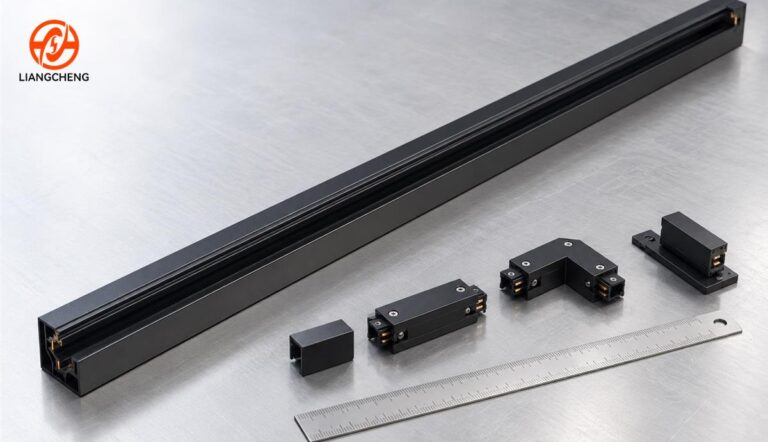

Quick answer: ENEC is an independent European third-party safety certification for specified electrical products. For track lighting, an ENEC claim is useful only when the certificate identifies the exact track system or luminaire, relevant standard, covered models and components, and issuing certification body. European buyers ask for it because product testing and ongoing production surveillance add evidence beyond a supplier’s own declaration. ENEC does not replace applicable EU conformity assessment, CE marking, or a check that the proposed rail and adapters work together.
Estimated reading time: 10 minutes. This guide explains the meaning of the mark, the difference between rail and luminaire certificates, how ENEC relates to CE, and the documents a European buyer should request before placing an order.
What does ENEC certification mean for track lighting?
ENEC stands for European Norms Electrical Certification. The mark is granted through an independent scheme for products assessed against standards within its scope. The scheme involves initial product testing, certification by an authorized body, and continuing surveillance that can include factory inspections and product retesting. A catalog statement is therefore weaker evidence than an identifiable, current certificate tied to the offered configuration.
The first question for a track lighting buyer is which product is certified. A track system, complete track luminaire, driver, and LED module are different items. Their certificates can refer to different standards and model lists. A certificate for one item does not automatically cover every item in a lighting project.
ENEC is a safety mark, not a universal performance rating. It does not by itself establish lumen output, beam angle, color consistency, flicker behavior, or lifetime. Those claims need separate performance evidence. ENEC+ is a distinct extension that addresses performance verification for eligible LED modules and luminaires; buyers should not infer ENEC+ from an ordinary ENEC certificate.
Why do European buyers ask for ENEC?
European distributors and project teams may request ENEC to reduce uncertainty when several factories offer similar-looking track systems. A verified license connects a defined product to independent safety assessment and a monitored production process. It can support supplier approval when a retailer, consultant, or project specification names an accepted third-party mark.
An ENEC request is also a practical test of document control. A buyer needs to know who issued the certificate, which models were tested, whether the proposed connectors and adapters are included, and whether the current production version matches the approved design. These questions matter more than a logo in a sales brochure.
If a tender or buyer agreement explicitly requires ENEC, treat it as a contractual requirement. If it does not, still verify applicable EU requirements, technical documentation, system compatibility, and installation conditions. The appropriate decision depends on the actual project specification.
Does ENEC cover the track rail, spotlight, or whole system?
An ENEC license covers only the products and variants stated in its scope. The ENEC scheme includes electrical supply track systems for luminaires under EN 60570 and luminaires under relevant parts of the EN 60598 series. A rail certificate should not be presented as a certificate for every spotlight that can be attached to it. Likewise, a luminaire certificate should not be presented as certification of an unrelated rail.
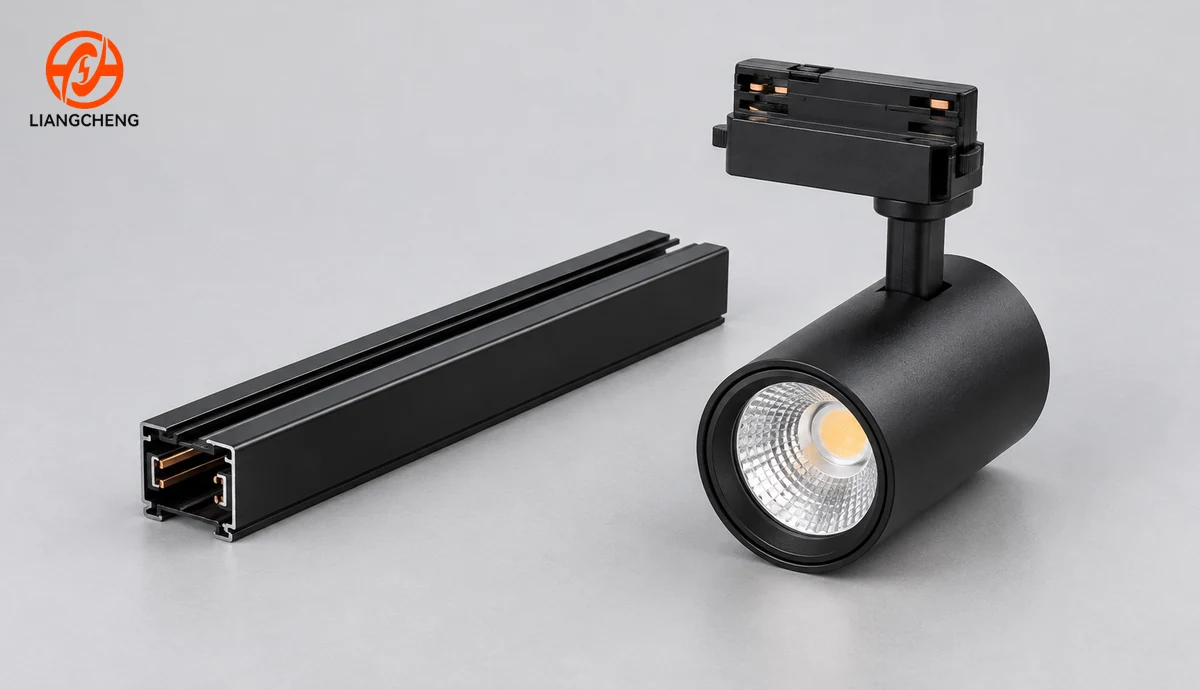
For an electrical supply track system, the assessed set may include a rail, supply connector, coupler, and adapter. The ENEC scope note for EN 60570 identifies these core components and indicates that catalog components should be tested. The decisive list is the actual certificate and its annexes. If an order includes end feeds, straight connectors, L joints, T joints, or special adapters, check whether those exact items fall within the claimed license.
Separate certificates do not automatically establish physical compatibility. Confirm the rail profile, adapter contact arrangement, locking method, polarity, and circuit selection with drawings and a physical sample. Our track light adapter compatibility checklist explains how to review fit, contact, and retention before a bulk order.
Which standards matter to a track lighting buyer?
EN 60570 is the standard named in the ENEC scope for electrical supply track systems for luminaires. It addresses the track system that supplies luminaires and includes electrical and mechanical considerations. Buyers should request the exact edition and model list shown on a certificate rather than assume the standard number covers every rail profile and accessory.
The EN 60598 series addresses luminaires. The applicable general and particular requirements depend on a spotlight’s design and intended use; the issuing body determines the certification basis. A rail-only supplier should not describe a rail certificate as a luminaire certificate, and a luminaire report should not be used as a substitute for evidence about the supply track.
Drivers, LED modules, emergency functions, and low-voltage magnetic systems may change the relevant standards or the component boundary. A useful supplier response maps each product code to its certificate or report number, standard, rated conditions, and responsible manufacturer. This simple document matrix prevents one report from being stretched across an unrelated bill of materials.
How is ENEC different from CE marking?
CE marking and ENEC answer different questions. CE marking is the manufacturer’s declaration that a product meets the applicable EU product rules after the required conformity assessment. The manufacturer prepares an EU Declaration of Conformity and supporting technical documentation. ENEC is a separate, voluntary third-party certification scheme for defined products and standards within its scope. One mark does not automatically grant the other.
| Buyer question | CE marking | ENEC mark |
|---|---|---|
| What does it show? | The manufacturer’s declaration of conformity with applicable EU legal requirements. | Third-party certification of a defined product under an independent safety scheme. |
| Who holds responsibility? | The manufacturer remains responsible for the declaration and technical file. | The certification body issues the license, while the manufacturer must maintain the approved design and production controls. |
| Which documents help? | EU Declaration of Conformity and relevant product identification and technical evidence. | License number, issuing body, model list, standard, annexes, and current certificate status. |
| Does it prove adapter fit? | No; compatibility needs a separate system check. | Only to the extent the certified system scope supports the proposed components. |
A valid ENEC certificate does not excuse missing CE documentation when CE marking is required. Conversely, a CE-marked product cannot be advertised as ENEC-certified without a current license covering that product. Buyers should ask for both sets of evidence when both are relevant to the purchase.
How can a buyer verify an ENEC certificate?
Start with the license number rather than a marketing image. Ask for the complete certificate, annexes, and covered product list. Check the number through the ENEC public certificate search or the issuing certification body. A cropped picture of a mark cannot establish current status or show whether the offered model is included.
- Match the entities. Check the certificate holder, manufacturer, production location where stated, and the seller’s relationship to them. An OEM seller should explain who holds the license.
- Match the exact model. Compare the quotation, product label, drawing, sample, carton, and certificate annex. A model suffix can identify a different conductor layout, feed direction, finish, or mounting arrangement.
- Match the product boundary. Determine whether the certificate applies to the rail system, luminaire, driver, or another component. Avoid extending a component certificate to a complete assembly.
- Match the ratings. Verify voltage, current, conductor and circuit configuration, earthing, and intended environment against the project schedule.
- Match accessories. Confirm whether feeds, couplers, joiners, and adapters in the bill of materials are included in the assessed system.
- Check changes. Ask whether revisions to contacts, insulation, extrusion, connector geometry, or factory location were reviewed by the certification body.
Repeat the certificate check when the supplier changes the proposed configuration. An approved sample does not authorize a later adapter substitution. The purchase order should name approved part numbers and require written approval for changes. Our track rail sample approval guide
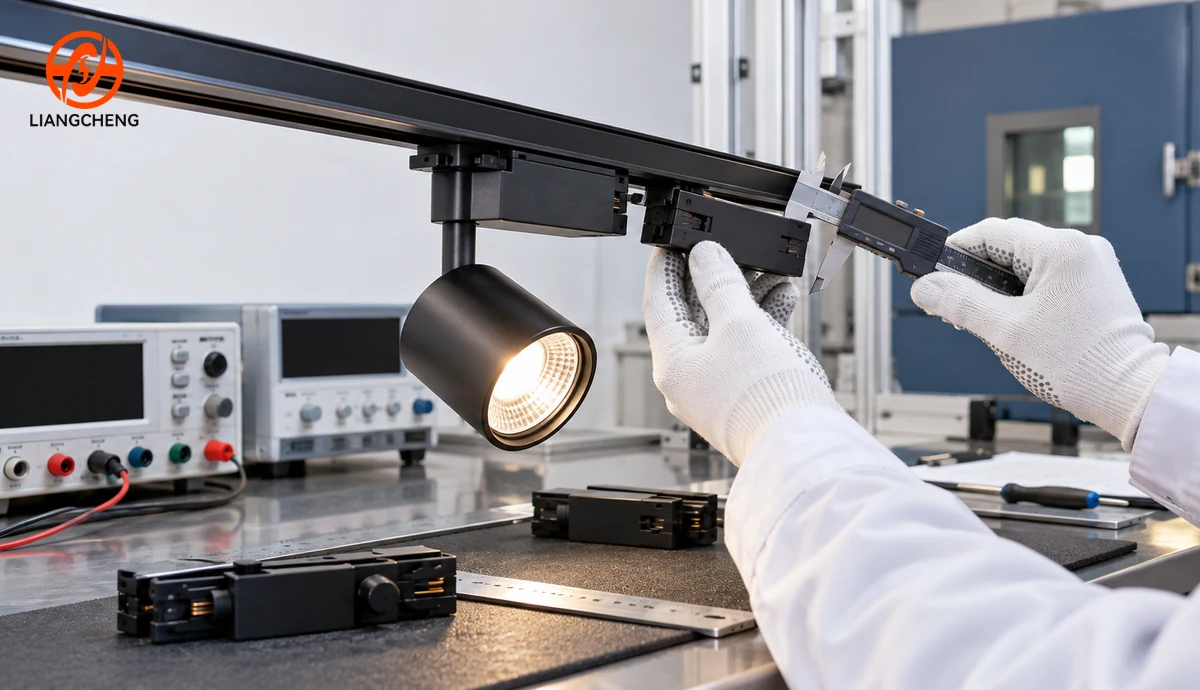
Which design details need extra attention?
Wiring and circuits: A two-wire, three-wire, four-wire, or multi-circuit rail does not provide the same switching and earthing arrangement. Request a conductor diagram and an adapter position drawing. A description such as “three circuit” is not enough to confirm the exact conductors. Our 2-wire versus 4-wire rail comparison
المواصفات الميكانيكية: Track geometry determines whether an adapter seats, locks, and maintains reliable contact. H-type, J-type, and L-type names can conceal supplier or regional differences. Compare actual cross-section drawings and mating samples, particularly when the rail and lights come from different sources. The H-type, J-type, and L-type compatibility guide
تثبيت: Surface, recessed, and suspended rails impose different fixing and clearance conditions. A certificate does not design ceiling supports or permit arbitrary installation changes. Check installation instructions, support spacing, allowable loads, and local installation rules. Our installation method comparison
OEM changes: Changing an extrusion, insulating insert, copper conductor, feed connector, or finishing process can affect an assessed design. A custom color or label may be less intrusive than a modified cross-section, but neither should be assumed to fall within a license. Ask the supplier to document whether the proposed OEM version is covered or needs certification-body review.
What should a European buyer put in the RFQ?
A precise RFQ identifies the intended assembly and its use. Specify the target country, rail type, mounting method, lengths, color, current rating, circuit arrangement, intended spotlight and adapter, connector layout, and volume. A generic request for “ENEC track” often produces generic documents that cannot be mapped to the actual bill of materials.
- Project country and any tender wording about third-party marks.
- Part numbers for rail, feeds, couplers, end caps, adapters, and luminaires.
- Electrical ratings, earthing, circuit arrangement, and installation environment.
- Full ENEC license and annexes for every item claimed to be certified.
- EU Declaration of Conformity and product-specific technical evidence where applicable.
- Drawings, installation instructions, packaging labels, and traceability method.
- Physical samples for fit, locking, continuity, finish, and packaging approval.
- A list of OEM modifications and their effect on certificate scope.
This checklist separates paperwork from system engineering. A factory may hold a valid license yet propose an unlisted connector; another may have the right rail geometry but insufficient documentation for a tender. Record both facts in the supplier comparison. The track rail factory audit checklist

What if a supplier has CE documents but no ENEC certificate?
A product without ENEC is not automatically unsuitable. First establish whether the contract actually requires ENEC. If it does, a CE declaration or generic test report should not be presented as a substitute. The buyer can seek a certified product, request a formally accepted alternative, or revise the requirement through the customer’s approval process.
If ENEC is preferred but not mandatory, evaluate the available EU Declaration of Conformity, relevant test reports, traceability, factory controls, sample results, and compatible accessories. Record the limits of that evidence. This approach avoids treating the absence of a voluntary mark as the only purchasing criterion.
An ENEC certificate is also not a reason to skip commercial and physical checks. Verify adapter fit, extrusion dimensions, finish tolerance, packing protection, and replacement-part availability. Our lighting track rail buying guide
الأسئلة الشائعة
Is ENEC legally mandatory for every track light sold in Europe?
ENEC is a voluntary third-party scheme, not a blanket legal requirement for every track light. A tender, customer, or distributor can make it mandatory for a particular purchase. Applicable EU legal conformity duties remain separate.
Does an ENEC-certified rail certify every spotlight attached to it?
No. A license applies only to listed products and variants. The spotlight needs its own evidence where required, and the proposed rail-to-adapter combination needs an approved compatibility basis.
Can an OEM logo or custom color be added to a certified track?
Only the certification body or license holder can confirm whether the precise change remains within the approved scope. Changes to contacts, insulation, geometry, or production processes are especially important to review before claiming continued coverage.
Is an ENEC test report the same as an ENEC certificate?
No. A test report records results for tested specimens. An ENEC license confirms certification under the scheme for specified products subject to the scheme’s continuing conditions.
How can Liangcheng Lighting support a European track rail project?
Liangcheng Lighting supplies wholesale and customized track lighting rail solutions for distributors, project buyers, and OEM programs. Send the target market, rail profile, conductor and circuit requirements, mounting method, accessory list, finish, quantities, and any certification wording from the tender. The team can match those needs to a proposed configuration and provide available drawings, samples, and product-specific documents for review. Any certification claim should always be checked against the exact quoted model and current supporting documents.
Ready to compare track rail options? Contact Liangcheng Lighting with your bill of materials or installation drawing to discuss wholesale pricing, OEM details, sample approval, and the documentation your European customer needs.
هل تحتاج إلى حلول إضاءة مسارات مخصصة؟
اتصل بـ Liangcheng Lighting لحلول قضبان الألومنيوم OEM/ODM ودعم الإضاءة الاحترافي.
ذو صلة