







Estimated reading time: 7 minutes
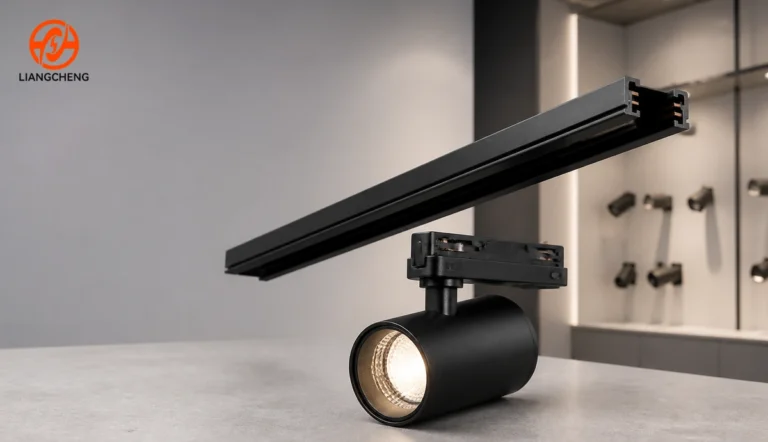
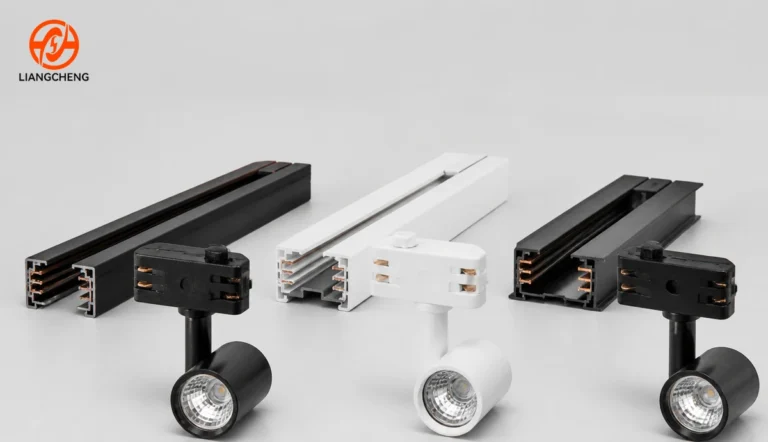
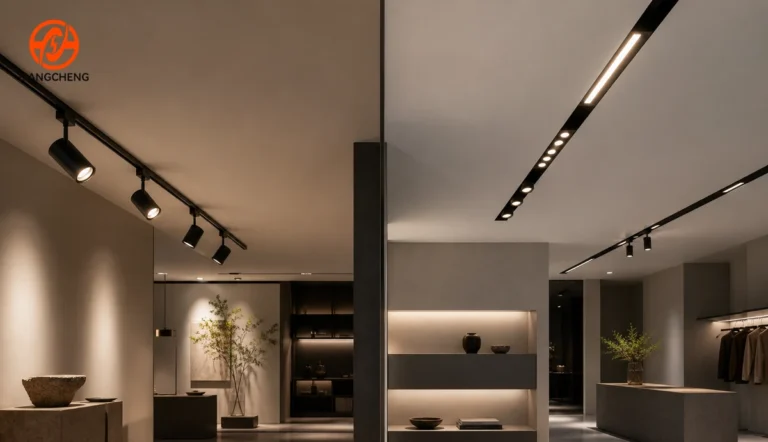
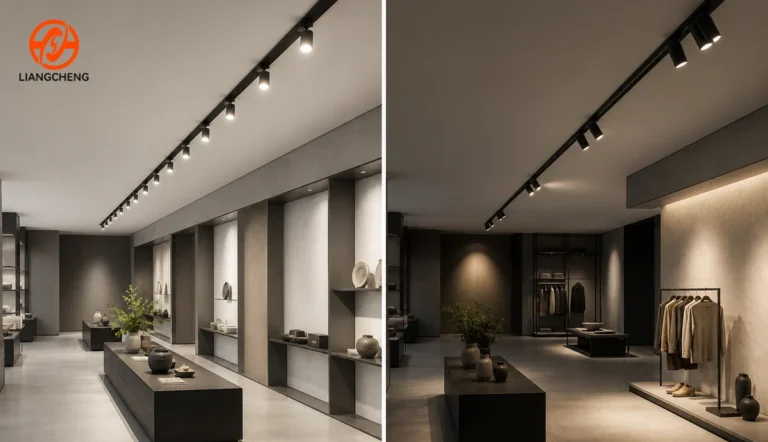
A track rail and a track light are different parts of the same lighting system. The track rail is the fixed infrastructure: it mounts to the ceiling or wall, distributes electrical power, and provides the mechanical channel for compatible fixtures. The track light is the active luminaire: it locks into the rail, converts electrical power into light, and directs that light toward a display, wall, work surface, or architectural feature.
The simplest comparison is this: the rail is the powered route, while the light is the adjustable device that uses that route. A complete installation normally needs both, plus compatible feeds, connectors, end caps, mounting parts, and controls.
Track rail vs track light at a glance
| Comparison point | Track rail | Track light |
|---|---|---|
| Main job | Carries power and supports compatible fixtures | Produces, shapes, and directs light |
| Typical position | Fixed to or recessed into the ceiling or wall | Attached to the rail through an adapter |
| Main components | Aluminum profile, conductors, insulation, feed, connectors, and end caps | Adapter, driver, LED light engine, heat sink, optics, and adjustable body |
| Key selection factors | Track family, circuit arrangement, mounting method, layout, ratings, and accessories | Compatible adapter, wattage, beam angle, lumen output, color quality, and aiming range |
| How often it moves | Usually remains fixed after installation | Can often be repositioned and re-aimed along the rail |
| Can it work alone? | It can distribute power but does not illuminate the space by itself | A track version normally requires a matching powered rail |
What exactly is a track rail?
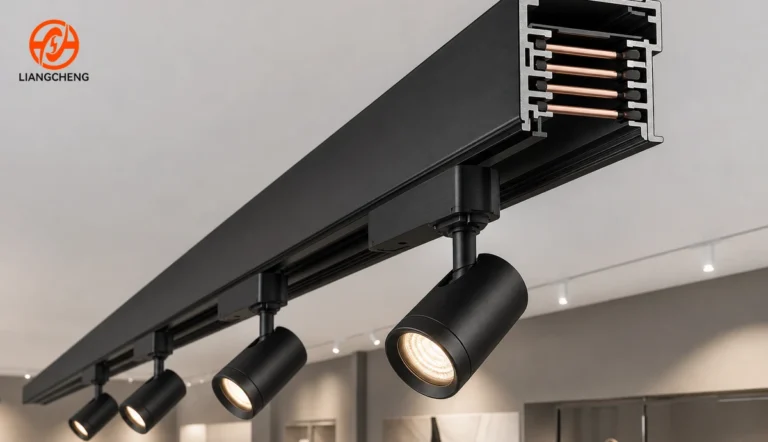
A track rail, also called a lighting track, is a linear mechanical and electrical support system. Its aluminum profile holds insulated conductive paths and creates a channel for compatible adapters. A power feed connects the rail to the building supply, while straight, corner, T, or flexible connectors can extend the route when they are part of the same system family.
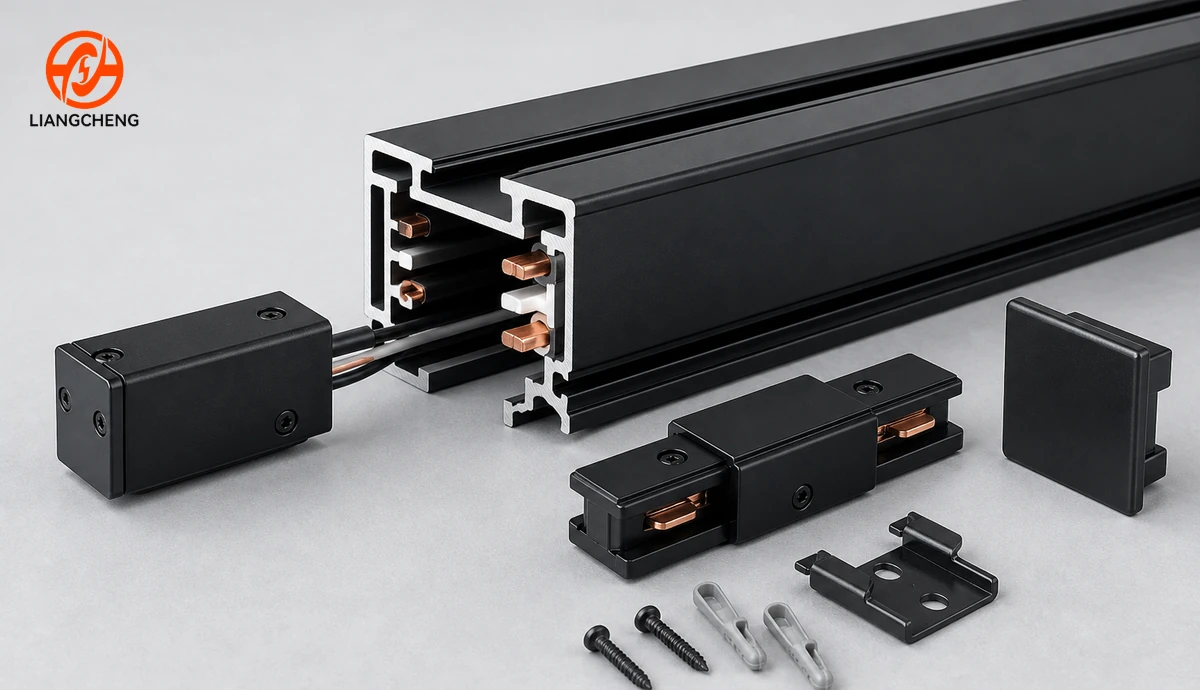
The rail determines several system-level decisions:
- Mechanical format: the profile shape, opening, dimensions, and locking features determine which adapters can enter and remain secure.
- Electrical arrangement: conductor positions, polarity, earthing method, voltage, current rating, and circuit configuration determine how power reaches each fixture.
- Control capacity: a simple rail may switch all fixtures together, while a multi-circuit family may allow fixtures on one physical route to be assigned to different groups.
- Installation method: surface-mounted, suspended, and recessed rails require different supports, trims, feeds, and ceiling coordination.
- Layout flexibility: rail lengths and compatible connectors determine whether the system can form straight runs, corners, grids, or suspended arrangements.
A rail is therefore more than a metal bar. It is the backbone of the system. For a broader explanation of its construction and uses, read what LED lighting track is and how it works.
What exactly is a track light?
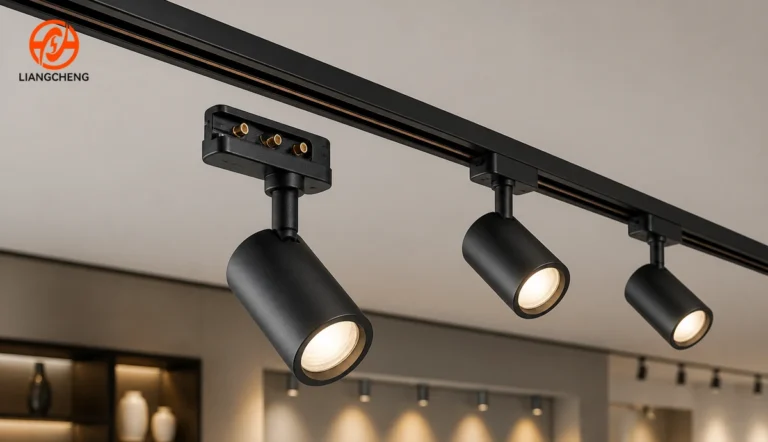
A track light is a luminaire designed to connect to a particular rail through an adapter. The adapter provides the mechanical lock and electrical contacts. Inside or above the luminaire body, a driver supplies the LED light engine. A heat sink manages operating temperature, while the reflector or lens controls the beam.
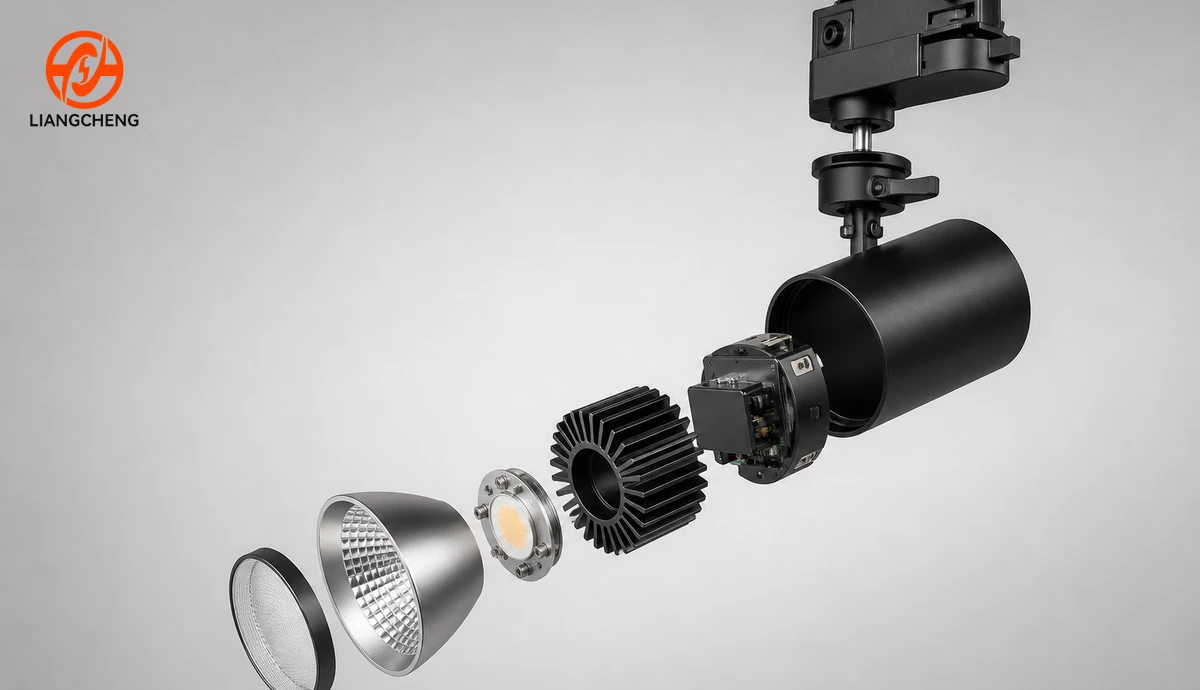
The light itself determines the visual result. Buyers normally compare:
- lumens and power consumption;
- beam angle and beam quality;
- color temperature and color rendering;
- glare control and cutoff;
- dimming or control capability;
- rotation and tilt range;
- body size, finish, thermal design, and service life;
- adapter type and electrical ratings.
Track lights can include spotlights, floodlights, wall-wash fixtures, pendants, or linear modules, depending on the rail family. The term describes how the luminaire connects, not one fixed beam shape.
How do the rail and light work together?
After the rail is installed and connected according to its instructions, a matching fixture adapter is inserted into the channel and locked. The adapter’s contacts meet the intended conductive paths. Power reaches the driver, the driver supplies the LED light engine, and the optics shape the emitted light. The fixture can then be positioned and aimed within the limits of the system.
This separation between infrastructure and luminaire creates the main advantage of track lighting: the ceiling route stays in place while individual fixtures can often be moved, replaced, added, removed, or re-aimed as displays and room functions change.
In a multi-circuit system, an adapter may also include a documented selector that assigns the fixture to a control group. The exact method depends on the product family. Never assume that two systems use the same conductor functions simply because their names sound similar. The guide to 2-wire, 3-wire, and 4-wire track rail types explains why circuit architecture must be checked before selecting fixtures.
Why are some track lights incompatible with some rails?
Track lighting is not universally interchangeable. A fixture may look close to the correct size and still have different contact positions, polarity, locking geometry, circuit selection, voltage, or ratings. Forcing an adapter into the wrong rail can damage contacts, create a loose connection, defeat protective features, or make the fixture unsafe.
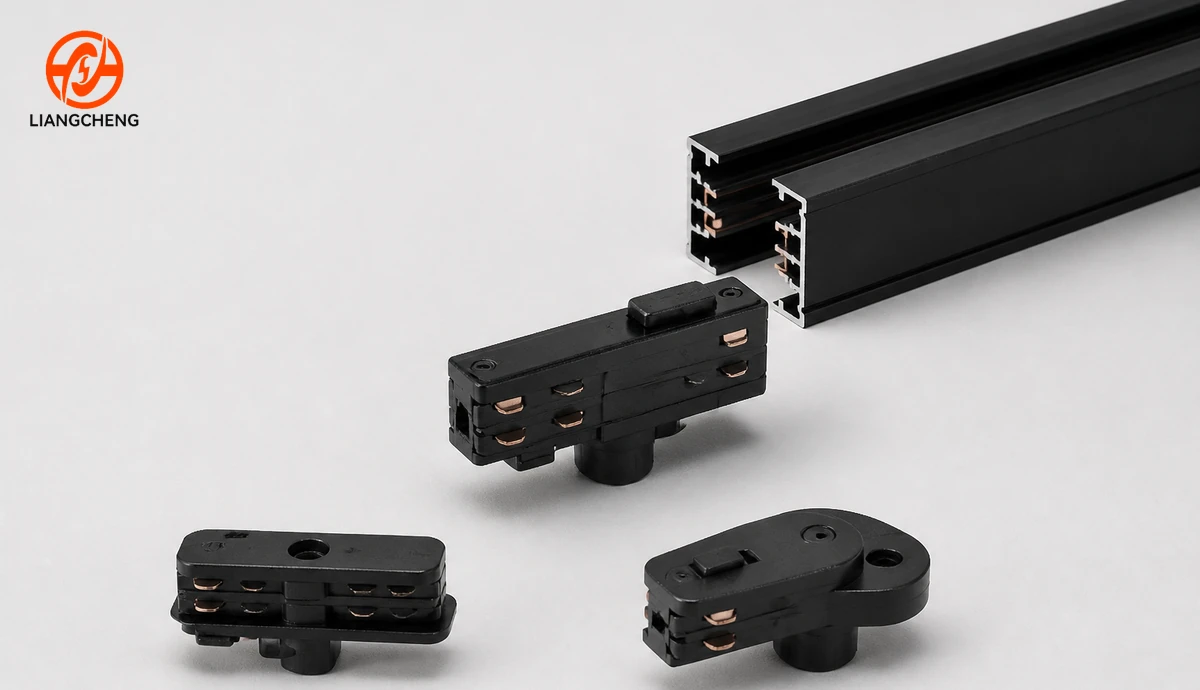
Confirm compatibility across all of these points:
- System family: obtain the exact rail and adapter model or an approved compatibility statement.
- Mechanical profile: compare cross-section dimensions, keying, insertion direction, and locking features.
- Contact arrangement: verify the number, position, and function of electrical contacts.
- Electrical ratings: match voltage, frequency where relevant, current limits, protective class, and earthing arrangement.
- Control method: confirm circuit selection, dimming, or control-bus requirements.
- Connector orientation: maintain polarity and circuit continuity through feeds and corners.
If you are working with a 3-wire system, use the detailed guide to track lights compatible with 3-wire rails. For regional mechanical families, the H-type, J-type, and L-type comparison shows why adapter geometry matters.
Should you choose the track rail or the track light first?
Choose them as one system, but begin with the project requirements. The best sequence is:
- Define the lighting task. Identify target surfaces, required illuminance, beam distribution, color quality, glare limits, aiming positions, and control scenes.
- Plan fixture quantities and positions. A lighting calculation or mock-up helps determine the number, output, beam angles, and aiming directions.
- Select a suitable system family. Confirm that one rail family supports the required fixture types, circuit arrangement, mounting method, controls, and accessories.
- Design the rail layout. Coordinate feed locations, joints, corners, support points, ceiling details, load, and future movement zones.
- Lock the compatibility schedule. List approved rail, adapter, light, feed, connector, end-cap, and mounting part numbers before ordering.
For a renovation with an existing rail, the order reverses: identify and verify the installed rail first, then choose only documented compatible track lights. Do not order fixtures from appearance alone.
Which component affects lighting performance more?
The track light has the most direct effect on beam, brightness, color, glare, and visual comfort. The rail has the greater effect on system compatibility, fixture positioning, circuit distribution, and future flexibility. A high-quality light cannot correct an incompatible or poorly planned rail, and a well-installed rail cannot make an unsuitable optic illuminate the target properly.
Commercial projects need both decisions to work together. Retail displays may require narrow and medium beams on one route. Galleries may need precise aiming and high color quality. Showrooms may need independently controlled fixture groups. The article on commercial track rail system design explains how the shared infrastructure supports changing layouts.
Track rail and track light buying checklist
| For the rail and accessories | For the track lights |
|---|---|
| System family and exact cross-section | Approved matching adapter |
| Circuit and conductor arrangement | Voltage, wattage, and driver specification |
| Rated current and load limits | Lumens, beam angle, and photometric data |
| Surface, suspended, or recessed mounting | Color temperature and color rendering |
| Feed and connector orientation | Dimming or control compatibility |
| Lengths, finish, end caps, and support parts | Tilt, rotation, glare control, and finish |
| Documentation and local compliance | Thermal design, warranty, and documentation |
Ask the supplier for a coordinated bill of materials instead of separate lists that happen to share a color. For general rail purchasing criteria, see the دليل شراء سكة إضاءة الألومنيوم.
Frequently asked questions
Is a track rail the same as a track light?
No. The rail is the powered mounting infrastructure. The track light is the adjustable luminaire attached to it.
Can a track rail light a room without fixtures?
No. A standard rail distributes power and provides support, but compatible luminaires are required to produce light.
Can I install any track light on an existing rail?
No. Identify the existing rail family and verify the adapter profile, contacts, electrical ratings, polarity, locking method, and controls before purchasing a fixture.
Is magnetic track lighting the same as ordinary track lighting?
No. Magnetic retention, operating voltage, adapter construction, and control architecture may differ. Read the comparison of ordinary and magnetic track lights before treating them as alternatives.
Can I replace only the track light?
Yes, when the replacement is documented as compatible with the existing rail and meets the project’s electrical and lighting requirements. Isolate power and follow the installation instructions.
Final answer
The difference is functional: the track rail is the fixed power-and-support backbone, while the track light is the removable, aimable luminaire that creates the illumination. Select both as one verified system. Match the mechanical interface, electrical arrangement, ratings, controls, and accessories before installation, then choose the light’s beam and output for the actual visual task.
هل تحتاج إلى حلول إضاءة مسارات مخصصة؟
اتصل بـ Liangcheng Lighting لحلول قضبان الألومنيوم OEM/ODM ودعم الإضاءة الاحترافي.
ذو صلة