







Estimated reading time: 6 minutes
LED track rail types are often described as 2-wire, 3-wire, or 4-wire systems, but the labels are not a universal electrical standard. The practical difference is the number of conductors or control paths available inside a specific rail design, which affects circuit switching, compatible adapters, and installation planning. Before purchasing, please confirm the rail series, connector type, voltage, and grounding method—or simply confirm the number of wires in the product name.
For most straightforward retail displays, galleries, and residential accent lighting, a single-circuit rail is the simplest choice. Projects that need independently switched lighting zones usually need a multi-circuit rail and matching luminaires. The key is to specify the whole system as a set: rail, live-end feed, joiners, adapters, and track heads.
What do 2-wire, 3-wire, and 4-wire LED track rails mean?
In supplier listings, 鈥渨ire鈥?can refer to internal copper conductors, electrical circuits, or sometimes an informal product-family name. That is why two rails with the same wire-count label can still be incompatible. A genuine specification should identify the circuit arrangement, whether the rail is earthed, the nominal input voltage, the rail profile, and the adapter standard.
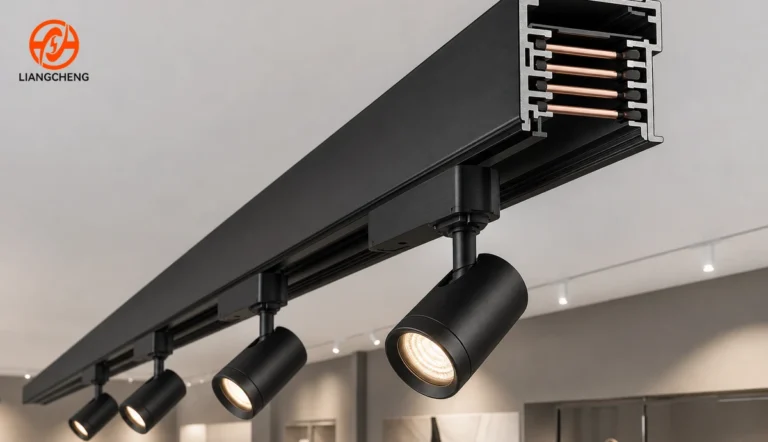
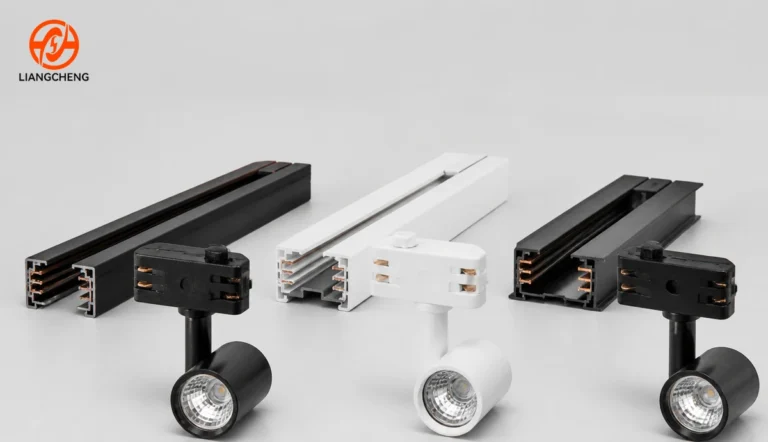
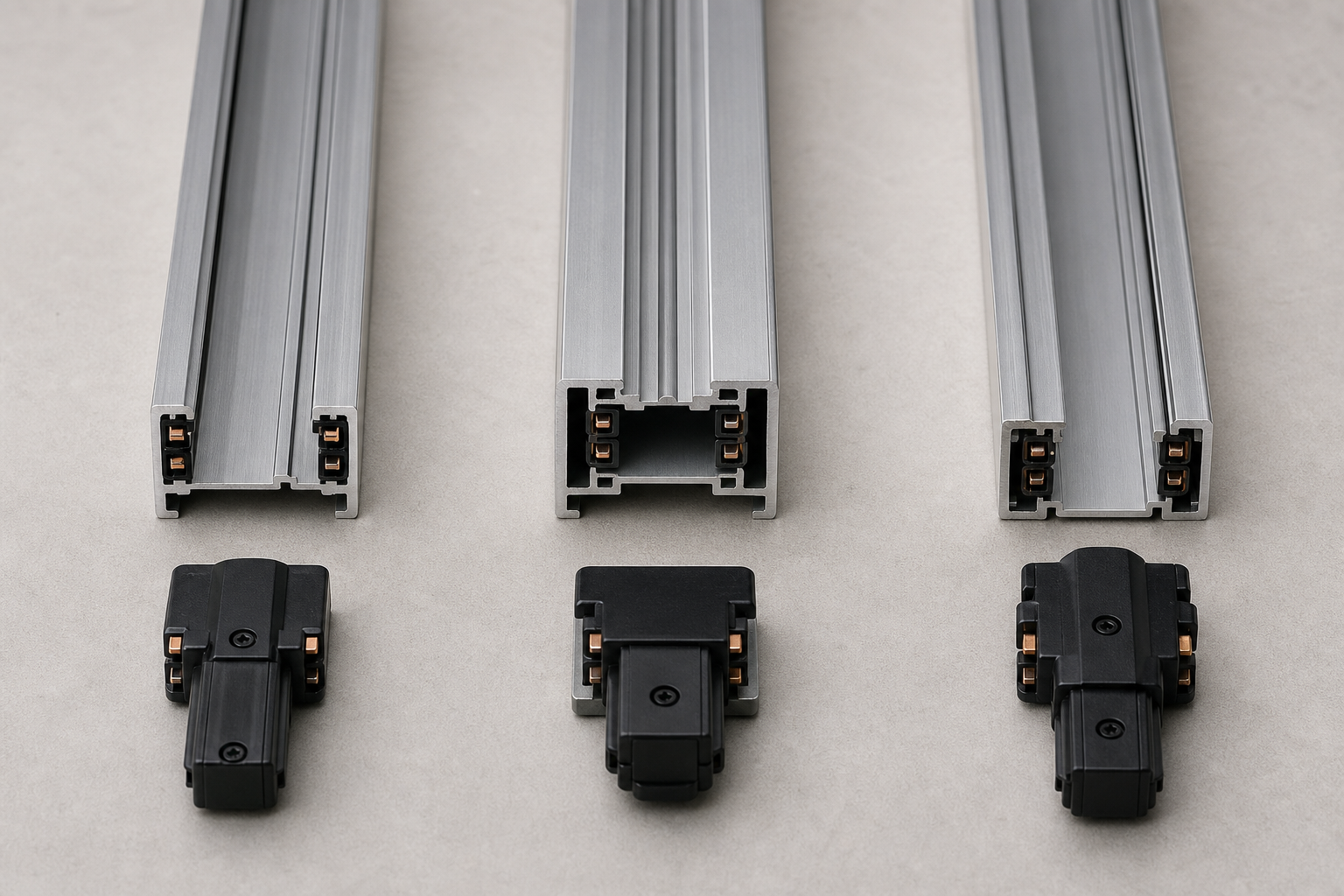
A 2-wire track rail is commonly used for a simple two-conductor low-voltage or single-feed arrangement. A 3-wire rail may add a protective-earth conductor or describe a single-circuit mains track in a particular regional convention. A 4-wire track typically refers to a system with additional switching or control capabilities, but this does not necessarily mean “three circuits.” In many commercial track series, three independently switchable live circuits require more wires than the four wires listed in a typical catalog.
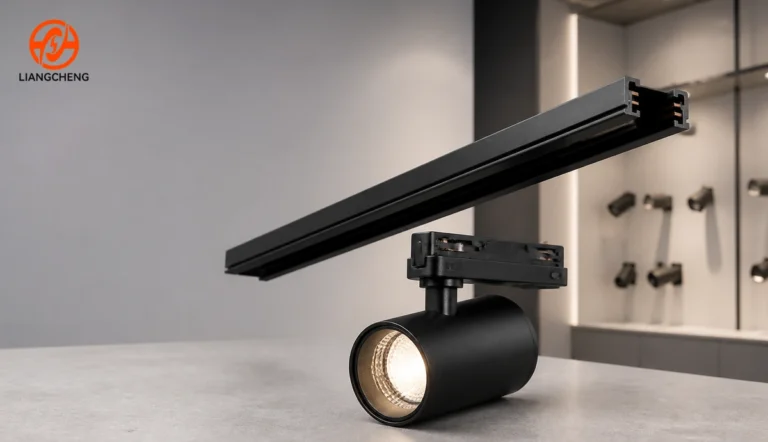
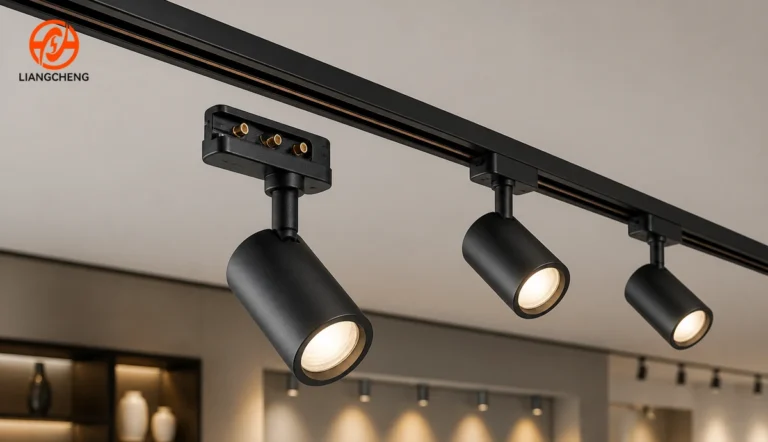
For a broader introduction to the components that make up a rail installation, see this guide to LED lighting track systems.
How do the three track rail types compare?
| Common label | Typical use | Switching flexibility | What to verify before ordering |
|---|---|---|---|
| 2-wire track rail | Simple, single-feed installations and certain low-voltage systems | Usually one lighting group | Operating voltage, driver location, polarity where applicable, and matching connector |
| 3-wire track rail | Single-circuit mains track in some product families | Usually one lighting group | Whether the third conductor is protective earth, the rail鈥檚 circuit designation, and adapter orientation |
| 4-wire track rail | Product families needing an extra conductor or control path | Depends on the manufacturer鈥檚 wiring scheme | Wiring diagram, number of independently switched circuits, dimming/control method, and accessory compatibility |
This comparison is intentionally cautious: a label alone cannot establish a safe wiring plan. The manufacturer鈥檚 current datasheet and the local electrical code take precedence over a generic rail description.
When is a 2-wire track system the right choice?
A 2-wire LED track system can be a sensible fit when every track head will operate as one group and the project does not require separately switched zones. It can reduce system complexity in small displays, feature walls, and compact retail areas. In low-voltage configurations, the driver and voltage-drop limits deserve particular attention because long rail runs can affect performance.
Choose a 2-wire option only after confirming that the track heads, adapters, and power feed are designed for that exact rail. A connector that appears to fit mechanically may not match the contact layout or electrical rating.
What should buyers know about 3-wire track rails?
A 3-wire description is commonly associated with a simple mains-powered track arrangement, but terminology differs by manufacturer and market. The third conductor may provide protective earthing; in another catalogue, the same description may be shorthand for a specific rail geometry. The important question isn’t “Does it have three wires?”, but rather “How many circuits can this track independently switch, and what is the function of each wire?”
Buyers comparing a simple rail with a multi-circuit option can also review 2-wire versus 3-circuit track rail. A 3-circuit rail is a distinct concept from a rail described as 3-wire, so product documentation should use both the circuit count and the connector specification.
When does a 4-wire rail make sense?
A 4-wire track rail is worth considering when a project needs more than a basic on/off feed and the selected manufacturer鈥檚 system uses an additional conductor for that purpose. Depending on the rail family, the extra path may support a separate switched group, a control signal, or a defined connection scheme. It should never be treated as a universal substitute for a three-circuit commercial rail.
For example, a boutique may want feature lighting to operate separately from general merchandise lighting. The correct solution could be a multi-circuit rail, a control-compatible rail, or separate rails with separate feeds. The choice depends on the switch design, driver and dimmer compatibility, and local installation requirements—not just the numbers in the product title.
How do you select the right LED track rail system?
- Map the lighting zones. Identify which fixtures must turn on, dim, or be controlled together.
- Define the electrical environment. Confirm the plans for mains or low-voltage operation, grounding requirements, local regulations, and qualified installers.
- Choose a compatible rail family. Specify rails, feed mechanisms, connectors, adapters, and heads from a single manufacturer whenever possible as tested systems.
- Check load and run length. Add the fixture load, allow suitable headroom, and confirm voltage drop or rail loading limits from the datasheet.
- Match the installation form. Surface, recessed, pendant, and suspended rails use different mounting details even when their electrical functions are similar.
Material and profile decisions matter as well. This guide d'achat de rail d'éclairage en aluminium explains practical sourcing considerations, while custom LED track rail solutions can help when dimensions, finishes, or project-specific layouts need to be specified.

Compatibility mistakes to avoid
The most expensive mistake is mixing rail and adapter families based on appearance alone. Track heads can use different contact positions, polarity conventions, locking mechanisms, and circuit selectors. Keep a sample rail, adapter, and connector together during approval, then verify the complete bill of materials before bulk purchasing.
Also avoid assuming that an LED track head is automatically dimmable. Dimming performance depends on the driver, dimming protocol, rail layout, and luminaire specifications. Before specifying tangent dimming, 0°C dimming, DALI dimming, or other control methods, request wiring diagrams and compatibility statements from the supplier.
Frequently asked questions
Can I use a 3-wire track light on a 4-wire rail?
Only if the manufacturer explicitly states that the adapter is compatible with that rail family and shows the required circuit or control position. Physical fit alone is not evidence of electrical compatibility.
Is a 4-wire track rail always better than a 2-wire rail?
No. A 4-wire rail may offer a capability needed by a particular system, but a simple single-group installation can be better served by a correctly specified 2-wire or single-circuit rail. Choose for the required function, not for the larger number.
How can I confirm the number of circuits in a rail?
Use the manufacturer鈥檚 wiring diagram and technical datasheet. Ask for the number of independently switchable live circuits, the neutral and earth arrangement, and the matching adapter part number.
Final takeaway
LED track rail types should be selected by system function and verified compatibility, not by a wire-count label alone. A 2-wire rail is often appropriate for a simple lighting group; 3-wire and 4-wire labels need closer confirmation because their meanings vary. For reliable procurement, document the rail family, circuit plan, voltage, control method, and every accessory part number before placing an order.
Besoin de solutions d'éclairage sur rail personnalisées ?
Contactez Liangcheng Lighting pour des solutions professionnelles de rails d'éclairage en aluminium en tant que fabricant d'équipement d'origine (OEM) ou fabricant d'équipement d'origine (ODM) et pour un support d'éclairage professionnel.
Connexe