






Lesezeit: 13 Minuten
Standard track rail solves a generic problem. Custom LED track rail solves your specific one.
The difference matters when you are specifying lighting for a luxury hotel where the ceiling integration must be seamless, a retail flagship where the track color has to match a precise brand palette, or a commercial office where six independent lighting zones need to be served from a single overhead track. Standard catalog products can approximate these requirements. Custom solutions fulfill them exactly.
This guide covers the complete customization landscape for LED track rail: the types of systems available, how to specify dimensions, what surface finish and color options exist, which circuit configurations serve which applications, how OEM programs work, and what separates a manufacturer capable of delivering custom solutions from one that can only talk about it.
What Is a Custom LED Track Rail System?
Understanding LED Track Rail Structure
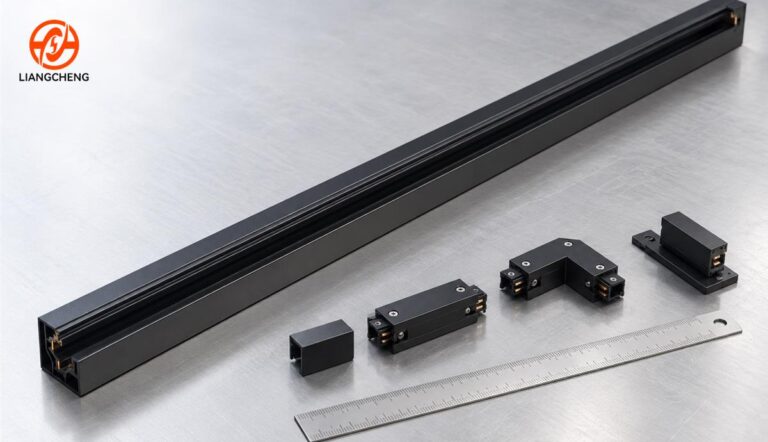
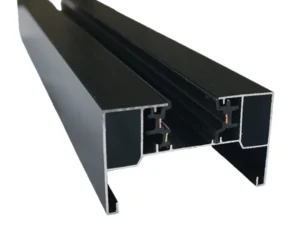
A custom LED track rail system is an aluminum extrusion-based electrical distribution system that combines structural support, power delivery, and aesthetic integration in a single linear component. Understanding the anatomy of the system makes it possible to specify each element against project requirements rather than accepting what the catalog provides.
Aluminum track rail body — the extruded 6063-T5 aluminum profile that forms the structural and electrical backbone of the system. Its cross-section geometry, external dimensions, wall thickness, and internal conductor channel configuration are the parameters that custom manufacturing can control to meet project-specific requirements.
Elektrische Leiter — copper conductors embedded within the aluminum profile’s internal channels. The number of conductors determines the circuit count; the cross-section area of each conductor (specified in mm²) determines the maximum current per circuit, which in turn determines the maximum wattage the system can carry per circuit run.
Magnetic mounting system (for magnetic track) — permanent magnets and spring-loaded electrical contacts integrated into the fixture attachment interface, allowing fixtures to attach, reposition, and detach without tools or rewiring.
Power supply system — in 48V magnetic systems, a constant voltage driver converts mains supply (110–240V AC) to 48V DC before the track. In mains voltage systems, power connects directly to the rail via a feed-in connector at one or multiple points along the run.
Verbinder und Verbindungsstücke — L-shaped, T-shaped, cross-shaped, and straight couplers that join track sections at corners and intersections. End feeds, center feeds, and live-end connectors deliver mains power from the building’s electrical system to the track at specified feed points.
Endkappen — close the open ends of the rail profile, finishing the appearance and preventing accidental contact with live conductors at rail terminations.
Installationszubehör — surface mounting clips, recessed retention brackets, ceiling suspension wire kits, wall mounting adapters, and flexible connectors for curved installations.
How Custom Track Rail Differs from Standard Products
The difference between standard catalog track rail and a custom solution is not merely cosmetic — it spans every dimension of the product specification:
| Faktor | Standard Track Rail | Custom LED Track Rail |
|---|---|---|
| Profilabmessungen | Fixed catalog sizes | Specified to project requirements |
| Stromkreisanzahl | Common configurations only | Any circuit count 1–6+ |
| Surface finish | Black, white, silver | Any RAL color, dual-tone, special texture |
| Profile cross-section | Standard catalog shapes | Proprietary cross-section design |
| Länge | Standard 1m / 2m / 3m | Cut-to-specification for the project |
| Zubehör | Generic compatibility | Project-matched and co-designed |
| Verpackung | Standard bulk | Private label, project-branded |
| Certification scope | Generic market approval | Specific to the project’s market |
The practical implication is that custom track rail allows the project specification to drive the product, rather than requiring the project to compromise around available products.
Why Custom LED Track Rail Delivers Better Project Outcomes
Flexible Lighting Design That Evolves with the Space
A custom track rail system designed for a specific project creates long-term operational flexibility that standard systems cannot match. When a retail store reconfigures its merchandise layout six months after opening, a track system designed with the right circuit count and connector geometry allows fixture positions to change without any structural modification. When a gallery rotates its exhibition, a magnetic track system custom-specified for the ceiling height and span dimensions accommodates new fixture configurations in minutes.
This flexibility has direct commercial value. For retail operators, the ability to reconfigure lighting with display changes reduces the cost of each layout update from an electrical contractor engagement to an in-house task. For hospitality operators, the ability to adjust lighting atmosphere for different events — dining service, private functions, daytime business — from a single track system eliminates the need for multiple separate lighting circuits.
Custom track rail delivers this flexibility by designing the system to the space’s operational requirements from the start, rather than adapting a generic product to circumstances it wasn’t engineered for.
Better Integration with Interior Design and Architecture
The visual integration of track rail with the ceiling and interior design is a specification priority in premium commercial environments — hotels, retail flagships, upscale restaurants, corporate headquarters — where the lighting system is a visible design element, not just functional infrastructure.
Standard track profiles in catalog black and white meet basic aesthetic requirements. Custom track rail enables:
Precise color matching — powder coating in any RAL color matches the track finish to ceiling paint colors, woodwork, or proprietary brand palettes. A flagship store specifying its brand’s precise tone across all interior elements can extend that color to the track rail itself.
Custom cross-section geometry — a profile designed for the project rather than selected from a catalog can optimize the visual proportion of the track for the ceiling height and interior scale. A very high-ceiling retail space benefits from a deeper-profile track that reads as a substantial linear element; a residential application benefits from a minimal slim profile that disappears into the ceiling plane.
Ceiling integration design — recessed track rail profiles can be co-designed with the plasterboard or millwork surround so the profile face sits flush with the finished surface and the lighting appears to emerge from the ceiling itself. This requires coordination between the profile dimension specification and the ceiling construction detail — the kind of project-specific engineering that custom manufacturing supports.
Improved Lighting Performance Through System Design
A track lighting system designed to the project’s specific luminaire types and layouts outperforms a system assembled from generic components because the electrical and thermal specifications can be optimized for actual use.
Conductor sizing matched to fixture load. A project using high-wattage fixtures on long track runs needs larger conductor cross-sections to manage voltage drop. A custom system specifies conductor size against the actual load at the actual run length — not the generic minimum that covers catalog use cases.
Circuit count matched to zone control requirements. A project requiring six independently switched and dimmed zones from a single overhead track run needs a 6-circuit system. Trying to achieve this with three separate 3-circuit tracks creates more ceiling penetrations, more feed-in connections, and higher installation cost than a single custom-specified 6-circuit system.
Thermal management for high-power applications. When fixture power density is high — museum-quality luminaires, high-output retail accent lighting — the aluminum profile’s wall thickness and cross-section area can be specified to ensure the thermal load is properly managed across the full range of ambient temperatures the installation will experience.
Custom LED Track Rail Sizes: How to Select the Right Dimensions
Common LED Track Rail Dimensions and What They Indicate
Track rail cross-section dimensions have direct implications for three areas: visual appearance, structural performance, and accessory compatibility. Each dimension should be specified intentionally, not simply accepted as whatever the catalog provides.
Profilbreite — the outer dimension across the track face. Narrower profiles (15–20mm wide) suit residential and low-ceiling commercial installations where visual minimalism is the priority. Wider profiles (25–35mm) suit commercial installations where the track must carry higher loads, accommodate larger conductor cross-sections for multi-circuit configurations, or provide greater structural stiffness on longer spans.
Profilhöhe — the dimension from the ceiling surface (or mounting surface) to the bottom face of the track. For recessed profiles, height determines how deep the ceiling cutout must be and whether the track sits within standard ceiling void depths. For surface mounted profiles, height determines how much the track protrudes from the ceiling — an aesthetic consideration in low-ceiling spaces.
Internal channel depth — determines compatibility with LED strip systems (for linear track profiles) and magnetic module geometry (for magnetic track systems). Custom cross-section design can optimize this dimension for specific LED module families.
Wandstärke — the primary thermal and structural parameter. For high-load commercial applications with fixtures above 20W per position, specifying 2.0mm+ walls ensures adequate thermal mass. For light-duty residential applications, 1.2mm walls are adequate and reduce material cost and profile weight.
Selecting Track Rail Dimensions by Application
Residential lighting applications — living rooms, kitchen overhead lighting, home office task lighting. Priority is visual minimalism: slim profile (15–20mm wide, 8–12mm high), 1.2–1.5mm wall thickness, typically single-circuit or 2-circuit configuration. Compact cross-section suits lower ceiling heights and creates a less visually prominent track presence.
Retail and commercial lighting applications — clothing stores, jewelry shops, shopping mall anchor tenants, supermarkets. Priority is operational flexibility and load capacity: medium-to-wide profile (20–30mm wide), 3-circuit or 4-circuit configuration to support independent zone control, 1.5–2.0mm wall thickness for commercial fixture loads, strong compatibility with high-output adjustable spotlights.
Architectural and specification projects — museums, galleries, hotels, corporate headquarters. Priority is ceiling integration and design quality: recessed profile with plaster-in flange geometry for flush ceiling finish, custom cross-section matched to the project’s specific fixture type, surface finish matched to the interior palette, custom accessories co-designed with the installation detail.
Custom LED Track Rail Colors and Surface Finishes
Popular Track Rail Colors by Application Context
Surface finish is the most visible quality indicator of a track rail system in an installed environment. In commercial spaces where multiple tracks are installed in a single space, color consistency across tracks — and between initial installation and subsequent additions or replacements — is a critical specification requirement.
Matt schwarz eloxiert oder pulverbeschichtet is the dominant commercial specification, particularly for retail, hospitality, and premium residential applications. Black track recedes visually against most ceiling colors, making the lighting fixtures themselves — not the track infrastructure — the visual focus. Matte black is specified for minimalist, industrial, contemporary, and luxury aesthetics equally.
Silber eloxiert is the standard for applications where the ceiling or interior palette is light or where a more neutral, less visually assertive track presence is preferred. Silver anodized has the practical advantage of revealing surface defects less readily than black finishes under close inspection, and the color consistency of 6063-T5 anodizing is well-controlled by professional manufacturers.
Weiß pulverbeschichtet is specified for retail environments with white ceiling systems, residential applications where the track is mounted on a white ceiling and visual integration requires color matching, and office environments with uniform white interior palettes. Confirm the specific white tone (RAL 9010, RAL 9016, RAL 9003) rather than specifying “white” — these tones are visibly different under lighting and require precise specification for color-consistent multi-room or multi-phase projects.
Custom RAL colors — any RAL powder coat color is available through professional OEM manufacturers, typically at a minimum order quantity threshold to justify setup costs. For branded retail environments where the track finish is part of a proprietary interior palette, custom RAL specification is the standard approach. Custom anodize colors are available for minimum order quantities and offer the durability advantage of an integral surface treatment.
Custom Surface Treatment Options
Anodisieren — the electrochemical surface treatment that converts the aluminum surface into an integral oxide layer. Available in silver (natural), black, champagne/bronze, and custom colors at minimum order quantities. Anodizing provides the most durable interior finish — scratch resistance superior to paint, no peeling or flaking over the product life, and self-repairing properties for minor surface damage. Standard interior anodizing: 10–15 microns. Outdoor or heavy-duty commercial: 15–25 microns.
Pulverbeschichtung — thermosetting polymer finish providing the widest color range (full RAL palette), good UV resistance in outdoor formulations, and color options not achievable through anodizing. Thickness typically 60–100 microns. The additional thickness must be factored into accessory fit specifications — diffuser covers and mounting clip dimensions should be specified for powder-coated tolerances.
Brushed aluminum — mechanical surface finish created by abrasive brushing in the extrusion direction, producing a linear grain texture. Popular in Scandinavian and industrial design contexts. Typically combined with a clear anodize topcoat for durability. Available as a custom finish option from specialized manufacturers.
Dual-finish profiles — some architectural specifications require different finishes on different surfaces of the same profile: for example, a recessed track profile with a white powder-coated face (matching the ceiling) and a silver anodized body (visible from below). This dual-finish specification is achievable but requires specific manufacturing capability and adds process steps and cost.
Custom LED Track Rail Circuit Design Options
Magnetic Track Rail Design
Magnetic track rail represents the most operationally flexible track system design currently available. The core characteristic — tool-free fixture attachment and repositioning via permanent magnet connection — transforms track lighting from a semi-fixed installation into a truly reconfigurable system.
48V DC magnetic track operates at low voltage, which provides a safety advantage in environments where people may come into direct contact with the track (retail display fixtures at accessible heights, museum spaces with ladder access for art handling). The 48V system requires a constant voltage driver converting mains supply before the track. Driver location — ceiling-mounted at the feed point, or remote in a ceiling void — is a coordination detail that should be resolved in the design phase.
Mains voltage (110–240V AC) magnetic track eliminates the driver requirement, simplifying the electrical connection and reducing component cost. The tradeoff is that mains voltage conductors in an accessible track position require appropriate IP rating and safety considerations that the electrical specification must address.
Track width and fixture compatibility — magnetic track systems are available in widths of 20mm, 25mm, 26mm, and 35mm (among others). The track width determines which fixture modules are compatible. For custom projects, confirm that the specified track width is compatible with the fixture range being specified — and that the same track-width standard is available from both the track manufacturer and the fixture manufacturer if these are different suppliers.
Recessed LED Track Rail Design
Recessed track rail installs within a pre-cut ceiling channel, flush with the finished ceiling surface. From below, only the track face — and the fixtures attached to it — are visible. The aluminum profile body is completely concealed within the ceiling void.
For architectural and high-end projects, the recessed installation geometry is the starting point for the design specification, not an afterthought. The profile cross-section must be dimensioned to fit within the available ceiling void depth, the mounting flange must be compatible with the ceiling construction method (plasterboard, timber, concrete), and the finish must coordinate with the adjacent ceiling surface.
Plaster-in profiles — a specialized recessed profile design where a wide flange projects horizontally from the profile body, allowing joint compound to be applied over the flange during ceiling construction. The result is a lighting installation with no visible perimeter gap between the track and the ceiling — the light appears to emerge directly from the architecture. This requires coordination between the track profile specification and the ceiling contractor’s finishing schedule, and is most cost-effectively incorporated into new construction or major renovation projects.
Surface Mounted Track Rail Design
Surface mounted track attaches directly to the ceiling or wall surface, providing the fastest installation and the most accessible system for retrofit projects in occupied spaces. The profile body and its full height are visible from below — making surface finish quality and profile geometry aesthetic choices as much as technical ones.
For custom surface mounted track programs, the cross-section design should consider the visual proportion of the track in relation to the ceiling height and the interior scale. A 25mm × 12mm profile reads as appropriately sized in a 2.8m office ceiling; the same profile in a 4m retail space may appear undersized relative to the scale of the fixtures it carries. Custom profile development allows the cross-section to be proportioned to the specific project context.
Suspended LED Track Rail Design
Suspended track hangs from the ceiling via cable or rod suspension systems, placing the track in open space below the ceiling surface. The visual character of suspended track — a defined linear element floating in the space — contributes to the architectural character of the environment. This makes suspended track particularly effective in high-ceiling spaces where bringing the light source closer to the occupied level improves both illumination efficiency and spatial proportion.
Custom suspended track programs address several project-specific requirements: suspension point spacing to match the structural ceiling elements available for anchoring; suspension depth to achieve the target track height; and power routing strategy (through the suspension cable, through a separate cable, or via surface-mounted conduit on the ceiling) to conceal electrical connections.
How to Customize LED Track Rail for Different Commercial Applications
Retail Store Lighting Solutions
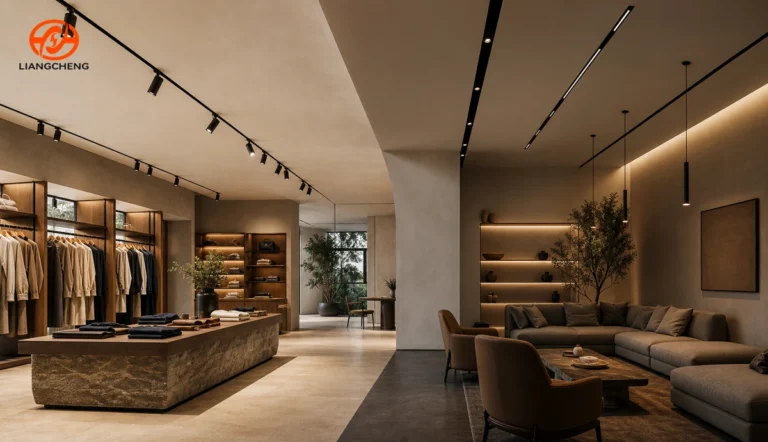
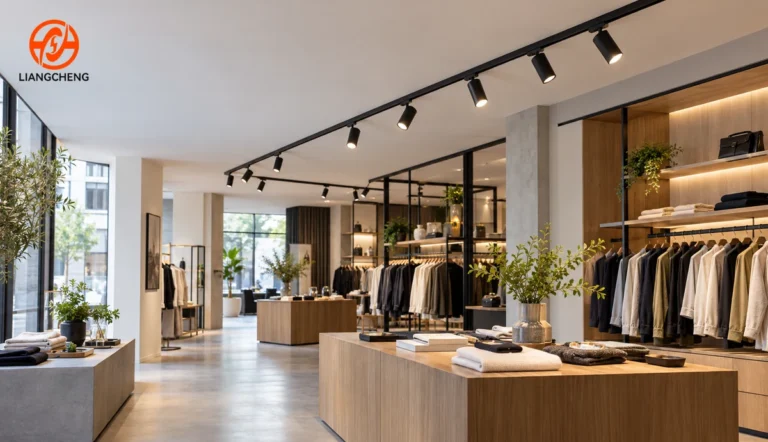
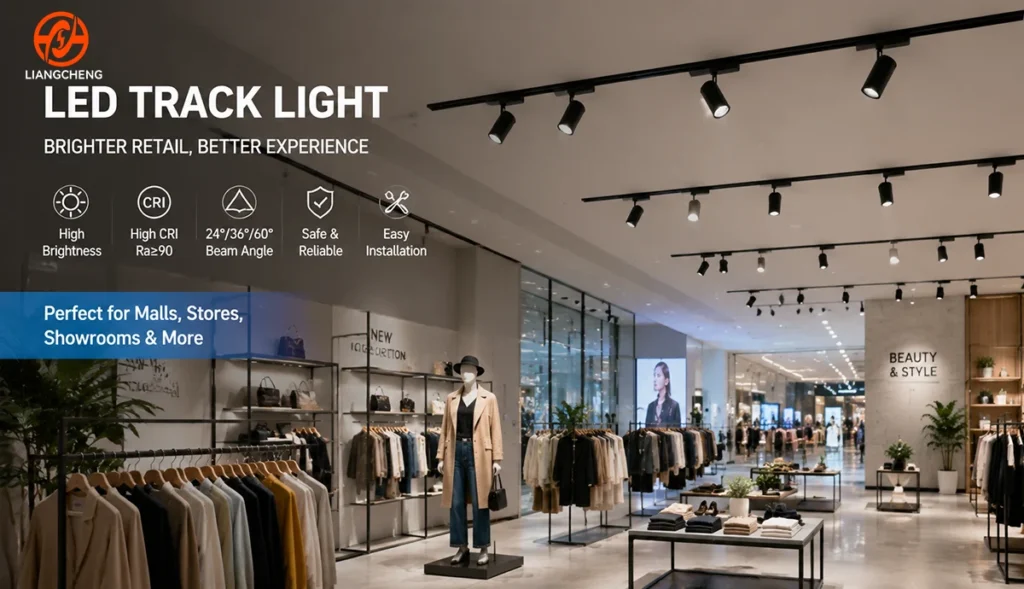
Retail track lighting must balance two often-conflicting requirements: enough fixture flexibility to adapt to changing merchandise layouts, and enough visual quality to enhance product presentation and support the brand aesthetic.
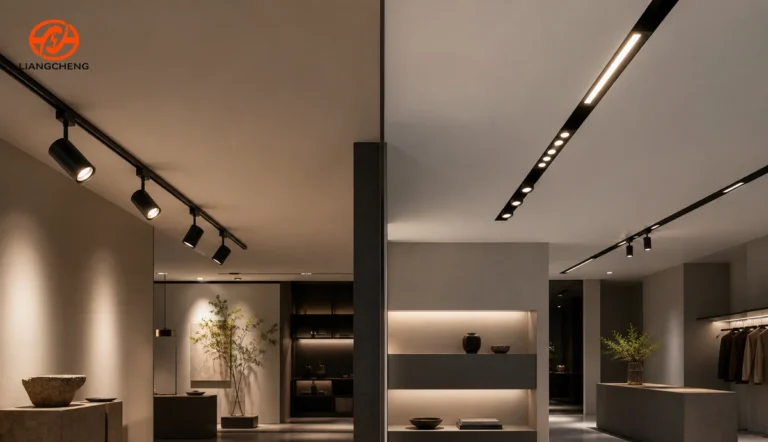
The specification choice that most directly addresses both requirements simultaneously is a magnetic track system in the appropriate surface finish for the retail brand palette. Magnetic systems allow merchandise display positions to change without any infrastructure modification — a critical operational advantage for fashion and accessory retailers that reconfigure displays monthly or seasonally.
For jewelry and high-value specialty retail, high-color-rendering fixtures (CRI 95+) on 3-circuit or 4-circuit track provide independent control over ambient, accent, and display case lighting from a single overhead track system. The ability to dim each circuit independently supports different operational modes (opening preparation, retail hours, cleaning/security) from a single installation.
Hotel and Hospitality Lighting Solutions
Hospitality environments impose the most stringent combination of aesthetic and performance requirements on track lighting systems. The appearance must meet premium interior design standards; the performance must remain consistent across years of continuous commercial operation; and the system must support the operational flexibility that hotel operations require.
For guest rooms, recessed magnetic track in custom finish color (matched to the room interior palette) with 48V fixtures serves as the primary ambient and accent system. The magnetic repositioning capability supports housekeeping and layout adjustments without specialized technical staff.
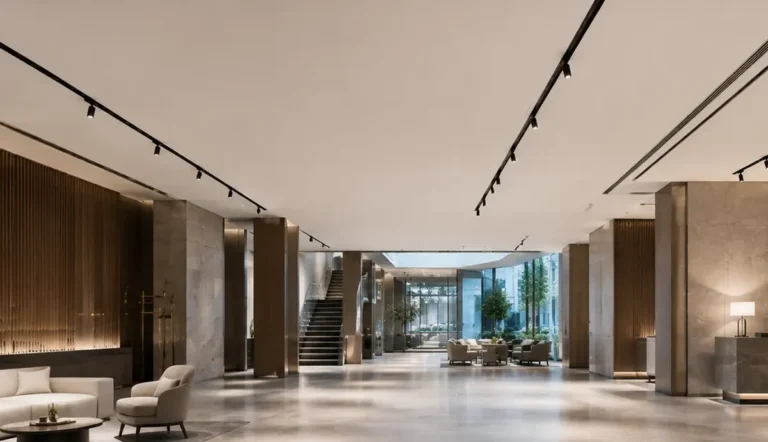
For public areas — lobbies, restaurant dining rooms, bars — suspended or surface mounted track in architecturally detailed profiles, custom cross-section, and premium anodized finish creates a lighting installation that contributes to the interior architecture rather than simply delivering functional illumination. The custom surface finish specification is particularly important in hospitality contexts where the same interior specification must be reproduced consistently across multiple properties in a brand portfolio.
Office Lighting Solutions
Commercial office environments specify track lighting for its flexibility in serving variable floor plate organizations and its compatibility with the modern aesthetic preferences of workplace design. The shift from traditional grid-based ceiling systems to track-based overhead lighting reflects the recognition that fixed grid spacing rarely aligns optimally with furniture arrangements that change as teams and organizations evolve.
For open-plan offices with suspended track systems, the specification priorities are: adequate circuit count for the zone control strategy (separate circuits for different seating areas, meeting areas, and circulation zones); compatibility with dimming and tunable white control protocols (DALI, 0-10V) for circadian lighting programs; and suspension hardware that integrates cleanly with the ceiling structure without requiring modification.
Wohnraumbeleuchtung
Premium residential track lighting has moved away from utilitarian surface-mounted track toward integrated systems that serve as architectural lighting elements. Recessed track in slim custom profiles for kitchen islands and dining areas, recessed magnetic track for living areas where flexible spotlight positioning adapts to furniture arrangements and artwork positions, and suspended track for high-ceiling dining and living rooms.
The residential custom specification differs from commercial in scale (shorter runs, smaller total meters) and quality priority (surface finish quality and design integration matter more than operational flexibility documentation). Premium residential buyers are willing to pay for the correct cross-section and finish — not the closest available standard product.
Materials Used in Custom LED Track Rail Manufacturing
Why 6063-T5 Aluminum Is the Foundation of Quality Custom Track Rail
Every custom LED track rail specification builds on the material foundation of 6063-T5 aluminum alloy. The thermal conductivity of approximately 200 W/m·K ensures effective heat management from both the current-carrying conductors and any LED components in thermal contact with the rail. The exceptional extrudability enables complex multi-chamber cross-sections — multiple conductor channels, mounting grooves, diffuser retention features, and external aesthetic details — all within a single precision extrusion.
The surface quality that 6063 produces directly from extrusion is the prerequisite for consistent, high-quality anodizing and powder coating results across production batches. Recycled or blended aluminum alloys with irregular surface characteristics produce inconsistent surface treatment results — visible as color variation between profiles in the same installation, a defect that is particularly conspicuous in long linear track runs.
Confirm that any supplier offering custom track rail can document 6063-T5 alloy specification with material certificates for each production batch. This documentation is the baseline verification that the material foundation of the custom solution meets the specification it is supposed to deliver.
Aluminum vs. Plastic Track Rail: The Comparison That Ends the Discussion
For any commercial application, the comparison between aluminum and plastic track housing resolves quickly across every relevant dimension:
| Immobilie | 6063-T5 Aluminum | Polycarbonate / ABS Plastic |
|---|---|---|
| Wärmeleitfähigkeit | ~200 W/m·K — effective heat dissipation | ~0.2 W/m·K — thermal insulator |
| Structural stiffness | Adequate for commercial spans | Insufficient for spans above 500mm |
| Surface quality | Anodizable, consistent finish | Limited to paint/coating; degrades with UV |
| Feuervorführung | Non-combustible | Combustible; self-extinguishing at best |
| Service life | 20–30+ years | 5–8 years in commercial environments |
| Customization depth | Full OEM cross-section, finish, dimension | Limited to injection mold tooling |
| Recyclingfähigkeit | Fully recyclable, residual value | Begrenzt |
Plastic track housing is used in low-cost decorative applications where thermal management is irrelevant (very low power density LEDs) and where longevity is not a primary consideration. For any commercial, architectural, or specification-grade application, aluminum is the only practical material choice.
OEM and ODM Services for LED Track Rail Buyers
Custom Manufacturing Process: From Concept to Production
A professional OEM LED track rail manufacturer follows a structured development process that converts a project specification into a production-ready product:
Step 1: Project requirement analysis — engineering review of the project specification: dimensions, circuit configuration, surface finish, accessory requirements, certification scope, target market, and volume. This stage identifies any specification conflicts or technical constraints before tooling investment begins.
Step 2: Cross-section design and confirmation — for new die development, the engineering team prepares a cross-section drawing that meets the specification requirements while optimizing for extrudability, material efficiency, and accessory compatibility. Buyer approval of the final drawing before die cutting is the critical checkpoint.
Step 3: Die development — precision steel extrusion die machined to the approved cross-section specification. Standard complexity LED track rail dies: 7–15 days, RMB 3,000–10,000. Complex multi-chamber dies for multi-circuit systems: 10–20 days, RMB 8,000–20,000.
Step 4: First samples — extrusion of the first samples from the new die, typically 3–5 days after die completion. First samples are evaluated against the specification for dimensional accuracy, surface quality, accessory fit, and electrical performance (conductor continuity, circuit isolation).
Step 5: Sample approval and production authorization — buyer approval of first samples, with or without specified dimensional or finish modifications. Sample modifications may require die adjustment (additional 3–7 days and modification cost) or process adjustment (no additional die cost).
Step 6: Production — aluminum extrusion, cutting, surface treatment, assembly, quality inspection, and packaging. Production lead time from order confirmation: 15–25 days for most custom configurations.
Full Customization Options Available from Professional Manufacturers
A manufacturer with genuine OEM capability for LED track rail can deliver:
Custom profile cross-section — proprietary die providing a track shape not available from any catalog. This is the highest level of product differentiation: competitors and direct customers cannot source the same profile without their own tooling investment.
Custom dimensions — specific width, height, wall thickness, and internal channel geometry matched to the project’s fixture types, ceiling void depth, and structural requirements.
Logo-Branding — die embossing of brand marks into the aluminum profile body during extrusion (permanent, no additional process step), or post-extrusion printing or engraving on end caps and accessories.
Kundenspezifische Verpackung — project-branded cartons, retail packaging for distribution programs, and labeled component sets for installation teams.
Custom accessory design — end caps, mounting clips, and connector housings designed to the profile’s specific geometry rather than adapted from a generic accessory catalog.
Color and finish specification — any RAL powder coat color, custom anodize, brushed finish, or dual-finish configuration.
Cost Factors for Custom LED Track Rail Solutions
What Determines Custom Track Rail Pricing
Custom track rail pricing involves several cost components that standard catalog pricing does not include. Understanding each component helps buyers evaluate supplier quotes and plan procurement budgets:
Aluminiummaterialkosten — the largest variable cost component, tied to LME aluminum commodity pricing. Quotes significantly below current aluminum market pricing signal material quality compromise. Custom cross-sections with higher wall thickness and more aluminum per meter cost more than lightweight standard profiles.
Profile complexity and extrusion efficiency — complex multi-circuit cross-sections with multiple internal chambers require more precision tooling and slower production speeds than simple single-circuit profiles. This affects both die cost and unit production cost.
Tooling (die) cost — a one-time charge for new cross-section development, typically amortized over the initial production run. Confirm die ownership before authorizing tooling spend — the die should be yours, not the factory’s.
Oberflächenbehandlung — anodizing and powder coating add cost; custom colors add setup costs. Dual-finish configurations add process steps and cost.
Zubehör inklusive — complete kit pricing (profile + conductors + diffuser cover + end caps + mounting clips) costs more than profile-only pricing but reduces assembly work and simplifies customs classification.
Bestellmenge — price per meter decreases substantially at volume. Custom profiles typically have higher MOQ requirements than standard catalog products (500–1,000 meters minimum per SKU) due to the setup costs involved.
How to Reduce Custom Manufacturing Costs
Reuse existing dies where possible. If the required cross-section closely matches a die the manufacturer already has, a die modification (adding or removing material from the existing die) is substantially cheaper than a new die. Ask suppliers whether existing tooling can be adapted before authorizing new die development.
Standardize within the project family. If multiple projects use similar track systems, standardizing on a single cross-section across the portfolio justifies a larger initial tooling investment while reducing per-project die costs and ensuring accessory compatibility across the range.
Bestellen Sie Mengen in Containerladungen. Custom track rail at container volumes (typically 5,000–15,000 linear meters depending on profile weight) attracts the strongest volume pricing and justifies the logistics overhead of international freight.
Finalize specifications before tooling. Design changes after die cutting incur modification costs (RMB 500–2,000 per change) or new die costs if the change is substantial. Complete the specification review process thoroughly before authorizing die production.
Common Mistakes When Ordering Custom LED Track Rail
Auswahl von Lieferanten ausschließlich nach dem Preis
The lowest quoted price for custom track rail almost always reflects a compromise on one or more of the following: material alloy quality (recycled or blended rather than 6063-T5), wall thickness below the stated specification, die quality that produces dimensional drift after the first few production runs, or omission of accessories that appear in competitor quotes. For custom programs where die investment has been made and supply continuity matters, a supplier who cuts costs on material quality is a liability, not a savings.
Specifying Without Project Coordination
Custom track rail dimensions must be coordinated with ceiling construction details before tooling begins. A recessed profile specified with a flange depth that doesn’t match the plasterboard thickness requires die modification after the fact — at additional cost and delay. Suspended track with suspension points at fixed centers that don’t align with the ceiling structure requires field-fabricated solutions that undermine the design intent. Resolve all installation details in the specification before authorizing die development.
Not Testing Samples Across the Full Specification
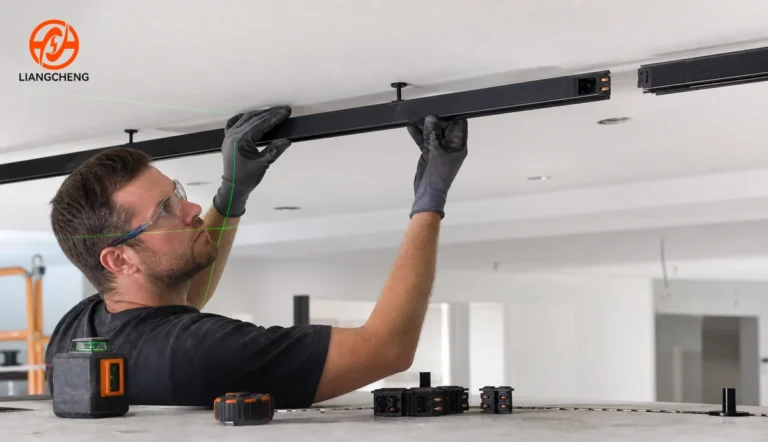
A sample that passes dimensional inspection and surface quality review against the specification drawing is not a complete approval. Before authorizing bulk production, test samples for: electrical continuity across the full conductor run, circuit isolation between conductors at operating voltage, compatibility between the track profile and the specified fixture adapters, and fit between the profile and the specified ceiling construction accessories. Field incompatibilities discovered after production are far more expensive to resolve than those caught at the sample stage.
Häufig gestellte Fragen
Can LED track rails be customized in different sizes? Yes — custom LED track rail manufacturing can produce any cross-section within the practical limits of aluminum extrusion, covering width, height, wall thickness, and internal conductor channel geometry. Size customization requires new die development (7–15 days, cost amortized over initial production run). Standard catalog modifications (shortened cut lengths, modified flange profiles) can typically be done without new die tooling.
What colors are available for aluminum track rails? Standard catalog colors are typically silver anodized, matte black (anodized or powder coated), and white powder coated. Custom colors are available as any RAL powder coat color, custom anodize colors at minimum order quantities, and specialty finishes including brushed aluminum and dual-finish configurations. Custom color specification requires written RAL or Pantone reference to ensure reproducible results across production batches.
What is the MOQ for custom LED track rails? Standard catalog products: 200–500 linear meters per SKU from most manufacturers. Custom profiles with new die development: 500–1,000 linear meters minimum per SKU to justify tooling investment. Full container load quantities (5,000–15,000 meters depending on profile weight) attract the most competitive pricing. Confirm MOQs specific to your profile type and customization level in the initial supplier inquiry.
How long does custom track rail production take? New die development: 7–15 days. First sample production: 3–5 days after die completion. Sample review and approval (with potential modifications): 5–10 days. Bulk production after approval: 15–25 days. Sea freight transit to destination: 14–40 days. Total from tooling authorization to arrival: approximately 45–70 days for first production. Repeat orders (same die, approved specification): 15–25 days production plus shipping.
Can manufacturers create entirely new track rail designs? Yes — OEM manufacturers with in-house engineering and die development capability can develop new track rail cross-sections from scratch based on a performance and dimensional specification. The development process includes cross-section drawing and buyer approval, die manufacture, first sample production, and sample approval before bulk production. New cross-section development produces a product that is proprietary to the buyer and unavailable to competitors without independent tooling investment.
What aluminum alloy is used for LED track rails? 6063-T5 aluminum alloy is the industry standard for LED track rail manufacturing. It provides thermal conductivity of approximately 200 W/m·K for effective heat dissipation from conductors and LED components, exceptional extrudability for complex multi-chamber cross-sections, and outstanding anodizing performance for consistent surface finish quality. Request material certificates confirming 6063-T5 specification when evaluating suppliers — particularly important for custom programs where material substitution risk is a real quality concern.
Conclusion: Building Custom LED Track Rail Solutions That Last
The value of a custom LED track rail solution is not measured at the point of purchase — it is measured across the service life of the installation. A system specified to the exact dimensions, circuit configuration, surface finish, and accessory compatibility of the project performs better, installs more cleanly, and requires less adaptation than a standard product forced to fit circumstances it wasn’t engineered for.
The specification process described in this guide — defining dimensions to the application, selecting circuit configuration to the zone control requirement, specifying surface finish to the interior design standard, and verifying OEM capability before tooling investment — produces installations that deliver the design intent reliably.
The right manufacturing partner for a custom LED track rail program is one who brings engineering capability to the specification process, not just production capacity to fulfill it.
Jiangmen Liangcheng Lighting: Custom Track Rail Systems Built for Commercial Projects
For lighting distributors, architects, and project contractors who need a manufacturing partner with genuine custom capability, Jiangmen Liangcheng Lighting Co., Ltd. provides the engineering depth and production infrastructure that custom LED-Schienenstrahler programs require.
Benötigen Sie individuelle Schienensystemlösungen?
Kontaktieren Sie Liangcheng Lighting für OEM/ODM Aluminium-Schienenlösungen und professionelle Beleuchtungsunterstützung.
Bezogen