








Read time: 12 minutes.
Quick answer: Track lights can flicker because a single head or its adapter has an intermittent connection, the LED driver and dimmer do not work together, a shared feed or control circuit is unstable, or a driver overheats or fails. The pattern identifies the next check: one head suggests a local fault; every head on one run suggests a shared feed or control; flicker only at low brightness suggests a dimming issue; flicker after warm-up suggests a heat-sensitive component. Switch off and isolate the circuit before any physical inspection. Burning smell, arcing, discoloration, repeated trips, or flicker across unrelated circuits warrants prompt inspection by a qualified electrician.
What counts as track light flicker?
Track light flicker is an unwanted change in light output over time. It can appear as a brief blink, a rapid shimmer, a periodic pulse, or complete dropouts. The word “strobe” often describes an especially noticeable pulsing effect, but a phone camera can also show dark bands from normal camera-light interaction. A visible band in a video is a clue, not proof of a defective installation.
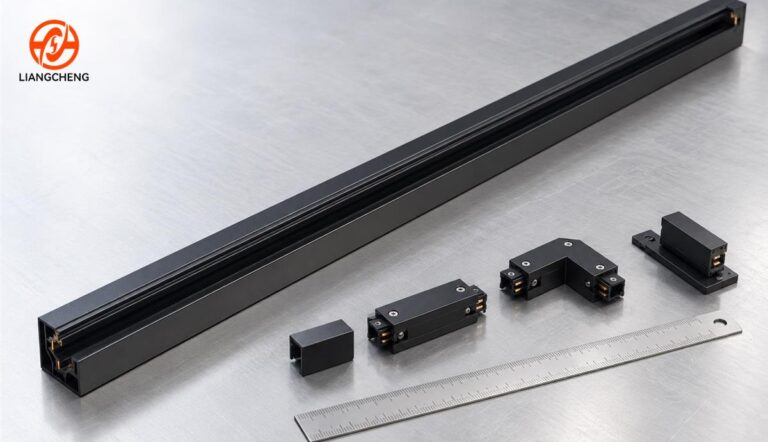
A track lighting system includes a power feed, a conductive rail, a mechanical and electrical adapter, a luminaire, and usually an LED driver. A dimmer, 0-10 V controller, DALI controller, or building control system may add another layer. Each layer has different failure patterns. A rail is a distribution component; it does not stabilize a poor driver or make incompatible controls compatible. The track rail versus track light guide explains which parts belong to each side of the system.
Visible flicker and stroboscopic effects are related but not identical. Direct flicker is a perceived change in brightness while the observer and scene are relatively still. A stroboscopic effect changes the apparent motion of moving objects under modulated light. A store owner who sees rapid pulsing should record the symptom, but the remedy depends on whether the cause is a faulty connection, control setting, driver, or supply.
Which symptom should you investigate first?
The safest first step is observation. Record which heads flicker, whether they move together, when the problem starts, the dimming level, and whether another load starts at the same moment. Do not move, twist, or remove an energized track head to “see if it reacts.” That can turn a minor contact problem into an arcing hazard.
| Observed pattern | Likely area to investigate | First controlled check |
|---|---|---|
| Only one head flickers | Lamp, adapter engagement, contacts, or driver in that head | Isolate power; compare that head with a known-good compatible unit |
| All heads on one rail flicker together | Rail feed, connector, dimmer, control channel, or branch circuit | Record whether the same heads share one feed and controller |
| Only one circuit group flickers on a multi-circuit rail | That circuit’s feed, adapter selection, control channel, or load | Map the affected group without changing the wiring |
| Flicker only when dimmed | Control-driver compatibility, dimming protocol, minimum load, or trim | Compare full output with several dimming levels |
| Flicker begins after warm-up | Driver thermal behavior or a connection affected by heat | Log elapsed time and ambient conditions |
| Several unrelated lights dip together | Upstream supply, branch circuit, or large-load interaction | Call a qualified electrician if the pattern repeats |
A pattern is a starting hypothesis, not a diagnosis. One head can flicker because its own driver is faulty, but it can also be the first unit to reveal an upstream voltage or dimmer problem. Likewise, several heads can appear synchronized because they use identical drivers. Confirm the hypothesis with a controlled substitution and electrical measurements by qualified personnel.

Why does only one track light flicker?
A single flickering head points first to local parts: a replaceable lamp, an integrated LED driver, an adapter that is not fully locked, or a damaged contact. It does not automatically mean the rail is bad. A qualified technician should isolate the circuit, verify absence of voltage with an appropriate tester, allow the fixture to cool, and then inspect the adapter and rail position according to the manufacturer’s instructions.
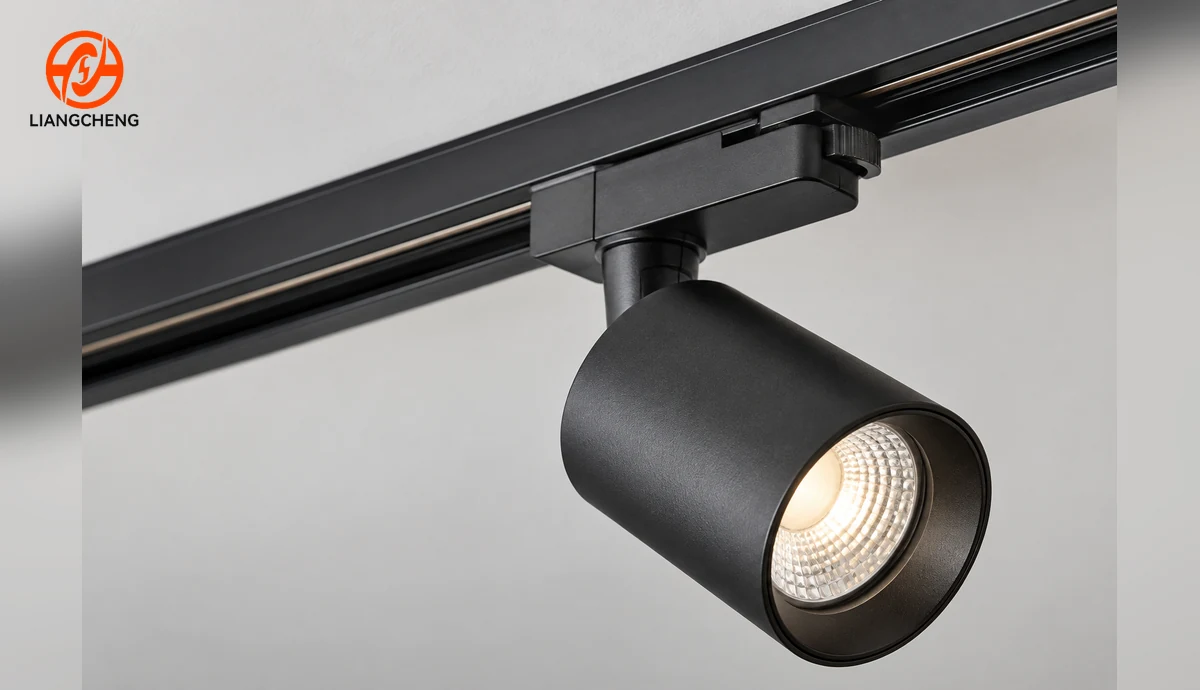
Track adapters are system specific. An H-type, J-type, L-type, or proprietary adapter can look close to another format yet fail to seat or contact correctly. Multi-circuit adapters may also have a selector or orientation requirement. Forcing an adapter into the rail or using a mechanically similar but electrically incompatible part can damage the contacts. The adapter compatibility checklist details the fit and circuit checks buyers should complete before rollout.
A controlled swap helps separate a head fault from a rail-position fault. With power isolated, a technician can move the suspect head to a known-good position on the same approved rail system, or place a known-good compatible head at the suspect position. If the symptom follows the head, inspect its lamp or driver. If it stays at the rail position, inspect the conductor, connector, feed, and mechanical condition of that section. Record the result rather than repeatedly moving heads while the circuit is live.
Visible pitting, discoloration, melted plastic, a loose locking mechanism, or a head that will not remain seated calls for replacement or further electrical inspection. Cleaning alone does not restore a damaged contact surface or correct a poor mechanical fit. A maintenance team should use only the cleaning method and replacement parts approved for that exact track family.
Why do all heads on one track flicker together?
When several heads on one run pulse at the same time, investigate what they share. That may be the track’s input connector, a dimmer, a relay, a control channel, a low-voltage power supply, or a branch circuit. Replacing all heads first is inefficient because synchronized behavior suggests a common cause. A qualified electrician should test the shared path and confirm that the rail and feed are correctly rated for the installed load.
Multi-circuit track needs a more precise question: do all heads flicker, or only heads assigned to one circuit? A single affected group points toward that circuit’s feed or control path. The physical rail can contain multiple conductors, so two heads on the same length of aluminum may not share the same switched supply. The single-circuit versus multi-circuit guide helps explain why circuit mapping matters.
Track connectors are another shared interface. End feeds, center feeds, joiners, and corners must be approved for the chosen rail profile and conductor arrangement. A loose or mismatched connector can create intermittent output downstream. The symptom may appear after vibration, a ceiling movement, or a new head installation. Any sign of heat or arcing at a connector means the circuit should remain off until the part and adjacent conductors are inspected.
Why do track lights flicker only when dimmed?
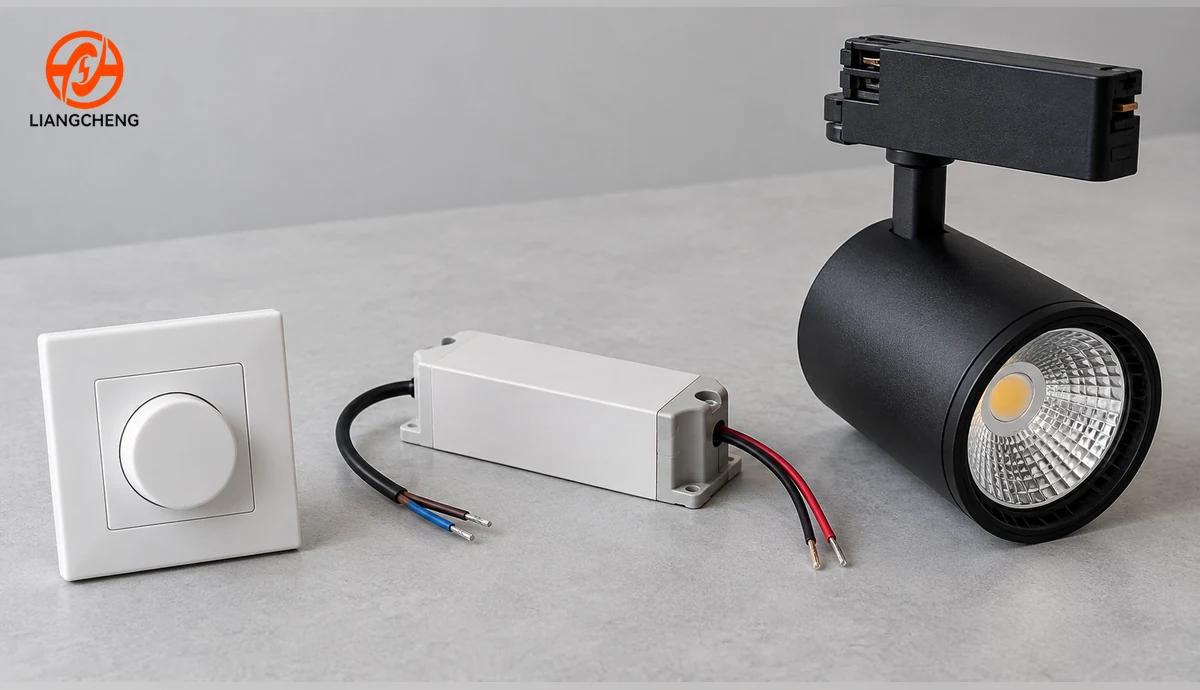
Flicker limited to part of the dimming range often indicates a mismatch between the LED driver and the control method. A driver labeled “dimmable” still needs a compatible protocol and operating range. Phase-cut, 0-10 V, DALI, and proprietary controls are different interfaces; one cannot assume that a driver designed for one will respond correctly to another. Confirm the driver model, controller model, wiring diagram, and commissioned settings before replacing hardware.
A phase-cut dimmer can also have a minimum or maximum LED load and a low-end trim setting. Too little load or a low-end setting below the driver’s stable range can produce shimmer, dropout, or flashing. Some controllers can be adjusted; others require a different compatible driver or control. Leading-edge and trailing-edge behavior can matter, but neither is universally correct for LEDs. Follow the specific driver’s compatibility list and the control manufacturer’s tested combinations.
A useful non-invasive test is to observe the same heads at full output, mid output, and the lowest commissioned setting. If flicker occurs only at the bottom, ask the controls specialist to review low-end trim and driver compatibility. If it occurs at full output too, the control may still be involved, but a feed, driver, or connection problem becomes more plausible. Do not bypass a dimmer or alter wiring as a casual troubleshooting shortcut; that is electrical work for qualified personnel.
Mixed driver families on one control channel can behave differently at the same command. In a retail retrofit, one new luminaire model may flicker while older heads remain stable. A sample trial should therefore include the exact head, driver revision, dimmer, circuit load, and target dimming range. The track rail sample approval process shows how to document a repeatable system test before bulk procurement.
Why does flicker start after the lights have been on for a while?
Flicker that begins after a repeatable warm-up period can indicate a heat-sensitive LED driver, an overheating power supply, or an electrical contact that changes behavior as it warms. The delay is evidence, but it is not proof that the driver alone is defective. A technician should log the time to failure, ambient temperature, dimming level, number of operating heads, and whether the problem clears after cooling.
Check the manufacturer’s thermal installation requirements before replacing a driver. A track head can overheat if its ventilation is obstructed or if a retrofit places a component into an unsuitable enclosure. A remote driver can overheat when installed in a confined ceiling space beyond its allowed ambient temperature. The correct remedy may be relocation, reduced load, a compatible replacement driver, or replacement of the luminaire, depending on the equipment design.
A burning odor, smoke, melted insulation, or a hot connector is not a routine “warm-up flicker.” Switch off and isolate the affected circuit, keep it out of service, and arrange inspection. Do not continue repeated trial runs to reproduce a symptom that may indicate arcing or thermal damage.
Can supply voltage or another appliance cause track lighting to flicker?
Supply disturbances can make several lighting loads dip together. A motor or other large load can briefly affect voltage when it starts, while a recurring or severe dip may point to a wiring, distribution, or utility issue. Observe whether the same event affects other lights on the branch circuit or in other areas. That distinction helps an electrician decide where to measure, but it does not justify opening a panel or tightening a neutral without training.
Loose or failing neutral connections can produce dangerous voltage behavior and should be treated seriously, especially when unrelated circuits brighten and dim irregularly. The site electrician should inspect the installation using appropriate isolation and test procedures. If the problem extends beyond the premises, the utility may need to investigate. Do not treat every appliance-related dip as proof of a loose neutral; it is one possible cause among several.
An LED track system’s electrical capacity must be evaluated as a complete assembly. Rail current rating, feed rating, connector rating, branch protection, driver inrush, and the number of luminaires can all limit a design. Adding head wattages is necessary but does not capture inrush or control compatibility. For bulk projects, request a schedule that states the circuit assignment and total connected load for every rail run.
Do magnetic or low-voltage tracks need a different diagnosis?
Yes. A magnetic track commonly uses a separate low-voltage power supply and a proprietary fixture-to-rail interface. If every magnetic head flickers, the shared supply, its load range, voltage drop, and control protocol are primary suspects. A conventional line-voltage track may instead distribute mains power to drivers inside each head. The same symptom can therefore come from a different part of the system.
Do not assume that a conventional track head, magnetic head, adapter, rail, or supply can be interchanged. Matching physical size does not establish electrical compatibility. The track rail versus magnetic track comparison explains the system-level differences that affect replacement and troubleshooting. A qualified installer should check the manufacturer’s approved combinations before testing alternative heads.
What can a phone camera tell you about flicker?
A phone camera can help document visible changes or reveal banding that the eye does not notice, but it cannot certify a luminaire as flicker-free. Rolling shutter, shutter speed, frame rate, exposure control, and the light’s modulation can create or hide bands. A steady-looking video is also not proof of low temporal modulation. Use video as a repeatable record of the complaint, not as the acceptance criterion.
When a project requires measured flicker performance, specify the operating conditions and use appropriate measurement equipment and methods. Record full output and the dimming levels used in the space, because driver behavior can change with control setting. Define the metric and limit in the purchase specification rather than relying on phrases such as “no flicker.” Lighting teams should also distinguish discomfort complaints from camera requirements for filming or live displays.
When should the rail or head be replaced?
Replace a head when its driver or lamp assembly has failed and the approved service method does not allow a reliable repair. Replace a rail section or connector when its conductors or insulation show pitting, deformation, corrosion, heat damage, or loss of mechanical retention. A driver replacement does not fix damaged rail contacts, and a new rail does not fix an incompatible dimmer.
Before approving replacements, verify rail profile, circuit count, adapter keying, electrical rating, connector family, mounting method, and finish. A distributor handling several product families should not assume that a head that mechanically enters a rail is safe or electrically correct. The track rail quality checklist and rail accessories guide can support a consistent replacement specification.
What should a facilities team record before calling a contractor?
A useful service report states the site and rail location, affected head count, head and adapter model, rail and connector family, controller model, circuit number, dimming level, and whether the issue is steady, intermittent, or tied to another load. Add photos of product labels and any visible damage without opening energized equipment. Record the date of the last retrofit or control change. This information lets the contractor bring the right parts and test instruments.
For a repeated fleet problem, compare the affected units by production batch, driver revision, room conditions, and control settings. A pattern across one batch may warrant a supplier review; a pattern across one dimmer channel may point to commissioning or circuit design. A small pilot test with one approved replacement head can prevent an unnecessary full-site purchase.
الأسئلة الشائعة
Why does a track light flicker only at a low dimming level?
A track light that flickers only near minimum brightness may be operating below the driver’s stable dimming range or outside the controller’s compatible load range. Have the control and driver specifications checked, then adjust the commissioned low-end trim or use a tested combination.
Why does a single head flicker after it is moved?
A symptom that appears after moving a head may involve incomplete adapter engagement, wrong circuit selection, a worn contact, or an incompatible adapter. Isolate the circuit and have a qualified technician verify the approved fit and locking procedure before operating it again.
Can a damaged track connector make several heads flash?
Yes. A shared connector or feed can interrupt power to all downstream heads. The pattern is especially suggestive when affected heads occupy one rail segment. Heat, discoloration, or arcing calls for immediate shutdown and inspection.
Does a slow-motion phone video prove that a track light is defective?
No. Camera settings can produce bands even when a light appears steady, and they can miss modulation under other conditions. A video is useful evidence for a service ticket, but a technical flicker claim requires an agreed measurement method and operating condition.
Need a consistent replacement rail or OEM track system?
Liangcheng Lighting supplies track lighting rails and related system components for wholesalers, distributors, and commercial projects. When a project is replacing a problem rail run or standardizing a new range, share the rail profile, circuit arrangement, adapter type, connector layout, mounting method, electrical rating, and target order volume. Liangcheng can discuss compatible wholesale or customized rail options and the sample checks needed before rollout. Contact Liangcheng Lighting with your system specification to start a B2B quotation.
هل تحتاج إلى حلول إضاءة مسارات مخصصة؟
اتصل بـ Liangcheng Lighting لحلول قضبان الألومنيوم OEM/ODM ودعم الإضاءة الاحترافي.
ذو صلة