








مدة القراءة التقديرية: 13 دقيقة
Wholesale 2-wire track rail price depends on the exact assembled rail, ordered lengths, quantity per specification, accessory scope, packaging, and delivery terms. A useful price states a currency and unit, identifies the approved model, and explains exclusions. There is no single dependable factory price for every product described as a 2-wire rail. Buyers should request a dated quotation for a defined order and compare the cost of receiving saleable, compatible products.
This guide helps distributors, lighting brands, importers, and project buyers build a price request for a two-wire rail order. The focus is the commercial arithmetic of rail lengths, order mix, accessory allocation, and delivered stock cost. For technical selection before pricing, use the 2-wire track rail buying guide. The calculations below are illustrative planning examples, not current Liangcheng Lighting prices or promises of a particular discount.
What should a wholesale 2-wire track rail price include?
A wholesale rail price should identify whether the seller supplies an empty aluminum housing or a finished electrical track assembly. A bare profile and an assembled rail can look similar in a catalog but represent different purchasing scopes. Ask whether insulation, conductors, mounting preparation, end treatment, and included components belong to the quoted SKU. A low housing price cannot be compared directly with an assembled product price.
A complete commercial offer should separate recurring product charges from one-time charges and transport costs. Rail sections, feeds, connectors, end caps, and mounting items need identifiable quantities. Tooling, samples, artwork, custom labeling, inspection, and special packing should appear separately when charged. Written inclusions allow the buyer to calculate the cost of a first order and a repeat order without silently transferring expenses between the two.
| Quotation field | Required detail | Commercial purpose |
|---|---|---|
| Product identity | Rail model, drawing revision, assembled or bare scope | Connects the price to one defined product |
| Price denominator | Currency and price per meter, piece, carton, or kit | Permits consistent arithmetic |
| Order mix | Pieces by length, finish, and packaging version | Exposes separate production requirements |
| إكسسوارات | Part codes, quantities, and inclusion status | Prevents omitted system costs |
| Commercial boundary | Delivery rule, named place, exclusions, validity | Defines the price that can actually be approved |
Why does the 2-wire label not establish a price class?
The term 2-wire describes a conductor arrangement within a product family; it does not fix the rail profile, conductor dimensions, electrical rating, protective arrangement, or adapter interface. Consequently, two offers carrying the same wire-count label may quote materially different assemblies. Define the model first, then request the price. Treat an unidentified equivalent as a proposed alternative requiring technical approval, rather than as an automatic saving.
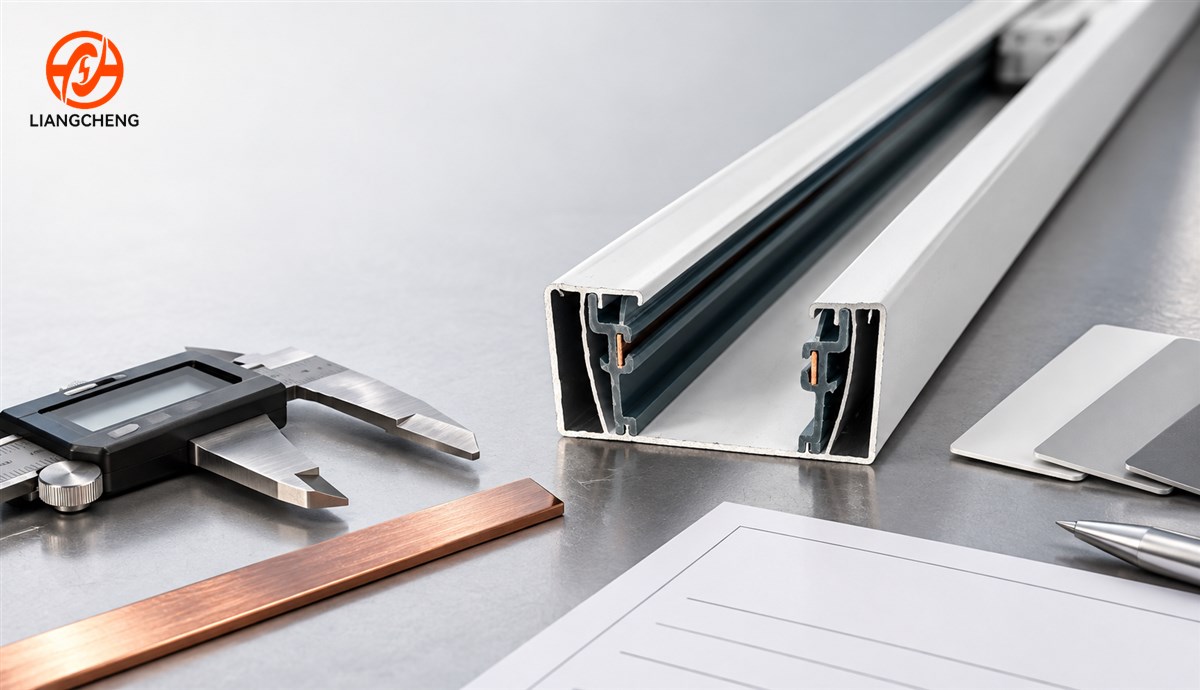
The supplied product photograph shows a white aluminum rail section with dark insulating carriers and visible flat contact strips. The photograph helps identify the construction being discussed, but it cannot verify alloy, copper grade, dimensional tolerances, ratings, or compatibility. A commercial quotation should connect that reference image to a supplier model and controlled drawing. Product appearance is a starting reference for pricing, not evidence of electrical suitability.
How do you convert price per piece into price per meter?
Convert a rail-section price into a meter price by dividing the section price by its quoted length in meters. An illustrative 2-meter section at USD 5.20 equals USD 2.60 per meter. An illustrative 1-meter section at USD 2.80 equals USD 2.80 per meter. These fictional figures demonstrate unit conversion only. The lower equivalent meter price does not establish which length is better for the actual order.
When a quotation contains several lengths, calculate a weighted rail price: total rail-section cost divided by total ordered meters. Do not average the individual meter prices without accounting for quantities. A distributor ordering mostly 2-meter sections has a different weighted result from a buyer ordering mostly 1-meter sections, even when both receive the same price list. Keep accessory and transport charges outside this rail-only calculation until scope is clearly labeled.
How should buyers specify the length mix before requesting pricing?
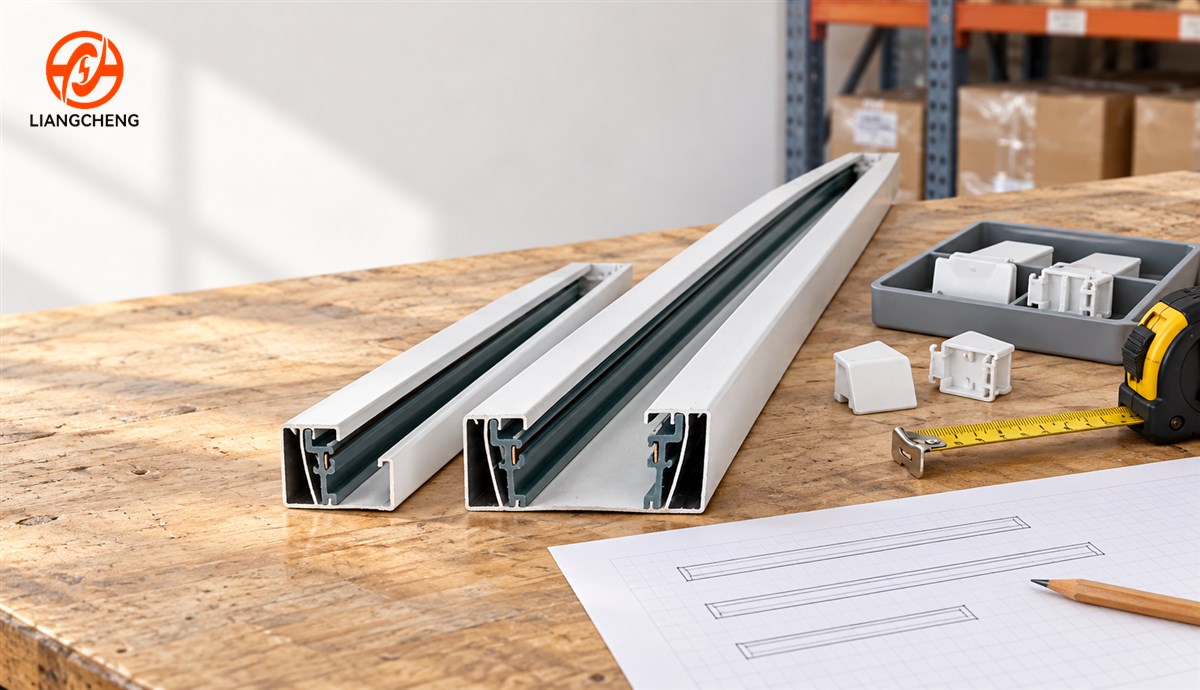
Specify wholesale quantities in pieces by length and finish, then show the corresponding total meters. For example, 100 pieces at 1 meter and 250 pieces at 2 meters represent 600 ordered meters across 350 sections. This length mix is a planning example, not a statement of available stock sizes. Ask the supplier to confirm available lengths and tolerances before turning the schedule into a purchase order.
The same 600 meters can create different accessory needs depending on how the sections will be used. Independent short runs may need more feeds and end caps than connected long runs. Distributor inventory requires a sales-based accessory plan, while a project order requires a layout-based plan. Total meters alone cannot establish the number of connectors or the completeness of a lighting system.
Are longer sections always cheaper for a wholesale buyer?
Longer rail sections can reduce the number of joints in an approved layout, but they do not always produce a lower delivered cost. Compare section pricing, permitted handling, packing dimensions, freight quotation, storage space, and intended selling lengths. A long section that costs less per meter may be less economical if its transport or storage requirements outweigh the saving. Obtain packing dimensions before choosing a length solely on price.
Cutting stock into shorter sections also requires a cost allowance when cutting is permitted for the selected system. Record cutting labor, suitable equipment, end finishing, usable offcuts, labels, and any required replacement components. Follow the model instructions and approved installation process. A theoretical zero-waste length plan becomes unreliable when it ignores the practical steps needed to make each finished section ready for its intended use.
Which construction details should remain fixed during negotiation?
Keep the approved rail profile, conductor specification, insulating components, adapter interface, finish acceptance criteria, and required documentation fixed while negotiating commercial options. Otherwise, a lower price may represent a changed product. If the supplier proposes a lighter profile, different conductor, alternative insulation, or revised contact geometry, list the change explicitly and evaluate the revised assembly before accepting its price.
Material comparisons need measurable specifications rather than descriptive labels alone. A statement such as premium aluminum or pure copper does not define the dimensions, material identity, or finished assembly performance being purchased. Request the controlled specification and relevant evidence for the selected model. The broader wholesale track rail pricing guide explains general cost drivers; this two-wire quotation should apply those drivers to one approved configuration.
How do finish and SKU variety affect the quotation?
Finish requirements affect pricing through the specific process, appearance criteria, handling, and production organization required for the order. Ask for separate prices when comparing standard finish options with a custom color or appearance requirement. Specify the approved sample or color reference, acceptable variation, and how visible surfaces will be inspected. A color name alone does not describe the finish quality that the buyer expects to resell.
SKU variety can matter as much as total order volume. A large order divided across many lengths, colors, labels, and cartons may require more separate preparation than the same meters in one stable configuration. Request quantity breaks by actual specification, not only by total meters. Identify which variations can share a production batch and which require separate minimum quantities or setup charges.
What does MOQ mean for a mixed wholesale rail order?
Minimum order quantity should be clarified at the level where the supplier applies it: order total, rail model, length, finish, or packaging version. A buyer meeting the total order minimum may still fall below the minimum for a custom finish. Request a written MOQ statement for every variation. Separate minimum purchase requirements from price-break thresholds because meeting an MOQ does not necessarily qualify the order for the next discount.
A practical quantity comparison requests several feasible order sizes using the same SKU proportions. Compare the extra inventory investment with the quoted saving and expected sales. Ask whether a scheduled repeat order or consolidated production can improve terms, but do not present a forecast as a guaranteed purchase commitment. The best quantity is the one the business can finance and sell while maintaining a complete accessory range.
How should accessories be allocated to the price of rail stock?
Accessories should remain separate quotation lines even when the buyer later allocates their cost to rail meters. Identify matching feeds, joiners, end caps, mounting parts, and adapters where included in the selling package. Verify each part code against the approved two-wire family. Use the track rail accessories system guide to distinguish component roles before calculating a package cost.
For a project, divide the approved accessory subtotal by the project rail length only when that figure is labeled as a layout-specific allocation. For distribution, base the accessory mix on expected orders and adjust it as sales data develops. Neither allocation is a universal accessory cost per meter. A quotation for rails without accessories can be valid, provided the buyer understands and budgets the separately purchased components.
How do packing and freight change the effective meter price?
Packing cost should specify the protection supplied for the exact section length, including individual separation, end protection, carton construction, and any pallet or outer reinforcement. Request a packing sample or clear packing specification when protection is important to receiving quality. A vague statement such as export packing leaves the buyer unable to compare the included service or reproduce it on a repeat order.
Freight should be quoted against actual packed dimensions, weight, quantity, route, and service. Long cartons may be priced or handled differently from compact cartons by the selected carrier. Confirm the carrier basis rather than assuming that the lightest rail creates the cheapest shipment. The long track rail packaging guide explains how protection and handling choices relate to bending and surface damage.

How can buyers compare two quotations with a worked calculation?
The following fictional example compares two offers for the same approved 600-meter two-wire rail order and accessory schedule. Both calculations use a common destination cost boundary. Actual taxes, charges, material prices, and freight depend on the transaction and must come from current quotations. The exercise shows why a lower rail-only meter price can produce a higher total procurement cost without assuming that either supplier has inferior product quality.
| Cost line | Offer A, USD | Offer B, USD |
|---|---|---|
| 600 meters of approved rail | 1,440 at 2.40/m | 1,380 at 2.30/m |
| Same accessory schedule | 220 | 290 |
| Required protective packing | 150 | 240 |
| Transport and common destination charges | 420 | 600 |
| Total at the same cost boundary | 2,230 | 2,510 |
| Total divided by 600 ordered meters | 3.72/m, rounded | 4.18/m, rounded |
Offer B saves USD 60 on the rail line but adds USD 340 across the other included lines, leaving the total USD 280 higher. The decision is therefore driven by the same-scope total, not the headline rail rate. Before using this calculation for an actual order, confirm that both accessory lists, packing requirements, delivery boundaries, and product revisions are equivalent. Unknown charges should be marked as unresolved rather than entered as zero.
Why should distributors calculate cost per saleable meter?
Cost per saleable meter divides the applicable procurement cost by the meters actually released for sale. Ordered meters and saleable meters can differ when stock is held for investigation, damaged in transport, reserved as samples, or otherwise unavailable for ordinary sales. Record each category separately. A distributor should distinguish a temporary receiving hold from a confirmed write-off because the accounting and replenishment consequences differ.
As a separate sensitivity example, USD 2,230 divided by 595 saleable meters equals approximately USD 3.75 per meter. USD 2,510 divided by 590 saleable meters equals approximately USD 4.25 per meter. The assumed saleable quantities are hypothetical, not measured defect rates or forecasts. Use documented receiving results to update the actual denominator, and record recoveries or credits separately so the same loss is not counted twice.
How should distributors turn purchase cost into a resale target?
A distributor should define the cost scope before setting a gross margin target. For a consistent calculation, identify whether cost includes landed rail, allocated accessories, labels, local delivery, and other direct selling costs. Then calculate the selling price from that agreed basis. Comparing margins across SKUs becomes misleading when one calculation includes accessory costs and another excludes them.
For example, an illustrative cost of USD 3.75 per meter and a 25% gross margin target imply a selling price of USD 5.00 per meter: 3.75 divided by 0.75. Adding a 25% markup produces USD 4.69 after rounding, which is a different calculation. These numbers are planning examples, not recommended market prices. Review the business overhead, competitive position, and customer package before adopting a resale target.
What should be clarified about delivery terms and quote validity?
State the delivery rule, named place, and version alongside the quotation, and itemize charges outside that scope. The ICC explanation of Incoterms 2020 describes how the rules allocate costs, risks, and obligations. A delivery abbreviation without a location leaves important commercial details unresolved. Obtain transaction-specific advice where needed rather than inferring responsibilities from a price column.
Quote validity should identify the expiration date, currency, payment schedule, and conditions for repricing. Ask what happens if the buyer changes quantity, finish, length mix, packaging, or delivery date after approval. For repeat orders, retain the previous specification and compare changes line by line. A new price can be assessed fairly only when the buyer knows whether the underlying product and commercial scope have also changed.
How can buyers reduce price without weakening the approved system?
Start cost discussions with controllable commercial variables: simplify the finish range, consolidate compatible SKU batches, use an approved standard length where suitable, clarify carton quantities, and provide reliable purchasing schedules. Ask the supplier to price each option against the original baseline. A documented alternative shows which saving comes from production planning and which saving requires a changed product or service.
Keep compatibility, required protective arrangements, ratings, and acceptance evidence outside informal price bargaining. These requirements determine whether the system is suitable for its intended destination and application. If an alternative construction is proposed, obtain a revised drawing and evaluate it through the same approval process. The track rail sample approval process helps connect commercial changes with a controlled product decision.
What information gets a useful factory quotation?
A useful two-wire price inquiry includes the reference photo, requested model or drawing, destination, pieces by length and finish, total meters, required accessory quantities, packaging, and expected order schedule. Include the intended fixture or adapter combination when compatibility needs confirmation. Label unknown details as questions for the supplier. This allows the factory to distinguish a priceable specification from a preliminary sourcing request.
Ask the supplier to return unit prices by SKU, a rail subtotal, separate accessory and packing charges, any nonrecurring fees, delivery terms, estimated production schedule, payment terms, and quote validity. Request a deviation list where the proposed offer differs from the inquiry. The track rail RFQ checklist provides the wider documentation fields when an order requires a more detailed technical review.
How should samples and first-order expenses affect the price comparison?
Sample expenses should be tracked separately from the recurring wholesale rail price. A first purchase may include sample transport, prototype preparation, packaging artwork, or other agreed development costs that do not apply to every shipment. Ask which charges recur, which may be credited, and what conditions apply to a credit. Do not assume that sample approval automatically removes a development charge from the commercial offer.
Compare first-order cash requirements and repeat-order unit costs as two different measures. Dividing a one-time charge across the first shipment can help assess launch investment, but carrying that allocation into every future order overstates recurring cost. Conversely, spreading a development charge across an uncertain annual forecast understates the immediate cash requirement. Use confirmed purchases for commitments and label forecast-based allocations as scenarios.
What should happen when the final invoice differs from the quotation?
A final invoice difference should be reconciled against the approved purchase order before the buyer treats it as a new unit cost. Compare quantities, section lengths, finish versions, accessories, packing, agreed adjustments, and transport scope line by line. A higher invoice caused by additional approved components is different from an unexplained increase for the same components. Request clarification for discrepancies instead of replacing the baseline without explanation.
Keep the quotation, drawing revision, purchase order, invoice, and receiving record connected to the same order identifier. This record allows a distributor to trace whether a cost change came from product revisions, order changes, or shipment expenses. Review repeat orders against this evidence rather than an old headline price copied into a spreadsheet. Clear records also make supplier discussions more specific when a missing component, quantity mismatch, or packing issue needs resolution.
Request wholesale 2-wire track rail pricing from Liangcheng Lighting
Liangcheng Lighting provides wholesale track lighting rail and customization services for lighting brands, distributors, and project buyers. To discuss a two-wire order, send the product reference, length schedule, finish, accessory requirements, target quantity, destination, and packaging needs. Request separate pricing for the selected standard configuration and any customization so the commercial comparison remains clear.
Contact Liangcheng Lighting for a specification-based quotation and ask which model, drawings, samples, and commercial terms apply to your order. A complete inquiry helps your purchasing team evaluate the assembled rail cost, accessory budget, and delivered stock cost together. The result should be a dated offer your business can review against its actual sales or project requirements.
هل تحتاج إلى حلول إضاءة مسارات مخصصة؟
اتصل بـ Liangcheng Lighting لحلول قضبان الألومنيوم OEM/ODM ودعم الإضاءة الاحترافي.
ذو صلة