







مدة القراءة التقديرية: 13 دقيقة
A buyer should purchase lighting track rail only after seven decisions are documented: the application, the system family, the circuit and control architecture, mechanical and electrical compatibility, the complete bill of materials, sample acceptance criteria, and the delivered commercial terms. A rail selected only by appearance, unit price, or a familiar product name can fail when adapters do not match, connectors are missing, mounting dimensions conflict with the ceiling, or replacement parts cannot be reordered.
The correct buying sequence moves from project requirements to system evidence and then to commercial approval. This sequence applies to contractors buying for one project, distributors building inventory, lighting brands developing private-label products, and retailers expanding a repeatable store concept. The required evidence changes by buying scenario, but the principle remains constant: purchase one documented system rather than unrelated parts that seem similar.
| Decision gate | Question that must be answered | Evidence before approval |
|---|---|---|
| 1. Application | What must the rail support now and later? | Project brief and target layout |
| 2. System family | Which rail and adapter interface will be controlled? | Model list and cross-section drawings |
| 3. Electrical architecture | How many circuits, loads, and control functions are required? | Electrical schedule and ratings |
| 4. Compatibility | Do every rail, adapter, feed, connector, and luminaire match? | Approved compatibility schedule |
| 5. Completeness | Can the delivered parts build the planned layout? | Layout-based bill of materials |
| 6. Verification | Does the sample meet the controlled specification? | Inspection record and approved sample |
| 7. Order release | Are price, quantity, packaging, lead time, and change control clear? | Signed purchase specification |
Which lighting track rail buying scenario applies?
The buying scenario must be identified first because a new installation, an extension, a replacement, and a distributor assortment carry different risks. A new installation can select a complete platform from the beginning. An extension must remain compatible with installed components. A replacement requires positive identification of the existing rail. A distributor assortment must support repeatable selection, stocking, sales, and reordering across many customers.
A new project should begin with lighting tasks, ceiling conditions, control zones, expected fixture movement, and maintenance access. The rail can then be selected with the luminaires, adapters, controls, feeds, connectors, and mounting parts as one system. The guide to choosing track rail for a lighting project provides a project-first framework for that decision.
An extension or replacement order should begin with identification, not assumption. Buyers should collect the installed model, supplier records, profile dimensions, conductor positions, contact arrangement, polarity, voltage, circuit configuration, connector orientation, and clear photographs. A part that slides into a rail is not proven compatible, and forcing a similar adapter can damage contacts or defeat protective features.
A distributor assortment should begin with a controlled platform and customer segment. Each rail length, finish, mounting option, connector, feed, adapter, end cap, and package quantity should have a defined role. Stocking many nearly identical interfaces increases training, picking, and compatibility risk without automatically improving customer choice.
What project information should be frozen before selecting a rail?
A buyer should freeze the lighting application, rail layout, ceiling interface, electrical supply, control intent, target loads, finish, environment, service access, and local compliance requirements before comparing products. These inputs define what the rail must do. Without them, a supplier can quote a product, but the buyer cannot prove that the product is suitable.
The lighting application should identify whether the system serves retail merchandise, gallery objects, office tasks, hospitality zones, residential accents, exhibitions, or another use. The layout should show straight runs, corners, branches, feeds, suspension points, obstacles, and credible future target locations. The ceiling information should distinguish surface, recessed, trimless, or suspended mounting and record available cavity depth and support conditions.
The electrical brief should state supply voltage and frequency where relevant, circuits, connected load, protective arrangements, earthing requirements, dimming or control method, and responsibility for calculation. The lighting designer and qualified electrical professional should approve these decisions under applicable requirements. A catalog rating does not replace a project electrical design.
The commercial brief should state destination market, expected quantity, standard or custom status, packaging method, labeling language, documentation, delivery terms, sample requirement, and target schedule. These details prevent late discoveries that a technically suitable rail cannot meet the planned installation, channel, or logistics process.
How should buyers compare track rail system families?
Buyers should compare system families by application fit, circuit capability, fixture range, mounting options, control support, interface stability, accessory completeness, and replacement availability. The number of conductors alone does not identify the best system. More circuits or a more complex attachment method has value only when the project can use that capability.
A simple single-circuit arrangement may be appropriate when every luminaire on a run operates together. A multi-circuit arrangement may be useful when different fixture groups share one physical rail but require separate switching. A control-enabled system may add dimming or addressing functions, but the rail, adapters, drivers, controls, and commissioning method must all support the intended result.
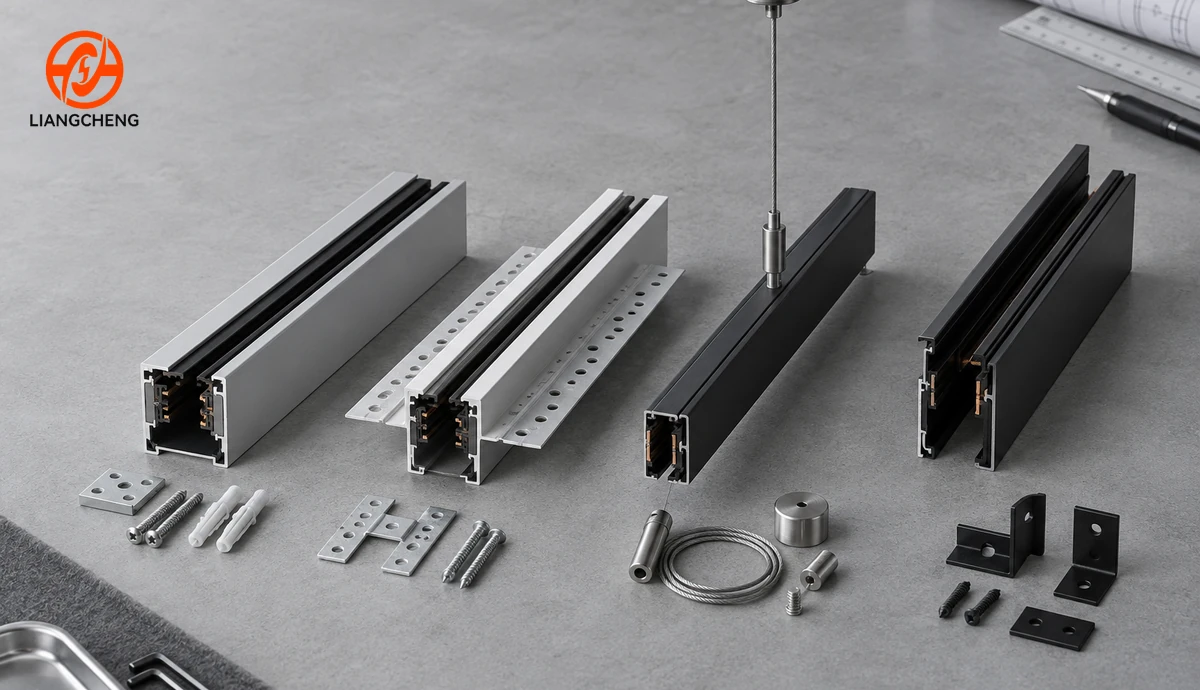
Mounting format is a separate decision from electrical architecture. Surface rail can simplify access and ceiling coordination. Recessed rail can reduce visual prominence but requires precise cutouts, depth, finishing, and service planning. Suspended rail can lower the lighting plane beneath a high ceiling but adds suspension, feed, alignment, and load considerations. Magnetic-style and conventional mechanical interfaces should be evaluated through documented system requirements rather than trend or appearance.
Why is track rail compatibility the most important buying check?
Compatibility is the most important buying check because track lighting components are not universally interchangeable. Two rails can have similar external dimensions while using different internal keying, conductor positions, earthing paths, contact geometry, polarity, locking mechanisms, circuit selection, or electrical ratings. Visual resemblance is not sufficient evidence.
Buyers should request the exact rail model, adapter model, cross-section drawing, contact layout, insertion direction, locking method, electrical ratings, control function, and written compatibility statement. The track light adapter compatibility checklist provides a focused method for comparing these interfaces before ordering.
Compatibility should be verified in both straight and directional parts. A correct straight joiner does not prove that an L connector, T connector, X connector, or feed maintains the required polarity and circuit continuity in every orientation. The final layout should mark connector handedness, feed direction, and circuit routing wherever orientation matters.
A replacement buyer should never approve a substitute only because it fits during a quick trial. A controlled fit check should confirm secure insertion, locking, contact engagement, removal, polarity, electrical function, and operation with the intended luminaire load. Testing and installation must follow supplier instructions and applicable safety procedures.
What belongs in a complete lighting track rail bill of materials?
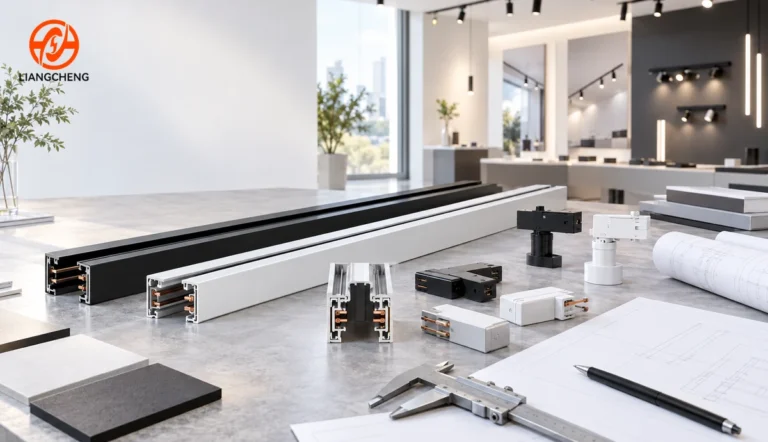
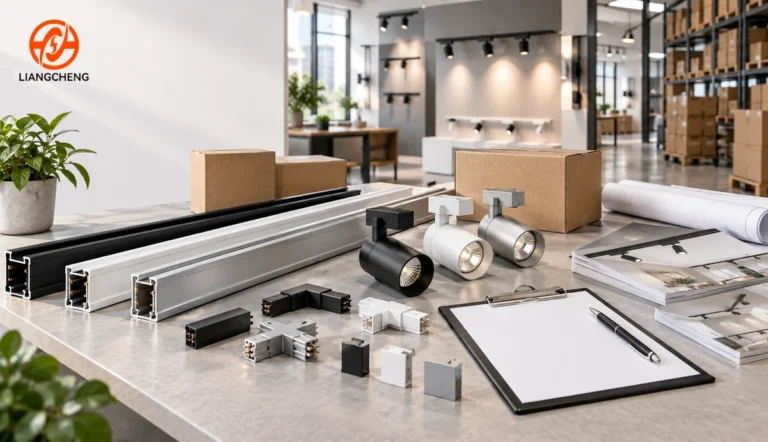
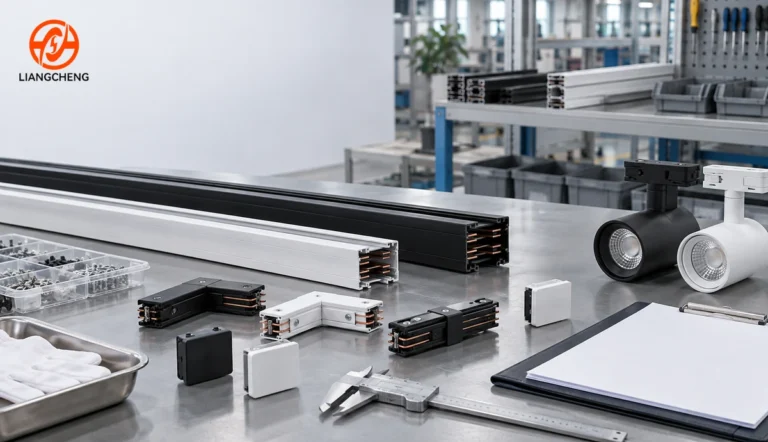
A complete bill of materials must include every part needed to receive, assemble, power, close, support, and use the track layout. The list normally covers rail lengths, power feeds, straight joiners, directional connectors, end caps, adapters, mounting clips or brackets, suspension hardware, canopies, fasteners, compatible luminaires, drivers or control components where applicable, and planned spares.
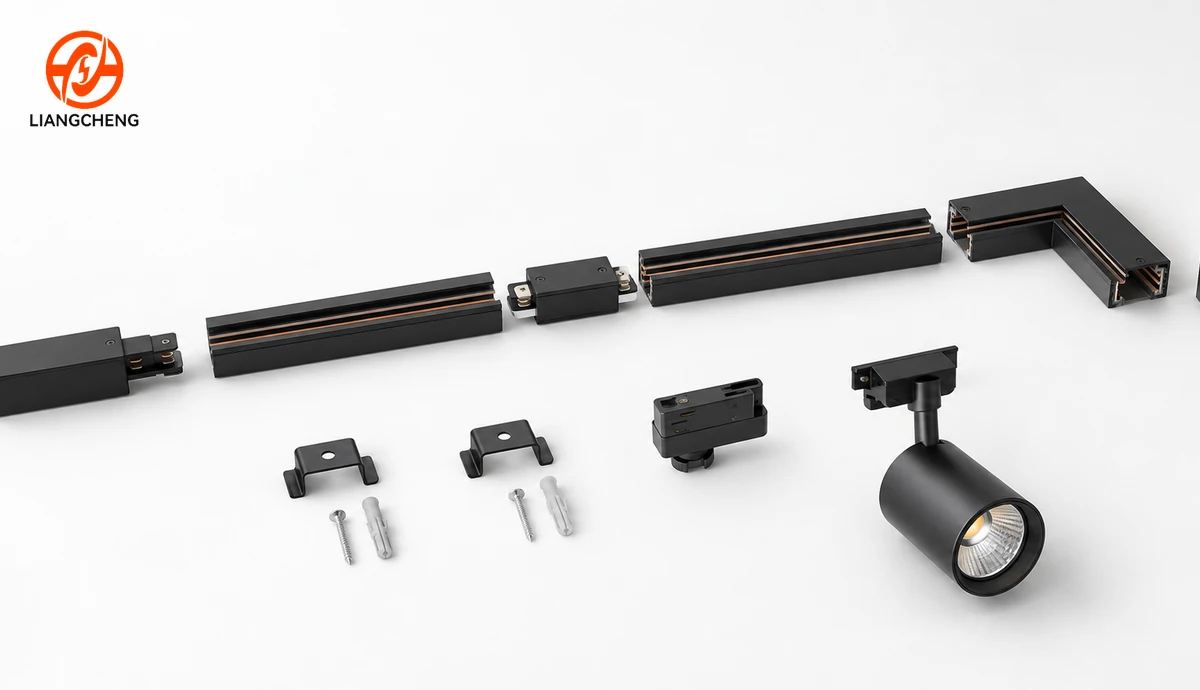
The bill of materials should be generated from the approved layout rather than from a generic package. Each line item should show the controlled part number, description, finish, electrical role, orientation where relevant, quantity, spare quantity, and drawing reference. The track rail accessories system guide explains how small components complete the electrical and mechanical path.
Buyers should compare quotations line by line. One offer may include feeds, connectors, adapters, mounting parts, packaging, and documentation, while another may quote only rail lengths. Comparing the headline rail price without normalizing scope creates a false commercial conclusion.
Which dimensions and mechanical details must be checked?
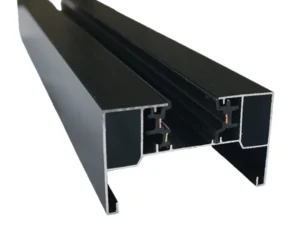
Buyers must check the rail cross-section, overall length, cut tolerance, straightness, conductor location, insulation position, wall features, mounting holes, recessed flange, cavity depth, connector insertion allowance, suspension spacing, end clearance, and interface with adjacent finishes. Each dimension should connect to installation or compatibility, not exist as an isolated catalog number.
Nominal rail length is not always the same as installed system length. Joiners, feeds, directional connectors, end caps, expansion provisions, and site cutting can change the final geometry. The دليل أبعاد سكة إضاءة المسار helps buyers separate profile dimensions from layout and connector allowances.
Straightness affects both appearance and assembly. Long rails can reveal waviness against a ceiling line, and distorted profiles can make connectors or adapters difficult to insert. Buyers should define how straightness will be checked, how long rails will be supported during measurement, and what acceptance criteria apply to the actual product length.
Mechanical loading must be evaluated for the selected mounting method and fixture arrangement. Rail rating, support spacing, connector limitations, suspension hardware, ceiling structure, fixture weight, and dynamic handling during adjustment all matter. A generic load statement should not be applied to a different span or installation condition without written technical confirmation.
What material and construction evidence should a buyer request?
A buyer should request evidence for the specified rail body material, conductor material, insulation system, surface finish, dimensional control, electrical ratings, and applicable compliance documentation. The goal is not to collect the largest document package. The goal is to connect each important requirement to current, identifiable evidence for the offered product and market.
Aluminum is commonly used for rail bodies because it combines low weight, useful stiffness, finish options, corrosion resistance, and extrusion precision. The alloy designation alone does not prove finished performance. Profile geometry, temper, wall distribution, straightening, machining, surface preparation, coating, packaging, and handling also influence the delivered rail.
Conductors and insulation should be evaluated as part of the electrical interface. Buyers should confirm conductor position, retention, continuity, contact engagement, insulation condition, creepage or clearance requirements where applicable, and consistency along the rail. Specific tests and acceptance values should come from the controlled product specification and relevant standards, not from unsupported universal claims.
Finish approval should cover color, gloss, texture, coverage, adhesion or durability requirements where specified, and visual consistency across rails and accessories. Black, white, silver, or a custom finish can look different under project lighting. A physical approved sample provides a more reliable reference than a screen image.
How should track rail samples be approved before a bulk order?
A sample should be approved against a controlled drawing, product revision, inspection plan, and complete system interface. A rail sample alone cannot prove that the adapters, feeds, connectors, mounting parts, and finish-matched accessories will work together. The sample set should represent the parts and interactions that create the highest order risk.
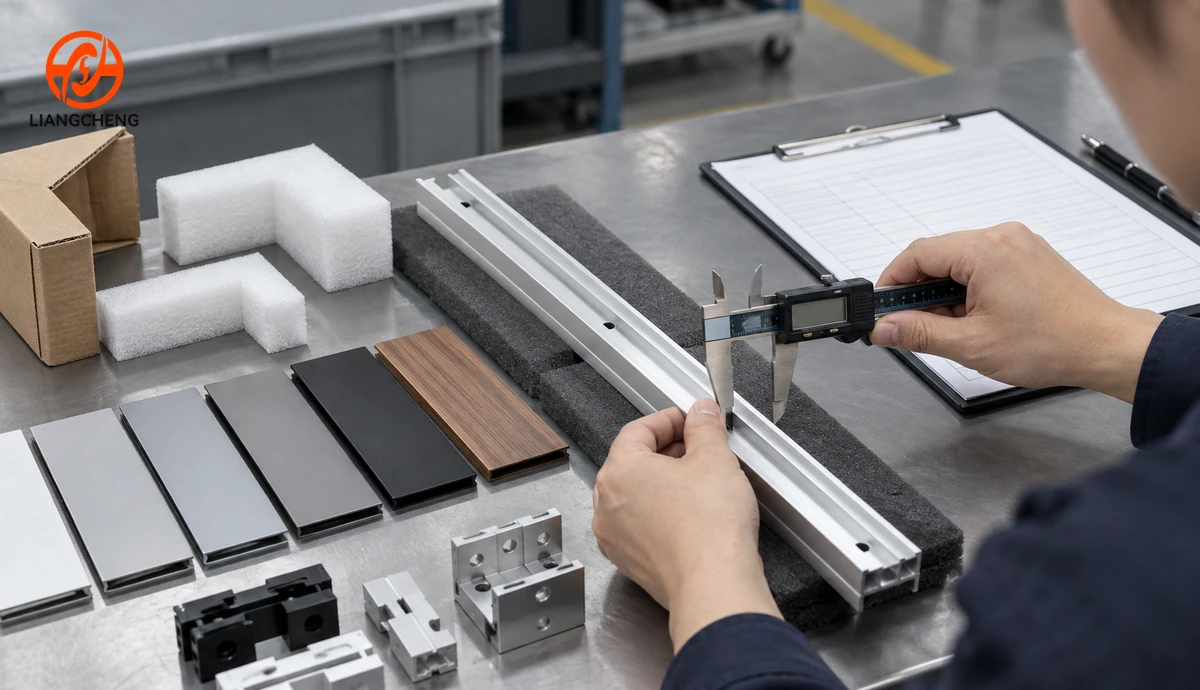
The sample review can include identity, dimensions, straightness, finish, conductor and insulation placement, adapter insertion and locking, connector fit, feed orientation, end-cap closure, mounting alignment, electrical function, control function where applicable, markings, packaging, and documentation. Safety-related tests should be performed only by qualified personnel using appropriate procedures and equipment.
Every result should be recorded as pass, fail, conditional approval, or not evaluated. A conditional approval should state the required correction, responsible party, evidence needed, and deadline. Silent acceptance of a changed drawing or verbal promise makes the sample a weak production reference.
The detailed track rail sample approval process explains how to connect drawings, identified samples, corrective actions, and a pilot run. Bulk production should begin only after important open issues are resolved and the approved configuration is frozen.
How should buyers compare price and total delivered cost?
Buyers should compare the total delivered and supportable system cost, not only price per meter. The meaningful comparison includes rail, all accessories, adapters, luminaires where included, custom tooling, samples, inspection, packaging, labels, documentation, freight, duties, local handling, installation effects, spares, warranty process, and replacement availability.
Price differences can result from profile size, material usage, conductor configuration, circuit complexity, finish, length, order quantity, packaging, customization, quality controls, and commercial terms. The guide to wholesale track rail pricing explains why two quotations can differ even when both use a similar product description.
A lower unit price can produce a higher project cost when missing connectors delay installation, long rails arrive bent, finish lots do not match, or replacement adapters are unavailable. Buyers should identify which failures would stop installation, require rework, create returns, or damage future customer trust. Commercial evaluation should weight those consequences rather than assume every price difference is savings.
Payment terms and lead time should be evaluated with the same discipline. A short quoted lead time has limited value if it excludes sample approval, custom material, packaging production, inspection, or transit. The purchase schedule should distinguish drawing approval, sample completion, production, inspection, dispatch, and arrival.
What packaging and logistics details matter for long rails?
Long track rails require packaging that controls bending, scratching, end damage, moisture exposure, mixed finishes, accessory loss, and handling errors. The package design should match rail length, shipment mode, stacking, warehouse handling, destination route, and unpacking method. A short sample package may not represent the forces experienced by full-length rails.
Buyers should define separators or protective sleeves, end protection, bundle restraint, carton or crate construction, moisture controls where needed, maximum package weight, lifting points, orientation marks, SKU labels, quantity labels, and accessory segregation. The packaging sample should be reviewed with the same product revision that will ship.
Accessories should not be hidden in an unmarked carton or mixed across similar system families. Each bag or inner box should identify the controlled part number, finish, quantity, and order reference. Clear labeling reduces receiving and installation errors, especially when a project contains several connector orientations or circuit families.
What information should be included in the RFQ?
A track rail request for quotation should define the buyer, application, destination market, system family, drawings, dimensions, mounting method, circuit and control requirements, ratings, finish, component list, quantities, packaging, documentation, samples, inspection, commercial terms, and schedule. A precise RFQ makes supplier answers comparable and exposes missing decisions before they become order changes.
ال track rail RFQ information checklist provides a structured set of fields for project and wholesale inquiries. Buyers should mark unknown items instead of filling gaps with assumptions. A supplier can then identify questions, propose options, and state exclusions clearly.
Every quotation should reference the same drawing or specification revision. If a supplier proposes an alternative material, dimension, finish, accessory, packaging method, or compliance route, the difference should be listed as a deviation. Hidden substitutions make technical and price comparisons unreliable.
What final checks should happen before the purchase order is released?
The purchase order should be released only when the controlled system definition, compatibility evidence, bill of materials, sample status, deviations, inspection plan, packaging, price, quantity, delivery terms, schedule, documentation, warranty process, and change-control rule are accepted. An unresolved item should have an owner and a defined decision date rather than remain inside an email thread.
- Confirm that the title, model, drawings, revisions, finishes, lengths, and quantities match across the quotation, sample record, and purchase order.
- Confirm that every rail, feed, connector, adapter, end cap, mounting part, and spare belongs to the approved system family.
- Confirm electrical ratings, circuit assignments, orientation, control compatibility, and required documentation.
- Confirm the approved sample and any closed corrective actions are identified for production reference.
- Confirm packaging protects full-length rails and keeps accessories traceable.
- Confirm inspection scope, acceptance criteria, reporting method, and release authority.
- Confirm lead-time milestones, delivery terms, payment terms, and communication responsibilities.
- Require written approval before any material, drawing, process, finish, component, or packaging change.
A purchase order is ready when another qualified person can understand exactly what will be made, how it will be checked, what will be delivered, and what happens if a change is proposed. If the order still depends on undocumented assumptions, it is not ready for release.
Frequently asked questions about buying lighting track rail
Should buyers choose the rail or the track light first?
Buyers should choose the rail and track light as one compatible system after defining the lighting task. A new project can select both together. An extension or replacement project must identify the installed rail first and then use only documented compatible adapters and luminaires.
Can track rails from different suppliers be mixed?
Track rails and accessories should not be mixed unless the exact combination has written technical approval and appropriate verification. Similar shape or conductor count does not prove matching keying, polarity, contact geometry, locking, ratings, or control functions.
Is a multi-circuit rail always better than a single-circuit rail?
A multi-circuit rail is better only when the project needs independent groups on the same physical run and the control plan uses them. A single-circuit rail can be simpler and more economical when all luminaires operate together. Unused complexity does not create value.
How many spare accessories should a buyer order?
Spare quantities should follow installation risk, site count, replenishment time, criticality, finish, and expected future changes. No fixed percentage suits every project. The buyer should prioritize items whose absence would stop installation or prevent common reconfiguration.
What is the best proof that a track rail order is ready?
The strongest practical proof is a controlled package containing approved drawings, a compatible bill of materials, an identified sample set, closed corrective actions, defined inspection criteria, confirmed packaging, and matching commercial documents. A product photo or verbal assurance is not equivalent evidence.
How can Liangcheng Lighting support B2B track rail buyers?
Liangcheng Lighting supplies wholesale and customized track lighting rail systems for distributors, lighting brands, contractors, project buyers, and private-label programs. B2B customers can request standard or customized rail lengths, finishes, mounting formats, circuit configurations, compatible accessories, branded packaging, labels, and sample development according to the agreed project scope.
For an efficient review, prepare the target market, application, rail layout, mounting method, system or adapter reference, lengths, finish, circuits, control needs, accessory list, quantities, packaging, documentation, and schedule. Clear information allows the sales and engineering teams to identify open compatibility questions and prepare a more complete quotation.
Contact Liangcheng Lighting to discuss a track rail wholesale order, customized project, or private-label product line. Send the drawings, technical requirements, estimated volume, and destination so the team can review suitable rails, matching components, sampling, packaging, and bulk-order planning.
هل تحتاج إلى حلول إضاءة مسارات مخصصة؟
اتصل بـ Liangcheng Lighting لحلول قضبان الألومنيوم OEM/ODM ودعم الإضاءة الاحترافي.